
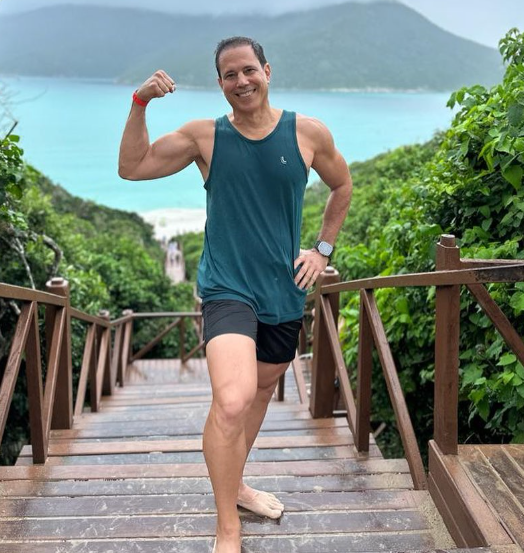
Peter Agro had a Series 7 license and worked with Wolf of Wall Street types before deciding he hated it. At John Frieda’s salon, he learned to draw portraits to unlock the creative brain. Later, at John Barrett in Bergdorf, he shampooed Marla Maples while her little daughter Tiffany in tow tugging on her robe. And he styled the hair of Jordan Belfort’s wife—one of the Bergdorf Blondes who would request him after color—the actual Wolf of Wall Street.
And somewhere between rejecting Wall Street, mastering Manhattan’s elite salons, and watching clients transform under Japanese thermal reconditioning treatments, Peter Agro figured out the formula that would eventually lead him from the city’s most competitive beauty scene to the beaches of Rio de Janeiro.
This is the story of how a stock trader’s instincts, a hair industry pioneer’s work ethic, and a wellness obsessive’s curiosity combined to create something most people over forty desperately want: a second act that actually delivers on its promises.
The Upper East Side Education
Before Peter Louis Salon existed, before the Japanese hair straightening empire, before Brazil became a second home, there was a kid growing up in his father’s Upper East Side hair salon, answering phones and handling the register after grammar school, thinking he’d stumbled into the greatest education of his life.
His father owned the salon, and as a result, Peter practically lived there as a child, helping out through grammar school and into high school. The clientele included some of Manhattan’s most connected women, the kind who summered in the Hamptons and lunched at Le Bilboquet. For a young man absorbing everything around him, this environment proved better than any business school admission could provide.
What Peter learned in that salon wasn’t just technique—it was psychology. He watched how wealthy women invested in themselves, how they made decisions about beauty and maintenance that reflected deeper values about presentation and self-worth. Moreover, he observed the power dynamics between stylist and client, the intimacy of the chair, the trust required to transform someone’s most visible asset. Ultimately, these observations would prove invaluable decades later when he began coaching clients on wellness investments that compound far beyond their dollar value.
The Detour Through Wall Street
After high school, Peter earned a full scholarship to CUNY Baruch College. Subsequently, he got his Series 7 and Series 63 licenses and went to work with the kind of traders who would later inspire Hollywood screenwriters. Wolf of Wall Street types. However, he saw what they were doing and didn’t like it.
Insurance came next, then real estate. Both were boring—days spent with old men discussing policies and parcels. Clearly, something was missing. So Peter did what methodical people do when they’re stuck: he made a list. Things he liked. Things he didn’t. Surprisingly, the exercise pointed toward an unexpected conclusion.
Beauty school. It was fun.
The Salon Education
Peter’s first salon job landed him at the spot where Howard Stern’s wife got her hair done. After learning what he could, he moved to John Frieda’s salon, where the training went deeper than technique. There, the staff studied the art of seeing and drew portraits to unlock the creative side of the brain. John Frieda himself trained them. During this time, Peter met Ivana and Ivanka Trump. Nice people. Eventually, the English accent he honed for the clientele became second nature.
From John Frieda, he moved to John Barrett’s salon in Bergdorf Goodman, taking the space Frederic Fekkai had vacated. The team there had trained under Fekkai, and consequently, Peter absorbed everything they knew. Giuliana taught him the Jacques Dessange method of cutting. Meanwhile, Peter Ishkhans passed on the English John Frieda style zen cuts, while Toshi drilled him in precision Japanese techniques. The celebrity parade continued—Marla Maples with her little daughter Tiffany in tow tugging on her robe, plus house calls to Bob Guccione’s amazing apartment where a pack of Rhodesian Ridgeback guard dogs prowled the marble floors.
Peter enjoyed working at John Barrett. However, he’d learned what he came to learn, and the path to the top chair wasn’t opening up. Time to move on.
The physical demands had been brutal, and the standards unforgiving. Yet for someone who would later advocate for wellness protocols requiring discipline and consistency, this apprenticeship installed the operating system. Essentially, you cannot transform anything, Peter learned, without first mastering the fundamentals and committing to the process.
September 1999: Peter Louis Salon Opens
Most aspiring salon owners scrape together investor money or max out credit cards. In contrast, Peter Agro funded Peter Louis Salon with profits from stock trading. Even then, he was operating on a different frequency than his peers in the beauty industry, reading market patterns during his breaks and developing the analytical frameworks he’d later apply to health optimization and business coaching.
The salon opened in September 1999, positioned in the Upper East Side market Peter knew intimately from his father’s business. Naturally, the clientele made sense to him. Their language was his language. What they wanted, he knew before they could articulate it themselves.
Two years of momentum followed. The salon built a reputation, and clients multiplied. Then the calendar turned to September 2001.
The Post-9/11 Pivot
Every Manhattan business owner who survived that period remembers the paralysis that followed. Clients stayed home, discretionary spending evaporated, and the city’s normal rhythms shattered. As a result, Peter Louis Salon stalled.
However, while competitors waited for recovery, Peter studied what was emerging. Japanese thermal reconditioning, a treatment developed in Japan during the 1990s, was gaining traction in New York City salons around 2002. The process used chemical restructuring and precise heat application to permanently straighten hair, thereby transforming maintenance routines for women with wavy, curly, or frizzy textures. Importantly, lifestyle services that solved genuine problems, Peter noticed, survived economic uncertainty better than purely cosmetic offerings.
Subsequently, Peter made a calculated move that would define the next chapter. He recruited a Japanese hair straightening specialist from a competitor and positioned Peter Louis Salon as the premier destination for the treatment in New York.
The Television Moment
In 2002, NY1 and Good Day New York featured the salon’s Japanese straightening services. What followed was the kind of demand surge every entrepreneur dreams about. Clients lined up for $600 to $1,500 treatments. The salon booked ten treatments per day, scheduled months in advance. At that volume and price point, the mathematics were transformational.
Peter had identified an emerging market, positioned himself as the expert, and captured disproportionate market share through media exposure. The same pattern, he would later realize, worked in wellness, real estate, trading, and every other domain where timing and positioning determined outcomes.
2005-2016: The Extension Empire
After Japanese straightening stabilized, Peter expanded into hair extensions, specifically Great Lengths, the Italian brand that set industry standards for quality human hair extensions using ethically sourced Remy hair processed under strict quality controls. The global hair extension market would eventually reach $4.77 billion by 2032, growing at nearly 7.5% annually. Peter was building his position more than a decade before the mainstream boom.
The salon thrived through the extension era. Art parties documented on Facebook showed the social scene Peter cultivated. The Upper East Side remained his base, his clientele remained loyal, and his stock trading continued generating returns on the side.
The Brazilian Discovery
During the winter of 2006, Peter traveled to Rio de Janeiro with friends. What he found there rewired his understanding of health, beauty, and the American lifestyle he’d been serving for two decades.
The women were striking, but that wasn’t the revelation. The culture was vibrant, but Peter had experienced vibrant cultures before. What genuinely shocked him was the food system. Vast quantities of natural, unprocessed ingredients. Minimal exposure to the wheat, sugar, and salt saturating the American diet. People who looked younger than their years without obvious cosmetic intervention.
Peter began returning to Brazil more frequently, studying what was different about their approach to eating, moving, and living. He became fluent in Portuguese. He connected with local practitioners. Then he walked into a gym and asked himself a simple question: how do these people get these bodies?
He decided to figure it out. And then he acquired the body himself.
The transformation wasn’t cosmetic vanity. It was proof of concept. Peter assembled his observations into what would become the Peter Louis Brazilian Wellness Protocol.
The Protocol Takes Shape
The Peter Louis Brazilian Wellness Protocol didn’t come from a textbook. It came from Peter’s body telling him different stories in different countries.
In Italy, something strange happened. No workouts. All he did was walk every day. When he returned home, his legs didn’t fit in his jeans. His muscles had simply grown. The local farm food, he later learned through the Gerson Therapy research, contained higher vitamin and mineral content than American produce. According to Gerson’s principles, soil should contain 52 vitamins and minerals for optimal health. Italian farmland still delivered. American industrial agriculture didn’t.
In Brazil, another puzzle. Peter felt stronger than ever, but he wasn’t drinking any green juices. Maybe those expensive juices back in the USA were actually making him weaker? In Brazil, fresh coconut water every day and açaí without added sugar became staples. Vitamins and minerals in their natural form. An improved potassium-sodium exchange—the cellular mechanism the Gerson Therapy identifies as fundamental to health and energy.
The Four Pillars
Peter began cross-referencing his physical experiences with what he read in the research. The protocol synthesizes lessons from four distinct traditions. From Max Gerson and the Gerson Therapy, he adopted the emphasis on organic whole foods, detoxification, mineral-rich soil, and the critical potassium-sodium balance. From Dr. William Davis and his book Wheat Belly, he took the case against modern wheat and its inflammatory effects. From Nobel Prize winner Linus Pauling, he incorporated the power of strategic vitamin supplementation. And from Paul Bragg, the pioneer of American health food stores, he learned the value of fasting and an outdoor lifestyle.
The protocol eliminates wheat, sugar, and salt—the three substances Peter considers most responsible for accelerated aging in Americans. These ingredients appear in nearly everything processed in the United States and, according to the McKinsey Global Institute’s wellness research, create metabolic conditions that undermine long-term health outcomes regardless of other interventions attempted.
The results Peter documented in himself became his most persuasive marketing material. His hair restored for $2,000 instead of the $15,000 domestic options would have cost. Muscle mass that prompted accusations of steroid use from observers who couldn’t believe the transformation was natural. A biological age that diverged increasingly from his chronological years.
The Medical Tourism Advantage
Brazil’s emergence as a medical tourism destination gave Peter additional tools for the clients he began advising. The country ranks first globally for surgical aesthetic procedures, with JCI-accredited facilities in São Paulo and other major cities offering treatments at 50-70% below American prices.
Dental work proved particularly compelling. I accompanied Peter for two weeks in Brazil, receiving $70,000 worth of major dental procedures, including six implants with bone grafts, root canals, and nine other teeth restored, for only $9,500. Brazilian dental implants typically cost 60-80% less than equivalent American procedures while utilizing the same international-standard materials from Straumann, Nobel, and other premium manufacturers.
For anyone who had postponed dental work because American prices seemed prohibitive, the Brazilian option represented a different calculation entirely. The savings covered flights, accommodations, recovery time on the beach, and still left a significant surplus.
The Austin Reset
By 2015, a landlord dispute over the lease created an inflection point. Peter could fight for the space and continue the same trajectory. Alternatively, he could use the disruption as permission to attempt something different.
He chose Austin, Texas. The move was intentional—a chance to focus on eCommerce, healthy living, and building income streams that didn’t require standing behind a chair. This included real estate investments, online product development, and the Bombshell hairbrush brand that would eventually generate passive revenue. Moreover, Austin offered lower costs, a growing entrepreneurial scene, and distance from the Manhattan grind that had defined two decades of his life.
Ft. Lauderdale and the Rio Connection
The next move made geographic sense. Specifically, Ft. Lauderdale put Peter closer to two things that mattered: his father, and Rio de Janeiro. Direct flights to Brazil, family nearby, and a base for the lifestyle he was building.
Since 2016, he’s spent twenty days every other month in Brazil. Meanwhile, stock trading remains highly profitable, benefiting from decades of pattern recognition and the analytical frameworks he developed while simultaneously building salon businesses. Additionally, the Bombshell brand generates passive income through e-commerce, and the networks he cultivated on the Upper East Side continue producing relationship dividends.
Today, his primary focus has shifted to organizing Rio de Janeiro trips for independently wealthy individuals seeking what Peter found: a second act that doesn’t require compromise. His coaching spans trading strategies, online commerce fundamentals, entrepreneurship principles, health and wellness optimization, and medical tourism navigation. Typically, his clients are successful in their primary domains but stuck in lifestyle patterns that no longer serve them.
The Longevity Economy Opportunity
Characteristically, Peter’s timing appears prescient. The global longevity tourism market reached $14.2 billion in 2024 and projects to grow at nearly 12% annually through 2033. Similarly, wellness tourism overall exceeded $1 trillion in 2024. In essence, the demand Peter serves—transformation-seeking clients willing to travel for results—represents a market segment that barely existed when he first discovered Brazil but now drives premium wellness retreats globally.
The Operating Philosophy
Peter approaches wellness the same way he approaches markets: identify asymmetric opportunities, position early, execute with discipline, and let compound effects work over time. Consequently, those who dismiss Brazil as impractical or the protocol as too restrictive typically remain stuck in patterns that produce predictable decline.
However, those who commit—like the clients who committed to Japanese straightening treatments in 2002 or Great Lengths extensions in 2006—discover that the investment creates leverage beyond its immediate returns. As a result, looking better affects confidence. Similarly, feeling better affects energy. Ultimately, performing better affects outcomes in every other domain.
From the Upper East Side salon where he watched his father work, through the John Frieda zen cuts and John Barrett’s Jacques Dessange precision training, through the post-9/11 pivot, through the extension empire and the Brazilian discovery, Peter Agro assembled a methodology that most wellness entrepreneurs spend decades attempting to systematize. His edge was always the same: read the patterns others miss, move before consensus forms, and remember that transformation requires both strategy and endurance.
Connect With Peter
For anyone interested in trading, online eCommerce, entrepreneurship, health and wellness, or medical tourism in Rio de Janeiro, Peter shares insights and coordinates trips through his Instagram: @peteragro.
Discover More Hamptons Lifestyle Intelligence: Contact Social Life Magazine for features, advertising, and partnership inquiries. Explore exclusive events at Polo Hamptons. Subscribe to our print edition or support our journalism.
Related Reading:
- Status Symbols Young Millionaires Actually Buy Today
- Ultra Wealthy Guest Experience Secrets Revealed
Author

Written by
Recent Posts
What Goes Into Planning a Professional Furnace Installation?
Why Sports Card Collecting Is More Than Just a Hobby
From Signature Scents to Scent Wardrobes: The Evolution of Personal Fragrance

Beyond the Booth: How Exhibition Design Is Creating New Brand Experiences
Trading the Hamptons for Hvar: A Summer on Croatia’s Most Glamorous Island
Categories
- Art
- Articles
- Business of Luxury
- Celebrities
- Culture
- Entertainment
- Events
- Faces of Summer 2026
- Fashion
- Fashion & Style
- Featured
- Finance
- Food, Spirits, Wine
- Hamptons
- Hamptons Celebrities
- Health
- Health & Beauty
- Lifestyle
- Luxury Lifestyle
- Press
- Profiles
- Real Estate
- Technology
- The Chronicles
- Travel
- Uncategorized
- Weddings