
By David Hornung, Co-Founder & Principal Designer, D&J Concepts

The Hamptons living room has been reinvented roughly every fifteen years since Sister Parish first dragged a chintz sofa to Southampton. Each reinvention claims to reject the one before it. Each one quietly borrows from Stanford White. That pattern, rebellion dressed as tradition, defines how Hamptons living room design has evolved from the gilded excess of the 1880s to the studied restraint of today. Understanding that evolution is not academic exercise. It is the prerequisite for designing a room that will still feel right in 2040.
David Hornung has spent 25 years observing this cycle from inside the rooms where it plays out. At D&J Concepts, every Hamptons living room project begins with the same question: what does this specific house owe to the 140 years of design history that preceded it? The answer is never nothing. Even the most contemporary East End interior carries the DNA of decisions made by Parish, by White, by the anonymous builders who established the shingle-style vernacular that still defines the South Fork skyline.
The Parish-Hadley Foundation: Why Chintz Mattered
Sister Parish did not invent the Hamptons living room. However, she defined its emotional register for half a century. Born Dorothy May Kinnicutt in 1910, Parish built her design practice on a radical premise: rooms should feel as though they had accumulated over generations even if they were assembled last Thursday. Chintz slipcovers, hooked rugs, painted floors, botanical prints, and wicker baskets became her signature materials. The look was warm without being precious, established without being stiff.
Parish’s partnership with Albert Hadley, which began in 1962 and endured until her death in 1994, influenced American interior design for more than three decades. Their firm’s client list included Astors, Mellons, Paleys, Rockefellers, and Whitneys. The Kennedys hired Parish to reimagine the White House itself. Her impact on Hamptons living room design was not merely stylistic. She established the principle that comfort outranks formality on the East End, a principle that remains operative in every serious living room design conversation today.
Furthermore, Parish-Hadley served as a training ground for an extraordinary roster of designers who would shape the next generation. Bunny Williams, Mark Hampton, David Easton, and others apprenticed at the firm before establishing their own practices. Each carried forward Parish’s instinct for layered, livable rooms while introducing new material palettes and spatial approaches. The Hamptons living room as we know it is essentially a Parish-Hadley inheritance, modified but never abandoned.
The White Shadow: Architecture That Refuses to Leave
Before Parish arrived with her chintz, Stanford White had already established the architectural framework that Hamptons living rooms would inhabit for the next century. White’s Shingle Style homes, designed in the 1880s and 1890s, introduced the wide porches, double-height living halls, and generous window proportions that still define East End residential architecture. Even homes built in 2025 reference these proportions, consciously or not.
White understood something about Hamptons light that continues to guide designers today: the quality of illumination on the South Fork demands generous window areas and high ceilings. The light here is particular. Maritime humidity softens it. The reflective surface of the Atlantic amplifies it. A room designed for this light needs different proportions than one designed for Manhattan or Palm Beach. Every successful Hamptons living room begins with a response to White’s original observation, even if the designer has never studied his work.
At D&J Concepts, this architectural inheritance informs every project. When renovating a Shingle Style home, David Hornung preserves the original window proportions and ceiling heights that White’s generation established. When designing within new construction, those proportions still serve as reference points. The Hamptons living room is not a blank canvas. It is a conversation with a specific architectural tradition.
The Modernist Interruption: Glass, Steel, and the Beach
The mid-twentieth century introduced a competing vision for Hamptons living rooms. Glass walls. Open floor plans. Furniture that floated rather than anchored. Designers influenced by California modernism and the International Style proposed that East End interiors could be transparent rather than layered, minimal rather than accumulated. Some of the most striking homes on the East End date from this period.
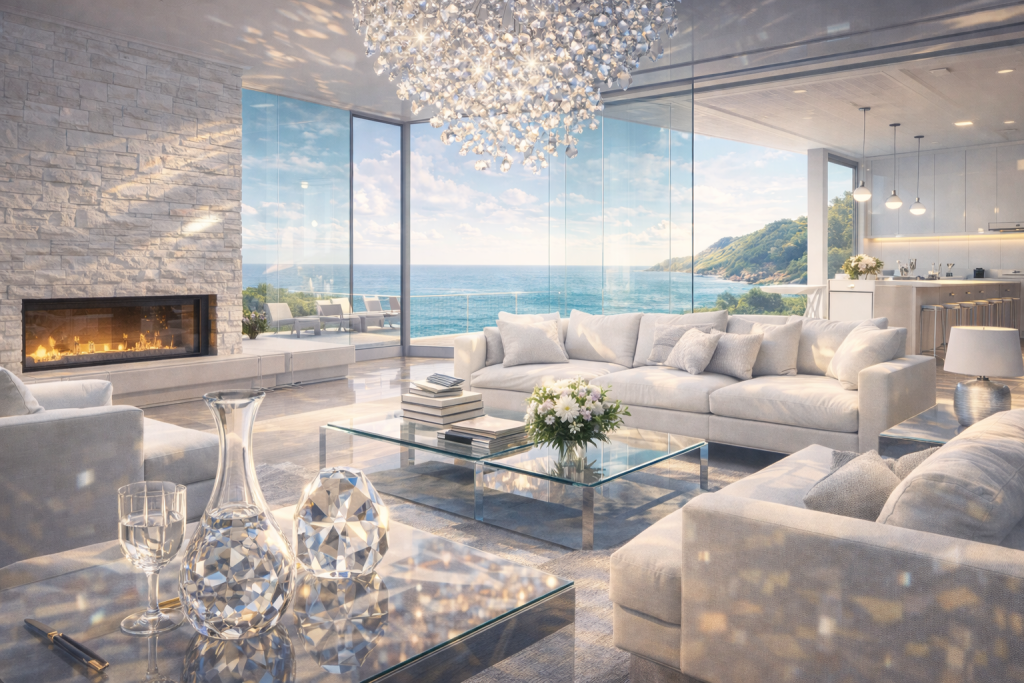
The tension between Parish’s layered warmth and modernist transparency has never been fully resolved. Instead, it has become productive. Today’s most sophisticated Hamptons living rooms borrow from both traditions. They use the generous proportions and natural light orientation of modernist architecture while incorporating the material warmth and textural depth that Parish championed. This synthesis, rather than either extreme, defines the current Hamptons design vernacular.
Architectural Digest’s coverage of contemporary Hamptons interiors confirms this hybrid approach. The most frequently featured living rooms combine clean architectural lines with rich natural materials. Linen replaces chintz. Limestone replaces painted floors. Nevertheless, the underlying commitment to comfort, light, and material honesty connects these rooms directly to what Parish established sixty years ago.
The Quiet Luxury Shift: What Changed After 2020
The pandemic accelerated a transformation in Hamptons living room design that had been building for years. When the East End shifted from seasonal retreat to year-round residence for many homeowners, living rooms had to function differently. Rooms designed for July cocktail parties now needed to support February work-from-home days. The performative living room, designed to impress weekend guests, gave way to the functional living room, designed to sustain daily life.
This shift aligned with the broader quiet luxury movement in fashion and design. Material quality replaced visible branding. Comfort engineering replaced decorative display. Sofas got deeper. Fabrics got more durable. Technology disappeared into millwork. The Hamptons living room of 2026 is arguably the most livable version the East End has produced, precisely because it was designed for inhabitants rather than audiences.
Elle Decor has noted that the quiet luxury approach in Hamptons interiors draws heavily on European precedents, particularly the Belgian and Scandinavian traditions of material minimalism paired with tonal warmth. However, the best Hamptons interpretations maintain a distinctly American ease that neither Brussels nor Copenhagen quite achieves. That ease, traceable directly to Sister Parish’s insistence on unstudied comfort, is the East End’s enduring contribution to global residential design.
Designing a Hamptons Living Room Now: What Endures
After 25 years of practice on the South Fork, David Hornung identifies five principles that survive every trend cycle in Hamptons living room design. Natural light must be the room’s primary feature. Material selections must reference the coastal environment without resorting to nautical cliché. Seating must invite extended occupation, not just visual approval. The room must connect to outdoor spaces through sight lines, materials, or both. In addition, the design must acknowledge the specific architectural history of its structure.
These principles apply whether the project is a Stanford White restoration, a mid-century modernist renovation, or a ground-up contemporary build. They are not stylistic preferences. They are responses to the specific conditions, physical, historical, and social, that define Hamptons residential life. A living room that honors these conditions will outlast its furniture. A room that ignores them will always feel temporary, regardless of what was spent.
Sister Parish understood this instinctively. Stanford White understood it architecturally. The best contemporary designers understand it through accumulated experience. The Hamptons living room does not need another reinvention. It needs designers who know what to keep.
Design Your Hamptons Living Room
D&J Concepts brings 25 years of East End residential expertise to every Hamptons living room project. Through the Method of Visual Clarity, David Hornung and team show clients exactly how their space will look and feel before construction begins. Contact us to discuss your project. For Polo Hamptons tickets and sponsorship, visit polohamptons.com.
Subscribe to Social Life Magazine for insider Hamptons design coverage. Join our email list for exclusive content. Print subscriptions deliver five summer issues plus fall and winter editions. Support independent luxury journalism with a $5 contribution. Continue reading with The Hamptons Design Vernacular and Sister Parish to Now: Quiet Luxury Won the Hamptons.
Author

Written by
Recent Posts

Why the Supplement Market Is Shifting From More Products to Smarter Choices
5 Ways Engraved Custom Trophies Boost Employee Engagement
Creating Beautiful Mix-and-Match Tablescapes for Any Occasion
Is It Cheaper to Drive or Ship Your Car? We Ran the Numbers
Dear Margo: Restaurateur Dean Pashilis’ Tribute to Family, Food and Hospitality
Categories
- Art
- Articles
- Business of Luxury
- Celebrities
- Culture
- Entertainment
- Events
- Faces of Summer 2026
- Fashion
- Fashion & Style
- Featured
- Finance
- Food, Spirits, Wine
- Hamptons
- Hamptons Celebrities
- Health
- Health & Beauty
- Lifestyle
- Luxury Lifestyle
- Press
- Profiles
- Real Estate
- Technology
- The Chronicles
- Travel
- Uncategorized
- Weddings