
By David Hornung, Co-Founder & Principal Designer, D&J Concepts
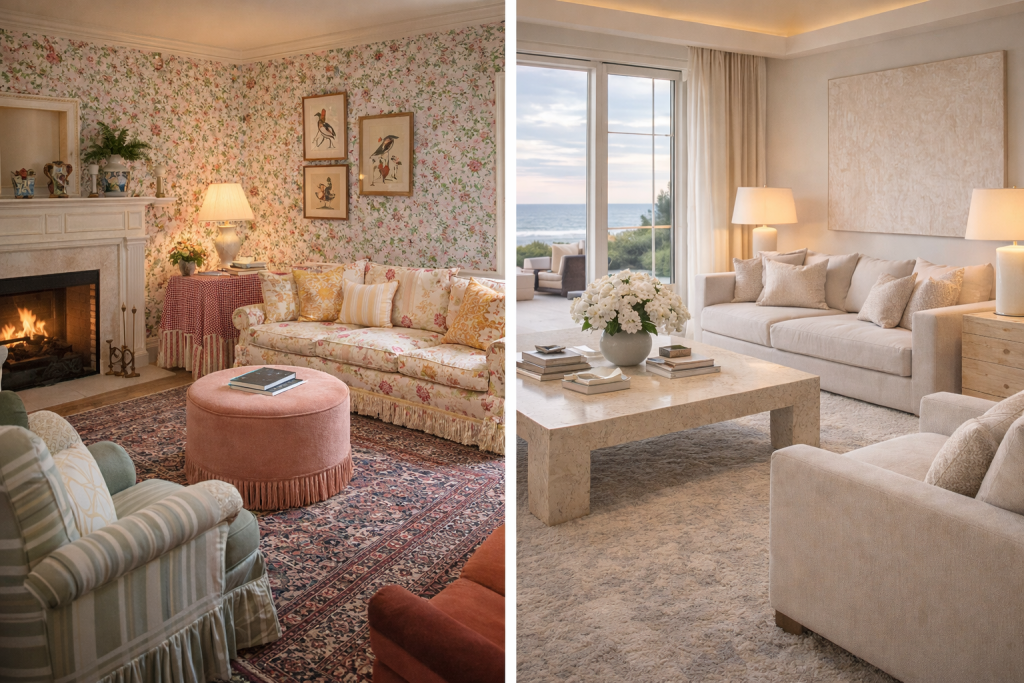
Sister Parish never used the phrase quiet luxury. She would have found it redundant. For the woman who dressed the White House in chintz and taught three generations of American decorators that comfort outranks formality, luxury was always quiet. It announced itself through the weight of a linen curtain, the depth of a sofa cushion, the patina on a brass door handle that had been turned ten thousand times. The quiet luxury interior that dominates Hamptons design today is not a new invention. It is Parish’s original idea, updated with better materials and stripped of floral pattern.
David Hornung has watched this evolution from inside the rooms where it plays out. After 25 years of practice on the South Fork, he recognizes the quiet luxury interior as the logical conclusion of a design philosophy that stretches from Parish-Hadley through Steve Chase to the contemporary moment. Understanding that lineage is not about crediting influences. It is about knowing why certain rooms feel inevitable and others feel assembled.
What Parish Actually Taught: Comfort as Conviction
Parish-Hadley interiors were never about chintz. The fabric was a vehicle for a deeper principle: that rooms should feel as though they had accumulated over time rather than been installed in a single expensive afternoon. Layering was the method. A hooked rug over a painted floor. A reading lamp on a table that also held family photographs. Bookshelves that contained actual books, read and annotated, not designer spines purchased by the yard.
This philosophy of lived-in richness directly anticipated what the market now calls quiet luxury interior design. The distinction between Parish’s approach and the logo-driven excess that followed her is precisely the distinction between quiet luxury and its opposite. Parish never needed to whisper because she never shouted. Her rooms simply existed, fully formed and immediately comfortable, as though they had always been there.
Albert Hadley, Parish’s partner from 1962 until her death in 1994, introduced a modernist rigor that Parish alone might not have embraced. Hadley’s contribution was editorial: he understood which elements to include and, crucially, which to leave out. That editorial instinct, the ability to achieve richness through restraint, is the defining skill of contemporary quiet luxury practice.
The Loud Interlude: What Happened Between Parish and Now
The years between Parish-Hadley’s peak influence and the current quiet luxury moment produced interiors that will not age well. The 1990s brought logo culture into residential design. The 2000s imported nightclub aesthetics: leather wall panels, backlit onyx bars, dedicated theater rooms that occupied 800 square feet for 20 hours of annual use. The hedge fund era of Hamptons new construction generated homes where the technology was the design and the materials were chosen for visual impact rather than tactile quality.
Architectural Digest’s archives from this period document the excesses with unintentional precision. Every room required a statement. Every surface required a brand. Every bathroom required a feature wall of exotic stone chosen from a photograph rather than a physical sample. The result was interiors that impressed on first viewing and exhausted on third. Consequently, these rooms failed the test that Parish’s rooms passed effortlessly: they did not improve with daily use.
Steve Chase, working in Palm Springs decades earlier, had predicted this failure. His insistence on natural materials that develop patina, his refusal to create a signature look, his commitment to designs that served the inhabitant rather than the designer’s portfolio all represented a counterargument to the approaching excess. When the market finally overcorrected, it overcorrected toward Chase’s position.
The Pandemic Pivot: Quiet Luxury Interior as Necessity
When the Hamptons shifted from seasonal escape to year-round residence in 2020, rooms had to work differently. The entertaining-focused living room needed to support Tuesday morning video conferences. The kitchen designed for Saturday dinner parties needed to function for Wednesday lunch prep. Homes that had been optimized for impression needed to be reoptimized for inhabitation.
This functional shift aligned perfectly with the broader cultural movement toward understated quality. Harvard Business Review documented the trend as it moved through fashion into residential design: consumers with genuine wealth began actively avoiding visible markers of cost. In interior design, this translated to natural materials over branded finishes, comfort engineering over decorative display, and spatial intelligence over square footage.
The quiet luxury interior became the dominant Hamptons aesthetic not because a tastemaker declared it but because circumstances demanded it. People who actually lived in their houses full-time discovered what Parish had known all along: the best rooms are the ones you forget you are sitting in. They support rather than perform. They age rather than degrade. They reward the third year of ownership more than the first.
Material Quality: The Quiet Luxury Foundation
Every quiet luxury interior rests on material decisions that are invisible in photographs and unmistakable in person. The difference between a $200-per-yard hand-woven Belgian linen and a $40-per-yard machine-woven alternative disappears on screen. In the room, under the hand, against the skin during an afternoon nap, the difference is everything.
D&J Concepts specifies materials that satisfy this tactile test. Rift-cut white oak flooring rather than character-grade. Hand-troweled lime plaster rather than skim-coated drywall. Unlacquered brass hardware that develops patina through use rather than plated alternatives that maintain a frozen shine. Each choice costs more. Each choice also lasts longer, feels better, and contributes to the quiet luxury interior’s defining quality: the sense that the room was made with care.
According to Bain & Company’s luxury market data, this emphasis on material quality over visual display is not cyclical. It represents a structural shift in how wealth expresses itself in residential environments. The quiet luxury interior will evolve in its specifics, but the underlying principle, that quality should be felt rather than seen, has proven resilient across multiple economic cycles and design eras.
Designing the Quiet Luxury Interior Now
Contemporary quiet luxury on the East End synthesizes three traditions. From Parish, it takes the commitment to comfort and the technique of layering. From Chase, it borrows the emphasis on natural materials and the suppression of designer ego. From European precedents, particularly Belgian and Scandinavian minimalism, it adopts the discipline of tonal restraint and spatial clarity.
However, the best Hamptons interpretations maintain a quality that none of those source traditions fully captures: an American ease that comes from the specific relationship between these homes and the ocean they face. Elle Decor has repeatedly noted this distinction. A quiet luxury interior in Southampton differs from one in Antwerp or Stockholm because the light differs, the materials differ, and the cultural expectations about domestic life differ. The East End contribution to this global movement is the insistence that rigor and relaxation can coexist in the same room.
Parish knew this. She practiced it every time she threw a linen slipcover over a perfectly good sofa and said the room was done. The quiet luxury interior is her legacy, simplified, modernized, and finally recognized for what it always was: the most sophisticated way to live.
Experience Quiet Luxury Design
D&J Concepts creates quiet luxury interiors through the Method of Visual Clarity, ensuring every material decision supports the goal of understated, enduring quality. Contact us to discuss your project. For Polo Hamptons events, visit polohamptons.com.
Subscribe to Social Life Magazine. Join our email list. Print subscriptions available. Support independent luxury journalism with a $5 contribution. Read more: Stanford White to Now: East End Design History and What Steve Chase Knew About Luxury Materials.
Author

Written by
Recent Posts
Jetsetter Style: Castello del Sole

The First Decision After a Collision Can Be the Most Important One
Two Weeks in Rome and Beyond: Turkish Airlines Itineraries from Boston, Chicago and Onward to India

Top 10 Hair Transplant Clinics in Turkey 2026
Artist Alley to Online Store: How Convention Artists Can Keep Selling After the Event
Categories
- Art
- Articles
- Business of Luxury
- Celebrities
- Culture
- Entertainment
- Events
- Faces of Summer 2026
- Fashion
- Fashion & Style
- Featured
- Finance
- Food, Spirits, Wine
- Hamptons
- Hamptons Celebrities
- Health
- Health & Beauty
- Lifestyle
- Luxury Lifestyle
- Press
- Profiles
- Real Estate
- Technology
- The Chronicles
- Travel
- Uncategorized
- Weddings