
By David Hornung, Co-Founder & Principal Designer, D&J Concepts
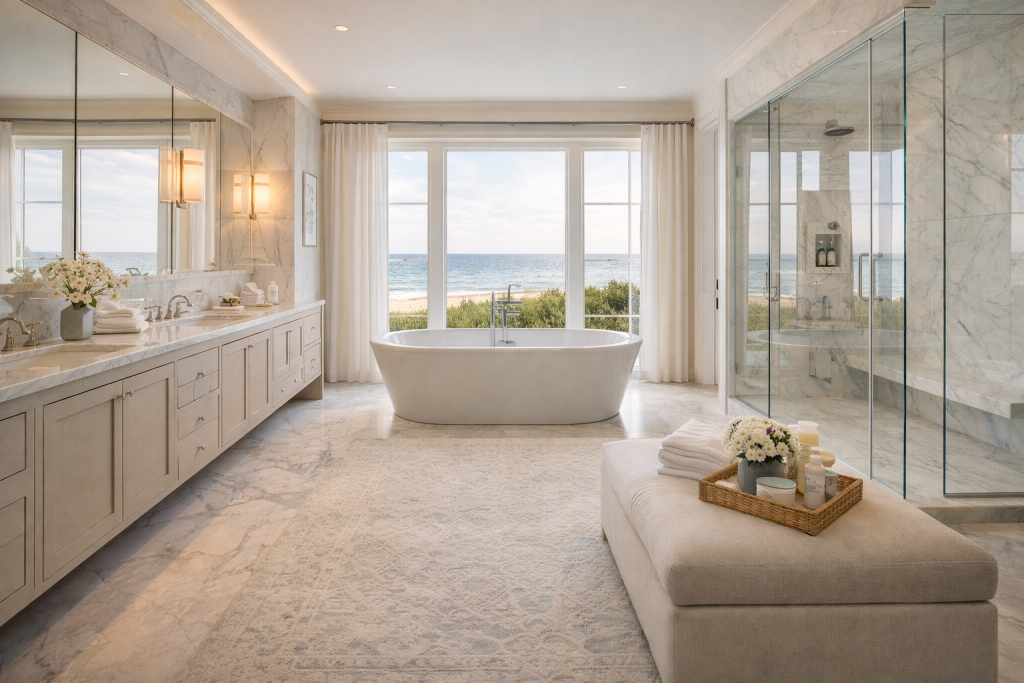
At the $15 million level, a Hamptons primary bathroom is no longer a room with expensive fixtures. It is a wellness environment engineered to the standards of a private spa, finished with materials that belong in a museum, and integrated into a home’s mechanical systems with complexity that rivals the kitchen. Luxury bathroom design at this tier requires understanding how stone performs over decades in coastal humidity, which fixtures justify their premiums, and why the decisions made before framing begins determine whether the room delivers daily satisfaction or daily compromise.
D&J Concepts has designed primary bathrooms in Southampton, East Hampton, and Bridgehampton homes where the bathroom renovation budget alone exceeded $500,000. The principles that govern these rooms apply proportionally to every bathroom at every level, but the tolerances tighten considerably at the top.
Stone Selection: The 25-Year Decision
Every surface in a $15M bathroom confronts moisture, temperature fluctuation, and the aggressive cleaning products that housekeeping staff apply regardless of material specifications. Stone selection is therefore the most consequential decision in luxury bathroom design, and it requires understanding performance characteristics that samples in a showroom cannot reveal.
Calacatta marble remains the dominant choice for Hamptons primary bathrooms. Its dramatic veining creates visual movement that porcelain imitations cannot replicate, and it develops a soft patina over time that homeowners learn to value. However, Calacatta requires sealing, tolerates etching from acidic products, and must be specified in slabs large enough to book-match across feature walls. D&J Concepts sources Calacatta directly from Italian quarries through relationships established over two decades, ensuring vein matching and slab consistency that domestic distributors cannot guarantee.
Quartzite offers an alternative for clients who desire the visual drama of marble with superior durability. Taj Mahal quartzite, with its warm ivory tones and subtle movement, has emerged as the preferred choice for Hamptons bathrooms where maintenance concern overrides the desire for Calacatta’s specific aesthetic. Architectural Digest features increasingly showcase quartzite in luxury bathroom applications, reflecting the material’s growing acceptance at the highest tier.
Fixture Intelligence: Waterworks vs. Lefroy Brooks
Two brands define the fixture conversation at the $15M level. Waterworks represents contemporary American elegance, with clean lines and a product range that extends from faucets to tile to furniture. Lefroy Brooks represents historically referenced British precision, with collections spanning from Victorian through Art Deco that deliver character no contemporary manufacturer can replicate.
The choice between them signals design intent. Waterworks suits bathrooms where the architecture is modern or transitional, where clean geometry and restrained detailing create the spatial language. Lefroy Brooks suits bathrooms that reference historical precedent, where the fixtures themselves carry narrative weight. In Hamptons homes that blend traditional architecture with contemporary interiors, D&J Concepts often specifies Waterworks for primary bathrooms and Lefroy Brooks for powder rooms and guest suites, allowing each space to express its own character within the home’s broader aesthetic.
Below Waterworks and Lefroy Brooks, brands like Kallista, THG Paris, and Dornbracht serve specific niches. Kallista offers sculptural statement pieces. THG Paris delivers French decorative arts tradition in functional form. Dornbracht provides German engineering precision for clients who prioritize mechanical excellence over decorative expression.
Wellness Integration: Beyond the Steam Shower
Heated stone floors are baseline at this level, not an upgrade. The question is how deeply wellness thinking pervades the bathroom’s design. Integrated steam systems require specific ventilation capacity, waterproofing details, and control systems that must be designed during the architectural phase, not added during construction. Chromotherapy lighting requires dedicated circuits and programming that integrates with the home’s automation system.
Radiant ceiling panels that maintain surface temperature at body-warm levels create a spa environment that traditional heating cannot replicate. Towel warming drawers built into vanity millwork eliminate the visual clutter of freestanding towel warmers while delivering warmed towels on demand. Each of these elements requires pre-construction coordination that luxury bathroom design at this level demands.
Elle Decor’s coverage of luxury bathroom trends confirms the shift from decorative luxury to functional wellness. Homeowners at the $15M level expect their bathrooms to deliver measurable health benefits, not merely aesthetic pleasure. D&J Concepts incorporates wellness consultation into the bathroom design process, working with clients’ wellness practitioners to specify features that support individual health protocols.
The Vanity as Furniture
Custom vanities in $15M bathrooms have evolved from cabinetry into furniture. Free-standing pieces with furniture-grade joinery, book-matched stone tops, and integrated electrical for grooming appliances replace the wall-mounted cabinet boxes that defined previous generations of luxury bathrooms. These vanities require furniture-making expertise that standard bathroom contractors cannot provide.
D&J Concepts commissions vanities from millwork shops that serve both the furniture and cabinetry markets, ensuring that the piece delivers both the aesthetic refinement of fine furniture and the moisture resistance that bathroom environments demand. Quarter-sawn white oak, rift-cut walnut, and lacquered finishes with marine-grade sealants form the material vocabulary for vanities that must perform in humid coastal environments for decades.
The Shower Enclosure: Engineering Meets Art
Shower enclosures at the $15M level are custom-engineered rooms within rooms. Standard shower pans and prefabricated glass doors have no place in these bathrooms. Custom-poured mortar beds with hot-mop waterproofing, frameless glass panels with minimal hardware, and rainfall systems with multiple body spray positions create shower experiences that rival commercial spas.
Linear drains have replaced center drains as the standard at this level. They allow the floor to slope in a single direction, which simplifies large-format stone installation and creates a cleaner visual plane. Infinity-edge drains that sit flush with the floor surface represent the current state of the art, requiring precise floor leveling that must be specified during the architectural phase.
Steam integration transforms the shower enclosure into a functional steam room, but only when proper ventilation, ceiling slope, and material specifications support the humidity levels steam generates. Improperly ventilated steam showers damage surrounding construction within three to five years, a failure that is invisible until remediation costs approach the original bathroom budget. D&J Concepts specifies steam-rated construction assemblies that accommodate 100 percent humidity without moisture migration into adjacent spaces.
Niche design has evolved from simple recessed shelves to illuminated display elements that showcase curated product selections. LED strip lighting behind frosted glass shelves creates ambient glow within the shower enclosure. Stone niches with waterfall edges turn functional storage into sculptural features. Each detail contributes to the overall experience that luxury bathroom design at this level promises to deliver daily.
Lighting: The Detail That Defines the Room
Bathroom lighting at the $15M level requires three independent systems: task lighting at the vanity calibrated for grooming accuracy, ambient lighting that creates the spa atmosphere wellness integration demands, and accent lighting that highlights architectural features and material selections. Each system operates on separate circuits with independent dimming control, typically integrated into the home’s Lutron or Crestron system.
Vanity lighting demands particular precision. Color rendering index above 95 ensures that skin tones appear accurate in the mirror, which matters for grooming and for the daily psychological experience of encountering your own reflection. Color temperature between 2700K and 3000K balances warmth with accuracy. Steve Chase understood that lighting quality in private spaces determines how inhabitants feel about themselves, and that insight drives D&J Concepts’ approach to every luxury bathroom design commission.
Start Your Design Conversation
D&J Concepts brings 25 years of luxury residential design experience to every project. The Method of Visual Clarity ensures your vision is resolved before construction begins. Contact Social Life Magazine for features, advertising, or partnership inquiries. Visit polohamptons.com for event tickets and sponsorship opportunities.
Subscribe to Social Life Magazine for ongoing design intelligence. Join our email list for exclusive content. Support independent Hamptons journalism with a $5 contribution.
Read more: Room-by-Room Guide to Luxury Home Design and Materials, Brands & Budget Intelligence.
David Hornung co-founded D&J Concepts in 2001 after training under Interior Design Hall of Fame inductee Steve Chase in Los Angeles. From Southampton headquarters, D&J serves clients across the Hamptons, Manhattan, Palm Beach, and Southern California. A member of the Society of Design Administration, Hornung brings 25 years of luxury residential design experience to every project. Discover the Visual Clarity Method at dandjconcepts.com.
Author

Written by
Recent Posts

Why the Supplement Market Is Shifting From More Products to Smarter Choices
5 Ways Engraved Custom Trophies Boost Employee Engagement
Creating Beautiful Mix-and-Match Tablescapes for Any Occasion
Is It Cheaper to Drive or Ship Your Car? We Ran the Numbers
Dear Margo: Restaurateur Dean Pashilis’ Tribute to Family, Food and Hospitality
Categories
- Art
- Articles
- Business of Luxury
- Celebrities
- Culture
- Entertainment
- Events
- Faces of Summer 2026
- Fashion
- Fashion & Style
- Featured
- Finance
- Food, Spirits, Wine
- Hamptons
- Hamptons Celebrities
- Health
- Health & Beauty
- Lifestyle
- Luxury Lifestyle
- Press
- Profiles
- Real Estate
- Technology
- The Chronicles
- Travel
- Uncategorized
- Weddings