
By David Hornung, Co-Founder & Principal Designer, D&J Concepts
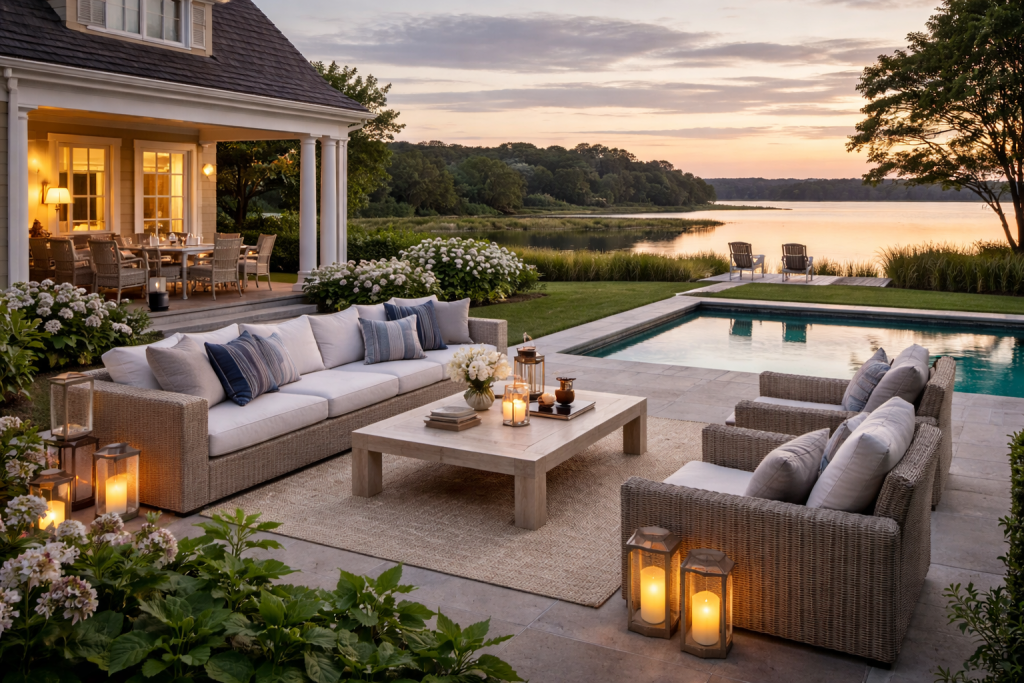
Georgica Pond sits in East Hampton like a private lake surrounded by some of the most valuable residential property in America. The homes around its perimeter house names that appear in financial headlines and entertainment coverage with equal frequency. Their living rooms must serve contradictory functions: intimate enough for a family movie night, expandable enough for a 200-person benefit, and photographically compelling enough to satisfy the shelter magazine editors who circle this zip code perpetually. Understanding how these luxury living room ideas translate to real daily use reveals design intelligence that applies to every high-end residential project.
D&J Concepts has designed interiors around Georgica Pond for over two decades, working with clients whose privacy requirements demand discretion and whose standards demand excellence. The living rooms that succeed here share specific characteristics that have remained consistent despite shifting decorative trends.
The Landscape Connection
Georgica Pond living rooms do not maximize glass. This surprises visitors who expect floor-to-ceiling windows showcasing water views. Instead, the most sophisticated homes use carefully scaled window openings that frame the landscape as a series of composed views rather than a panoramic backdrop.
The logic is both aesthetic and practical. Panoramic glass creates glare that makes daytime living uncomfortable without aggressive window treatment. It exposes interiors to views from the water, which compromises the privacy that Georgica Pond residents consider non-negotiable. Furthermore, large glass surfaces create thermal challenges that force HVAC systems to work harder, producing the ambient noise that quiet luxury cannot tolerate.
Quarter-sawn white oak floors reference the trees visible through those carefully composed windows. Linen upholstery in tones that echo marsh grass creates continuity between interior and landscape. Stone fireplaces anchor rooms with geological permanence that contrasts the organic softness of surrounding materials. Each material choice reinforces the connection to landscape without surrendering the room’s independence as a designed interior space.
Furniture as Social Infrastructure
Living rooms around the pond contain more seating than their square footage initially suggests. Multiple conversation groupings, each scaled for four to six people, allow the room to function as a single large space or as several intimate zones depending on the evening’s requirements. This flexibility is not achieved through movable furniture. It is designed into the room’s permanent arrangement.
1stDibs sourcing plays a significant role in these rooms. Vintage pieces from recognized mid-century designers provide conversation anchors that mass-produced furniture cannot deliver. A pair of Vladimir Kagan sofas or a Jean Prouve console establishes the room’s cultural register immediately, signaling that the homeowner collects with knowledge rather than decorates with budget. D&J Concepts maintains relationships with 1stDibs dealers and private sellers, sourcing pieces that align with each project’s specific aesthetic program.
Coffee tables and side tables are scaled to serve, not merely to decorate. In homes where entertaining is a professional obligation, every surface must accommodate a drink, a plate, or a place to set reading glasses without competing for the attention that the room’s art and architecture deserve.
Art as Architecture
Georgica Pond living rooms treat art as an architectural element rather than a decorative addition. Major works are positioned during the design phase, with lighting, wall color, and furniture placement calibrated to serve each piece. The art does not fill empty walls. The walls are designed to display specific art.
This approach requires collaboration between the designer, the client’s art advisor, and frequently the artist or gallery. D&J Concepts initiates art placement conversations during the Visual Clarity phase, incorporating known collection pieces into renderings so that scale relationships, sight lines, and lighting are resolved before construction. The alternative, hanging art after move-in, produces rooms where the architecture and the collection compete rather than collaborate.
Architectural Digest features of Hamptons residences consistently demonstrate that the most celebrated interiors treat art integration as a design discipline rather than a finishing step. Living rooms where significant works appear afterthought never achieve the spatial harmony of rooms where art placement informed the architecture from the beginning.
The Acoustics Nobody Discusses
Living rooms in Hamptons homes with high ceilings and hard surface floors create acoustic environments that make intimate conversation difficult and large gatherings exhausting. Most luxury designers treat this as an acceptable trade-off for visual grandeur. D&J Concepts treats it as a solvable design problem.
Acoustic management begins with ceiling treatment. Plaster finishes with acoustic backing reduce reverberation without visible acoustic panels. Upholstered furniture absorbs mid-range frequencies that hard surfaces reflect. Area rugs over stone or wood floors provide frequency dampening that is adjustable by season, with lighter rugs in summer and heavier options in winter when the room serves more intensive entertaining.
Drapery fabric selection affects acoustic performance more than most clients realize. Heavy linen drapes absorb sound at the room’s perimeter, creating a warmer acoustic environment than lighter treatments. In Georgica Pond homes where large gatherings require acoustic comfort for sustained conversation, drapery specification is as much an acoustic decision as a decorative one.
Technology: Invisible by Design
Georgica Pond living rooms contain extensive technology infrastructure that remains entirely invisible during daily use. Audio systems built into ceiling cavities and wall assemblies deliver distributed sound without visible speakers. Television displays retract into millwork, descend from ceiling cavities, or hide behind motorized art panels. Lighting control operates through keypads recessed into wall surfaces or through tablet interfaces concealed in drawer pockets.
The commitment to invisible technology reflects the broader aesthetic values of this enclave. Residents who have achieved sufficient success to afford Georgica Pond addresses do not need technology to signal modernity. They need it to perform flawlessly without demanding visual attention. A living room where technology asserts itself is a living room that has not been properly designed for this level of client.
D&J Concepts collaborates with Crestron and Lutron certified integrators during the architectural phase, ensuring that technology infrastructure is built into wall assemblies, ceiling cavities, and millwork rather than added after construction. Retrofit technology installation always compromises either performance or aesthetics. Pre-construction integration delivers both without compromise, which is the standard luxury living room ideas at the Georgica Pond level demand.
The Summer-to-Winter Transition
Many Georgica Pond homes serve both summer and winter use, and living rooms must accommodate the aesthetic shift between seasons. Summer demands lighter textiles, open sight lines to the landscape, and a color palette that references the natural environment. Winter demands warmth, enclosure, and a palette that creates intimacy against gray skies and bare trees.
D&J Concepts designs living rooms with seasonal flexibility built into the permanent elements. Neutral architectural finishes serve as the constant. Slipcovers, throw pillows, and seasonal art rotation provide the variables. This approach requires designing storage for off-season textiles, planning lighting scenes for both long summer evenings and short winter afternoons, and selecting permanent upholstery in tones that anchor both seasonal palettes.
The best luxury living room ideas around Georgica Pond share this quality of designed flexibility. Rooms that work only in July are summer houses. Rooms that work equally well in January are homes. The distinction reflects design intelligence that transcends decorative trend and delivers rooms that support actual life in one of America’s most demanding residential settings.
Start Your Design Conversation
D&J Concepts brings 25 years of luxury residential design experience to every project. The Method of Visual Clarity ensures your vision is resolved before construction begins. Contact Social Life Magazine for features, advertising, or partnership inquiries. Visit polohamptons.com for event tickets and sponsorship opportunities.
Subscribe to Social Life Magazine for ongoing design intelligence. Join our email list for exclusive content. Support independent Hamptons journalism with a $5 contribution.
Read more: Room-by-Room Guide to Luxury Home Design and Beyond Parish-Hadley: Modern Hamptons Living.
David Hornung co-founded D&J Concepts in 2001 after training under Interior Design Hall of Fame inductee Steve Chase in Los Angeles. From Southampton headquarters, D&J serves clients across the Hamptons, Manhattan, Palm Beach, and Southern California. A member of the Society of Design Administration, Hornung brings 25 years of luxury residential design experience to every project. Discover the Visual Clarity Method at dandjconcepts.com.
Author

Written by
Recent Posts

Why the Supplement Market Is Shifting From More Products to Smarter Choices
5 Ways Engraved Custom Trophies Boost Employee Engagement
Creating Beautiful Mix-and-Match Tablescapes for Any Occasion
Is It Cheaper to Drive or Ship Your Car? We Ran the Numbers

Dear Margo: Restaurateur Dean Pashilis’ Tribute to Family, Food and Hospitality
Categories
- Art
- Articles
- Business of Luxury
- Celebrities
- Culture
- Entertainment
- Events
- Faces of Summer 2026
- Fashion
- Fashion & Style
- Featured
- Finance
- Food, Spirits, Wine
- Hamptons
- Hamptons Celebrities
- Health
- Health & Beauty
- Lifestyle
- Luxury Lifestyle
- Press
- Profiles
- Real Estate
- Technology
- The Chronicles
- Travel
- Uncategorized
- Weddings