
By David Hornung, Co-Founder & Principal Designer, D&J Concepts
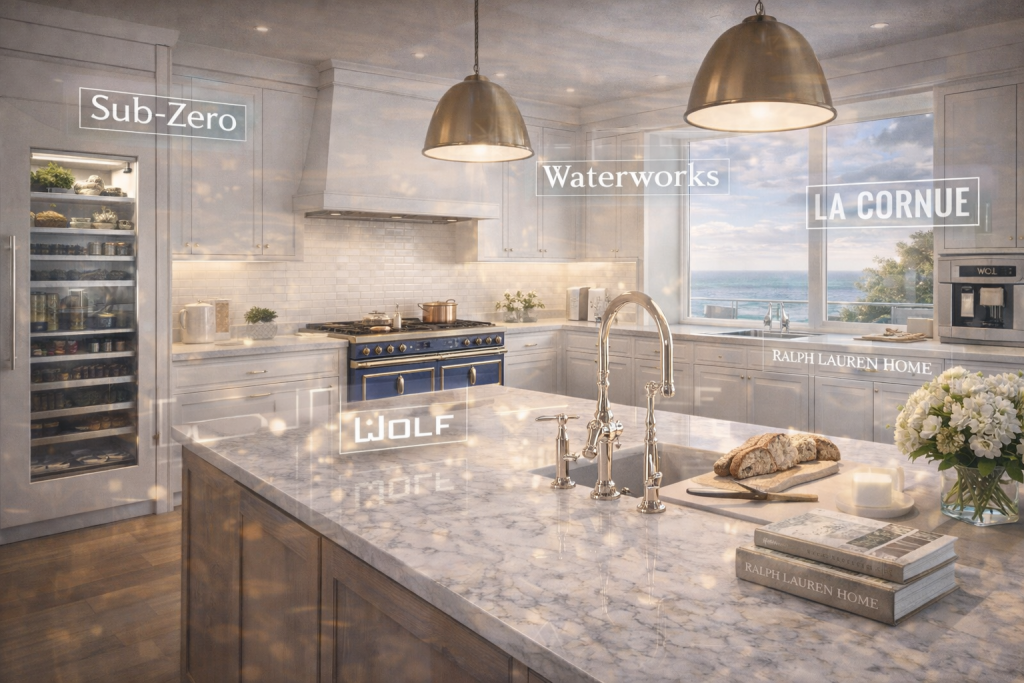
Walk through the ten most celebrated kitchens in the Hamptons and you will encounter the same luxury kitchen brands in different configurations. Sub-Zero refrigeration columns flanking a Wolf range. Gaggenau steam ovens recessed into custom millwork. Miele dishwashers hidden behind panel fronts that match the cabinetry. These are not arbitrary selections. Each brand occupies its position through demonstrated performance at the highest level. Understanding why designers specify them prevents the expensive mistake of choosing brands that look equivalent but perform differently.
D&J Concepts has specified luxury kitchen brands for 25 years across the Hamptons, Manhattan, Palm Beach, and Southern California. The intelligence below comes from specifying, installing, and maintaining these products in demanding residential environments, not from reviewing manufacturer literature.
Refrigeration: Sub-Zero Dominates for a Reason
Sub-Zero’s dominance in luxury refrigeration is not marketing success. It is engineering superiority validated across millions of installations. Their vacuum-sealed doors maintain temperature consistency that competitors approximate but do not match. The air purification and scrubber system removes ethylene gas from aging produce, extending freshness by measurable margins that clients with full-time housekeeping staff notice within the first month of use.
At the $5M+ level, D&J Concepts typically specifies integrated column refrigeration rather than freestanding units. Separate refrigerator and freezer columns allow flexible placement within the kitchen layout, and the panel-ready configuration disappears behind cabinetry that maintains the kitchen’s visual coherence. A 30-inch refrigerator column paired with an 18-inch freezer column provides the capacity most Hamptons households require without the visual interruption of a full-size freestanding unit.
Gaggenau’s Vario refrigeration system offers the primary alternative for clients who prefer European engineering aesthetic. Their modular approach allows mixing refrigeration, freezer, and wine storage columns in customized configurations. The industrial design is bolder than Sub-Zero’s more restrained aesthetic, making Gaggenau the choice for kitchens where appliance design serves as a visual feature rather than disappearing behind panels.
Cooking: Wolf and Gaggenau Serve Different Masters
Wolf ranges deliver the heat output and build quality that serious home cooks demand. Their dual-stacked burners produce both the high heat required for wok cooking and the precise low simmer that delicate sauces require. For Hamptons homes where the kitchen serves as both a cooking environment and an entertaining stage, Wolf’s professional aesthetic communicates culinary seriousness without the sterility of actual commercial equipment.
Luxe Interiors + Design kitchen features consistently showcase Wolf ranges as the dominant cooking appliance in Hamptons properties. The brand’s red knobs have become so ubiquitous that some designers now specify alternative handle colors to differentiate their projects, a testament to Wolf’s market penetration at the luxury level.
Gaggenau occupies a different position. Their wall-mounted ovens and cooktops appeal to kitchens designed around the European model of separate cooking stations rather than the American model of a central range. Gaggenau’s steam oven technology exceeds Wolf’s capability in this category, delivering restaurant-level precision that serious home cooks recognize immediately. For clients who cook at a high level, D&J Concepts often specifies a Wolf range as the primary cooking station with a Gaggenau steam oven as the supplementary unit, capturing the strengths of both brands.
Dishwashing: Miele’s Quiet Dominance
Miele’s reputation in dishwashing is earned through engineering that other brands have attempted to replicate for decades without success. Their wash systems deliver consistently clean results across crystal, fine china, and everyday dishes without the noise levels that competitors accept as normal. In open-concept Hamptons kitchens where the dishwasher runs during dinner parties, Miele’s noise rating of 38 to 42 decibels makes conversation possible.
Miele dishwashers also offer the most intuitive controls in the luxury segment, which matters in homes with rotating housekeeping staff who must operate every appliance without training. Elle Decor’s kitchen coverage frequently highlights Miele as the consensus choice among interior designers, a distinction the brand has maintained for over a decade through consistent quality rather than marketing innovation.
Cabinetry: Bulthaup, SieMatic, and Custom
Cabinetry selection at the luxury level divides into three paths: German systems from Bulthaup or SieMatic, Italian systems from Poliform or Arclinea, or fully custom American millwork. Each path produces excellent kitchens with fundamentally different character.
Bulthaup delivers precision engineering that treats the kitchen as a machine. Their aluminum drawer systems, engineered stone work surfaces, and modular approach create kitchens that function with mechanical reliability. The aesthetic is minimalist and European, suiting contemporary Hamptons homes that reject traditional cedar-shingle domesticity.
Custom American millwork, sourced from shops like Christopher Peacock or Smallbone, delivers furniture-quality cabinetry that references English country house traditions. These kitchens feature inset doors, furniture legs, and decorative molding profiles that create warmth Bulthaup’s system approach intentionally avoids. For Hamptons homes in the traditional vernacular, custom millwork is the only appropriate choice.
D&J Concepts selects cabinetry systems based on the home’s architectural language. Forcing Bulthaup into a shingle-style cottage produces aesthetic conflict. Similarly, installing English-style millwork in a modernist glass house ignores the architecture’s clear intentions.
Ventilation: The Brand Nobody Sees
Ventilation is the most overlooked luxury kitchen brands category and the one most likely to produce daily dissatisfaction. A Wolf range producing 25,000 BTUs per burner requires extraction capacity that standard residential hoods cannot deliver. Inadequate ventilation allows cooking odors to permeate upholstery, drapery, and soft furnishings throughout the home, degrading the interior environment that the rest of the kitchen investment was designed to create.
Best-Link and Vent-A-Hood serve the commercial-grade residential market, but the premium choice for Hamptons kitchens is a custom hood designed by the interior designer and fabricated to match the kitchen’s aesthetic program. D&J Concepts designs hoods as architectural features, specifying internal blowers from Best or Vent-A-Hood within custom enclosures that integrate seamlessly with the kitchen’s millwork or stonework.
External blower systems, mounted on the roof or exterior wall, reduce hood noise levels dramatically. In open-concept Hamptons homes where the kitchen connects directly to living and dining areas, external ventilation allows cooking and conversation to coexist without the compromise that internal blower noise imposes.
Water Filtration and Specialty Systems
Luxury kitchens increasingly incorporate water systems beyond the standard faucet. Zip HydroTap and similar instant hot-cold-sparkling systems eliminate the need for countertop kettles and bottled water. These systems require under-counter space, dedicated electrical circuits, and water line connections that must be planned during the rough-in phase.
Bain & Company’s consumer research indicates that wellness-driven kitchen features are the fastest-growing category in luxury renovation. Whole-house water filtration that feeds the kitchen and steam ovens that require purified water input. Plus dedicated bar sinks with instant chilled water all reflect clients’ increasing expectation. Their kitchen infrastructure supports health optimization alongside culinary performance.
The Integration Principle
The most common luxury kitchen brands mistake is selecting the best individual product in each category without considering how those products interact. A Wolf range generates heat that affects adjacent Sub-Zero refrigeration performance if ventilation between them is inadequate. A Gaggenau steam oven requires water line access and dedicated ventilation that standard kitchen rough-ins do not anticipate. A Miele dishwasher positioned too far from the primary sink creates a workflow disruption that no amount of engineering excellence can overcome.
D&J Concepts resolves these integration challenges. During the Visual Clarity phase, appliance selection, cabinet layout, and mechanical infrastructure are coordinated as a unified system, rather than a collection of individual product decisions. The result is a kitchen where every brand’s strengths are optimized and no brand’s requirements compromise another’s performance.
Start Your Design Conversation
D&J Concepts brings 25 years of luxury residential design experience to every project. The Method of Visual Clarity ensures your vision is resolved before construction begins. Contact Social Life Magazine for features, advertising, or partnership inquiries. Visit polohamptons.com for event tickets and sponsorship opportunities.
Subscribe to Social Life Magazine for ongoing design intelligence. Join our email list for exclusive content. Support independent Hamptons journalism with a $5 contribution.
Read more: Materials, Brands & Budget Intelligence and What Ina Garten’s Kitchen Teaches About Design.
David Hornung co-founded D&J Concepts in 2001. He trained under Interior Design Hall of Fame inductee Steve Chase in Los Angeles. From Southampton headquarters, D&J serves clients across the Hamptons, Manhattan, Palm Beach, and Southern California. A member of the Society of Design Administration, Hornung brings 25 years of luxury residential design experience to every project. Discover the Visual Clarity Method at dandjconcepts.com.
Author

Written by
Recent Posts

Why the Supplement Market Is Shifting From More Products to Smarter Choices
5 Ways Engraved Custom Trophies Boost Employee Engagement
Creating Beautiful Mix-and-Match Tablescapes for Any Occasion
Is It Cheaper to Drive or Ship Your Car? We Ran the Numbers
Dear Margo: Restaurateur Dean Pashilis’ Tribute to Family, Food and Hospitality
Categories
- Art
- Articles
- Business of Luxury
- Celebrities
- Culture
- Entertainment
- Events
- Faces of Summer 2026
- Fashion
- Fashion & Style
- Featured
- Finance
- Food, Spirits, Wine
- Hamptons
- Hamptons Celebrities
- Health
- Health & Beauty
- Lifestyle
- Luxury Lifestyle
- Press
- Profiles
- Real Estate
- Technology
- The Chronicles
- Travel
- Uncategorized
- Weddings