
By David Hornung, Co-Founder & Principal Designer, D&J Concepts
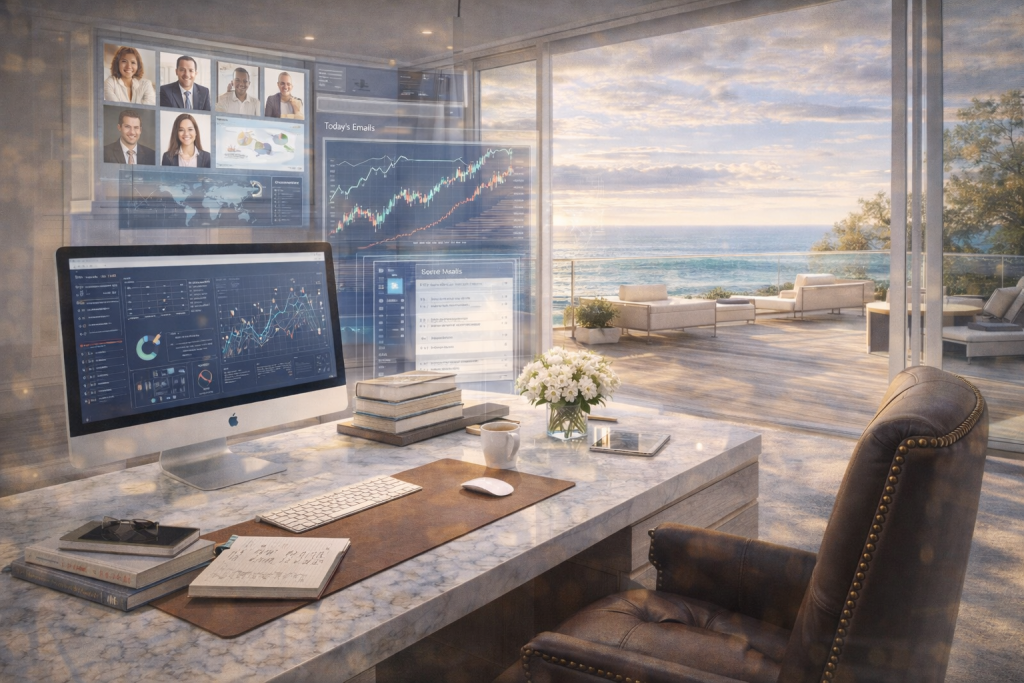
Before 2020, a luxury home office in the Hamptons was a converted bedroom with a mahogany desk, built-in bookshelves, and an ocean view. It was a room where deals were discussed by phone and correspondence was handled by an assistant who worked elsewhere. The pandemic changed the brief permanently. The luxury home office is now a professional environment that must support video conferences with institutional investors, virtual board meetings, and focused analytical work, all while maintaining the residential aesthetic that justifies the Hamptons investment. It is, without exaggeration, the most technically demanding room in contemporary residential design.
D&J Concepts has redesigned more home offices since 2020 than in the previous nineteen years of practice combined. The clients are hedge fund managers, private equity principals, corporate executives, and entrepreneurs whose professional credibility depends partially on how they present during video calls. The room behind them on camera communicates as loudly as their words, and they know it.
Acoustic Engineering: The Foundation
Sound quality in video conferences determines whether a luxury home office functions professionally or remains an expensive residential room where work happens poorly. Echo, background noise, and reverberation transform polished executives into participants who appear to be calling from a swimming pool. Acoustic engineering is therefore the first, not the last, discipline applied to luxury home office design.
D&J Concepts specifies wall assemblies rated for STC (Sound Transmission Class) 55 or higher in home office applications. Standard residential walls achieve STC 35 to 40, which means a conversation in the adjacent room is clearly audible. STC 55 walls reduce that transmission to an indistinct murmur that even sensitive microphones will not capture. The construction cost increase for STC 55 walls over standard construction is approximately 30 to 40 percent for the affected walls, an investment that clients describe as the single most valuable upgrade in their home.
Ceiling treatment matters equally. Acoustic ceiling panels concealed behind finished surfaces absorb the sound energy that hard ceilings reflect. In rooms with 10-foot or higher ceilings, a secondary acoustic ceiling suspended above a perforated panel provides the reverberation control that professional recording studios employ. The result is conversation quality that clients’ Manhattan offices, designed by commercial acousticians, have always provided.
Camera-Ready Lighting
Video conference lighting requires a specific set of conditions that standard residential lighting does not provide. The camera needs even facial illumination without harsh shadows, a background lit independently from the subject, and color accuracy that presents skin tones naturally rather than through the warm amber cast that residential lighting typically produces.
D&J Concepts positions the primary light source in front of and above the desk, typically a linear LED fixture concealed in a ceiling detail that washes light across the occupant’s face without glare. The background, visible over the occupant’s shoulder, receives separate accent lighting that creates the depth and visual interest that professional television studios engineer. Harvard Business Review’s research on video presence confirms that lighting quality measurably affects how colleagues perceive authority and competence during virtual meetings.
Natural light from windows creates complications that require careful management. Side-lighting from windows produces half-lit faces that cameras render harshly. Backlighting from windows behind the desk creates silhouettes that no camera exposure can resolve. D&J Concepts positions desks perpendicular to windows, allowing natural light to serve as fill illumination while artificial sources provide the primary key light. Motorized shades on the window allow the occupant to adjust natural light contribution throughout the day without leaving the desk.
Technology Integration: Invisible by Default
The luxury home office contains more technology per square foot than any other residential room. High-resolution cameras, directional microphones, display monitors, network equipment, and control systems must function seamlessly while remaining invisible when the room is not in professional use. The evening transition from office to library should require nothing more than a single keypad press.
Crestron and Savant systems provide the control infrastructure. A single interface manages display activation, camera positioning, lighting scene selection, shade adjustment, and HVAC mode switching. The “meeting” scene activates camera, adjusts lighting, raises monitors from concealed positions, and shifts the room to professional configuration. The “library” scene reverses everything, lowering monitors into millwork, shifting lighting to ambient warmth, and returning the room to its residential identity.
McKinsey’s workplace research indicates that the distinction between professional and personal environments affects cognitive performance. Dedicated work environments with professional infrastructure produce measurably better focus and decision-making than shared-use spaces where work competes with domestic life. The luxury home office that transforms between modes provides both environments in a single room.
The View Question
Hamptons home offices face a design tension that Manhattan offices do not: the view is too good. A desk positioned facing an ocean view provides inspiration and visual pleasure during focused work. The same desk positioned facing the ocean during a video call presents a backlit silhouette to conference participants and an irresistible distraction to the occupant.
D&J Concepts resolves this by creating dual orientation within the room. The desk faces the room’s interior wall, which serves as the camera background and features bookshelves, art, and millwork that communicates professional gravitas. A separate reading area, positioned at the window, provides the ocean-view experience during breaks, phone calls, and contemplative work. The room serves both needs without compromising either.
The camera background itself requires design attention. Bookshelves with curated objects, a single significant artwork, and warm material tones create backgrounds that professional image consultants recommend. D&J Concepts designs these backgrounds during the Visual Clarity phase, verifying through renderings that the camera composition creates the professional impression the client’s role demands.
HVAC: The Invisible Performer
Independent HVAC zones for home offices serve both comfort and acoustic functions. Temperature control independent from the rest of the home allows the occupant to maintain the cooler temperatures that sustained cognitive work demands without affecting family comfort elsewhere. Equally important, a dedicated zone allows the office’s air handling to be designed for quiet operation that shared residential systems cannot achieve.
D&J Concepts specifies ducted mini-split systems for home office applications, with duct velocities designed to produce noise levels below 25 decibels at the desk position. Standard residential HVAC produces 35 to 45 decibels, a range that microphones capture clearly. The quieter system costs approximately $8,000 to $15,000 more than tapping into the home’s central system, an investment that every client who conducts virtual meetings considers essential once they experience the difference.
The luxury home office has evolved from afterthought to the room that defines how Hamptons residents conduct their professional lives. D&J Concepts designs these rooms with the same rigor applied to kitchens and primary suites, because for the clients who work from their East End properties, the home office is where career decisions happen. Getting it right is not optional.
Start Your Design Conversation
D&J Concepts brings 25 years of luxury residential design experience to every project. The Method of Visual Clarity ensures your vision is resolved before construction begins. Contact Social Life Magazine for features, advertising, or partnership inquiries. Visit polohamptons.com for event tickets and sponsorship opportunities.
Subscribe to Social Life Magazine for ongoing design intelligence. Join our email list for exclusive content. Support independent Hamptons journalism with a $5 contribution.
Read more: Room-by-Room Guide to Luxury Home Design and Before You Break Ground: Visual Clarity for $5M+.
David Hornung co-founded D&J Concepts in 2001 after training under Interior Design Hall of Fame inductee Steve Chase in Los Angeles. From Southampton headquarters, D&J serves clients across the Hamptons, Manhattan, Palm Beach, and Southern California. A member of the Society of Design Administration, Hornung brings 25 years of luxury residential design experience to every project. Discover the Visual Clarity Method at dandjconcepts.com.
Author

Written by
Recent Posts
Stanford White to Now: East End Design History
The Corner Office Moved to the Hamptons
The Brands Behind the Hamptons’ Best Kitchens
Rooms That Outlast Trends: 25 Years of Proof
Modern Party Culture Is About Experience, Not Excess
Categories
- 2025 Social Life Events
- Access to Digital + Physical Magazine
- Art
- Articles
- Beauty & Skincare
- Beauty & Wellness
- Business Strategy
- Celebrities
- Chronicles
- Design History
- Design History|Hamptons
- Design Process
- Design Trends
- Event Photos
- Events
- Family
- Fashion
- Fashion & Style
- Featured
- Food & Beverage
- Food, Spirits, Wine
- Hamptons
- Hamptons Celebrities
- Hamptons Design
- Health
- Health & Beauty
- Home & Design
- Home & Living
- Lifestyle
- Luxury Home Design|Design Process
- Luxury Home Design|Design Trends
- Luxury Home Design|Hamptons Design
- Luxury Home Design|Interior Design
- Luxury Lifestyle
- Luxury Living|Design Process
- Luxury Living|Hamptons
- Luxury Living|Hamptons Design
- Press
- Profiles
- Real Estate
- Technology
- The Chronicles
- Travel
- Trending
- Uncategorized
- Weddings
- Wellness