
By David Hornung, Co-Founder & Principal Designer, D&J Concepts
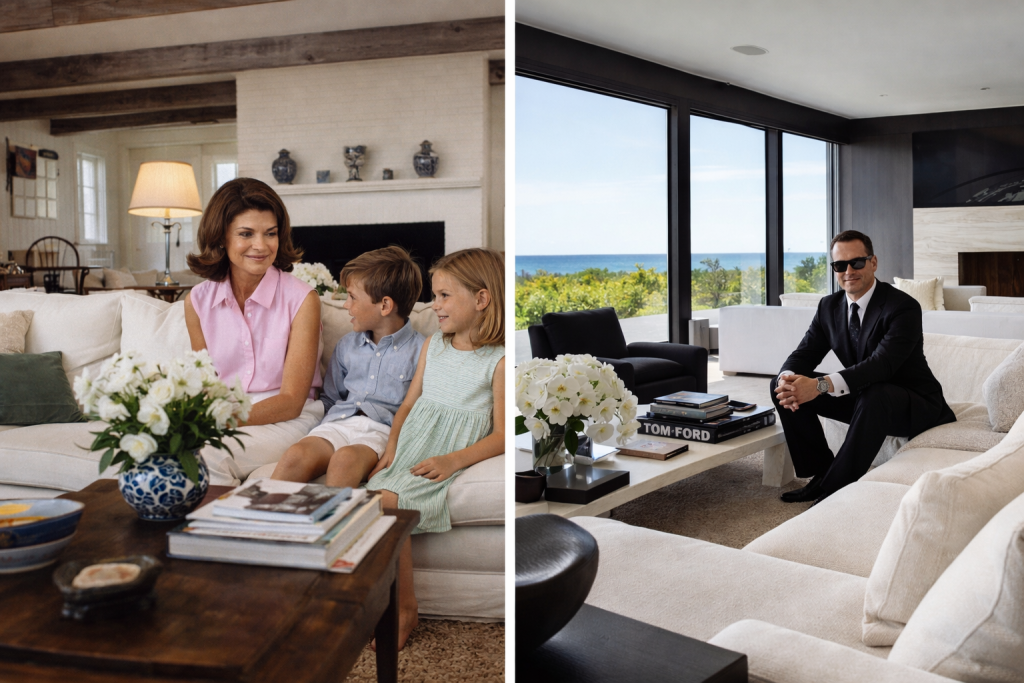
Modern Hamptons style did not arrive fully formed. Instead, it accumulated across seven decades of evolution. Each era added a layer that the next generation either absorbed or rejected. Understanding this evolution is not academic exercise. It is the prerequisite for designing interiors that belong to the Hamptons rather than merely existing within its geography. D&J Concepts has practiced on the East End since 2001. Yet the design traditions the firm draws upon extend further back, to the Bouvier era and the social codes Jacqueline Kennedy embodied before the world knew her married name.
The Kennedy Aesthetic: 1950s-1960s
The modern Hamptons style begins with restraint that reads as effortlessness. Jacqueline Bouvier, summering at Lasata in East Hampton, absorbed an aesthetic vocabulary that would later define American taste. Natural materials, understated color, and a particular kind of simplicity were its hallmarks. Achieving that simplicity, of course, required enormous resources. Biographer Sarah Bradford described rooms furnished with inherited pieces and Persian rugs worn to softness. These interiors reflected old-money confidence. They embodied the kind of lived-in elegance that new money finds impossible to replicate because it cannot be purchased.
As First Lady, Jackie Kennedy translated this aesthetic into the White House restoration project. She hired Parish-Hadley to balance historical gravitas with contemporary livability. Consequently, the influence radiated outward. Hamptons homeowners who had previously decorated in the heavy colonial revival style of the 1940s began lightening their rooms, introducing the casual formality that remains the East End’s default design language.
Architectural Digest’s coverage of Hamptons interiors from this era reveals rooms that feel remarkably contemporary: slipcovered furniture, sisal rugs, white-painted trim, and collected objects arranged with the apparent casualness that only deliberate curation produces. Modern Hamptons style was born in this period, not as a designed aesthetic but as a social expression of how old money wanted to be perceived while relaxing.
The Expansion Era: 1970s-1980s
Money changed the Hamptons. The financial deregulation of the 1980s produced a new class of buyer whose wealth was earned rather than inherited and whose relationship with display differed fundamentally from the Bouvier generation’s studied understatement. Houses grew larger. At the same time, interiors grew more decorative. The chintz-heavy, heavily layered style that designers like Mario Buatta championed in Manhattan migrated east with their clients.
This era produced interiors that modern Hamptons style now explicitly rejects. Patterned wallpapers, heavy draperies, and gilt-framed mirrors signaled wealth through quantity. The rooms were often beautifully executed. They were also exhausting to inhabit, particularly in a landscape that offered the ocean, the light, and the sky as constant competition for visual attention.
Grey Gardens, the Beale family’s decaying estate in Georgica, became an accidental aesthetic landmark during this period. Their 1976 documentary revealed interiors stripped to their bones, occupied by memory rather than decoration. Heartbreaking in their beauty, those rooms were the precise opposite of expansion-era excess. Although the documentary’s influence on modern Hamptons style would not become apparent for decades, designers now cite its unintentional wabi-sabi as a reference point for contemporary East End restraint.
The Correction: 1990s-2000s
The 1990s introduced a course correction that redirected modern Hamptons style toward the restraint that the Kennedy era had established. Designers including Victoria Hagan, Steven Gambrel, and Timothy Whealon produced Hamptons interiors that stripped the decorative excess of the previous decade while maintaining the quality of construction and material that luxury clients demanded. White became the dominant color. Similarly, linen replaced chintz. Collected objects replaced coordinated accessories.
This period also saw the arrival of the “Hamptons style” as a marketed commodity. Shelter magazines codified the aesthetic into reproducible formulas: white shiplap, blue accents, driftwood accessories, and the particular shade of navy that appeared on every other throw pillow from Montauk to Westhampton. The codification was simultaneously the aesthetic’s greatest commercial success and its greatest design risk. When a style becomes a formula, it ceases to respond to individual circumstances and becomes wallpaper applied over personality.
Elle Decor and Luxe Interiors + Design began distinguishing between “Hamptons style” as marketed and actual Hamptons design as practiced by the region’s serious practitioners. The distinction matters. Marketed Hamptons style is a product. By contrast, practiced Hamptons design responds to specific conditions of light, landscape, and social context that no formula can capture.
The Contemporary Moment: 2010s-Present
Modern Hamptons style in its current iteration draws from every preceding era while rejecting each era’s excesses. Kennedy-era restraint remains foundational. Similarly, the expansion era’s commitment to quality materials persists. The correction era’s lighter palette has become permanent. What distinguishes the contemporary moment is an openness to non-traditional influences that previous decades’ insularity did not permit.
European designers working in the Hamptons have introduced Continental sensibilities that enrich the regional vocabulary. Pierre Yovanovich’s Lasata interiors, completed for David Zander before Tom Ford’s 2023 acquisition, brought Parisian material contrasts to an American Arts and Crafts estate. Crucially, the juxtaposition worked because the designer respected the building’s proportions while challenging its decorative assumptions. This is the contemporary model: respect the architecture, challenge the decoration.
Tom Ford’s $52 million purchase of Lasata in 2023 represents the current apex of modern Hamptons style as cultural statement. Ford, whose visual discipline is unmatched in American fashion, chose the property that most completely embodies Hamptons design history. The selection was not accidental. Ford understands, as all great designers do, that the best foundation for contemporary expression is historical depth.
What This History Means for Today’s Design
D&J Concepts designs within this historical continuum. Every Hamptons project the firm undertakes references, consciously or not, the design evolution from Bouvier restraint through expansion excess through corrective simplification to contemporary synthesis. Rooms that feel authentically Hamptons contain echoes of all these eras without belonging exclusively to any of them.
McKinsey’s research on luxury brand longevity demonstrates that the most enduring luxury expressions balance heritage with innovation. Modern Hamptons style follows this principle precisely. The homes that D&J Concepts’ clients occupy most happily are those where the design acknowledges the East End’s accumulated aesthetic intelligence while serving the specific requirements of how this particular family lives right now.
Japanese design influence, visible in the clean lines and material honesty of contemporary East End interiors, represents the newest layer in modern Hamptons style. Designers including John Pawson and Tadao Ando have demonstrated that minimalist spatial philosophy harmonizes naturally with coastal environments where the landscape provides sufficient visual complexity. Hamptons homes that adopt this influence produce interiors of extraordinary calm, rooms where the ocean visible through every window provides all the decoration any space requires.
The through-line from Jackie Kennedy’s Lasata summers to Tom Ford’s $52 million acquisition is not nostalgia. It is evidence. Seven decades of Hamptons design evolution demonstrate several truths. Restraint endures. Quality materials outlast fashion. Landscape connection defines the region’s best interiors. And modern Hamptons style, at its finest, is not a style at all. It is a relationship between a house and the land it occupies, informed by light, moderated by taste, and improved by every generation that has the wisdom to listen to what the place itself demands.
Start Your Design Conversation
D&J Concepts brings 25 years of luxury residential design experience to every project. The Method of Visual Clarity ensures your vision is resolved before construction begins. Contact Social Life Magazine for features, advertising, or partnership inquiries. Visit polohamptons.com for event tickets and sponsorship opportunities.
Subscribe to Social Life Magazine for ongoing design intelligence. Join our email list for exclusive content. Support independent Hamptons journalism with a $5 contribution.
Read more: Lasata to Tom Ford: One Estate’s Design Story and Sand, Light, Restraint: 25 East End Years.
David Hornung co-founded D&J Concepts in 2001 after training under Interior Design Hall of Fame inductee Steve Chase in Los Angeles. From Southampton headquarters, D&J serves clients across the Hamptons, Manhattan, Palm Beach, and Southern California. A member of the Society of Design Administration, Hornung brings 25 years of luxury residential design experience to every project. Discover the Visual Clarity Method at dandjconcepts.com.
Author
Written by
Recent Posts
Jetsetter Style: Castello del Sole

The First Decision After a Collision Can Be the Most Important One
Two Weeks in Rome and Beyond: Turkish Airlines Itineraries from Boston, Chicago and Onward to India

Top 10 Hair Transplant Clinics in Turkey 2026
Artist Alley to Online Store: How Convention Artists Can Keep Selling After the Event
Categories
- Art
- Articles
- Business of Luxury
- Celebrities
- Culture
- Entertainment
- Events
- Faces of Summer 2026
- Fashion
- Fashion & Style
- Featured
- Finance
- Food, Spirits, Wine
- Hamptons
- Hamptons Celebrities
- Health
- Health & Beauty
- Lifestyle
- Luxury Lifestyle
- Press
- Profiles
- Real Estate
- Technology
- The Chronicles
- Travel
- Uncategorized
- Weddings