
By David Hornung, Co-Founder & Principal Designer, D&J Concepts
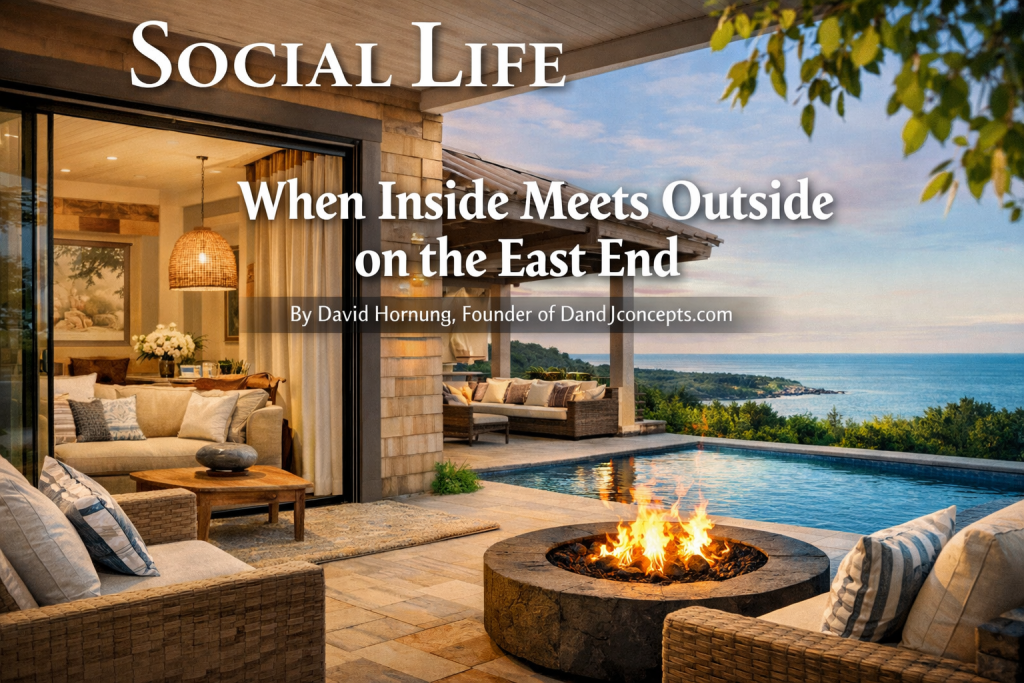
The most important room in a Hamptons home has no roof. Outdoor living spaces on the East End receive more use than any interior room. They generate more pleasure and create more lasting memories during the five months from Memorial Day to Labor Day. Yet these spaces receive less design attention than a powder room. Consequently, the disconnect is remarkable: homeowners invest $200,000 in a kitchen they use for an hour a day and $30,000 in outdoor spaces where they spend entire weekends. D&J Concepts designs outdoor living spaces with the same rigor applied to every interior room. Twenty-five summers on the East End have demonstrated a clear truth: these spaces define the Hamptons experience more than any room inside the house.
The Threshold: Where Interior Becomes Exterior
The transition from interior to outdoor living spaces determines whether the outside feels like an extension of the home or an afterthought attached to it. Sliding door systems, folding glass walls, and lift-and-slide panels provide the mechanical infrastructure. However, mechanical openness alone does not create the experiential continuity that the best Hamptons properties achieve.
Floor material continuity is the first design decision. Interior stone or composite that extends through the threshold onto the terrace without a material break creates the visual impression that the living room continues outward. By contrast, a mahogany interior floor meeting bluestone at the door creates a seam. Psychologically, it registers as a boundary. D&J Concepts specifies exterior-rated versions of interior materials whenever possible, or selects interior materials whose exterior counterparts achieve visual continuity.
Ceiling treatment at the transition matters equally. An interior ceiling that stops at the wall line and gives way to open sky creates an abrupt spatial shift. A covered terrace with ceiling material that references the interior extends the room’s enclosure outward. Painted wood, natural cedar, or architectural beams all work. The result is a graduated transition from fully interior through semi-sheltered to fully exterior, one the body moves through comfortably.
Architectural Digest features of the most celebrated Hamptons properties consistently showcase this graduated threshold design. The interiors that photograph best are those where the camera cannot determine precisely where inside ends and outside begins, because the design intended exactly that ambiguity.
The Outdoor Room: Structure and Comfort
Luxury outdoor living spaces require the same functional planning that interior rooms receive. A terrace without spatial definition is a slab. A terrace with defined zones for dining, lounging, cooking, and conversation is a room. The distinction between slab and room is design, and design begins with understanding how people actually use outdoor space in the Hamptons.
D&J Concepts organizes outdoor living spaces into functional zones with clear spatial boundaries defined by changes in level, overhead structure, furniture grouping, and landscape framing. For dining, a pergola or covered structure provides shade without enclosure. The lounge zone, meanwhile, receives furniture scaled to outdoor proportions that dwarf interior-scale pieces. Separately, the cooking zone features a full outdoor kitchen with grill, refrigeration, sink, and counter space sufficient for meal preparation rather than merely grilling.
Furniture quality in outdoor living spaces has improved dramatically as luxury outdoor manufacturers, including Dedon, Kettal, Paola Lenti, and Sutherland, produce pieces that match interior comfort and aesthetic quality while withstanding coastal weather conditions. D&J Concepts specifies outdoor furniture with the same dimensional precision applied to interior selections. Seating heights, table dimensions, and circulation paths must create the comfort that encourages sustained outdoor use.
The Landscape as Design Partner
Jason Fisher, D&J Concepts’ co-founder, brings landscape architecture training to the firm’s integrated design practice. This dual expertise produces outdoor living spaces where the planted landscape and the constructed terrace collaborate rather than coexist. Hedging defines spatial boundaries with living walls. Specimen trees provide canopy where built structures would be intrusive. Perennial gardens introduce seasonal color that no static material can replicate.
The East End planting palette responds to specific coastal conditions. Salt spray tolerance, wind resistance, and sandy soil adaptation all factor in. Hamptons light, in particular, favors silver-green foliage over the deep greens that thrive in protected inland gardens. Hydrangeas, ornamental grasses, beach plums, and native rosa rugosa define the Hamptons landscape vocabulary. Privet hedging, perhaps the single most characteristic plant of the East End, provides the privacy screening that outdoor living spaces in close proximity to neighbors require.
Elle Decor’s coverage of Hamptons landscape design emphasizes the integration of built and planted elements as the distinguishing feature of the region’s finest properties. The landscape is not a backdrop to the outdoor room. It is the outdoor room’s primary material, and designers who treat it otherwise produce spaces that feel imposed upon the land rather than emergent from it.
The Pool as Centerpiece
The swimming pool in a luxury Hamptons property functions as the outdoor living room’s equivalent of a fireplace: the focal point around which everything else organizes. Pool design at the luxury level has evolved significantly. What was once a rectangular blue rectangle is now an architectural element. Shape, material, and edge treatment all contribute to the overall spatial composition.
Infinity edges oriented toward views dissolve the pool’s boundary. Natural stone coping that matches the terrace integrates the pool into the ground plane. As a result, the pool reads as part of the landscape rather than an independent object. Pool color, determined by the interior finish material, affects the entire terrace’s visual temperature: dark finishes create reflecting pools that mirror the sky, while lighter finishes create the Caribbean turquoise that some clients prefer.
D&J Concepts designs pool environments as complete compositions rather than pools with surrounding terraces. The spa position, the sun shelf depth, the step configuration, the lighting plan, and the relationship between pool edge and lounge furniture all receive design attention during the Visual Clarity phase. Clients see their complete outdoor environment, pool included, in rendered form before any excavation begins.
Seasonal Durability
Hamptons outdoor living spaces must perform through conditions that many luxury markets do not face: nor’easters, salt-laden winter winds, freeze-thaw cycles, and the intense UV exposure of south-facing oceanfront positions. Materials specified for Hamptons exterior applications must survive these conditions across decades without the maintenance burden that seasonal homeowners, absent for months at a time, cannot provide.
For wood applications, Ipe hardwood decking resists rot and insect damage without chemical treatment. It represents D&J Concepts’ primary outdoor specification. Bluestone, a regional sedimentary stone with excellent freeze-thaw resistance, provides the natural stone option that performs best in Hamptons conditions. Marine-grade stainless steel hardware prevents the corrosion that standard exterior hardware develops within two to three seasons of coastal exposure.
Outdoor living spaces in the Hamptons are not amenities. They are the reason people buy here. D&J Concepts designs them accordingly: with the precision, material intelligence, and spatial sophistication that the most important room in the house deserves.
Start Your Design Conversation
D&J Concepts brings 25 years of luxury residential design experience to every project. The Method of Visual Clarity ensures your vision is resolved before construction begins. Contact Social Life Magazine for features, advertising, or partnership inquiries. Visit polohamptons.com for event tickets and sponsorship opportunities.
Subscribe to Social Life Magazine for ongoing design intelligence. Join our email list for exclusive content. Support independent Hamptons journalism with a $5 contribution.
Read more: Room-by-Room Guide to Luxury Home Design and Sand, Light, Restraint: 25 East End Years.
David Hornung co-founded D&J Concepts in 2001 after training under Interior Design Hall of Fame inductee Steve Chase in Los Angeles. From Southampton headquarters, D&J serves clients across the Hamptons, Manhattan, Palm Beach, and Southern California. A member of the Society of Design Administration, Hornung brings 25 years of luxury residential design experience to every project. Discover the Visual Clarity Method at dandjconcepts.com.
Author

Written by
Recent Posts
Sectional Sofa vs. Regular Sofa: Which One is Best for You?

Sober and Injured: How to Manage Pain Treatment After a Massachusetts Slip and Fall
Flexible Liquidity Options Are Reshaping How Modern Professionals Handle Unexpected Expenses
5 Best At-Home Teeth Whitening Kits for a Brighter Smile in 2026

From Spa Retreats to Aesthetic Care, the Luxury Travel Itinerary Is Changing
Categories
- Art
- Articles
- Business of Luxury
- Celebrities
- Culture
- Entertainment
- Events
- Faces of Summer 2026
- Fashion
- Fashion & Style
- Featured
- Finance
- Food, Spirits, Wine
- Hamptons
- Hamptons Celebrities
- Health
- Health & Beauty
- Lifestyle
- Luxury Lifestyle
- Press
- Profiles
- Real Estate
- Technology
- The Chronicles
- Travel
- Uncategorized
- Weddings