
By David Hornung, Co-Founder & Principal Designer, D&J Concepts
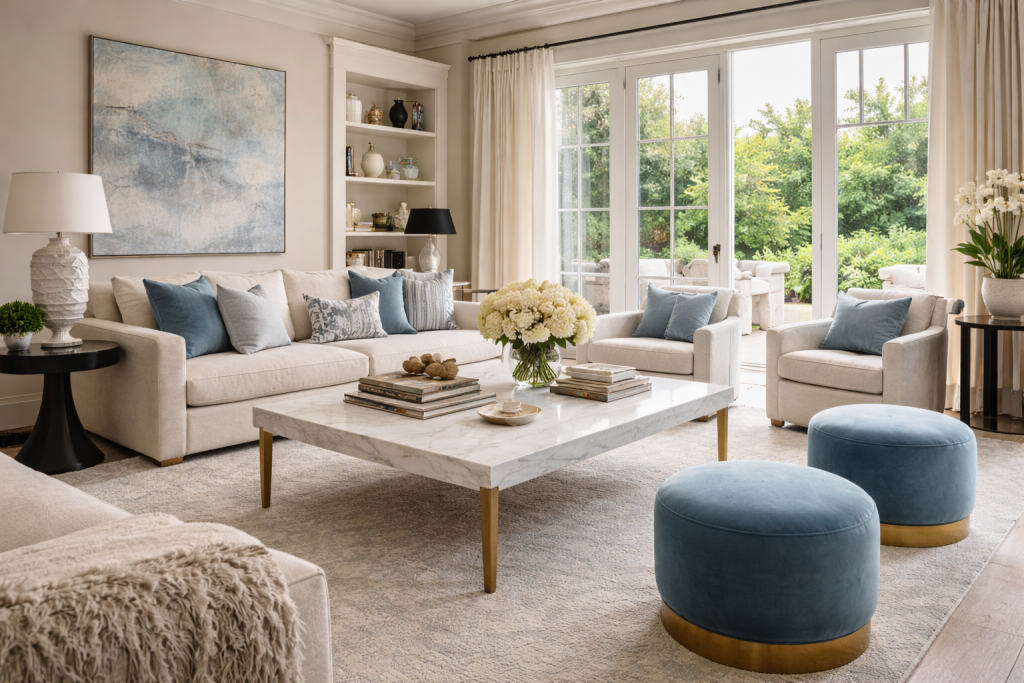
There is a reason the most celebrated luxury interiors look like they were designed for magazine pages. In most cases, they were. Not literally, in most cases, but the designers who produce exceptional rooms apply the same compositional discipline that editorial photographers use when capturing spaces for Elle Decor or Architectural Digest. Understanding editorial photography style as a design methodology, rather than documentation, is the key insight. It separates interiors people photograph from interiors people merely inhabit.
D&J Concepts’ Method of Visual Clarity was built on this insight. By presenting designs at magazine-quality rendering standards before construction, the firm holds every room to the compositional rigor that editorial publication demands. Rooms designed to this standard do not merely look good in photographs. They feel right in person because the compositional principles that make photographs compelling are the same principles that make spaces satisfying to occupy.
What Editorial Composition Actually Means
Magazine photographers do not arrive at a finished room and simply document what exists. They orchestrate the room’s elements into a composition that communicates spatial narrative through a two-dimensional frame. They adjust pillow angles, reposition objects on surfaces, and modify window treatment positioning. Sometimes they relocate entire furniture pieces before capturing a single image. Consequently, the resulting photograph does not show the room as it is. It shows the room as the designer intended it to be experienced.
This distinction matters enormously for the design process. Designers who understand editorial composition design rooms that contain these photographic moments as permanent features rather than temporary arrangements. Consider a reading corner with a cashmere throw draped over an armchair. It sits beside a window with afternoon light, near a side table scaled for both a book and a drink. This vignette is not styling. It is design that anticipates the moment a photograph would capture, then builds that moment into the room’s permanent condition.
Luxe Interiors + Design editors select rooms for publication based on whether the space contains what they call “layers.” A room with layers offers multiple points of visual interest at different depths, creating the sense that the eye can travel through the space rather than merely across it. This layering is a design decision, not a decorative afterthought, and D&J Concepts builds it into every room during the Visual Clarity phase.
The Sight Line Discipline
Editorial photography reveals sight line failures that daily habitation gradually normalizes. For instance, a living room where the entry view reveals the back of a sofa rather than the fireplace fails the editorial test. It may function perfectly for daily use, but the composition is wrong. The eye requires a focal point upon entry. Rooms designed with editorial photography style awareness ensure that every threshold delivers one.
Steve Chase designed rooms with what he called “the photograph from the door.” Before specifying a single material, he stood at each room’s entry point. From there, he determined what the eye should encounter first, second, and third. This hierarchy, planned from the threshold inward, produced rooms photographers loved. The composition was built into the architecture rather than improvised during the shoot.
D&J Concepts applies this discipline to every room in the Visual Clarity process. Renderings are produced from multiple vantage points: every doorway, every primary seating position. This verifies that sight lines deliver composed experiences from every angle. Rooms that fail from any vantage point are redesigned before construction. This is precisely the kind of pre-construction resolution that prevents the subtle dissatisfactions clients feel but cannot articulate.
Material Texture as Visual Depth
Editorial photographers understand that texture creates visual interest that flat surfaces cannot provide, regardless of their color or pattern. A room photographed for Elle Decor contains deliberate texture variation: smooth stone against rough linen, polished brass against matte plaster, glossy lacquer against brushed oak. Each material contrast creates a visual edge that the eye registers as depth and complexity.
Accordingly, designing for texture requires specifying materials in relationship to each other rather than in isolation. A marble countertop selected alone is beautiful. However, the same countertop specified alongside brushed nickel hardware, rift-cut oak cabinetry, and handmade ceramic tile becomes something more. It joins a textural composition that photographs brilliantly and inhabits even better. D&J Concepts presents material specifications in contextual renderings that show texture relationships at room scale, preventing the showroom error of selecting beautiful individual materials that create visual monotony when combined.
Scale and Proportion in the Frame
Magazine photographers select lens focal lengths that present rooms at the most flattering proportion. Wider lenses make rooms appear larger but distort furniture scale. Conversely, longer lenses compress depth but render proportions more accurately. The best editorial interior photography, typically shot between 24mm and 35mm equivalent focal length, captures rooms at proportions close to human visual experience.
Designers who understand this relationship design rooms that look correct at these focal lengths, which means they look correct to the human eye. Specifically, furniture scaled for the room’s actual dimensions rather than for showroom display. Art hung at sight-line height rather than decorative convention. Lighting positioned to create the depth perception that both cameras and eyes require to read three-dimensional space accurately.
McKinsey’s consumer research demonstrates that visual presentation quality directly affects perceived value. Notably, homes photographed to editorial standard sell faster and at higher prices than identical homes photographed to standard documentation quality. The same principle applies to design presentations: renderings produced at editorial quality communicate design intent more effectively than sketches or mood boards, accelerating client approval and reducing revision cycles.
Living in a Photograph
The objection to designing for editorial photography style is that people do not live in photographs. Books accumulate on surfaces. Children leave toys in sight lines. Remote controls cluster on coffee tables. This objection mistakes the method for the goal. Designing to editorial standards does not produce rooms too precious for daily life. It produces rooms where the underlying composition is strong enough to absorb daily life without losing its spatial narrative.
A room with excellent compositional bones accommodates the visual noise of habitation. The architecture, sight lines, and material relationships remain intact beneath the domestic surface. A room without those bones falls apart the moment reality intervenes because nothing holds the space together once the styling is disturbed.
Ultimately, the Visual Clarity Method ensures every room D&J Concepts designs contains the compositional strength that editorial photography demands and daily life requires. Clients see this quality in the renderings before construction. They experience it in the finished rooms for years afterward. The magazine-quality standard is not vanity. It is the most reliable indicator of design quality available, and pursuing it produces rooms that endure because their beauty is structural rather than cosmetic.
Start Your Design Conversation
D&J Concepts brings 25 years of luxury residential design experience to every project. The Method of Visual Clarity ensures your vision is resolved before construction begins. Contact Social Life Magazine for features, advertising, or partnership inquiries. Visit polohamptons.com for event tickets and sponsorship opportunities.
Subscribe to Social Life Magazine for ongoing design intelligence. Join our email list for exclusive content. Support independent Hamptons journalism with a $5 contribution.
Read more: The Visual Clarity Method in Luxury Design and Arthur Elrod to AI: How Design Process Evolved.
David Hornung co-founded D&J Concepts in 2001 after training under Interior Design Hall of Fame inductee Steve Chase in Los Angeles. From Southampton headquarters, D&J serves clients across the Hamptons, Manhattan, Palm Beach, and Southern California. A member of the Society of Design Administration, Hornung brings 25 years of luxury residential design experience to every project. Discover the Visual Clarity Method at dandjconcepts.com.
Author

Written by
Recent Posts
Studio Mayfair Marks New York Fashion Week With Intimate Cocktail Event at Sushi By Bou FiDi
What Goes Into Planning a Professional Furnace Installation?
Why Sports Card Collecting Is More Than Just a Hobby
From Signature Scents to Scent Wardrobes: The Evolution of Personal Fragrance

Beyond the Booth: How Exhibition Design Is Creating New Brand Experiences
Categories
- Art
- Articles
- Business of Luxury
- Celebrities
- Culture
- Entertainment
- Events
- Faces of Summer 2026
- Fashion
- Fashion & Style
- Featured
- Finance
- Food, Spirits, Wine
- Hamptons
- Hamptons Celebrities
- Health
- Health & Beauty
- Lifestyle
- Luxury Lifestyle
- Press
- Profiles
- Real Estate
- Technology
- The Chronicles
- Travel
- Uncategorized
- Weddings