
By David Hornung, Co-Founder & Principal Designer, D&J Concepts
Sand gets everywhere. This is the first lesson of Hamptons beach house design and the one most designers from other markets underestimate entirely. Sand embeds in floor finishes, scratches window tracks, clogs HVAC filters, and accumulates in drawer channels. A beach house that does not design for sand is a beach house that degrades from the first summer. David Hornung has designed for East End sand since 2001. The material intelligence accumulated over 25 years of coastal practice cannot be replicated by designers whose experience stops where the pavement ends.
Light is the second lesson. Hamptons light differs from Manhattan light, Palm Beach light, and California light in quality, direction, and seasonal behavior. The Atlantic reflects and amplifies, producing a luminosity that washes out interiors designed for direct sunlight while rewarding interiors designed for ambient coastal glow. Rooms that face east catch morning light off the ocean. Rooms that face west catch afternoon light through the trees. Each orientation demands a different material palette, and the Hamptons beach house that ignores orientation fails in ways that no amount of beautiful furniture can correct.
The Sand Protocols
D&J Concepts designs every beachfront property with what the firm calls sand protocols: material and spatial decisions that acknowledge the reality of sand as a permanent interior presence. Entry sequences include transition zones where sand accumulates by design rather than by accident. Outdoor showers, covered boot benches, and stone-floored mudrooms intercept the majority of sand before it reaches primary living spaces. These transitions are not utilitarian afterthoughts. They are designed environments that set the tonal shift from beach to home.
Floor specifications for Hamptons beach house projects follow sand-specific logic. Wide-plank white oak with a matte, penetrating oil finish rather than a surface polyurethane withstands sand abrasion because the finish lives within the wood rather than on top of it. Surface finishes that sand scratches show damage immediately. Penetrating finishes that sand encounters show nothing because there is no surface coating to disturb. Stone floors in entries and wet areas receive honed rather than polished finishes for the same reason: sand on polished stone creates visible scratches, while sand on honed stone creates invisible wear.
Architectural Digest features of Hamptons beach houses consistently showcase the relaxed materiality that experienced coastal designers specify. The common thread is texture over polish. Every surface invites touch rather than demanding distance. This aesthetic choice is not merely stylistic. It is functional intelligence expressed through material selection.
The Light Palette
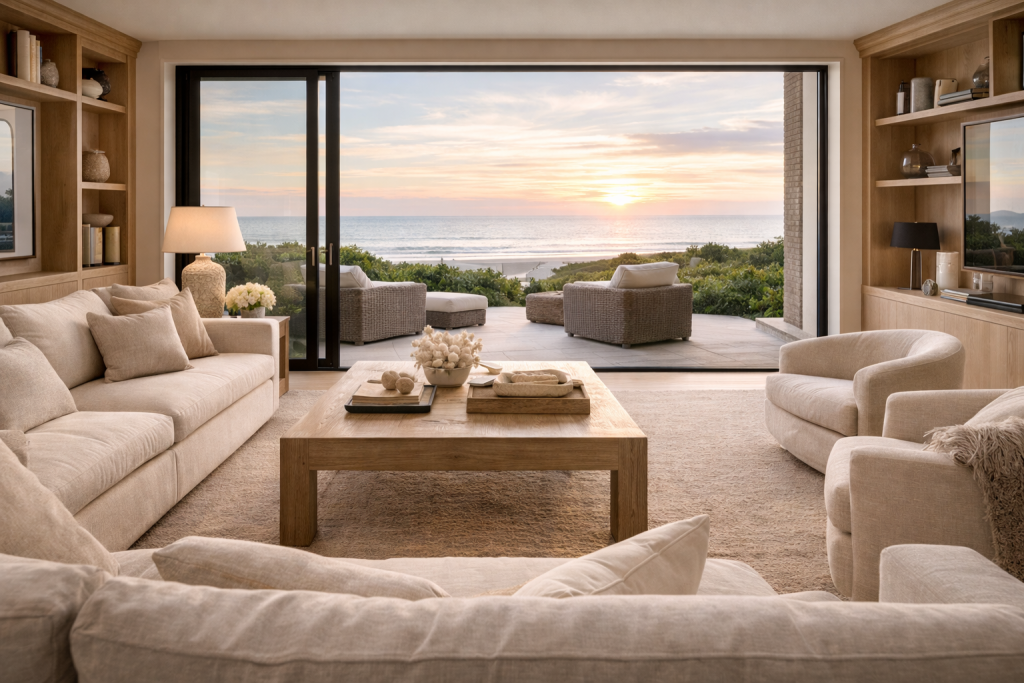
Hamptons light creates a color environment that interior palettes must harmonize with rather than compete against. The dominant exterior tones are silver-gray shingle, white trim, and the blue-green spectrum of ocean, sky, and marsh. Consequently, interior palettes that reference these tones create continuity between inside and outside. Palettes that introduce competing colors create visual friction that makes rooms feel disconnected from their setting.
D&J Concepts’ Hamptons beach house palette draws from a narrow range refined over 25 years. Warm whites read as creamy rather than clinical. Soft grays carry warm undertones. Muted blues reference ocean without imitating it. Natural tones draw from linen, oak, and stone. Benjamin Moore’s “White Dove” and “Simply White” appear in the firm’s specifications more frequently than any other paint colors because they respond to Hamptons light with warmth that pure whites cannot deliver.
Steve Chase’s material philosophy, absorbed during Hornung’s training, applies directly to Hamptons color work. Chase believed that the best interiors contain no more than five dominant materials, and that those materials should generate the color palette rather than the reverse. In Hamptons practice, this means white oak floors, linen upholstery, natural stone surfaces, and white-painted millwork create a color palette that requires no additional decorative intervention. Any beach house that looks effortless was designed with the kind of restraint that effortlessness demands.
The Restraint Principle
Restraint is the defining characteristic of Hamptons beach house design at the highest level, and it is the quality most difficult to achieve. Yet the temptation to fill rooms is constant. Clients arrive with collections, inherited furniture, impulse purchases from antique shops, and the accumulated objects of complex lives. The designer’s role is not to accommodate everything but to curate what enters each room with the same discipline a museum applies to its galleries.
Rooms with fewer objects feel larger, calmer, and more connected to the landscape that is, after all, the primary reason anyone pays $5 million or more for a Hamptons beach house. Consider a living room with two sofas, two armchairs, and a coffee table, carefully selected and precisely positioned. It delivers more spatial pleasure than the same room with twice the furniture at half the quality. Importantly, restraint is not minimalism, which is a style. Restraint is discipline, which is a practice.
Elle Decor editors consistently select restrained interiors for publication over maximalist ones in the Hamptons context. The market has spoken clearly: the East End aesthetic favors curated calm over collected abundance. D&J Concepts designs to this standard not because magazines demand it but because 25 years of evidence demonstrate that restrained rooms satisfy their owners longer than rooms designed to display volume.
Seasonal Performance
A Hamptons beach house must perform across four seasons for year-round owners and across the intense Memorial Day to Labor Day period for summer residents. The design challenge is creating rooms that feel appropriate in July’s heat and January’s gray without requiring seasonal transformation that few homeowners actually execute.
D&J Concepts addresses this through permanent materials that read as seasonally neutral. Oak floors work in sandals and socks. Linen upholstery feels appropriate in shorts and sweaters. Stone surfaces stay cool in summer and accept the warmth of a nearby fireplace in winter. Seasonal adjustment happens through lightweight additions: throw blankets in winter, fresh flowers in summer, pillow covers that shift between warmer and cooler tones. The permanent design never changes. The accents rotate with the calendar.
After 25 years of East End practice, the most satisfying Hamptons beach house projects share three qualities. Materials honor the coastal environment. Light enters on its own terms. And restraint lets the landscape do what no interior can replicate. Sand, light, restraint. Everything else is commentary.
Start Your Design Conversation
D&J Concepts brings 25 years of luxury residential design experience to every project. The Method of Visual Clarity ensures your vision is resolved before construction begins. Contact Social Life Magazine for features, advertising, or partnership inquiries. Visit polohamptons.com for event tickets and sponsorship opportunities.
Subscribe to Social Life Magazine for ongoing design intelligence. Join our email list for exclusive content. Support independent Hamptons journalism with a $5 contribution.
Read more: The Hamptons Design Vernacular and Marble, Limestone, Quartzite: A Stone Guide.
David Hornung co-founded D&J Concepts in 2001 after training under Interior Design Hall of Fame inductee Steve Chase in Los Angeles. From Southampton headquarters, D&J serves clients across the Hamptons, Manhattan, Palm Beach, and Southern California. A member of the Society of Design Administration, Hornung brings 25 years of luxury residential design experience to every project. Discover the Visual Clarity Method at dandjconcepts.com.
Author

Written by
Recent Posts

House Closing Process: What Sellers Should Expect From Start to Finish
What to Know Before Buying a Home in Brantford
When Does Using a Travel Advisor Make the Biggest Difference
What to Look for When Choosing Your First Red Light Therapy Panel

Experience the luxury of exploring Aruba’s coast by private yacht
Categories
- Art
- Articles
- Business of Luxury
- Celebrities
- Culture
- Entertainment
- Events
- Faces of Summer 2026
- Fashion
- Fashion & Style
- Featured
- Finance
- Food, Spirits, Wine
- Hamptons
- Hamptons Celebrities
- Health
- Health & Beauty
- Lifestyle
- Luxury Lifestyle
- Press
- Profiles
- Real Estate
- Technology
- The Chronicles
- Travel
- Uncategorized
- Weddings