

On Friday evening, March 13, Dolly Parton walked onto a stage in Pigeon Forge, Tennessee, to open the 41st season of Dollywood — the theme park she built in the foothills of the Smoky Mountains from a name and a work ethic and sixty years of songs. She is 80 years old. For months, no major public appearance had come. The Film Academy’s Governors Awards in November passed without her. Her own 80th birthday celebration at the Grand Ole Opry in January came and went the same way. A Las Vegas residency shifted from December 2025 to September 2026. When her sister Freida posted on social media that she had been “praying all night” for Dolly’s recovery, the internet responded with the specific, helpless tenderness that only Dolly Parton generates.

Standing onstage at Dollywood, she told the crowd what had happened. “I’ve not been touring, as you know. I’ve had a few little health issues, and we’re taking good care of them.” Then came the part that mattered. “I just kind of got worn down and worn out, grieving over Carl and a lot of other little things going on. I just got myself kind of where I needed to build myself back up — spiritually, emotionally, and physically.” All is good, she added. None of it slowed her down. Then came the joke about Carl Dean waiting at the pearly gates, warning away any man she might arrive with: “He’d be saying, ‘Who’s that little pisser? You leave him outside the gates.'” The crowd laughed. She smiled. It is possible she was also telling the truth about something that hurt a great deal.
One Year Later: The Weight Behind the Words
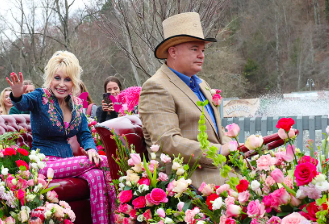
Carl Dean died on March 3, 2025. He was 82. They had been married for 58 years. Friday’s appearance marked her first major public statement since his death a year ago. It took her a year to say “worn down and worn out” in front of an audience. That is the story — not the health update, not the postponed Vegas dates, but the specific weight of what it costs to be Dolly Parton, and what it meant for her to say, even briefly, that the weight had landed.
Who Carl Dean Was and What His Absence Means
Carl Dean spent nearly six decades making sure no one knew who Carl Dean was. He went to exactly one industry event with his wife in their entire marriage — a BMI dinner in 1966, the year they wed, the only year he tried. After that, he made it simple. “I want you to do everything that you want to do,” he told her. “But don’t ever ask me to go to another one of those damn things, because I ain’t going.” She respected it. Running an asphalt paving business in Nashville suited him better. Tinkering in the barn on their Brentwood property suited him best. He watched the 9 to 5 movie on his own, having skipped the Nashville premiere. When reporters staked out their home, he told them he wasn’t Dolly Parton’s husband. He was the gardener. This went on for 58 years.
He was the person she came home to — not the audience, not the fans who loved her with an intensity unusual even by celebrity standards. The Imagination Library readers, the 200 million children worldwide who received free books through the program she built because she had no children of her own and decided that meant all children were hers — they weren’t there either. Carl Dean was the man in the barn, and when she closed the door and took off the rhinestones, he was still there. On March 3, 2025, he wasn’t. He was 82. It had been a good life. March 3 was still March 3.
The Songs He Never Gave Interviews About
She wrote “Jolene” about a red-haired bank teller who flirted with Carl early in their marriage. “I Will Always Love You” came the year they nearly separated when she considered leaving her manager, Porter Wagoner, for a solo career — it was her goodbye, then her goodbye to every relationship she’d ever had to leave to keep going. Their 50th anniversary inspired “From Here to the Moon and Back,” written the year they renewed their vows, the year she finally wore an elaborate wedding dress — they’d eloped to a small church in Georgia in 1966 with only her mother as a witness and she never felt she’d had the wedding she wanted. The songs the whole world knows are mostly about Carl Dean, a man who never gave an interview.
What She Has Given and Why “Worn Down” Is Earned
There is a version of this story that focuses on Dolly Parton’s resilience — the upbeat ending, the Dollywood season opening, the jokes about Carl at the pearly gates, the “all is good.” That version is available and she offered it freely. But the more honest reading of Friday’s keynote is that she admitted, in public, for the first time, that the year since Carl’s death had been hard in a way she had not fully communicated before. She said she got worn down. Rebuilding herself became the necessary project. That is not the Dolly Parton the country prefers — the invincible one, who donated a million dollars to Vanderbilt University that became the COVID vaccine research that saved lives, who funded the Dolly Parton Children’s Hospital in Knoxville, who launched the Imagination Library in 1995 and has kept it running for thirty years.
Two Hundred Million Books and One Reason
The Imagination Library has distributed over 200 million books. That number is not a rounding error — it is the product of thirty years of institutional commitment, annual funding, and organizational infrastructure built to get books to children before they start school, in countries including the United States, Canada, the United Kingdom, Australia, and beyond. Growing up in a one-room cabin in Locust Ridge, Tennessee, one of twelve children, with a father who couldn’t read, is where the idea began. A literacy program followed because she understood what the absence of books costs a child. Building it and keeping it going happened alongside making three thousand other songs, starring in films, running Dollywood, running her entertainment company, funding a children’s hospital, and being married to a man in a barn in Brentwood who preferred it that way.
The living legends of American entertainment earn their definitions from what they made. Dolly Parton earns hers equally from what she gave — not as an afterthought, not as tax strategy, but as the central organizing project of a public life that happened to involve fame and music and rhinestones and a voice that has never stopped being extraordinary at 80. Giving began before celebrity philanthropy became a brand strategy, before anyone suggested it would be good for her image. The reason was simpler: her father couldn’t read and she could, and she knew what that meant.
The Work Ethic Behind the Work Ethic
The woman who wrote “9 to 5” — about the exhaustion of people who work and work and work and never get what they’ve earned — is now, herself, someone who has worked and worked and worked and is finally saying, out loud, that she got worn down. Building herself back up is the plan, she confirmed, and the work is already underway. All is good. The joke about the pearly gates followed — her oldest habit: make sure the people watching feel okay, spare them the worry, land the punchline, and keep going. That is what sixty years of performing looks like when someone finally says what it cost.
What “Building Myself Back Up” Looks Like at 80
The Las Vegas residency moves to September 2026. A Broadway musical based on her life, Hello I’m Dolly, enters development. Dollywood’s 41st season opened Friday with a new indoor roller coaster, NightFlight Expedition. Not dating anyone, she made clear. Carl Dean is waiting at the gates. And in the specific, deflecting, gracious way that is entirely her own, everything she said confirmed that she is still here, still working, still Dolly.
The Person Behind the Performance
What she did not say — and what Friday’s appearance communicated in the space between her words — is that losing the person who was there when she wasn’t Dolly, when she was just Robyn, the girl who came to Nashville with a bag of dirty laundry and met a man outside a laundromat on her first day in the city, is a different kind of loss than any other. The fans can grieve Dolly Parton. Nobody grieves with her. That’s the arrangement she made in 1966 when she married someone who didn’t want to be famous. For 58 years it held. Today it still holds. The price of it was always there.
The people who hold rooms together — who provide the warmth and the jokes and the reassurance that everything is going to be fine — often do so without anyone acknowledging that holding a room together is itself a form of labor. Dolly Parton has held every room she has ever entered together for sixty years. On Friday she told an audience she got worn down, that building herself back up is the plan, that Carl is waiting. Then she opened a roller coaster and went back to work.
She deserved more than one year to say it. She said it anyway. That is the whole story, and it is enough. The wealthiest and most celebrated people in America often have the least permission to be human in public. Dolly Parton used her keynote address at a theme park in the Smoky Mountains to take thirty seconds of that permission. The crowd laughed at the joke about Carl and the pearly gates. Some of them were probably crying. That is the effect she has always had. That is what sixty years of giving looks like when someone finally says what it cost.
Related: Living Legends Net Worth 2025: The Fortunes Built Over Six Decades | The Convening Power Premium: Why the Host Controls the Room
Want your brand featured alongside stories like this? Contact Social Life Magazine about partnerships and editorial opportunities. Join us this summer at Polo Hamptons — where New York’s power players meet in person. Subscribe to the print edition or join our email list for Hamptons insider access delivered first. And if this story moved you, support independent luxury journalism for $5.
Author

Written by
Recent Posts
Smart Cooking and Simple Party Planning for Home Bakers
The Benefits of Using an AI Speech Generator for Special Occasions
7 Best Custom DTF Transfer Suppliers in 2026

Protected: Exit Money vs. Inherited Money: Why Hamptons’ Wealthiest Handle Them Completely Differently

Protected: MASQUERADE: The Immersive Phantom NYC Is Obsessed With