
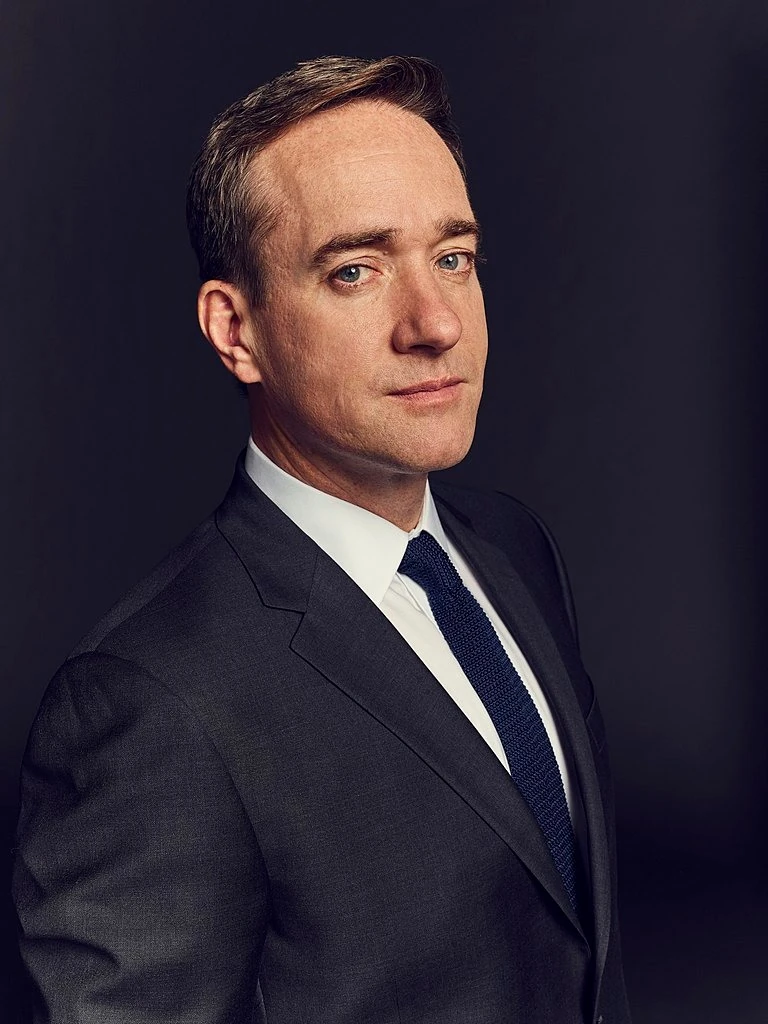
Matthew Macfadyen’s net worth is approximately $8 million. Notably, that figure reflects two careers that most people don’t fully register as belonging to the same man. Consequently, the actor who played Mr. Darcy in the 2005 Pride and Prejudice — the most eligible, most desired, most socially untouchable man in English literature — spent the next fifteen years perfecting his portrait of a man who desperately wants to belong to rooms he was never built for. Furthermore, that apparent contradiction is not a contradiction at all. It is, on closer examination, a master class in range. Tom Wambsgans is the inverse of Fitzwilliam Darcy in nearly every measurable way. Moreover, Macfadyen plays both with the same quality: a stillness that contains, underneath it, enormous amounts of running calculation. The Darcy casting made him famous. The Tom casting made him great.
Before Tom: Norfolk, 1974
The Before
Matthew Macfadyen was born October 17, 1974, in Norfolk, England, into a family with no particular connection to the entertainment industry. Norfolk is not London. Additionally, it is not the kind of place that produces actors through proximity — it produces them through deliberate choice, which means the ones who make it tend to arrive with conviction rather than accident. Macfadyen was the kind of teenager who found school productions and understood immediately that performance was the thing. By contrast with peers who treated drama as an extracurricular, he treated it as a destination.

He earned a place at the Royal Academy of Dramatic Art — RADA, the institution whose alumni list reads as a comprehensive history of serious British acting. Subsequently, he graduated in 1996 and moved into the professional theatre circuit that RADA’s network supports. The training was technically rigorous, classically grounded, and designed to produce actors who could sustain Shakespeare across three hours as readily as they could anchor a contemporary television drama. Macfadyen absorbed it all. The craft that would eventually make Tom Wambsgans feel real was being built, quietly, in rep theatres and classical productions that most of his future audience never saw.
The Pivot Moment
Macfadyen’s early television career produced the role that should have made him a household name: Richard Armitage in the BBC spy thriller Spooks, which ran from 2002 to 2004. The show was a critical and ratings success. Notably, his performance generated the kind of attention that typically translates into international visibility. However, Macfadyen left the series at the height of its popularity to pursue other work — a decision that puzzled observers at the time and that, in retrospect, characterizes a consistent pattern. He has never appeared to organize his career around the maximization of celebrity. Consequently, celebrity has followed him at a slight and telling delay.
The delay ended in 2005. Joe Wright’s film adaptation of Pride and Prejudice cast Macfadyen opposite Keira Knightley as the definitive screen Darcy of his generation. Furthermore, the film was a global success. Macfadyen’s Darcy — brooding, internally turbulent, physically commanding, and emotionally inarticulate in ways that Austen’s readers had spent two centuries projecting onto — generated the kind of cultural saturation that follows when a piece of casting is simply correct.
The Climb: Darcy’s Shadow and What Grew In It
Life After Darcy

The decade after Pride and Prejudice presented Macfadyen with a specific challenge: being defined by a role so culturally embedded that everything else registers as departure from it. Notably, he managed this more gracefully than most actors in equivalent positions. He appeared in Ripper Street (2012–2016), the BBC period crime drama, playing Detective Inspector Edmund Reid with the same quality of contained authority that had defined his Darcy. Additionally, he appeared in Moriarty and various stage productions, maintaining the theatrical work that RADA had positioned as foundational.
During this period, Macfadyen married actress Keeley Hawes — herself a RADA graduate and one of the most respected dramatic performers in British television — in 2004. Consequently, his personal and professional lives share an orientation toward serious craft over commercial visibility. The household they built is, by the standards of comparable profiles, notably private. By contrast with peers who maintained visible public presences during this period, Macfadyen worked steadily and said little. Tom Wambsgans, it turns out, was already being prepared.
What Tom Required
When Jesse Armstrong cast Macfadyen as Tom Wambsgans in 2018, he was casting for a character whose entire existence is organized around a single social calculation: how far will he go to belong to a world that wasn’t built for him? Furthermore, Tom’s specific position — the middle-class Midwesterner who married into American media royalty — required an actor who understood, from the inside, what it feels like to be technically accomplished and perpetually outside the circle of people who take their belonging for granted.
Macfadyen understood it. Moreover, his British perspective on American class dynamics gave him a useful distance from the material. He plays Tom’s social anxiety not as neurosis but as strategy — each calculation running slightly ahead of each action, each performance of belonging calibrated to the specific room. Additionally, the fact that Macfadyen himself is so far from Tom’s particular damage made the performance more precise, not less. He was not drawing on experience. He was constructing, from observation and craft, the exact shape of a particular kind of longing. For the full portrait of what Tom Wambsgans represents culturally and how Macfadyen’s performance anchors the Succession TV show legacy, the hub piece maps every character in the ensemble.
Matthew Macfadyen Net Worth: The Tom Wambsgans Premium
The Numbers
Matthew Macfadyen net worth of approximately $8 million reflects his Succession salary alongside two decades of British television and film work. Notably, his salary reportedly aligned with the principal cast’s equalized structure in the later seasons, reaching several hundred thousand dollars per episode. By the standards of the role’s cultural impact, the number is modest. However, by the standards of a career deliberately organized around craft rather than celebrity, it represents a significant financial arrival that the Darcy years foreshadowed but did not deliver.
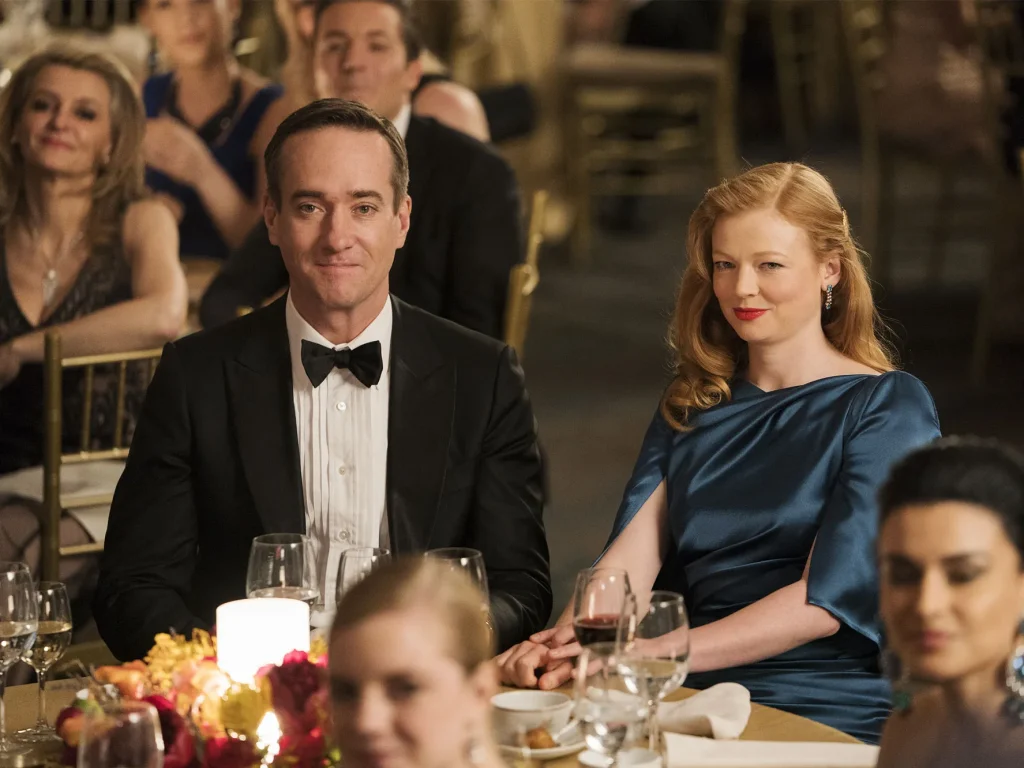
The 2023 Emmy win for Outstanding Supporting Actor in a Drama Series — awarded for Season 3 — recognized a performance the audience had been discussing since Season 1. Macfadyen’s Tom is consistently the funniest character in a show not principally designed as a comedy, and consistently the most strategically opaque. Consequently, the Emmy acknowledged both simultaneously, which is precisely the achievement: he held two registers across four seasons without ever letting one collapse the other.
The Disgusting Brothers and What They Demonstrate
The relationship between Tom Wambsgans and Greg Hirsch — dubbed the “Disgusting Brothers” within the show’s fan vocabulary — produced some of the finest comedic work in prestige television’s recent history. Notably, the dynamic required Macfadyen to play a man who is simultaneously the dominant and the subordinate in a relationship with no stable hierarchy. Tom performs authority over Greg. Meanwhile, he recognizes in Greg the same social outsider status he carries himself. Furthermore, the scenes between them work because Macfadyen plays Tom’s affection for Greg as the one genuine emotion the character permits himself — the only relationship in the show not organized around calculation.
Nicholas Braun‘s physical presence — 6’7″ of perpetual social miscalibration — gave Macfadyen a scene partner whose comedic rhythm required precise timing to match. By contrast with performers who find physical comedy easy, Macfadyen’s comedy is entirely internal. The laugh comes from what he’s thinking, not from what he’s doing. That is technically harder to execute and, in the hands of a RADA-trained actor with twenty years of classical work behind him, entirely natural.
The Darcy Paradox: Why the Casting Makes Sense
Inside and Outside the Same Body
The apparent paradox — Darcy and Tom Wambsgans as consecutive career-defining roles — resolves immediately when you examine what both characters actually require. Darcy is a man of absolute social authority who cannot express what he feels. Tom is a man of no social authority who cannot stop calculating how to acquire it. Notably, both characters live in the gap between internal reality and external performance. Furthermore, both require an actor who can make that gap visible without explaining it.
Macfadyen’s specific instrument — the quality of contained interiority that RADA builds and years of classical work refine — is precisely what both roles need. Additionally, the Darcy casting was not a coincidence that preceded Tom. It was evidence of the same quality that made Tom possible. Consequently, the career that looked like a sequence of departures from a single defining role was, in fact, a consistent demonstration of a single consistent skill applied to different material.
The Hamptons Chapter: Tom Wambsgans at the Table
The Outsider in the Room
Matthew Macfadyen does not maintain a Hamptons presence. He is a Norfolk-born, RADA-trained British actor married to a British actress, living a life that the Hamptons summer circuit is not designed to accommodate and that he has shown no particular interest in seeking. However, Tom Wambsgans is at every Hamptons table every summer.
Specifically, Tom is the person who arrived through marriage, or through connection, or through a professional relationship that granted access without conferring belonging — and who has spent every subsequent season calculating, with extraordinary precision, how to convert access into permanence. Furthermore, in the rooms where Succession registers as documentary rather than drama, this character is not rare. Moreover, he is the one everyone underestimates until the moment the underestimation becomes expensive. Social Life Magazine has covered this world for 23 years. Tom Wambsgans is a recurring feature of every summer social landscape we’ve documented. Macfadyen made him specific enough that people stopped watching the show and started checking the room.
What Matthew Macfadyen Built: The Career Behind the Roles
The Soft Landing
At 50, Macfadyen occupies a position that most actors who’ve carried two career-defining roles in different decades don’t reach: genuine industry respect uncomplicated by the kind of overexposure that erodes it. Notably, the Darcy years made him recognizable. Consequently, the Tom years made him respected. Furthermore, the gap between the two — a decade of serious work that didn’t generate headlines — is not a gap at all. It is the foundation on which both performances stand.
Post-Succession, Macfadyen has continued working with the same selection principle that governed his pre-Succession career: roles that require something, taken seriously, executed well. Additionally, his personal life remains private by design — a deliberate counterweight to the visibility his career now generates. By contrast with the social performance his most famous character spent four seasons executing, Macfadyen’s own relationship to the industry’s attention appears to require no maintenance at all.
Matthew Macfadyen net worth of $8 million will grow. The post-Emmy trajectory for performers of his caliber runs upward reliably. Moreover, it grows in the direction he chooses — which is the outcome Tom Wambsgans spent four seasons engineering and never quite secured. That difference, between the character’s anxious calculation and the actor’s quiet confidence, is the most Succession-appropriate irony in the entire cast. Tom finally won. Meanwhile, the man who played him had already won years ago, in ways that didn’t require a boardroom.
Related Reading
- Succession: The Show That Knew Your Family — Full Character Hub
- Brian Cox: Net Worth, Origin Story, and Where He Is Now
- Jeremy Strong: Net Worth, Origin Story, and Where He Is Now
- Kieran Culkin: Net Worth, Origin Story, and Where He Is Now
- Nicholas Braun: Net Worth, Origin Story, and Where He Is Now
- Hamptons Hedge Fund Billionaires: Net Worth and the Philosophy Behind It
You already know which room this is about. The question Social Life Magazine has been asking for 23 years — in the Hamptons, in the rooms that matter, at the tables where things actually get decided — is not who’s in it. It’s what they’re really saying.
If your brand, business, or story belongs in those rooms, we’d like to talk. Editorial features, partnerships, and press inquiries start here.
To place your brand directly in front of the audience that recognizes this world from the inside, paid feature placements are available here.
82,000 readers receive the Social Life Magazine email — people who summer east of the bridge, own the homes, attend the events, and make the decisions. Join that list here.
Polo Hamptons is where the real version of this world shows up in person — sponsors, guests, and brand activations for the audience the Roys would have killed to reach. See what’s available at polohamptons.com.
Five issues a summer, 25,000 copies each, distributed between Westhampton and Montauk to the people who make the Hamptons the Hamptons. Print subscriptions here.
If this piece named something you recognized and couldn’t quite articulate, consider supporting independent luxury media. $5 keeps the lights on and the table set.
Author

Written by
Recent Posts

Planning an Arizona Road Trip? Practical Details to Handle Before You Leave

Short Homecoming Dresses That Feel Polished, Not Overdone
Men’s Health After 40: Important Changes to Pay Attention To
What You Need to Know About Spray Tanning

Simple Ways to Upgrade Your Summer Drink Routine
Categories
- Art
- Articles
- Business of Luxury
- Celebrities
- Culture
- Entertainment
- Events
- Faces of Summer 2026
- Fashion
- Fashion & Style
- Featured
- Finance
- Food, Spirits, Wine
- Hamptons
- Hamptons Celebrities
- Health
- Health & Beauty
- Lifestyle
- Luxury Lifestyle
- Press
- Profiles
- Real Estate
- Technology
- The Chronicles
- Travel
- Uncategorized
- Weddings