
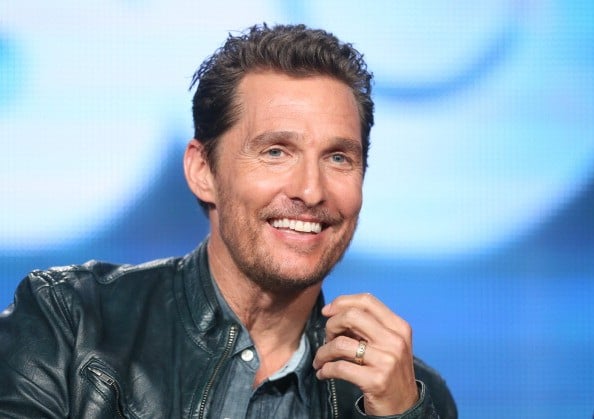
The Before: Uvalde, Oil Pipes, and Parents Who Divorced Three Times
As a result, Matthew David McConaughey was born on November 4, 1969, in Uvalde, Texas — a small town in the southwestern brush country that most Americans had never heard of until May 24, 2022, when a gunman killed 19 children and two teachers at Robb Elementary. Similarly, McConaughey himself was born at the old hospital on Getty Street. Despite this, his father, James Donald McConaughey, ran an oil pipe supply business after a brief football career that included being drafted by the Green Bay Packers. In turn, his mother, Mary Kathleen “Kay” McCabe, was a kindergarten teacher who would later publish a memoir about raising her famous son. Regardless, they were larger-than-life Texans who divorced and remarried each other three separate times, a romantic chaos that Matthew would later describe as simply the way his parents loved — violently, stubbornly, and without anyone else’s permission.
Still, Jim McConaughey died of a heart attack in 1992. Even so, Matthew has said his father once told him he would die making love to his wife, and that is precisely what happened. That said, the story is delivered in Greenlights, McConaughey’s 2020 memoir, with the matter-of-fact tenderness of a man who learned early that love and destruction share an address. Young Matthew was the youngest of three sons. Additionally, his oldest brother, Michael “Rooster” McConaughey, would later appear on reality television.
The Real Impact
Furthermore, his middle brother, Pat, runs a pipe supply business. Moreover, the household ran on sports, discipline, and the assumption that you earned what you got. Consequently, Matthew played football at Longview High School after the family relocated, then studied film at the University of Texas at Austin. He had originally planned to attend law school. However, the pivot to filmmaking came late and without fanfare, which is how most pivots that matter actually happen.
The Pivot Moment: A Bar, a Casting Director, and “Alright, Alright, Alright”
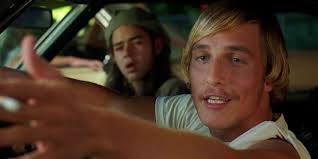
Nevertheless, the most consequential meeting of Matthew McConaughey’s life happened at the Hyatt Hotel bar in Austin, Texas, on a night he had no reason to be there. A film production was in town. Notably, a casting director named Don Phillips was drinking alone. In fact, McConaughey sat down, started talking, and didn’t stop until Phillips introduced him to director Richard Linklater, who was casting a low-budget ensemble film about the last day of high school in 1976. The film was Dazed and Confused. Subsequently, McConaughey landed the role as David Wooderson, the guy who graduated years ago but keeps hanging around because, as he explains with perfect, creepy sincerity, the girls stay the same age.
His first line on camera was improvised. Meanwhile, sitting in a car, waiting for the scene to start, McConaughey muttered three words to himself that became the defining catchphrase of his career: “Alright, alright, alright.” He has said he was channeling the energy of a Jim Morrison concert film he’d been watching the night before. The line wasn’t scripted. Linklater kept it. The film grossed only $8 million theatrically but became one of the most enduring cult classics of the 1990s, launching careers for McConaughey, Ben Affleck, Milla Jovovich, and Parker Posey. McConaughey was 23. He had no agent, no training in the traditional sense, and no plan beyond showing up at a bar at the right moment. The lesson he took from it — that preparation is important but availability is everything — would define every decision he made for the next three decades.
The Climb: Rom-Com King, the Wilderness, and the McConaissance
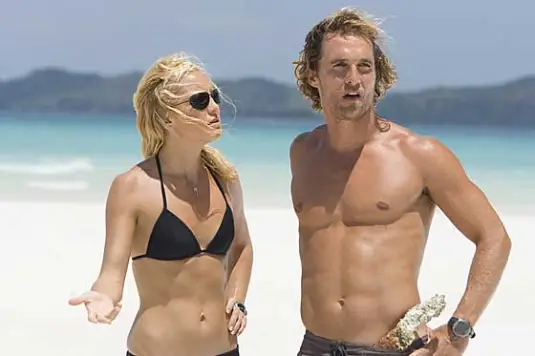
As a result, the decade between A Time to Kill (1996) and Fool’s Gold (2008) was the most lucrative and least respected period of McConaughey’s career. He became Hollywood’s go-to romantic comedy leading man, starring opposite Jennifer Lopez in The Wedding Planner, Kate Hudson in How to Lose a Guy in 10 Days and Fool’s Gold, and Sarah Jessica Parker in Failure to Launch. The films were formulaic, enormously profitable, and gradually reducing McConaughey to a single note: the handsome, shirtless Texan who says something charming in the third act and gets the girl. His paychecks rose from $250,000 for A Time to Kill to $8 million for How to Lose a Guy to $15 million for Fool’s Gold. The money was extraordinary. The work was disposable. He knew it.
In 2009, after the birth of his son Levi, McConaughey stopped. He turned down every romantic comedy offered to him — including, he later revealed, a $14.5 million payday that would have been the easiest check of his career. The industry interpreted this as retirement or self-destruction. It was neither. It was a calculated bet that if he disappeared long enough, the phone would ring with different offers. For nearly two years, the phone didn’t ring at all.
The Turning Point
Then it did. William Friedkin cast him in Killer Joe. Jeff Nichols cast him in Mud. Steven Soderbergh cast him in Magic Mike. Richard Linklater, the man who’d started it all, cast him in Bernie. Each role was small, strange, and completely unlike anything he’d done before. Critics started calling the shift “the McConaissance.” The name was clever enough that it stuck, which helped, because the performances were strong enough that they didn’t need it.
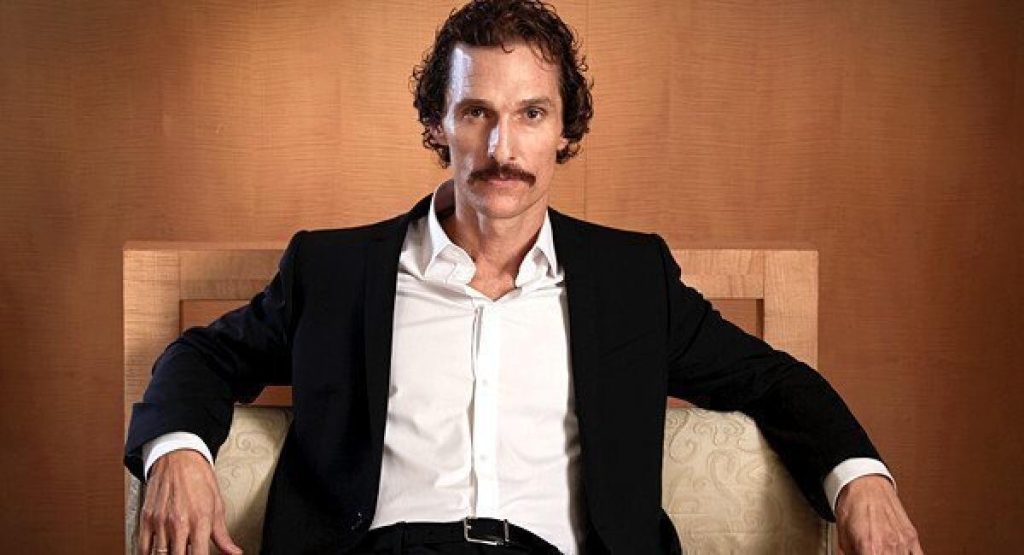
Dallas Buyers Club arrived in 2013. McConaughey lost nearly 50 pounds to play Ron Woodroof, an electrician and rodeo cowboy diagnosed with AIDS in 1985 who smuggled unapproved medications across the Mexican border to treat himself and others the pharmaceutical industry had abandoned. He accepted under $200,000 for the role — a 98% pay cut from his rom-com peak. The film earned $55 million worldwide and won McConaughey the Academy Award, Golden Globe, and SAG Award for Best Actor. The kid from Uvalde who’d said “alright, alright, alright” into a camera twenty years earlier was now holding an Oscar. Specifically, the distance between those two moments is the entire Matthew McConaughey net worth story.
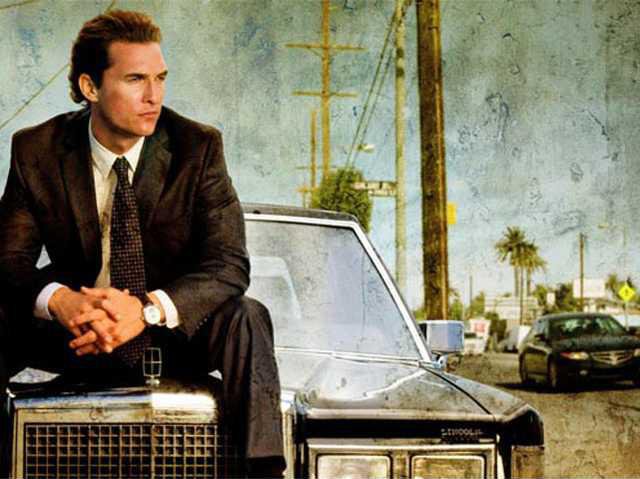
The Hamptons Chapter: Austin Over Hollywood, Malibu to the Ranch
McConaughey made a real estate decision in his thirties that reveals more about his financial philosophy than any salary negotiation. He chose Austin over Los Angeles. While most actors of his stature cluster in Beverly Hills, Bel Air, or the Palisades, McConaughey planted his family in the Texas capital, where the cost of living is lower, the privacy is greater, and the social infrastructure runs on barbecue and live music rather than premiere after-parties. The choice was philosophical and practical. Texas has no state income tax. A $160 million fortune preserved in Austin compounds differently than one maintained in a California zip code where the top marginal rate exceeds 13%.
He did own Malibu property — a beachfront mansion purchased for approximately $10 million and later sold for $15 million. The transaction was clean, profitable, and entirely consistent with a man who treats real estate as an asset class rather than a lifestyle statement. His primary Texas holdings reportedly include a 10,000-acre ranch, the kind of property that exists in a category of wealth that doesn’t require explanation to anyone who has stood on that much land and watched the sun set over it. In 2019, McConaughey became a part-owner of Austin FC, the Major League Soccer expansion team whose valuation has since grown to approximately $680 million. The investment is characteristic: patient, local, and structured to appreciate over decades rather than quarters.
Behind the Numbers
McConaughey’s social orbit overlaps with the Hamptons crowd without requiring geographic proximity. His Wild Turkey bourbon creative directorship, his Salesforce advisory role at $10 million annually, and his Lincoln Motor Company partnership connect him to the same brand universe — luxury, aspiration, understated power — that populates Southampton benefit dinners and Bridgehampton polo fields. He’s the rare A-lister who doesn’t need to show up in the Hamptons to be present in the conversation.
What He Built: Greenlights, the Foundation, and the One Scene in Wolf of Wall Street
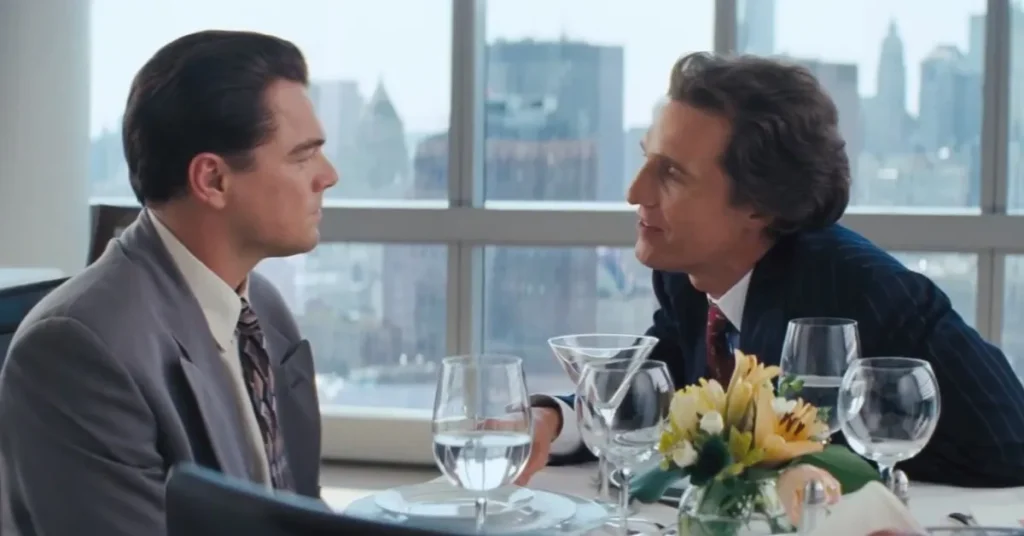
McConaughey’s most culturally durable performance of the 2010s lasted exactly four minutes and thirty-seven seconds. His single scene in The Wolf of Wall Street as Mark Hanna — the senior broker who teaches Leonardo DiCaprio’s Jordan Belfort that the entire industry is a game of keeping clients’ money in motion while skimming fees — became the most quoted sequence in the film. The chest-thumping, the humming, the casual cocaine confession over a martini lunch: all of it was improvised. DiCaprio has said that McConaughey was doing the chest-thumping routine to relax himself before takes, and DiCaprio asked Scorsese to keep the camera rolling. The scene was never scripted. It became the movie’s thesis statement.
The irony is precise. McConaughey played a man who explains that Wall Street is a performance, that the money isn’t real, that the game is the game. He delivered this performance in a film that grossed $392 million and spawned an industry of motivational speakers quoting a fictional broker’s philosophy. The scene also functions as a perfect metaphor for McConaughey’s own career: a man who spent a decade being paid millions to perform in romantic comedies he didn’t believe in, then walked away from the money to do work that mattered, and then returned to collect even more money because the work that mattered made him more valuable than the work that paid.
What the Record Shows
His memoir, Greenlights, published in 2020, sold millions of copies and spent weeks atop the New York Times bestseller list. The book functions as a collection of life lessons organized around the metaphor of a traffic light: green lights are the moments everything aligns, yellow lights are the moments of caution, red lights are the moments that stop you. The writing is earnest in a way that would be unbearable from almost any other celebrity. From McConaughey, it works, because the man has always been constitutionally incapable of irony. He means every word. The book’s royalties added millions to a fortune that was already well into nine figures.
His Just Keep Livin Foundation, co-founded with wife Camila Alves in 2008, operates after-school wellness programs for high school students in underserved communities. By 2026, the foundation served over 20,000 kids across 45 programs nationwide. After the Uvalde shooting in his hometown, McConaughey visited the White House and delivered a speech calling for gun reform, holding up the green Converse sneakers of one of the victims as visual testimony. He reportedly considered running for governor of Texas before ultimately declining. The political career that never happened may be the most McConaughey move of all: he showed up, he was present, he left before anyone could reduce him to a single position.
The Soft Landing: $160 Million and the Art of Knowing When to Leave
Matthew McConaughey’s net worth sits at an estimated $160 million. The architecture of that fortune is deliberately diversified: film salaries that range from $200,000 (Dallas Buyers Club) to $20 million (The Gentlemen), endorsement deals worth north of $10 million annually (Salesforce alone pays that figure for his creative advisory role), equity in Austin FC, Wild Turkey bourbon creative director fees, Greenlights royalties, and Texas real estate that appreciates without the tax burden of a California portfolio. He turned down $15 million for a Magnum P.I. reboot in 2008 because he knew the role would cement exactly the image he was trying to escape. He accepted $200,000 for the role that won him an Oscar. The gap between those two numbers is not a pay cut. It is a business plan.
The Hidden Detail
His upcoming slate includes The Rivals of Amziah King, a crime drama that premiered at SXSW to a 97% Rotten Tomatoes score, and Positano, a Netflix romance with Zoe Saldana. He is 56 years old, married to the same woman for over a decade, raising three children in Austin, and collecting eight-figure checks from corporations that pay him to be exactly himself. The rom-com king who walked away from $14.5 million is now worth eleven times that amount. The man who improvised “alright, alright, alright” in a car in 1993 has spent thirty years proving that the best things in his life were never scripted. They were just available, and he was paying attention.
Related: Wolf of Wall Street True Story: How Jordan Belfort Built and Lost a $200 Million Fraud Empire · Leonardo DiCaprio Net Worth: How a Kid From “Scumsville” Built a $300 Million Empire · Margot Robbie Net Worth: From Queensland Farm Girl to $80 Million Power Broker · Jonah Hill Net Worth: The $60,000 Gamble That Built an $80 Million Empire · The Wall Street Movies That Rewired How America Thinks About Money
If you understand the math — that walking away from the guaranteed check is sometimes the only way to build the real fortune — then you already know why Social Life Magazine exists. We cover the people who bet on themselves and won. Reach out to our editorial team to be featured.
Inside the Decision
Want to position your brand alongside the culture that rewards reinvention? Submit a Paid Feature and let our editors build something worth reading.
Join 82,000+ subscribers who get our take on luxury, culture, and the Hamptons scene before anyone else. Subscribe to our email list.
The Deeper Story
Experience the intersection of sport, style, and status at Polo Hamptons — Bridgehampton’s premier luxury polo event, now in its seventh year with BMW as title sponsor.
Never miss a print issue. Subscribe to Social Life Magazine and get five summer issues delivered from Memorial Day to Labor Day.
Love what we do? Support Social Life Magazine and help us keep covering the culture that matters.
Author

Written by
Recent Posts

The First Decision After a Collision Can Be the Most Important One
Two Weeks in Rome and Beyond: Turkish Airlines Itineraries from Boston, Chicago and Onward to India

Top 10 Hair Transplant Clinics in Turkey 2026

Artist Alley to Online Store: How Convention Artists Can Keep Selling After the Event
When an 18-Wheeler Crash Leaves Lasting Consequences
Categories
- Art
- Articles
- Business of Luxury
- Celebrities
- Culture
- Entertainment
- Events
- Faces of Summer 2026
- Fashion
- Fashion & Style
- Featured
- Finance
- Food, Spirits, Wine
- Hamptons
- Hamptons Celebrities
- Health
- Health & Beauty
- Lifestyle
- Luxury Lifestyle
- Press
- Profiles
- Real Estate
- Technology
- The Chronicles
- Travel
- Uncategorized
- Weddings