
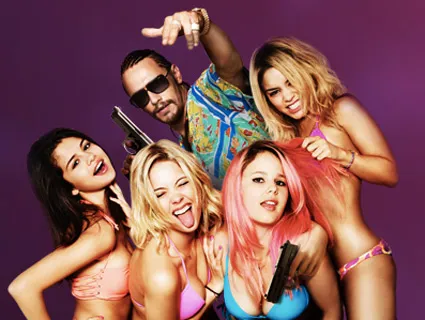
Spring Breakers A24 Cast Net Worth — Disney Kids Gone Dangerous
The Spring Breakers A24 cast net worth story is the most deliriously transgressive chapter in the entire A24 catalog, which is saying something for a company whose catalog includes a film about a man falling in love with a whale and another about a woman discovering the meaning of existence through hot dog fingers. Harmony Korine took Disney Channel darlings, wrapped them in neon and bikinis and automatic weapons, and created a film that critics could not decide was a masterpiece of cultural commentary or an elaborate provocation designed to see how much cognitive dissonance the American viewing public could absorb before their brains simply refused to process what their eyes were showing them.

The answer, as it turns out, was: quite a lot. The cast Korine assembled had a combined net worth that now exceeds $800 million, making Spring Breakers the wealthiest ensemble in A24 history by a margin so large it feels like a mathematical error. It is not an error. It is a consequence of what happens when Disney Channel fame is correctly understood not as a career peak but as a launch pad.
The Casting as Cultural Thesis
The genius of Spring Breakers’ casting was not just that it hired Disney stars to play criminals. It was that the film understood something about the architecture of American innocence that most cultural commentators were still years away from articulating: that the wholesome image projected by the Disney Channel is itself a form of brand management so sophisticated that it creates its own demand for transgression. Every audience that watches a Disney star grow up is also, whether consciously or not, waiting for the moment when that star does something that proves they were never really that innocent. The anticipation is part of the product. Spring Breakers monetized the anticipation by skipping directly to the payoff.
In Perspective
The financial architecture of this transaction deserves closer examination than it typically receives, because it reveals something fundamental about how value is created in the attention economy. Disney invested approximately $100 million in building Selena Gomez’s wholesome image over four seasons of Wizards of Waverly Place. Disney invested a similar amount in Vanessa Hudgens through the High School Musical franchise. Those investments created brand equity in the form of audience trust, recognition, and emotional attachment. Spring Breakers then leveraged that brand equity by inverting it, by taking the wholesome image and detonating it on screen, and the detonation itself became the content that audiences paid to see.
The Takeaway
This is not unlike what happens in finance when a trader takes a short position against a stock that everyone else considers safe. The value of the short position depends entirely on the strength of the consensus being bet against. If nobody believed Gomez and Hudgens were wholesome, their appearances in Spring Breakers would have been unremarkable. Because everyone believed it, the transgression had commercial value proportional to the strength of the belief being transgressed. Harmony Korine understood this intuitively. A24 understood it commercially. And the $31 million box office, generated against a $5 million budget, confirmed that attention arbitrage is a real and profitable enterprise.
The Takeaway
The cultural legacy of this casting strategy extends well beyond Spring Breakers itself. It demonstrated, conclusively and profitably, that the Disney-to-prestige pipeline is not a detour but a highway, one that subsequent Disney alumni would travel with increasing frequency and decreasing controversy. Zendaya’s transition from Shake It Up to Euphoria follows the same structural logic, though executed with more institutional support and less deliberate shock value. The path that Gomez and Hudgens macheted through the jungle of audience expectations is now a paved road with signage and rest stops, and every Disney star who uses it owes a debt to the Spring Breakers cast that will never be formally acknowledged but is impossible to deny.
Harmony Korine understood this, which is why he cast Selena Gomez and Vanessa Hudgens in roles that would have gotten their Disney contracts terminated in real time. The gap between the actors’ public images and the characters they played was not a side effect of the casting. It was the entire point. The gap was the spectacle. A24 distributed the spectacle, and in doing so established, very early in its corporate existence, that the company understood how attention works in an economy where attention is the scarcest and most valuable resource.
Selena Gomez — The Near-Billionaire Who Started as a Wizard from Waverly Place

Selena Gomez’s net worth is estimated at $800 million, a figure so large that it dwarfs every other actor in the entire A24 universe combined, multiplied by two, and then rounded up for good measure. But that fortune was not built on acting. Rare Beauty, her cosmetics brand, is valued at over $2 billion. Her Instagram following exceeds 400 million people, which is roughly the population of the United States plus the population of Germany, all looking at one person’s phone screen. She is not an actress who became famous. She is a global media platform who happens to act, and Spring Breakers was the film where she proved she could operate outside the frequency that Disney had calibrated for her since she was fifteen years old.
The Spring Breakers Signal
In Spring Breakers, Gomez played Faith, the religious good girl who serves as the audience’s moral compass before the film deliberately destroys that compass, dismantles it into its component parts, and scatters them across a neon-lit Florida landscape that feels like the inside of a fever dream. It was a small role that signaled a large ambition: the desire to be taken seriously by an industry that had filed her under “children’s television, do not promote to adult programming.”
The role paid modestly. The signal it sent was worth exponentially more. And the $800 million empire she built afterward, powered primarily by Rare Beauty’s ability to convert parasocial trust into product sales at a scale that makes most CPG companies look like lemonade stands, traces part of its origin to the moment she proved she could exist outside the Disney ecosystem without losing the audience that ecosystem had built for her.
For the full story of how a Texas kid turned Disney fame into the most valuable personal brand in entertainment, read our Selena Gomez net worth origin story.
Vanessa Hudgens — The High School Musical Graduate Who Refused the Obvious Sequel

Vanessa Hudgens’ net worth is estimated at $18 million, built through a career that has spanned Disney musicals, Broadway stages, Hollywood films, and business ventures that collectively demonstrate the underappreciated financial strategy of refusing to be defined by your biggest hit. Spring Breakers was her most aggressive act of image deconstruction. She played Candy, one of the bikini-clad criminals, with a commitment to chaos that obliterated every trace of Gabriella Montez so thoroughly that High School Musical fans who stumbled into the theater must have experienced a form of cognitive whiplash that no amount of preparation could have prevented.
Beyond the Disney Lane
The role did not make Hudgens rich in financial terms. Spring Breakers grossed $31 million worldwide against a $5 million budget, and the cast salaries were modest by any standard. What it did was prove to every casting director in Hollywood that Hudgens had range extending well beyond the musical-comedy lane Disney had constructed for her with the precision and permanence of a highway median. Every subsequent role that required edge, grit, or the ability to project menace while wearing a bikini traces its lineage back to this film.
For the full arc of how a Disney musical star built a surprisingly diversified fortune, read our Vanessa Hudgens net worth origin story.
James Franco — The Performance That Outlived the Performer’s Reputation

James Franco’s net worth is estimated at $30 million, a figure that represents the residual value of a career that was once one of the most creatively ambitious and financially productive in Hollywood before misconduct allegations effectively ended his mainstream viability in a way that no amount of talent, ambition, or previously accumulated goodwill could reverse. In Spring Breakers, he played Alien, a cornrowed drug dealer loosely inspired by a real Florida rapper named Dangeruss, and the performance was so unhinged, so committed, and so entirely liberated from the constraints of good taste that it remains the single best thing he has ever done on screen and quite possibly the best thing anyone has ever done in an A24 film.
The Performance Economy
The now-iconic “look at my stuff” monologue, in which Alien inventories his possessions with the fervor of a prosperity gospel preacher and the specificity of an estate appraiser, is a masterclass in the economics of performance. Franco improvised significant portions of the dialogue. He performed the piano scene, in which Alien plays Britney Spears on a white grand piano while his friends cock shotguns behind him, with the kind of sincere emotional commitment that transforms absurdity into something approaching genuine beauty.
It was a performance so committed to its own internal logic that it transcended the film containing it, which is both the highest compliment an actor can receive and, in Franco’s case, a cruel irony given what happened to the career that produced it.
For the full and complicated story of how a once-celebrated career generated and then partially destroyed a fortune, read our James Franco net worth origin story.
The Wealthiest Ensemble in A24 History

Spring Breakers was one of A24’s earliest releases, arriving in 2013 when the company was still establishing its identity and its competitors were still dismissing it as a boutique operation that would be absorbed or eliminated within three years. The film grossed $31 million against a $5 million budget, a 6x return that demonstrated A24 could market provocation as effectively as it would later market prestige, and that the two categories are not as far apart as the industry’s self-image would prefer to believe.
The Long-Term Calculus
A decade later, the Spring Breakers cast has collectively generated more wealth than any other A24 ensemble by such an absurd margin that the comparison barely qualifies as meaningful. Gomez alone outearns the combined net worth of every other actor profiled in this entire pillar. Her $800 million dwarfs the totals of Moonlight, Ex Machina, Lady Bird, and Everything Everywhere All at Once put together. The film did not create that wealth, but it was a waypoint in each career that mattered more than its modest budget suggested, more than its mixed reviews predicted, and more than anyone involved could have known at the time.
The Deeper Math
That is the Spring Breakers principle: sometimes the most valuable thing a film can do is not make money but change the story that the people in it get to tell about themselves. Change the story, and the career follows. The career shifts and the net worth shift with it. Suddenly, a $5 million movie about spring break in Florida looks less like a provocation and more like the best investment A24 ever made.
Explore our full A24 Movies and Actors Net Worth pillar for every cast, every fortune, every origin story behind independent cinema’s most valuable brand.
What It Means Now
You are reading this because you already understand something most people scroll right past. The intersection of culture, money, and taste is not a Venn diagram. It is a mirror. Social Life Magazine has spent 23 years holding that mirror up to the people who shape the Hamptons, Manhattan, and the corridors between them. If you see yourself in these pages, we should talk. Reach out at sociallifemagazine.com/contact.
If your brand, your launch, or your personal story belongs in front of 82,000 affluent readers and a digital audience that keeps growing, our editorial features are built for exactly that moment. Learn more at Submit a Paid Feature.
The Longer Arc
Our email list reaches 82,000 subscribers who actually open, read, and act. If your audience is high-net-worth, culturally engaged, and based between Park Avenue and Montauk, you are already in the right place. Join the list.
Polo Hamptons returns to Bridgehampton this July with 1,200 guests, Getty Images coverage, and seven years of BMW title sponsorship behind it. If your brand belongs in that conversation, visit polohamptons.com.
A print subscription to Social Life Magazine puts 25,000 copies per issue into the boutiques, lobbies, and living rooms where decisions get made, from Westhampton to Montauk every summer and Upper East Side doorman buildings for Fall and Winter. Subscribe at sociallifemagazine.com/subscription.
If this publication has added value to your world and you want to support independent luxury journalism, you can contribute directly at our donation page.
Author

Written by
Recent Posts
Where Can You Find the Best Made-to-Measure Bespoke Suits in NYC
The Financial Habits Every Successful Entrepreneur Swears By
What Happens If You Delay Hemorrhoid Treatment in New York City

James Franco Net Worth — A $30 Million Career Interrupted

Selena Gomez Net Worth — How a Disney Kid Built a $1.3 Billion Empire
Categories
- Art
- Articles
- Beauty & Skincare
- Celebrities
- Celebrities|Movies
- Celebrities|The Chronicles
- Chronicles
- Culture|Television
- Entertainment|Culture
- Event Photos
- Events
- Fashion
- Fashion & Style
- Featured
- Food & Beverage
- Food, Spirits, Wine
- Hamptons
- Hamptons Celebrities
- Hamptons Celebrities|Celebrities|The Chronicles
- Health
- Health & Beauty
- Lifestyle
- Luxury Lifestyle
- Movies
- Movies|Culture
- Movies|Hamptons Lifestyle
- Press
- Profiles
- Real Estate
- Technology
- The Chronicles
- Travel
- Uncategorized
- Weddings