
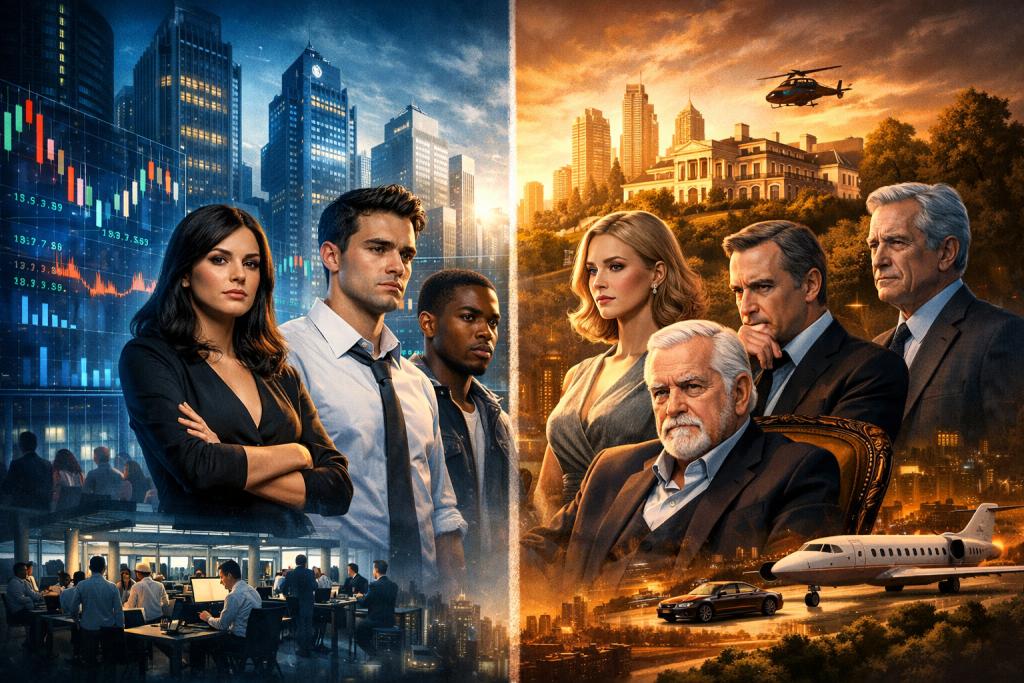
The Industry vs Succession debate started the moment Succession ended. Jesse Armstrong’s family dynasty drama aired its final episode in May 2023. HBO moved Industry from its overlooked Monday night slot to the prestige Sunday night position. The implication was clear: Industry was being asked to carry the crown that Succession had worn for four seasons. Whether it deserved to wear that crown became television’s most contentious argument.
The answer depends on what you think television is supposed to do. If television’s job is to create indelible characters whose names enter the cultural vocabulary, Succession wins. Logan Roy, Kendall Roy, Roman Roy, Shiv Roy — these names mean something even to people who never watched the show. If television’s job is to show you how a system actually works and what it does to the people inside it, Industry wins. The shows are not competing. They’re doing different things. But the Industry vs Succession conversation refuses to die because both shows occupy the same cultural space: HBO dramas about money, power, and the specific kind of self-destruction that comes from having too much of both.
Top-Down vs. Bottom-Up
The fundamental structural difference between Industry and Succession is perspective. Succession looks at the world from the penthouse. Logan Roy owns a global media empire. His children fight over who will inherit it. The stakes are measured in billions. The characters never worry about rent. They worry about legacy, control, and the love of a father who is constitutionally incapable of giving it.

Industry looks at the world from the lobby. Harper Stern is a graduate trainee with a forged transcript. Yasmin Kara-Hanani is a rich kid who thinks her family connections will protect her. Robert Spearing is a working-class kid from the north pretending to be comfortable in a world where the wrong color shoes can destroy your reputation. The stakes are measured in survival. These characters worry about keeping their jobs, making rent, and whether the person sitting next to them will report them to HR.
Why the Difference Matters
Succession’s top-down perspective produces a specific kind of drama. The Roys can afford to be terrible because their wealth insulates them from consequences. Logan can fire anyone. Kendall can fail upward. Roman can say anything. The comedy of Succession comes from watching people with unlimited power exercise it in the most juvenile possible ways. The tragedy comes from watching those same people realize that unlimited power hasn’t made them happy.
Industry’s bottom-up perspective produces a different kind of tension entirely. Harper can’t afford to be terrible. She has to be strategic. Every mistake could end her career. Every relationship is transactional because she can’t afford emotional luxury. The Industry vs Succession comparison breaks down at this fundamental level: Succession characters destroy themselves because they can. Industry characters destroy themselves because they must.
The Characters: Harper vs. Kendall
The most obvious Industry vs Succession character parallel is Harper Stern and Kendall Roy. Both are driven and calculating. Both betray their mentors and cycle between moments of brilliance and moments of catastrophic self-sabotage.
The difference is origin. Kendall Roy is the heir apparent to a media empire. His ambition is inherited, and his advantages are structural. His failures are self-inflicted by a man who has every possible resource and still can’t get out of his own way. Harper Stern is a state school dropout with a forged transcript. Her ambition is survival-coded. Her advantages are earned through talent, observation, and the willingness to do things that better-credentialed people won’t. Her failures come from a system that was never designed to accommodate her.
Eric vs. Logan
Eric Tao and Logan Roy both occupy the mentor-tyrant position. Both are older men who see younger versions of themselves in their protégés. They use emotional manipulation as a management tool. Both are capable of genuine affection that they express through cruelty.

Logan Roy is a monster. The show never pretends otherwise. His children orbit him like planets orbiting a dying sun, unable to escape his gravitational pull even when it burns them. Eric Tao is something more complicated. He’s a managing director at a bank, not a billionaire. His power is institutional rather than personal. He can fire Harper, but he can’t destroy her the way Logan destroys Kendall. When Eric betrays Harper in the Season 2 finale, the betrayal is ambiguous. He might be protecting her. He might be eliminating her. The Industry vs Succession gap shows here: Logan Roy’s cruelty is operatic. Eric Tao’s cruelty is corporate. Both are devastating. Eric’s hurts more because you can’t quite tell if it’s cruelty at all.
Yasmin vs. Shiv
Yasmin Kara-Hanani and Shiv Roy share the most DNA of any cross-show pairing. Both are women born into wealth who believe they can navigate male-dominated power structures through intelligence and strategic marriage and
discover that the structures don’t care how smart they are. Both make marriages that serve professional rather than romantic purposes. Both end their respective series with less power than they expected and more self-knowledge than they wanted.
The difference is sympathy. Succession asks you to feel for Shiv despite her privilege. Industry doesn’t ask you to feel anything for Yasmin. It shows you what she does and lets you decide. Marisa Abela’s BAFTA-winning performance makes Yasmin compelling without making her likeable — a distinction that most TV shows don’t even attempt.
The Numbers: Which Show is Actually Bigger?
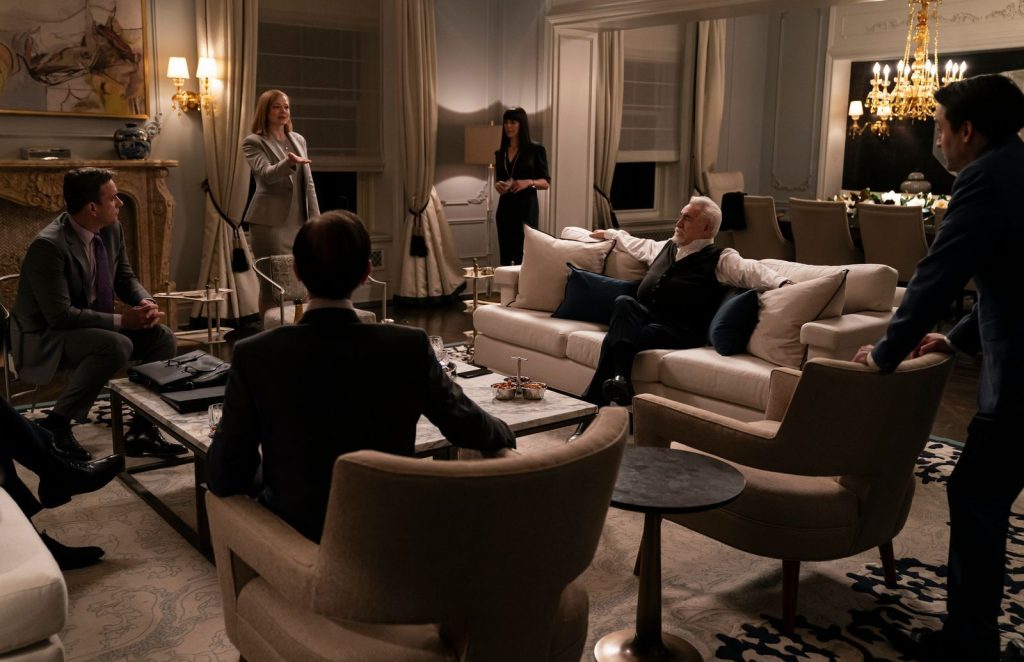
Succession at its peak was a cultural phenomenon that transcended its viewership. The series finale drew 2.9 million viewers. The show won 19 Primetime Emmy Awards across its run. It generated the kind of social media conversation that makes a show feel bigger than its actual audience.
Industry Season 4 averaged 1.7 million viewers per episode — impressive growth from a show that started with negligible ratings on Monday nights. Its Rotten Tomatoes score of 96% for Season 4 actually exceeds Succession’s overall average. The show has never been nominated for an Emmy in a major category, though Marisa Abela’s BAFTA win represents equivalent UK recognition.
The Industry vs Succession numbers reveal different audience profiles. Succession attracted a broader cultural audience. Industry attracts a more dedicated niche — finance professionals, prestige TV completists, and viewers who discovered the show after Succession ended and needed something to fill the void. Industry’s audience is smaller but possibly more committed. Every viewer chose to be there. Nobody watches Industry because it’s trending on Twitter.
What Industry Does Better
The Industry vs Succession comparison favors Industry in several specific areas.
Diversity. Industry’s cast reflects the actual composition of modern London finance. Harper is a Black American woman. Eric is a Chinese American man. Rishi is British South Asian. Yasmin is half-Maltese. The show doesn’t congratulate itself for this diversity. It uses it to examine how race, gender, and class intersect within institutions that claim to be meritocratic while operating as anything but.
Technical accuracy. Succession’s business dealings are deliberately vague. The show doesn’t care whether you understand what Waystar Royco actually does. Industry cares intensely about getting the finance right. Bloomberg terminals work. Trades have specific mechanics. The jargon is accurate enough that real bankers validate it. You don’t need to understand the finance to enjoy the drama, but the accuracy creates a texture that Succession never attempted.
Physicality. Industry is a more physical show than Succession. The sex is explicit. The drug use is graphic. The trading floor has a bodily presence that Waystar Royco’s boardroom never had. Succession kept its characters at an emotional distance. Industry puts you on the trading floor at 2 AM, surrounded by empty coffee cups, with a deadline you’re going to miss.
What Succession Does Better
Succession’s advantages in the Industry vs Succession debate are equally clear.
Character depth. Succession spent four seasons building characters whose inner lives are as complex as any in television history. Kendall’s addiction, Roman’s sexual dysfunction, Shiv’s political ambition — these aren’t plot points. They’re psychological portraits rendered across 39 episodes. Industry’s characters are vivid but thinner. Harper is brilliant and ruthless. Yasmin is privileged and desperate. The archetypes are clear. The inner lives are suggested rather than excavated.
Dialogue. Jesse Armstrong’s writing for Succession is among the finest television writing of the century. The insults are Shakespearean. The humor is lacerating. The emotional reversals happen mid-sentence. Industry’s dialogue is sharp but functional. It serves the plot. It doesn’t transcend it. Nobody quotes Industry lines the way they quote “You’re not a real person” or “I am the eldest boy.”
Ending. Succession’s finale was a cultural event. The resolution of the Roy family saga felt earned, devastating, and complete. Industry hasn’t ended yet. Whether it can stick the landing remains the biggest open question in the Industry vs Succession comparison.
The Shared Universe Theory
In Season 2’s penultimate episode, Eric delivers a one-liner comparing a colleague to Kendall Roy. The reference is casual. It might be a character referencing a fictional person from a show he watches. It might be an acknowledgment that Industry and Succession occupy the same fictional universe. Either way, the Industry vs Succession connection became canon in that moment. The shows share HBO. They share a production calendar. They share an audience. And now they share a textual reference that fans have been debating ever since.
The crossover extends beyond Easter eggs. Several critics have noted that Industry’s growth trajectory mirrors Succession’s. Both shows started small, expanded their scope and cast with each season. Both attracted bigger names as their reputations grew. Succession added Alexander Skarsgård and Adrien Brody. Industry added Kit Harington, Kiernan Shipka, and Kal Penn. The pattern suggests that HBO views Industry as occupying the same developmental arc that turned Succession from a modest debut into an Emmy juggernaut.
The Cultural Moment: Why This Comparison Matters Now
The Industry vs Succession debate intensified in 2026 because both shows have now defined their eras. Succession owned 2019-2023. Industry owns 2024-2026. The gap between them is less about quality and more about timing. Succession arrived during peak prestige TV. Industry arrived during the streaming wars, when HBO was fighting for relevance against Netflix, Apple, and Amazon. The fact that Industry built its audience during a harder era for HBO makes its growth more impressive, even if the raw numbers are smaller.
The debate also reflects a generational shift in what audiences want from television. Succession’s audience skewed older and more affluent. Industry’s audience skews younger and more diverse. The Industry vs Succession comparison isn’t just about two shows. It’s about two different audiences arguing over what prestige television should look like in the 2020s.
The Verdict: Different Shows for Different Needs
The Industry vs Succession debate is ultimately a false binary. Succession is a family drama set in the business world. Industry is a business drama set in the working world. One examines what wealth does to the people who have it. The other examines what the pursuit of wealth does to the people who don’t. Both are essential. Neither is redundant.
What Industry proved is that the void Succession left wasn’t a void for a specific show. It was a void for a specific feeling: the anxiety of watching people you care about make decisions you know will destroy them. Industry fills that void differently but completely. It doesn’t replace Succession. It stands beside it. And in some respects — diversity, technical accuracy, the bottom-up perspective that shows you what the system looks like from inside the machine rather than above it — it does what Succession never tried to do.
The Industry vs Succession conversation will continue through Industry Season 5 and beyond. The two shows belong to the same conversation about HBO’s golden era of prestige drama. They answer different questions about the same subject: what money does to people, and what people do for money. Succession answered with a Shakespearean tragedy about inheritance. Industry answers with a thriller about survival. Both answers are correct. Both shows will be remembered as essential. And both prove that HBO at its best doesn’t make one kind of show. It makes shows that ask hard questions and trust the audience to handle the answers.
Related Articles
Industry HBO: The Complete Guide to TV’s Most Dangerous Finance Drama
Succession: The Complete Guide to HBO’s Greatest Family Drama
The Real Industry: What HBO Gets Right About Investment Banking
Is Pierpoint Real? Industry’s Bank vs Goldman Sachs
Myha’la Net Worth: The Girl Who Faked It Until She Made It
Stay Connected
The Industry vs Succession debate is really about what kind of ambition story resonates with you. Social Life Magazine covers both: the inherited empires and the self-made climbers. Twenty-three years in the Hamptons teaches you that both types show up at the same parties.
Feature your brand in Social Life Magazine — contact us at sociallifemagazine.com/contact.
Guaranteed digital placement starts at $975 via our Submit A Paid Feature page.
Join 82,000+ readers at sociallifemagazine.com.
Polo Hamptons returns July 18 and 25, 2026. BMW title sponsor.
Print subscriptions at sociallifemagazine.com/subscription.
Support independent publishing: donate here.
Author

Written by
Recent Posts

The First Decision After a Collision Can Be the Most Important One
Two Weeks in Rome and Beyond: Turkish Airlines Itineraries from Boston, Chicago and Onward to India

Top 10 Hair Transplant Clinics in Turkey 2026
Artist Alley to Online Store: How Convention Artists Can Keep Selling After the Event
When an 18-Wheeler Crash Leaves Lasting Consequences
Categories
- Art
- Articles
- Business of Luxury
- Celebrities
- Culture
- Entertainment
- Events
- Faces of Summer 2026
- Fashion
- Fashion & Style
- Featured
- Finance
- Food, Spirits, Wine
- Hamptons
- Hamptons Celebrities
- Health
- Health & Beauty
- Lifestyle
- Luxury Lifestyle
- Press
- Profiles
- Real Estate
- Technology
- The Chronicles
- Travel
- Uncategorized
- Weddings