
December 19, 2022. A man-made ramp bolted to a cliff in the Norwegian mountains. Tom Cruise, age sixty, at the top of it on a modified Honda motocross bike, helmet on, throttle twisting. Thirteen helicopters in the air. Christopher McQuarrie behind a monitor. A parachute folded into Cruise’s backpack that had been tested 500 times in the previous twelve months and never once deployed in the specific wind-and-rock configuration waiting below.
He released the brake. The bike accelerated. The ramp ended. Paramount later confirmed that Cruise had completed 13,000 motocross jumps and more than 500 skydives in preparation for that single six-second launch. Ultimately, what happened in those six seconds became the signature Tom Cruise stunts sequence of a career defined entirely by them.
This is the physical inventory of the most dangerous decade any lead actor has ever survived. Fourteen years. Six major sequences. One broken ankle. Zero stunt doubles for any shot that mattered. What follows is every stunt that built the legend, every training regimen that made it possible, and every moment the math almost went the other way.
The Stunt Philosophy: Why Cruise Does What No Other Actor Will
The defining decision came around 2010, on the heels of Cruise’s commercial low point. After the Oprah couch incident and the Paramount exile, Cruise needed a move that would reset his commercial value without depending on the prestige-film track where the Academy had repeatedly refused him. The move he chose was physical. He would do stunts no insurance company would ordinarily permit a lead actor to attempt. Consequently, he would own those stunts, market those stunts, and make the stunts themselves the reason audiences showed up.
Notably, the economic model runs parallel. Cruise takes no upfront salary. He takes first-dollar gross participation, which means every practical effect he performs personally is simultaneously a brand signature and a revenue-optimizing mechanism. Furthermore, the stunts themselves generate marketing assets. Each major sequence gets its own behind-the-scenes featurette, its own press tour, its own eighteen-month attention cycle before the film releases. Other A-list actors have publicists running point on promotion. Cruise has a flywheel, and the flywheel spins on what his body physically does in front of a camera.
The full architecture of how this system produced his $600 million fortune lives in Tom Cruise’s net worth. The question of why the system is not replicable by any younger actor is covered in the Movie Star Extinction hub. Meanwhile, this guide covers the specific physical accomplishments that made both possible.
The Burj Khalifa Climb (Ghost Protocol, 2011)
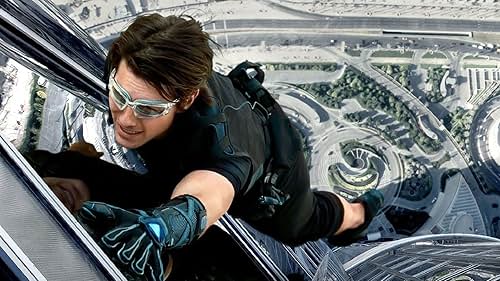
The stunt that relaunched the entire Cruise era. Dubai, 2010. Director Brad Bird making his live-action debut. The world’s tallest building, 2,722 feet. Cruise performed the exterior climbing sequence himself at approximately 1,700 feet up, secured by multiple safety cables that Industrial Light and Magic later erased digitally in post-production.
The logistics were unprecedented. Stunt coordinator Gregg Smrz negotiated access with the Burj’s owners, knocked out seventeen glass panels on vacant upper floors to accommodate rigging, and trained Cruise in Australian rappelling technique over the course of several months. Cruise also did extensive mental preparation, which he has described in multiple interviews as a Zen-state focus drill. One small mistake at 1,700 feet is not the kind of mistake that gets corrected in the next take.
Why the Burj Changed Everything
Before Ghost Protocol, Cruise’s stunt reputation existed but was not a brand. After Ghost Protocol, the stunt became the marketing. The teaser trailer released in July 2011 featured the climb as its single unified image. Theatrical presentations to journalists emphasized it. Subsequently, the film earned $694 million worldwide and relaunched a franchise that industry insiders had begun to write off as tired. The Burj sequence became the reference point against which every future Tom Cruise stunts sequence would be measured. Cruise has been trying to top it ever since, and according to Smrz in a 2021 interview, he never fully has.
The Airbus A400M Ascent (Rogue Nation, 2015)
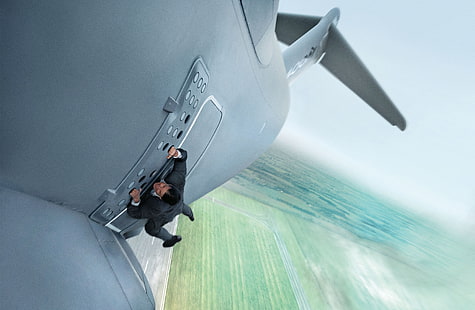
McQuarrie’s directorial debut in the franchise. Cruise hung from the exterior of a cargo plane during actual takeoff, reaching altitudes around 5,000 feet, across eight separate takes. The rig was a custom harness attached to the fuselage. The plane was a real Airbus A400M, not a CGI substitute. The wind at those speeds hit Cruise’s face at hurricane force.
Furthermore, Rogue Nation introduced Ilsa Faust, played by Rebecca Ferguson, who would match Cruise stunt-for-stunt across three subsequent films. Her presence in the franchise reshaped the gender ratio of physical commitment at the A-list level. Ferguson’s willingness to perform her own rooftop and vehicle sequences alongside Cruise became its own marketing angle across the Fallout and Dead Reckoning press tours.
The Submarine Breath-Hold (Rogue Nation, 2015)
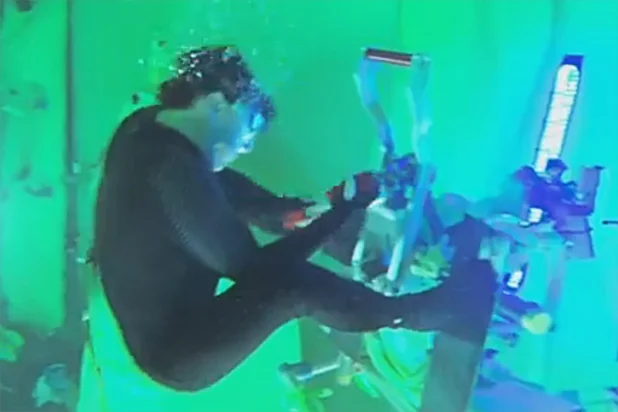
The same film that gave us the Airbus sequence also contained the water-torture tank scene, filmed underwater over multiple days. Cruise trained with free-diving instructors to hold his breath for more than six minutes on a single lungful. The final on-screen breath-hold was captured in a single take of approximately three minutes and reportedly tested the upper ceiling of what he could do safely.
Notably, Kate Winslet briefly held a longer on-screen breath-hold record of seven minutes and fourteen seconds during production of Avatar: The Way of Water. Cruise has publicly indicated that reclaiming the record was part of the motivation for the underwater sequences in The Final Reckoning ten years later. Ultimately, competing against Winslet on a breath-hold benchmark is the kind of detail that makes Cruise’s approach to craft legible. Every metric is a target. Every target requires training. The training is the career.
The HALO Jump (Fallout, 2018)
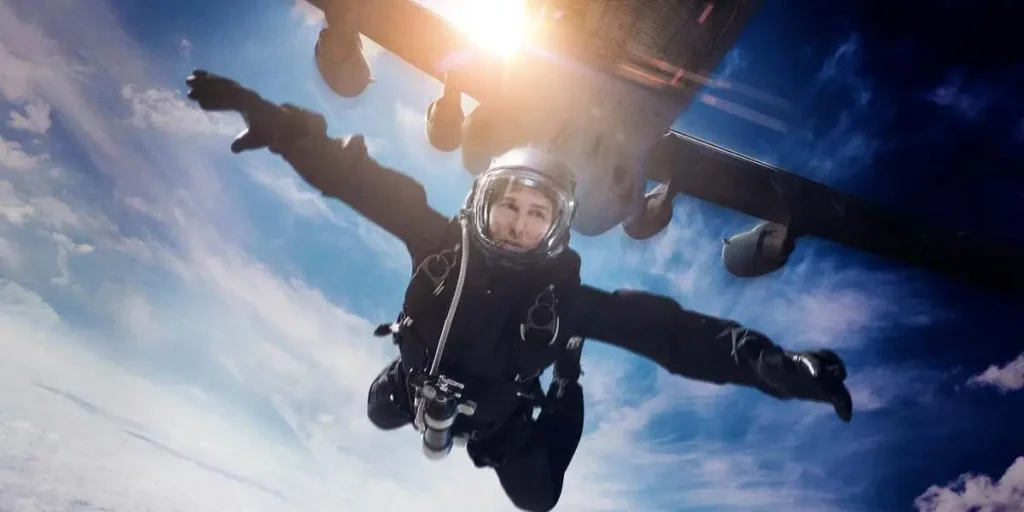
Fallout, released in July 2018, contained what was at that point the most technically demanding aerial sequence ever shot with a lead actor on camera. HALO stands for High Altitude, Low Opening. Military special operations units use HALO jumps for nighttime insertion from 25,000 feet with oxygen masks, the parachute deployed only a few thousand feet from the ground.
Cruise became the first actor ever to perform a HALO jump on camera for a feature film. The production filmed in the United Arab Emirates, the only country willing to permit the stunt. By contrast, standard military HALO visors completely obscure the jumper’s face, which is useless for a movie. Consequently, production designers custom-built a helmet with internal lighting so the camera could capture Cruise’s expression during freefall.
106 Jumps, Three-Minute Dusk Window
The specific challenge: filming at dusk for the cinematic lighting McQuarrie wanted, which created a three-minute daily window for the shot. A skydiver with a helmet-mounted camera filmed Cruise in mid-air, maintaining a precise three-foot distance. Focus-pulling in freefall was, for most of the production, the unsolved technical problem. Once the team identified the focus puller on the jump plane as the issue and resolved it, the crew needed 106 total jumps to capture the three segments that became the final shot. McQuarrie described the margin: if the jumps missed the three-minute window, the entire day was lost.
The Broken Ankle (Fallout Rooftop Leap, 2017)
The same production that produced the HALO jump nearly cost Cruise his leg. In August 2017, during principal photography on Fallout, Cruise performed a rooftop-to-rooftop leap in central London. He landed short. The impact broke his ankle. Footage from the on-set camera captured the injury in real time, and Cruise finished the shot before pausing production. The footage eventually appeared in the film itself.
Production paused for approximately nine weeks while Cruise recovered. Insurance absorbed the overrun, but the incident reshaped how McQuarrie and the production approached physical risk. Subsequently, training regimens expanded. Stunt rehearsals doubled. The Dead Reckoning and Final Reckoning shoots both included injury-prevention protocols directly derived from the Fallout lesson. The broken ankle, in retrospect, was the pivot point where Cruise’s stunt work moved from daring to engineered.
The Motorcycle Cliff Jump (Dead Reckoning, 2023)
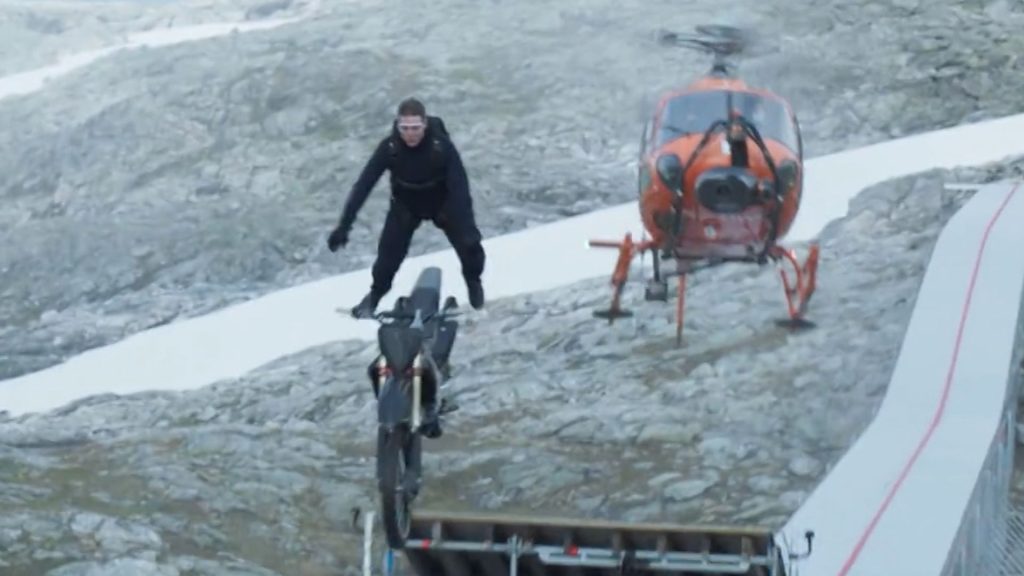
The flagship sequence of the 2020s. Filmed in Helsetkopen, Norway, in 2022. A custom-built 250-meter ramp attached to the face of an alpine mountain, rising to eighteen meters at the cliff edge. A modified Honda motocross bike. Thirteen helicopters filming simultaneously. Wade Eastwood coordinating. McQuarrie directing. The preparation numbers became their own publicity event.
Cruise completed 13,000 motocross jumps on custom tracks built in the English countryside, plus more than 500 skydives and a full year of BASE-jumping training with elite coaches including Miles Daisher. The training split into two distinct disciplines. Motocross drilling focused on body positioning at high speed, on the theory that Cruise would need to separate from the bike cleanly in mid-air regardless of what angle the launch produced. BASE-jump training focused on what happened after separation: canopy deployment while tracking away from the mountain face, clearing the terrain before the parachute caught.
The Near-Miss That Almost Killed It
During early parachute tests in Norway, Cruise encountered a wind-direction miscalculation that nearly sent him into the cliff face. He later told ET Canada at the Rome premiere that the margin had been measured in feet, not metres. McQuarrie and Eastwood reengineered the wind-testing protocol before Cruise attempted the full stunt. Once the full stunt was green-lit, Cruise completed it multiple times so McQuarrie could capture it from different helicopter angles. Visual effects artists later digitally replaced the ramp with natural rock, creating the illusion that Cruise simply rode off a raw cliff edge. The ramp, at 250 meters long and eighteen meters tall at its peak, had never been meant to appear on screen.
The Biplane Wing-Walk (Final Reckoning, 2025)
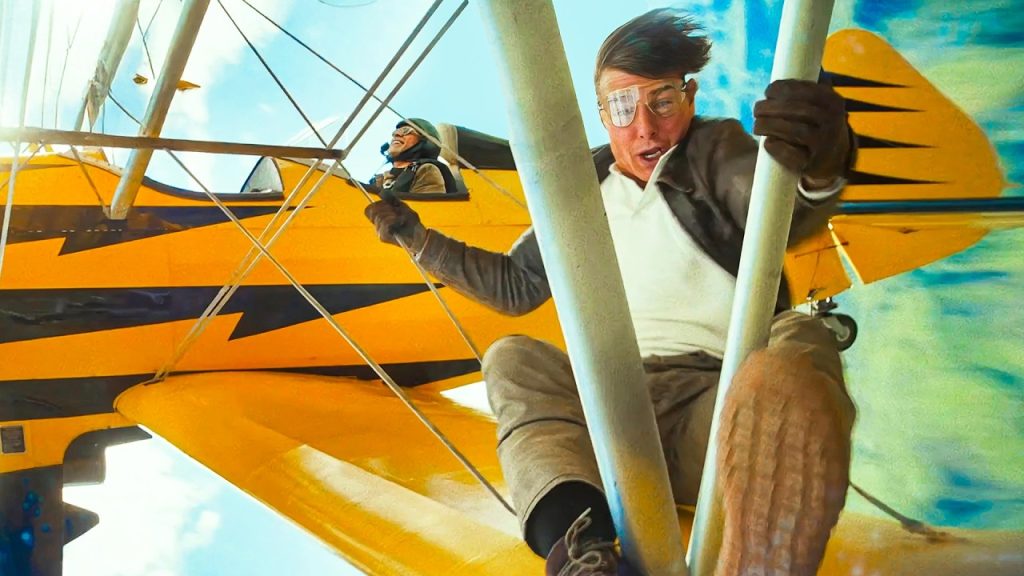
The goodbye stunt. Filmed in South Africa for Mission: Impossible – The Final Reckoning, which closed the franchise in May 2025. Cruise, at sixty-two, hung from the exterior of a biplane during actual flight. The biplane was a restored 1940s aircraft. The choreography required him to transfer between the upper and lower wings while the plane performed aerial maneuvers. No CGI. No stunt double. Real altitude, real wind, real consequences.
Notably, the sequence functioned simultaneously as narrative climax and career punctuation. Cruise had confirmed at the New York premiere that Final Reckoning was his last film as Ethan Hunt. The biplane was therefore the final major Tom Cruise stunts sequence within the Mission: Impossible franchise. Meanwhile, the box office confirmed the audience had not yet tired of the formula. Final Reckoning grossed $580 million globally, closing the eight-film franchise with a cumulative $4.35 billion in box office receipts.
The Training Regimen Economics
What the stunts actually cost, in money and in time. The training calendar for a single Mission: Impossible sequence typically runs twelve to eighteen months before principal photography. Cruise trains on multiple disciplines simultaneously. For Fallout, the preparation included HALO-jump qualification, helicopter pilot certification (Cruise already had fixed-wing ratings), and extensive hand-to-hand combat rehearsal. For Dead Reckoning, the preparation included a year of BASE-jumping under elite coaches and a parallel year of motocross at professional-racing intensity.
Furthermore, the cost structure has no direct parallel in contemporary filmmaking. Industry estimates place stunt training costs on a single Cruise film in the $5 million to $15 million range, which is absorbed into production budgets and covered by Cruise/McQuarrie Productions and Paramount. However, Cruise does not bill for training hours. He treats the preparation as part of his ongoing physical discipline rather than as a line item. Consequently, the training cost on any given film is substantially lower than it would be for any other actor performing equivalent sequences, because Cruise arrives at training already carrying the skill base from the previous film.
The Injury Ledger (2011-2025)
Documented on-set injuries across the Stunt God Era. The broken ankle on Fallout is the most severe. Additional documented incidents include a shoulder strain during the Airbus A400M sequence, a hand laceration during the Rogue Nation motorcycle chase in Morocco, and an undisclosed neck injury during Ghost Protocol that Cruise has referenced in passing but never detailed publicly. Cruise has also logged, by his own admission, multiple bruising incidents from the Dead Reckoning motocross training in England. None required hospital admission.
Notably, the injury rate across fourteen years of this workload is lower than the statistical baseline for professional stunt performers of equivalent age attempting equivalent sequences. The reason, by industry consensus, is preparation. Cruise arrives at each set having already drilled every component of the stunt to the point where the stunt itself is the rehearsal’s fourth or fifth iteration rather than its first attempt. Stunt coordinators including Smrz, Eastwood, and Daisher have all described the same principle: Cruise treats rehearsal as the job, and filming as the performance review.
What Comes Next: Deeper and the Iñárritu Film
The Stunt God Era has one more chapter. Deeper, Doug Liman’s underwater thriller with Ana de Armas, has been in development since 2020 and is now in pre-production. The film’s central premise requires extended underwater sequences at significant depth, which will return Cruise to the free-diving discipline he first developed for Rogue Nation. Additionally, industry sources suggest Cruise may attempt to reclaim the on-screen breath-hold record from Kate Winslet during the Deeper shoot.
Meanwhile, the untitled Alejandro Iñárritu film currently in post-production represents a different kind of physical challenge. Iñárritu famously shoots long, unbroken takes that place extreme sustained demand on his actors. Reports suggest Cruise is performing the majority of the film’s physical work himself, though the sequences involve less aerial or vehicular action than the Mission: Impossible films. The Iñárritu film is scheduled for a late-2026 release window.
The complete 2026-and-beyond schedule lives in the Tom Cruise movies ranked pillar, which covers every reported casting, every rumored project, and the career architecture the stunts supported.
East End Verdict: The Training Is the Career
The Hamptons reader looks at Tom Cruise’s stunt work and sees the pattern. Own the upside. Train harder than anyone expects you to train. Build competence at a rate that outpaces the market’s willingness to replace you. Accept that the preparation is the job, not the performance. Reject the standard deal when a better one is available to anyone willing to ask. Above all, never stop.
Every Hamptons founder who has logged ten thousand hours on a skill before launching a company is running the Cruise playbook. Every fund manager who built an expertise moat through obsessive reading while peers took summers off is running the Cruise playbook. Similarly, every brand owner who trained on the factory floor before taking the CEO title is running the same script. The stunts themselves are not the Cruise product. The training regimen that produced them is. That regimen scales across every domain in which a professional has ever tried to outrun obsolescence.
The biplane in South Africa was the last major sequence inside a Mission: Impossible film. It will not be the last major sequence of his career. Deeper is already prepped. The Iñárritu film is already shot. Somewhere, a younger Tom Cruise is currently figuring out what he wants to do next. Ultimately, that figuring-out is the only activity that has ever driven the machine forward, and the machine shows no sign of stopping.
Hamptons Insiders Read Social Life First
Fish don’t know they’re in water. The Hamptons reader who looks at Tom Cruise’s fourteen-year stunt resume and sees only entertainment is missing the operating manual hiding in plain sight. Social Life Magazine has covered the East End’s most successful operators for twenty-three years, and the pattern is always the same one Cruise just spent his career demonstrating.
→ Feature your brand or business: Contact Social Life Magazine’s editorial team for partnership and feature inquiries.
→ Submit A Paid Feature: Learn about our paid feature program (three tiers, from $975).
→ Join our 82,000-reader email list: Weekly Hamptons intelligence, delivered to your inbox before the print edition reaches newsstands.
→ Polo Hamptons 2026: Platinum, Gold, and Corporate Cabana sponsorships available. July 18 and 25 in Bridgehampton. Seven-year partnership with BMW.
→ Print subscription: Subscribe to the print edition — five summer issues distributed Westhampton to Montauk, plus fall and winter issues to UES doorman buildings.
→ Support independent East End journalism: Donate $10 to Social Life Magazine.
By Cass Almendral, Head of Business Development, Social Life Magazine. Co-founder, Polo Hamptons.
Author

Written by
Recent Posts
How to Choose Useful Tech Gifts for Employees and Clients in 2026
The Garage Question: Which Car Goes South for the Season?
VandS Clinic Review Treatment: How Seoul Injectable and Laser Options Compare for US Patients
Before Buying a View Home: What a Sloped Lot Means for the Purchase

Powerful Strategies to Stay Ahead in a Fast-Moving Real Estate Market
Categories
- Art
- Articles
- Business of Luxury
- Celebrities
- Culture
- Entertainment
- Events
- Faces of Summer 2026
- Fashion
- Fashion & Style
- Featured
- Finance
- Food, Spirits, Wine
- Hamptons
- Hamptons Celebrities
- Health
- Health & Beauty
- Lifestyle
- Luxury Lifestyle
- Press
- Profiles
- Real Estate
- Technology
- The Chronicles
- Travel
- Uncategorized
- Weddings