
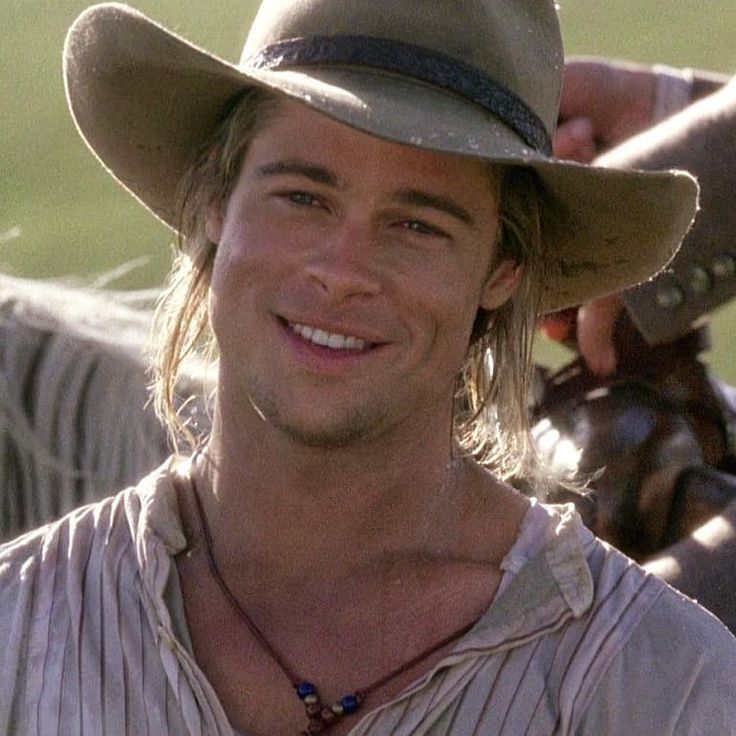
In September 1999, at the Venice Film Festival, a movie Brad Pitt had spent two years fighting to make was booed on first viewing. He turned to his co-star and said, “This is the best movie I’m ever going to be in.” He was right.
Brad Pitt Fight Club is not a 1999 film. Rather, it is the 90-minute decision that separated Pitt from every other A-list actor of his generation. Specifically, in the four years between Legends of the Fall in 1994 and Fight Club in 1999, Pitt walked away from the commercial path that People magazine had written for him and chose, deliberately, to make the ugliest, most uncomfortable, most commercially risky films available. Furthermore, that five-year rebellion is the era that built the credibility which made everything since, from Plan B to F1, structurally possible.
This is how the Sexiest Man Alive blew up his own brand on purpose and got richer for doing it.
Where Era 2 Began: The 1995 Pivot

In 1994, Brad Pitt was 30 years old, commanding $5 to $8 million per film, and being positioned by every agent, manager, and studio executive in Hollywood as the next Robert Redford. Specifically, Legends of the Fall had grossed $160 million globally and earned him the People Sexiest Man Alive cover. Consequently, the obvious path was a decade of romantic leads, prestige Westerns, and romance-adventure vehicles that would have compounded his fame without ever challenging his range.
Se7en and the Decision to Go Dark
Instead, he took a phone call from David Fincher. Fincher was 33, had directed exactly one feature film (the critically brutalized Alien 3 for 20th Century Fox), and was pitching a dark serial killer thriller called Se7en. Moreover, Fincher offered Pitt the role of Detective Mills, a young cop hunting a killer whose crimes were based on the seven deadly sins. Additionally, Pitt accepted for a salary substantially below his commercial quote. Specifically, he reportedly took approximately $5 million for Se7en against his pre-existing commercial rate.
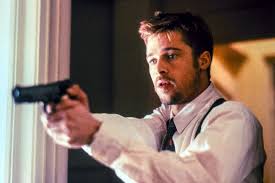
Se7en opened in September 1995 and grossed $327 million globally against a $33 million budget. Furthermore, the film is now widely considered one of the greatest crime thrillers of the 1990s. Consequently, the Pitt-Fincher collaboration began a creative partnership that would define the entire rebellion era.
12 Monkeys and the First Oscar Nomination
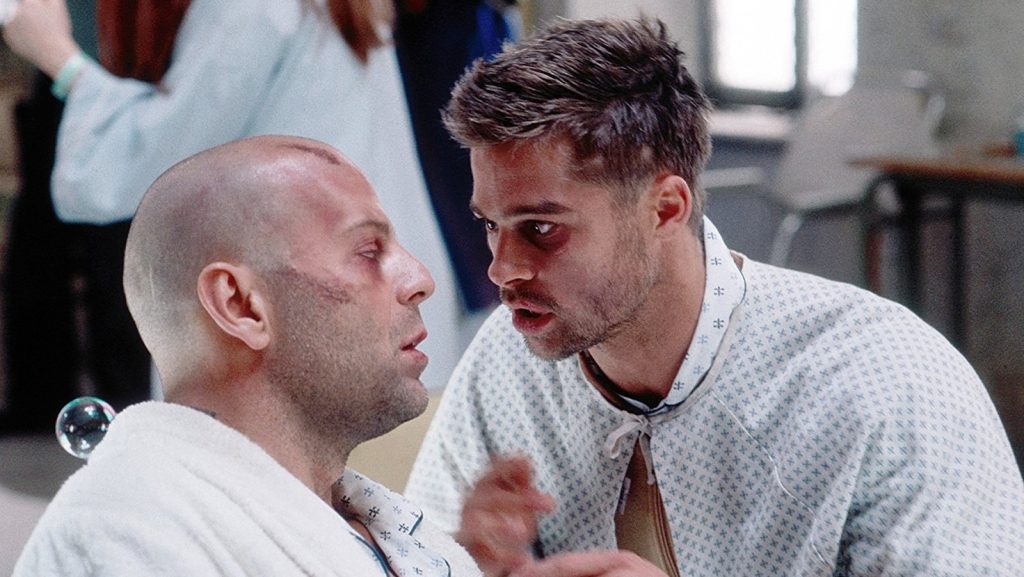
Three months later, in December 1995, Terry Gilliam’s 12 Monkeys opened. Specifically, Pitt played Jeffrey Goines, a twitchy mental patient whose paranoid babble turns out to contain key information about a coming viral apocalypse. Moreover, the performance required him to disappear into physicality and verbal chaos in ways that actively undermined his pretty-boy image. Additionally, he earned his first Academy Award nomination for Best Supporting Actor. Although he did not win (Kevin Spacey took the award for The Usual Suspects), the nomination validated the strategic pivot. Specifically, the industry began to notice that the actor selling $100 million romantic leads could also disappear into the kind of character work that wins serious acting prizes.
The Middle Rebellion: 1996 to 1998
Between 12 Monkeys and Fight Club, Pitt continued making deliberately unconventional choices. Specifically, he starred in Alan Pakula’s The Devil’s Own in 1997, playing an IRA operative with a complicated Irish accent. Additionally, he took on Seven Years in Tibet in 1997, playing Austrian mountaineer Heinrich Harrer in a Jean-Jacques Annaud historical drama shot at altitude. Furthermore, the film generated political controversy when China banned Annaud and the cast from entering the country in response to its Tibet sympathies.
Meet Joe Black and the Commercial Miss
In 1998, Pitt starred opposite Anthony Hopkins in Martin Brest’s Meet Joe Black. The film grossed $142 million globally against a $90 million production budget, performing well below commercial expectations. Nevertheless, the performance was commercially safer than anything else Pitt made during the rebellion era. Consequently, Meet Joe Black functioned as a commercial hedge against the increasingly uncomfortable choices that bookended it. For deeper context on how the full five-era career arc operates, the Brad Pitt net worth pillar treats this middle period as the bridge between the Thelma & Louise detonation and the Tyler Durden detonation.
The Fight Club Production: Two Years of Development Hell
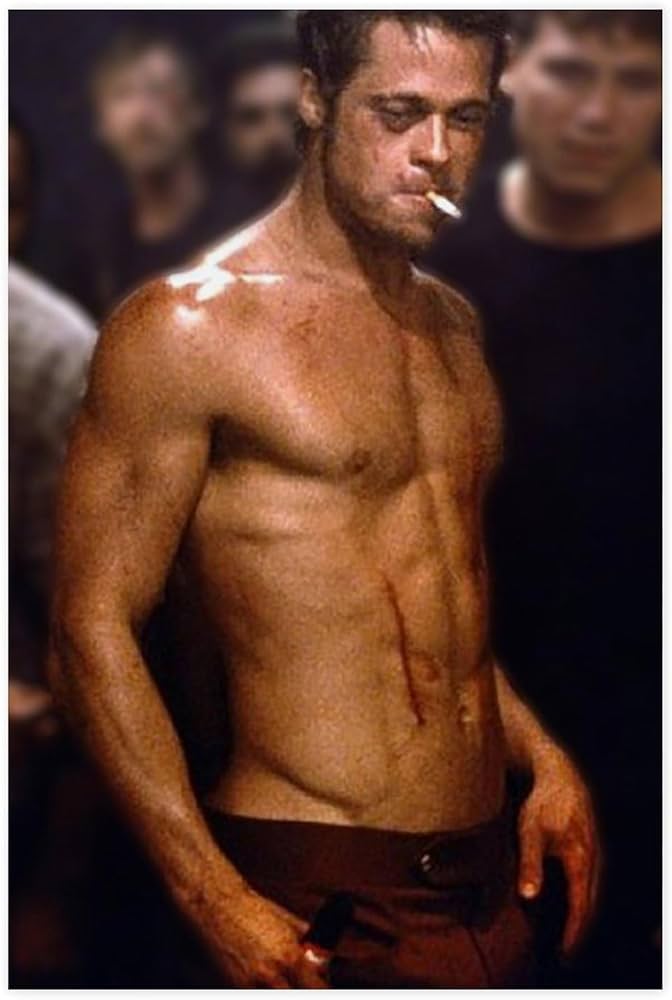
Chuck Palahniuk’s novel Fight Club was published in 1996. Specifically, Fox 2000 Pictures producer Laura Ziskin optioned the book almost immediately and hired screenwriter Jim Uhls to adapt it. Furthermore, Ziskin approached multiple directors before Fincher took the project. Peter Jackson was her first choice, but he was filming The Frighteners in New Zealand. Bryan Singer received the book but never read it. Additionally, Danny Boyle met with the producers, read the book, and passed. Consequently, Fincher, who had tried to buy the rights personally, got the project by default.
The Casting Decision: Russell Crowe vs Brad Pitt
The Tyler Durden role was not originally Pitt’s. Specifically, producer Ross Bell met with Russell Crowe about playing the character in the early casting conversations. Nevertheless, senior producer Art Linson joined the project late and pushed for Pitt. Consequently, the studio chose Pitt over Crowe, a decision that would reshape both actors’ careers for the subsequent decade. Moreover, when Pitt was cast, he read the script and expressed concerns that Tyler Durden was too one-dimensional. Fincher responded by consulting writer-director Cameron Crowe for additional script work. Additionally, Fincher hired Andrew Kevin Walker to do further revisions. Specifically, Pitt and Norton then helped revise the script themselves, producing five revisions in one year.
The $17.5 Million Salary and the $63 Million Budget
Pitt was paid approximately $17.5 million for Brad Pitt Fight Club. Additionally, the original production budget was $23 million. However, the final production budget landed at approximately $63 to $65 million, nearly tripling the original estimate. Consequently, the budget expansion created significant pressure on the film to perform commercially. Nevertheless, Fincher, Pitt, and Norton had committed fully to the creative vision. Specifically, the script had voice-over narration added by Fincher despite industry skepticism about the technique. Moreover, the film’s dark humor, graphic violence, and sexual overtones were retained rather than softened for commercial palatability.
Venice 1999: The Night It Got Booed
Brad Pitt Fight Club premiered at the Venice International Film Festival on September 10, 1999. Specifically, the screening was marked by pronounced negative audience reaction. Furthermore, a portion of the Venice audience booed during key scenes. Additionally, international press coverage framed the film as a commercial disaster in the making. Nevertheless, Pitt turned to Norton during the booing and told him, “This is the best movie I’m ever going to be in.” Moreover, Norton later confirmed the quote in multiple interviews. Consequently, the Venice moment now functions as one of Pitt’s most-cited professional decisions, because he read the cultural significance of the film accurately while the room around him was reading it as failure.
The Domestic Box Office Collapse
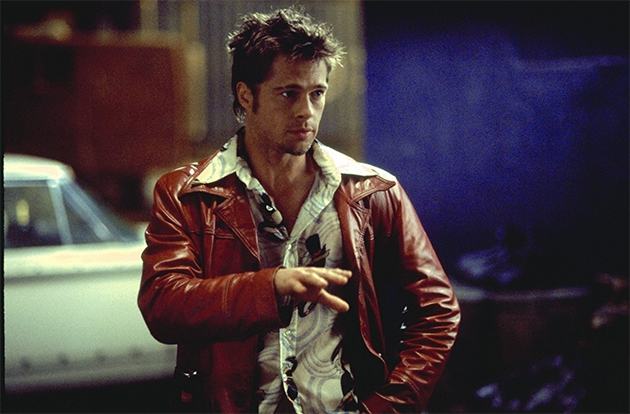
Fight Club opened in North American theaters on October 15, 1999. Specifically, it opened to $11 million in its first weekend, well below studio expectations. Furthermore, the final domestic gross reached only $37 million. Globally, the film earned approximately $100.9 million. Consequently, against a $63 million production budget plus marketing spend, Fight Club was commercially categorized as a disappointment. Specifically, the break-even threshold was approximately $126 million. Moreover, the film never reached it.
The Cult Ascent: Why Fight Club Outlasted Its Era
Although Fight Club underperformed theatrically, its post-release trajectory is the single most important case study in modern cinematic longevity. Specifically, the DVD release in June 2000 generated over $55 million in rental and sales revenue within 18 months. Furthermore, by 2005, the film was selling more units on DVD than its theatrical box office had earned. Moreover, by 2015, academic film journals had published hundreds of peer-reviewed articles analyzing the film’s themes, techniques, and cultural legacy.
The 25-Year Streaming Dominance
As of 2026, Fight Club remains a reliable top-ten performer on every streaming platform where it appears. Specifically, the film debuted on Max in June 2025 and reached the platform’s top-seven within its first week of availability. Furthermore, 26 years after its theatrical release, Fight Club is generating streaming revenue and cultural conversation at levels most 2020s releases cannot match. Consequently, the
math has inverted completely. What looked like a $60 million flop in 1999 has generated an estimated $400 million in cumulative lifetime revenue when all post-theatrical streams are aggregated.
Edward Norton as the Other Half of the Rebellion
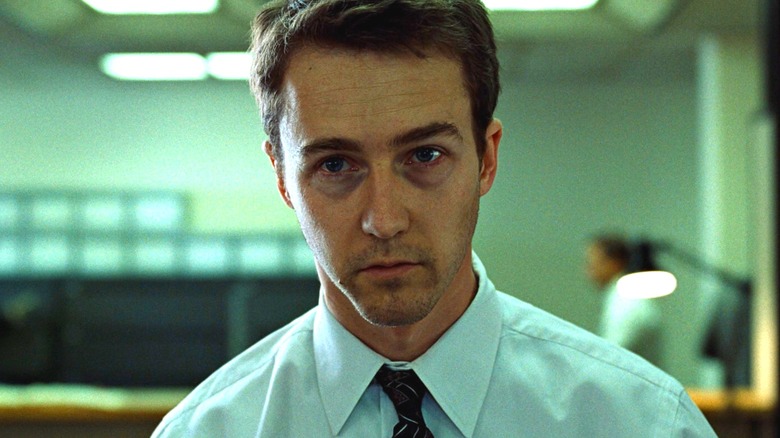
Brad Pitt Fight Club works because of the specific chemistry between Pitt and Edward Norton. Specifically, Norton plays the unnamed narrator whose mental breakdown creates the entire framework for Tyler Durden’s existence. Furthermore, Norton’s physical deterioration across the film is mirrored by Pitt’s increasing idealization. Moreover, the two actors starved and bulked in opposite directions throughout the 1998 production. Specifically, Norton told interviewers that Fincher’s creative direction involved Norton visibly wasting away while Pitt became more conventionally beautiful.
Norton’s Post-Fight Club Wealth
Norton’s career after Fight Club took an unconventional turn. Specifically, he made fewer films than expected, became a serious art collector, and executed significant early investments in technology companies including Uber. Furthermore, his pre-IPO position in Uber reportedly generated one of the largest celebrity-adjacent tech windfalls of the 2010s. Consequently, Norton’s current net worth of approximately $300 million is heavier on equity returns than on acting salaries, which makes his arc structurally similar to Pitt’s Plan B trajectory. For broader context on how celebrity equity builds wealth faster than salaries, the Celebrity Ownership Wealth framework tracks multiple A-list operators who built their fortunes through equity rather than salary.
Jared Leto as Angel Face
Jared Leto’s appearance as Angel Face in Fight Club represents the film’s most consequential supporting performance. Specifically, Leto plays a blond, beautiful Project Mayhem recruit whose face Tyler Durden pummels into unrecognizable meat during a late-film scene. Furthermore, the scene is widely read as a direct commentary on male beauty as currency. Moreover, Leto’s subsequent career reflected the same chaos-as-strategy playbook Pitt was executing. Specifically, Leto won his Best Supporting Actor Oscar in 2014 for Dallas Buyers Club after a nearly identical transformation-heavy commitment pattern. Additionally, Leto’s quiet venture capital portfolio, including pre-IPO positions in Uber, Airbnb, and Spotify, produced a wealth architecture that parallels Norton’s.
The Gwyneth Paltrow Chapter and the Aniston Transition
Alongside the professional rebellion, Pitt’s private life during Era 2 mapped almost cleanly onto the same chaos-as-strategy framework. Specifically, his engagement to Gwyneth Paltrow, which began in 1996, ended publicly in June 1997. Furthermore, the breakup played out in real time across tabloid covers for roughly six months. Additionally, he met Jennifer Aniston at a restaurant in 1998 through mutual agents. Specifically, they began dating that year and married in July 2000 at a private ceremony in Malibu.
Why the Paltrow-to-Aniston Transition Matters
Paltrow was a fellow A-list actor who would win her own Best Actress Oscar for Shakespeare in Love in 1999. Consequently, the Pitt-Paltrow pairing functioned as an industry power couple with overlapping professional interests. Nevertheless, the relationship’s public intensity and career-compressing visibility created pressure both parties eventually moved away from. Moreover, the Aniston marriage represented a different architecture. Specifically, Aniston was a television star whose Friends schedule produced a more stable professional rhythm than Paltrow’s film slate allowed. Consequently, the move from Paltrow to Aniston quietly closed out the rebellion era’s personal chapter and set up the infrastructure era that Plan B would formalize in 2001.
For the complete arc of how the Aniston marriage preceded the Brangelina infrastructure era, the Brad Pitt and Angelina Jolie power couple deep-dive picks up the story in May 2004 when Pitt met Jolie on the set of Mr. & Mrs. Smith. Additionally, the Jennifer Aniston $320 million net worth story covers the financial architecture Aniston built during and after her marriage to Pitt.
Why Era 2 Built the Credibility for Everything After
The rebellion era produced four defining outcomes that together enabled every subsequent chapter of Brad Pitt’s career. Specifically, it produced the Fincher partnership, which would later generate Curious Case of Benjamin Button and critical cultural capital. Additionally, it produced the first Oscar nomination, which converted the commercial star into a serious-acting-tier performer. Furthermore, it produced the Fight Club credential, which made Pitt the permanent cultural reference point for masculine anti-establishment cinema. Moreover, it produced the specific industry understanding that Pitt was willing to sacrifice commercial safety for creative risk, a reputation that would attract prestige filmmakers for the subsequent 25 years.
The Post-Era 2 Prestige Filmography

After Fight Club, Pitt worked with Steven Soderbergh on the Ocean’s trilogy, with Alejandro González Iñárritu on Babel, with Terrence Malick on The Tree of Life, and with Quentin Tarantino on Inglourious Basterds and Once Upon a Time in Hollywood. Specifically, the Tarantino collaboration produced his 2020 Best Supporting Actor Oscar win, which is covered in full detail in the Brad Pitt sobriety deep-dive. Furthermore, the prestige director roster that actively sought Pitt for the subsequent two decades was the direct downstream consequence of the five-year rebellion that started with Se7en and peaked at Venice in 1999.
What Era 2 Actually Means for Brad Pitt’s Net Worth
The rebellion era did not generate the bulk of Brad Pitt’s current $400 million net worth. Specifically, his combined take from Se7en, 12 Monkeys, The Devil’s Own, Seven Years in Tibet, Meet Joe Black, and Fight Club totaled approximately $45 to $55 million in gross salary across five years. Nevertheless, the era produced something more valuable than immediate cash. Rather, it produced the credentialing architecture that made Plan B Entertainment possible, which made the $300 million Mediawan transaction possible, which produced an estimated $120 to $150 million in personal consideration to Pitt in December 2022. For the complete operator arc, the Plan B Entertainment deep-dive walks through the full deal mechanics.
Consequently, Brad Pitt Fight Club was not a commercial success. Nevertheless, it was a structural investment. Specifically, the five years of lower-than-commercial-rate salaries created the cultural credibility that turned an actor into an institution. Moreover, the institution was eventually valued by KKR, Mediawan, and the private equity marketplace at over $300 million. That is the exchange rate between chaos-as-strategy and nine-figure wealth.
What Tyler Durden Understood
Tyler Durden’s most-quoted line in Fight Club is: “The things you own end up owning you.” Furthermore, the irony of that line, delivered by a character played by an actor who 23 years later would sell a majority stake in his production company for $300 million, is not lost on anyone who has watched Pitt’s career closely. Specifically, Pitt understood the line differently than Tyler did. Rather than refusing ownership, he restructured it. Specifically, he made sure the things he owned were things that appreciated, compounded, and could eventually be transferred to institutional buyers at premium valuations.
Tyler Durden blew up a credit card company in Fight Club’s final scene. Meanwhile, Brad Pitt sold his company to one. That is what Era 2 actually was. Specifically, it was the cover story. Moreover, the real plot ran underneath.
Everything else is arithmetic.
The Social Life Reader Chapter
If you read this far, you are the kind of person who understands that the best plays in a career are almost always the ones that look reckless in the moment and obvious in retrospect. That is the water you are already swimming in. Most readers scroll. However, you stayed. That is the only actual difference between audiences and the people they read about.
Social Life Magazine covers the kind of stories most outlets miss or sanitize. If your brand, firm, or practice sits at the intersection of masculine cultural identity, prestige media, or high-stakes creative work, our editorial team takes direct submissions for feature coverage. Reach out here to start the conversation.
For brands that want to move faster, our Submit A Paid Feature program offers three production tiers at $975, $3,200, and $6,500. Each tier includes editorial development, SEO-optimized placement, and distribution through the full Social Life network. Moreover, spirits, menswear, and prestige lifestyle brands are the strongest fits for content in this category.
Our email list reaches 82,000 subscribers who actually open, read, and act. If your audience sits between Park Avenue and Montauk, join the list here.
Polo Hamptons returns to Bridgehampton in July 2026 with 1,200 guests, Getty Images coverage, and seven years of BMW title sponsorship behind it. Sponsorships, cabanas, and activation slots are available now at polohamptons.com.
The print edition of Social Life Magazine delivers 25,000 copies per issue to the boutiques, lobbies, and living rooms where Hamptons decisions actually get made from Westhampton to Montauk each summer, and to Upper East Side doorman buildings each fall and winter. Subscribe here.
If this publication has added value to your week and you want to support independent luxury journalism that does not answer to algorithms, contribute directly at our donation page.
Read Next
- Brad Pitt Net Worth 2026: The Five Lives of a Movie Star
- Brad Pitt Plan B Entertainment: The $300M Operator Play
- Brad Pitt F1 Salary: The $30M Payday That Grossed $631M
- Brad Pitt Sobriety: The $400M Rebuild After Rock Bottom
- Brad Pitt Angelina Jolie: The Power Couple That Became Infrastructure
- Jennifer Aniston Net Worth 2026: The $320M Passive Income Machine
- Celebrity Ownership Wealth: Why Salary Alone Never Wins
Author

Written by
Recent Posts

AI for personal finance: where PennyGuard fits

How to Pick a Homecoming Dress for Your Body Type (and Feel Amazing in It)

World Cup Injury Attorney for Vancouver Events
What a 3-Carat Engagement Ring Actually Costs in 2026: The Real Numbers
The Skincare Habits That Make a Real Difference Over Time
Categories
- Art
- Articles
- Business of Luxury
- Celebrities
- Culture
- Entertainment
- Events
- Faces of Summer 2026
- Fashion
- Fashion & Style
- Featured
- Finance
- Food, Spirits, Wine
- Hamptons
- Hamptons Celebrities
- Health
- Health & Beauty
- Lifestyle
- Luxury Lifestyle
- Press
- Profiles
- Real Estate
- Technology
- The Chronicles
- Travel
- Uncategorized
- Weddings