

In December 2022, a French media conglomerate backed by KKR paid approximately $316 million for the majority of a production company Brad Pitt had quietly been running for 21 years. The transaction is the single most important business event of his adult life, and almost nobody who follows his career has read the deal terms.
Brad Pitt Plan B Entertainment is not a vanity production company. Rather, it is a fully operational independent studio with three Best Picture Academy Awards, a catalog of 50-plus feature films, a global distribution footprint, and a balance sheet that attracted institutional private equity capital from one of the largest buyout firms in the world. Furthermore, the Mediawan deal that closed in late 2022 valued Plan B at more than $300 million. Moreover, that transaction transformed Pitt from a well-paid actor into a structural equity holder inside a transatlantic media platform whose ongoing appreciation now compounds independent of his acting career.
This is how that happened, what the math actually says, and why Era 4 of Brad Pitt’s career is the era that built his real fortune.
The Founding: 2001 and the Brad Grey Connection
Plan B Entertainment was founded in 2001 by three people: Brad Pitt, Jennifer Aniston, and Brad Grey. Grey was Pitt’s longtime manager and one of Hollywood’s most powerful agents-turned-executives. Specifically, Grey would go on to run Paramount Pictures from 2005 until his death in 2017. Furthermore, Aniston held a one-third founding stake until the 2005 divorce. Consequently, Pitt bought out her equity position as part of the divorce settlement and restructured the company under his sole creative leadership.
The Early Slate: Proof of Concept
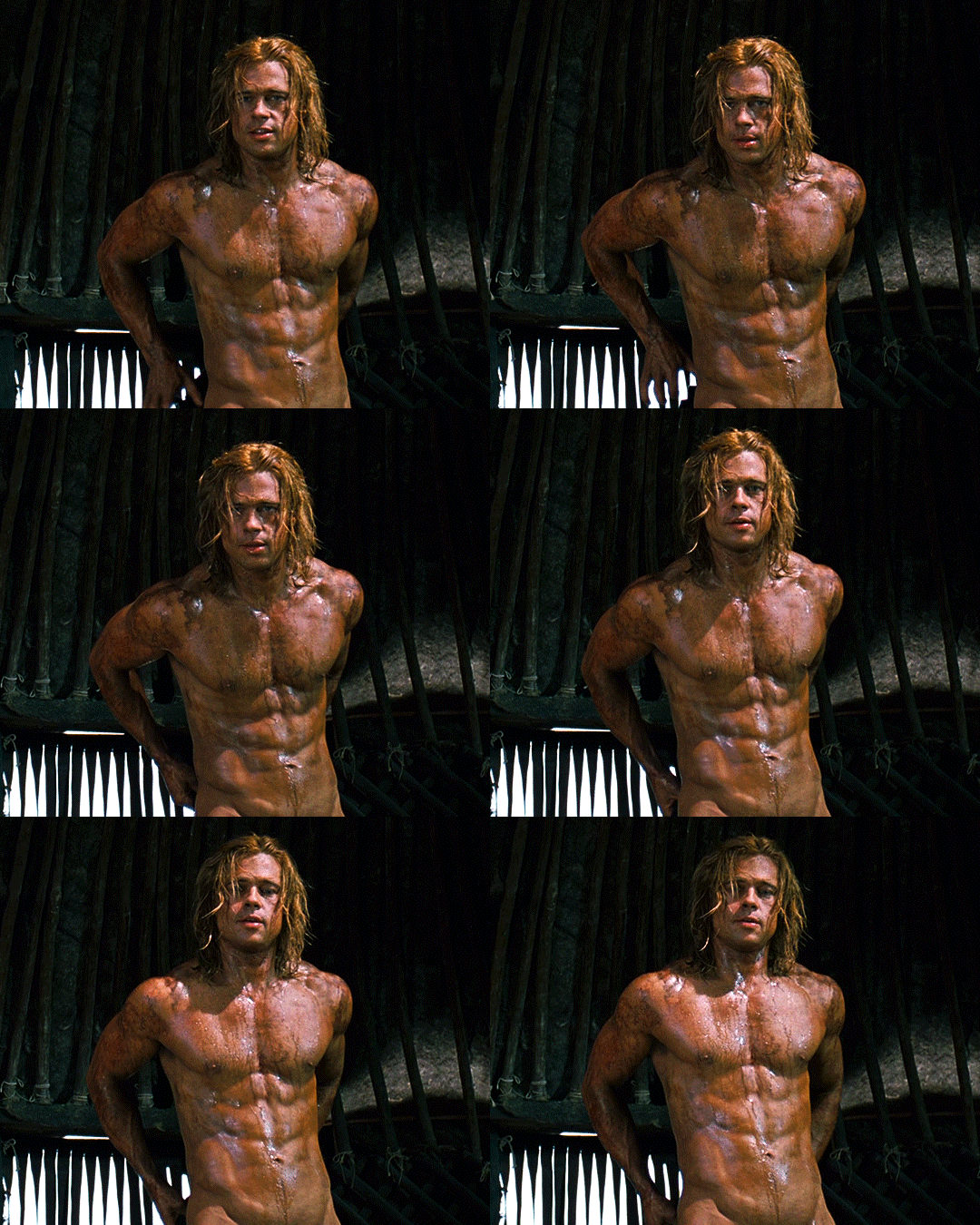
Plan B’s first major production was Troy in 2004, followed by Charlie and the Chocolate Factory in 2005. However, the breakthrough was The Departed in 2006, directed by Martin Scorsese. Specifically, the film grossed $289 million against a $90 million budget and won the Academy Award for Best Picture in 2007. Additionally, it was Scorsese’s first Best Picture win after six prior directing nominations. Moreover, the Best Picture Oscar transformed Plan B from a Pitt vanity project into a legitimate independent studio with institutional credibility. For the broader context of how this moment fit into Pitt’s career, the Brad Pitt net worth pillar treats 2001 to 2009 as the infrastructure-building phase that preceded the full operator arc.
Dede Gardner and Jeremy Kleiner: The Real Operating Team
Although Pitt’s name appears on every Plan B credit, the company’s operational leadership runs through Dede Gardner and Jeremy Kleiner. Specifically, Gardner joined Plan B as a producer in 2004 and rose to co-president in 2010. Additionally, Kleiner joined in 2006 and became co-president alongside Gardner in 2011. Furthermore, both have been named on Pitt’s Oscar Best Picture nominations as fellow producers, which is the industry’s formal acknowledgment that the operating creative work flows through them.
What Gardner and Kleiner Actually Do
Gardner and Kleiner source material, develop screenplays, package talent, structure financing, and manage production logistics across Plan B’s active slate. Specifically, they are the executives who sit in pitch meetings, read coverage, make the first calls to directors, and negotiate the below-the-line production deals that determine whether a project actually gets made. Meanwhile, Pitt’s role is primarily creative and strategic. He reviews early material, approves slate decisions, uses his star power to attract talent and financing, and occasionally appears in Plan B-produced films as an actor. Consequently, the Plan B operational architecture resembles a two-GP private equity fund more than a traditional celebrity vanity shingle.
Three Best Picture Wins: The Credential That Enabled Everything

Plan B has produced three Academy Award Best Picture winners across a ten-year span. Specifically, The Departed won in 2007, 12 Years a Slave won in 2014, and Moonlight won in 2017. Moreover, no other independent production company in Hollywood matched that hit rate during the same period. Consequently, three Best Picture statues over ten years is the structural credential that converted Plan B from a movie star’s pet project into a private-equity-grade asset.
The Prestige Catalog Since 2017
Beyond the three Best Picture wins, Plan B’s slate from 2017 forward has continued generating critical and commercial momentum. Specifically, recent production credits include Minari (2020), If Beale Street Could Talk (2018), Ad Astra (2019), She Said (2022), Women Talking (2022), Andrew Dominik’s Blonde (2022), Bong Joon-ho’s Mickey 17 (2025), David Michôd’s Wizards for A24, and Joseph Kosinski’s F1 (2025). Furthermore, the F1 credit is particularly significant from a valuation standpoint. For the full context of how F1 compounded Plan B’s strategic positioning, the Brad Pitt F1 salary deep-dive details the $30 million upfront salary, the $631.7 million global gross, and the subsequent halo effects that directly drove Apple’s $750 million deal for US Formula One broadcast rights.
The 2022 Mediawan Deal: Transaction Mechanics
In October 2022, Plan B retained Moelis & Co. to run a formal sell-side auction process. Specifically, the mandate was to identify strategic buyers or institutional investors who could provide both growth capital and international distribution. Furthermore, the process culminated in December 2022 with the announcement that Mediawan, the French media conglomerate, had entered a definitive agreement to acquire a majority stake in Plan B.
The Deal TReal3D Flipbookerms
The transaction valued Plan B at more than $300 million. Additionally, the consideration structure was approximately 50 percent cash and 50 percent Mediawan equity shares. Consequently, Pitt, Gardner, and Kleiner received roughly $150 million in cash consideration distributed among them based on equity ownership percentages. Moreover, the three executives also received approximately $150 million worth of Mediawan stock, making them Mediawan shareholders going forward.
Furthermore, the equity component means Brad Pitt Plan B Entertainment is not a clean exit. Rather, it is a partial liquidity event with continued upside exposure. Specifically, if Mediawan’s stock appreciates over the subsequent decade, the equity portion of Pitt’s consideration continues compounding. Additionally, if Mediawan itself becomes an acquisition target at a premium valuation, the shareholders capture that premium in proportion to their ownership.
Who Actually Bought Plan B: Mediawan and Its Capital Stack
Mediawan is a French media conglomerate founded in 2015 as a SPAC by three high-profile French businessmen. Specifically, the founders are Pierre-Antoine Capton, a television producer; Xavier Niel, a telecom billionaire and founder of Iliad; and Matthieu Pigasse, a banker at Centerview Partners. Furthermore, Mediawan has grown aggressively through acquisition, consolidating European production companies across film, television, animation, and distribution.
The KKR Factor
The Plan B acquisition was financed through a capital increase at Mediawan. Specifically, the lead institutional investors supporting the deal included KKR, Atwater Capital, and Societe Generale. Consequently, KKR’s participation is the single most important structural fact in the entire transaction. Specifically, KKR is one of the largest private equity firms in the world, with over $500 billion in assets under management as of 2024. Moreover, KKR’s willingness to back the Mediawan capital raise specifically to acquire Plan B confirms that institutional private equity now treats celebrity-attached production companies as legitimate asset-class investments rather than speculative plays.
For the broader framework of how this pattern operates across Hollywood, the Celebrity Private Equity analysis explains why PE firms pay 2 to 3x financial-buyer multiples for celebrity-attached brands. Moreover, the Celebrity Ownership Wealth framework shows why structural ownership separates nine-figure fortunes from ten-figure ones. Furthermore, both pieces treat the Plan B transaction as a central case study.
The Peer Comparisons: Hello Sunshine, SpringHill, and the Celebrity Production Gold Rush
Plan B’s $300 million valuation did not occur in a vacuum. Rather, it occurred during a two-year window in which institutional capital was aggressively consolidating celebrity-attached production companies at premium valuations. Specifically, three peer transactions framed the market comps that Moelis used when marketing Plan B to buyers.
Reese Witherspoon’s Hello Sunshine at $900M

In August 2021, Reese Witherspoon sold a majority stake in Hello Sunshine to a Blackstone-backed venture led by former Walt Disney Company executives. Specifically, the deal valued Hello Sunshine at $900 million. Furthermore, Hello Sunshine’s catalog included The Morning Show, Big Little Lies, and Little Fires Everywhere, plus an aggressive book-to-screen pipeline through Reese’s Book Club. Consequently, the Hello Sunshine exit set the benchmark valuation for female-led celebrity production companies. For the complete Witherspoon operator arc, the Reese Witherspoon $400 million net worth story details the full Hello Sunshine timeline.
LeBron James’s SpringHill at $725M
In October 2021, LeBron James’s SpringHill Company sold a minority stake to RedBird Capital Partners in a deal that valued the business at $725 million. Specifically, RedBird was joined by Nike, Epic Games, and Fenway Sports Group as co-investors. Additionally, SpringHill’s output ranged from Space Jam: A New Legacy to original documentaries and branded content. Consequently, SpringHill’s valuation confirmed that celebrity-attached production companies could achieve nine-figure valuations even without prestige film credentials, provided the celebrity attached to the company carries sufficient cultural scale.
Leonardo DiCaprio’s Appian Way as the Counterpoint
Leonardo DiCaprio has not sold any equity stake in Appian Way Productions to date. Specifically, Appian Way continues operating under DiCaprio’s full ownership with first-look deals at Apple and Sony. Moreover, DiCaprio’s decision not to execute a liquidity event represents the third path available to celebrity-producers. For the full comparison of these two producer-operator models, the Leonardo DiCaprio $300 million net worth story explores how Appian Way’s current structure differs strategically from Plan B’s post-Mediawan architecture.
Why Plan B Was Worth $300 Million
A $300 million valuation for a private independent production company is not a casual price tag. Specifically, three structural factors drove the valuation to that level. Consequently, understanding these factors is the difference between reading the Mediawan deal as a celebrity transaction and reading it as a private equity transaction.
Factor One: The Prestige Catalog
Plan B’s three Best Picture wins generated cumulative revenue exceeding $800 million across theatrical, streaming, and ancillary rights. Furthermore, the prestige catalog’s library continues earning licensing revenue years after theatrical release. Specifically, prestige film libraries typically generate steady annuity-like cash flows for 10 to 20 years post-release, which makes them attractive to PE investors evaluating risk-adjusted returns.
Factor Two: The Active Slate
At the time of the Mediawan deal, Plan B had over 40 projects in active development across film, television, and documentary. Moreover, the slate’s scale and diversity means Plan B was not dependent on any single title for future revenue. Additionally, the development pipeline creates optionality value, which PE investors price into acquisition models as forward revenue potential discounted to present value.
Factor Three: The Pitt Brand Premium
Pitt’s continued attachment to Plan B provides what acquisition analysts call “embedded marketing infrastructure.” Specifically, every time Pitt appears publicly, Plan B receives incidental brand reinforcement worth millions in avoided advertising spend. Consequently, this is the structural reason Plan B commanded a premium multiple relative to non-celebrity independent production companies of comparable catalog scale.
What the Deal Actually Paid Pitt Personally
Pitt’s exact personal consideration from the Mediawan transaction has not been publicly disclosed. Nevertheless, industry sources and disclosed deal mechanics allow for a reasonable estimate. Specifically, Pitt is understood to have held approximately 40 to 50 percent of Plan B’s equity at the time of the transaction, with Gardner and Kleiner holding meaningful minority stakes. Consequently, on a $300 million enterprise valuation with majority consideration flowing to selling shareholders, Pitt’s personal consideration likely landed in the $120 to $150 million range.
The Split Between Cash and Shares
Approximately 50 percent of Pitt’s consideration arrived in cash, meaning an estimated $60 to $75 million in immediate liquidity. Furthermore, the remaining 50 percent arrived as Mediawan stock, meaning another $60 to $75 million in ongoing equity exposure. Additionally, the Mediawan shares continue compounding or depreciating based on the French company’s subsequent operating performance. Moreover, this structure is why the Plan B transaction is accurately described as a partial exit rather than a clean exit.
The Continuing Operation: Plan B Post-Mediawan
Following the December 2022 close, Plan B continued operating as a substantially independent production company under the Mediawan umbrella. Specifically, Pitt, Gardner, and Kleiner retained operational control over creative decisions, slate selection, and talent relationships. Furthermore, Mediawan’s strategic value to Plan B is primarily distributional. Consequently, Mediawan’s European distribution footprint expands Plan B’s access to international financing, co-production capital, and streaming rights sales across markets where Plan B previously had limited reach.
The F1 Production Credit

Brad Pitt Plan B Entertainment’s producer credit on F1 is the clearest evidence of the post-Mediawan operating model at scale. Specifically, F1 was produced by Plan B alongside Jerry Bruckheimer and Apple Original Films. Furthermore, Plan B’s producer fees plus back-end participation on F1 are estimated to have generated $30 to $50 million in gross revenue for the company on that project alone. Moreover, a significant portion of that revenue flows through to the Plan B partnership, with Pitt’s personal participation estimated at $12 to $18 million.
The Structural Lesson: Why Era 4 Built the Real Fortune
Most casual readers of Pitt’s financial history assume his fortune comes from acting salaries. Specifically, they assume 40 years of $10 to $30 million film paydays compounded into the current $400 million net worth. Nevertheless, that assumption is structurally incorrect. Rather, Pitt’s acting income across four decades is estimated at $250 million pre-tax. Furthermore, after agency fees, legal costs, taxes, and lifestyle expenses, his net accumulated acting earnings likely contribute $120 to $160 million to his current wealth.
The Plan B Delta
Plan B’s Mediawan valuation, plus the company’s ongoing operating income, plus the F1 producer participation, plus the appreciating Mediawan equity all together contribute an estimated $180 to $220 million to Pitt’s current net worth. Consequently, the operator arc generated more personal wealth than the acting career did. Moreover, that structural inversion is the entire thesis of Era 4. Specifically, the production company was always the real fortune. The acting career was the marketing engine that made the production company valuable enough to sell.
For the broader pattern of how this structural inversion operates across the A-list, the Celebrity Ownership Wealth framework tracks Tyler Perry, Oprah Winfrey, Jerry Seinfeld, and several other operators who built their fortunes through equity rather than salary. Additionally, the Hollywood Actor Net Worth Rankings 2026 hub demonstrates why the billionaire actors are almost always the ones who owned their content rather than acted in it.
What Era 4 Means for Every Other Operator
Brad Pitt Plan B Entertainment is now the reference case that every mid-career A-list actor with a production banner studies. Specifically, Margot Robbie’s LuckyChap Entertainment, Jennifer Aniston and Reese Witherspoon’s respective companies, Chris Pratt’s Indivisible Productions, and dozens of other celebrity-producer operations are now being evaluated against the Plan B benchmark. Furthermore, the benchmark is clear. Three Best Picture wins plus a diversified active slate plus sustained star attachment produces a $300 million acquisition valuation backed by institutional private equity capital.
The Missouri kid who arrived in Los Angeles in 1986 with $325 is now the architect of one of Hollywood’s most commercially sophisticated independent production companies. Moreover, the production company has already produced more lifetime personal wealth than the acting career that made it possible. Consequently, Era 4 is not the era that made Brad Pitt famous. Rather, it is the era that made Brad Pitt rich.
Everything else is arithmetic.
The Social Life Reader Chapter
If you read this far, you are the kind of person who understands that the most valuable decisions in a career are almost always the ones that look boring from the outside. Production company equity is boring. Consequently, it is also worth $300 million. That is the water you are already swimming in. Most readers scroll. However, you stayed. That is the only actual difference between audiences and the people they read about.
Social Life Magazine covers the kind of stories most outlets miss or sanitize. If your firm sits in the intersection of private equity, wealth management, media M&A, or founder-class liquidity planning, our editorial team takes direct submissions for feature coverage. Reach out here to start the conversation.
For brands and firms that want to move faster, our Submit A Paid Feature program offers three production tiers at $975, $3,200, and $6,500. Each tier includes editorial development, SEO-optimized placement, and distribution through the full Social Life network.
Our email list reaches 82,000 subscribers who actually open, read, and act. If your audience sits between Park Avenue and Montauk, join the list here.
Polo Hamptons returns to Bridgehampton in July 2026 with 1,200 guests, Getty Images coverage, and seven years of BMW title sponsorship behind it. Sponsorships, cabanas, and activation slots are available now at polohamptons.com.
The print edition of Social Life Magazine delivers 25,000 copies per issue to the boutiques, lobbies, and living rooms where Hamptons decisions actually get made from Westhampton to Montauk each summer, and to Upper East Side doorman buildings each fall and winter. Subscribe here.
If this publication has added value to your week and you want to support independent luxury journalism that does not answer to algorithms, contribute directly at our donation page.
Read Next
- Brad Pitt Net Worth 2026: The Five Lives of a Movie Star
- Brad Pitt F1 Salary: The $30M Payday That Grossed $631M
- Brad Pitt Chateau Miraval: Inside the $164M Wine War
- Brad Pitt Sobriety: The $400M Rebuild After Rock Bottom
- Leonardo DiCaprio Net Worth 2026: The $300M Blueprint
- Reese Witherspoon Net Worth: The $400M Hello Sunshine Exit
- Celebrity Private Equity: Why PE Pays Premium Multiples
- Celebrity Ownership Wealth: Why Salary Alone Never Wins
- Hollywood Actor Net Worth Rankings 2026
Author

Written by
Recent Posts

AI for personal finance: where PennyGuard fits

How to Pick a Homecoming Dress for Your Body Type (and Feel Amazing in It)

World Cup Injury Attorney for Vancouver Events
What a 3-Carat Engagement Ring Actually Costs in 2026: The Real Numbers
The Skincare Habits That Make a Real Difference Over Time
Categories
- Art
- Articles
- Business of Luxury
- Celebrities
- Culture
- Entertainment
- Events
- Faces of Summer 2026
- Fashion
- Fashion & Style
- Featured
- Finance
- Food, Spirits, Wine
- Hamptons
- Hamptons Celebrities
- Health
- Health & Beauty
- Lifestyle
- Luxury Lifestyle
- Press
- Profiles
- Real Estate
- Technology
- The Chronicles
- Travel
- Uncategorized
- Weddings