
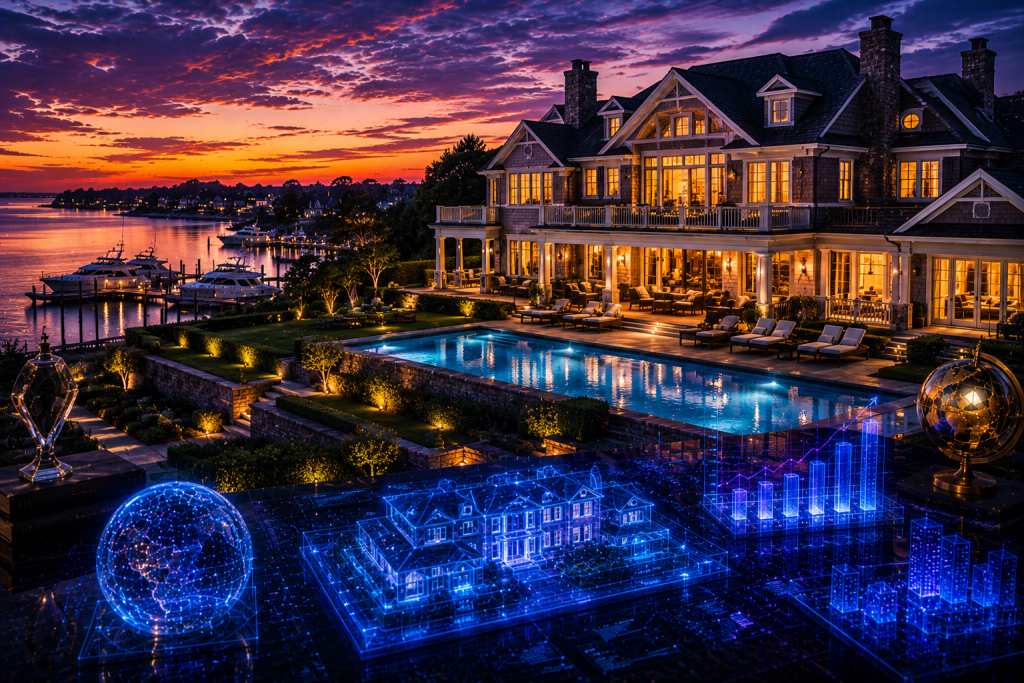
How AI Money Is Reshaping Hamptons Real Estate in 2026
Hamptons real estate hit a record median sales price of $2.34 million in Q4 2025, up 34% from the prior year, as Wall Street bonuses and technology wealth fueled the strongest luxury market in the region’s history. Sales of homes priced above $20 million surged 59%. Luxury transactions above $10 million jumped 75%. Months of supply fell to 6.8, down 24%, as buyers competed hardest for oceanfront properties and turnkey homes in Southampton, Sag Harbor, and East Hampton. The AI billionaires reshaping American wealth are now reshaping the South Fork, and the real estate data confirms what brokers have been saying quietly for two seasons: AI money is the fastest-growing segment of ultra-luxury East End demand.
The Numbers: Record Prices, Vanishing Inventory
Seventy percent of Hamptons homes now sell above $1 million. Median prices crossed $2 million for the first time in 2025. Douglas Elliman and Miller Samuel reported the $2.34 million record median in Q4. Brown Harris Stevens noted that prices west of the Shinnecock Canal jumped 25% in a single year. Philip O’Connell, managing director of Brown Harris Stevens’ Hamptons office, attributed the surge to “a third consecutive year of double-digit stock market returns and record Wall Street bonuses.” But Wall Street bonuses are only part of the story. Tech liquidity events, RSU vestings at Nvidia, Meta, and Anthropic, and the capital generated by the AI infrastructure boom are creating a buyer class that operates on a different financial timeline.
The New Buyer Profile: Young, Liquid, and Indifferent to the Social Circuit
Brokers report that the AI-era buyer skews younger and more liquid than the traditional Hamptons purchaser. Stock vesting events generate immediate purchasing power. These buyers do not need fund distributions to clear. They do not need bonus season to arrive. A single RSU tranche at a company like Nvidia, where the stock has risen over 3,000% in five years, can fund a $10 million purchase without leverage.
The Due Diligence Inversion
Traditional Hamptons buyers conducted social due diligence before financial due diligence. What clubs accept members in this village. Identifying which charity boards have openings. Which restaurants require a relationship with the maitre d’ that predates the purchase. The AI-era buyer inverts this entirely. Financial due diligence is immediate and often completed before the first showing: comps, tax history, flood zone status, rental yield potential, all assembled by algorithms or assistants before the buyer sets foot on the property. Social due diligence is not conducted at all, because the buyer does not know it exists and would not care if informed. This inversion unsettles brokers who built their careers on the assumption that a $15 million purchase is also a social application. For the Nvidia employee whose RSUs just vested at $280, the $15 million purchase is a real estate transaction. Nothing more. Nothing less. The social layer that previous generations considered inseparable from the financial one simply does not register.
The social requirements are also different. Traditional East End wealth arrives with legacy memberships, charity circuit obligations, and ancestral claims to specific restaurants. AI money arrives with a wire transfer and a request for fiber-optic internet speed. The charity gala holds no appeal. The benefit dinner is optional. What matters is the house, the beach, and a connection fast enough to run operations remotely. This profile challenges the existing social architecture of the South Fork without attempting to replace it.
See also: Jensen Huang’s $53 million real estate portfolio.
Where AI Money Is Landing
Sag Harbor draws the creative-technical hybrid. Its maritime character and walkable village scale appeal to founders who spent their twenties in San Francisco. Amagansett attracts the privacy-focused buyer who wants exceptional beach access without the social overhead of Southampton proper. Bridgehampton, home to Polo Hamptons on July 18 and 25 at 900 Lumber Lane, represents the geographic crossover point where finance and technology wealth converge. East Hampton remains the prestige address, but competition from younger buyers is pushing prices higher and decision timelines shorter.
The Infrastructure Premium
One detail brokers mention repeatedly, usually with a mix of amusement and disbelief, is the fiber-optic question. Traditional buyers ask about the pool, the kitchen, the proximity to the beach. AI-era buyers ask about internet speed with a specificity that reveals their professional requirements: not “is the internet fast” but “what is the download speed in megabits per second and is the connection fiber to the premises or fiber to the node.” A buyer who runs a machine learning operation remotely needs connectivity that a 1920s shingled cottage in Wainscott was not built to provide, and the cost of upgrading that connectivity can exceed $50,000, which is a rounding error on a $12 million purchase but a logistical complexity that changes which properties are viable and which are not. The infrastructure premium is real and growing: properties with confirmed fiber-optic connections are moving faster and commanding higher prices per square foot than equivalent properties without them, which is a market signal that would have been unintelligible five years ago and is now a standard line item in the listing description.
See also: the $20,000 longevity weekend.
Sotheby’s International Realty forecasts continued strength in luxury real estate through 2026, driven by a $6 trillion generational wealth transfer, a 44% surge in foreign buyer activity, and rising demand for wellness-focused, multigenerational layouts. The Jensen Huang profile (0.03% of net worth in real estate) may not be typical, but the employees whose Nvidia RSUs vested at $280 per share are buying at a pace brokers describe as unprecedented.
That Liquidity Event as Real Estate Catalyst
There is a specific mechanism by which AI wealth enters the Hamptons real estate market, and the mechanism is more precise than the generic phrase “tech money” suggests. The mechanism is the liquidity event: the moment when paper wealth converts to spendable capital. Among Nvidia employees, the event is an RSU vesting date combined with a stock price above a certain threshold. For Scale AI employees, the event was Meta’s $14.3 billion investment, which created a secondary market for employee shares. For SpaceX employees, the event will be the anticipated mid-2026 IPO. Each event produces a cohort of newly liquid individuals with seven- and eight-figure checking accounts and a specific emotional state: the combined relief, excitement, and anxiety of suddenly possessing more money than they have ever had.
The Vesting Calendar Effect
Brokers who have adapted to the vesting calendar report a new seasonal pattern overlaying the traditional one. February through April, when major technology companies report Q4 earnings and trigger annual RSU vesting events, generates a surge in inquiries that supplements but does not replace the traditional bonus-season pipeline. The inquiries arrive with characteristics that distinguish them from Wall Street inquiries: faster decision timelines (days rather than weeks), less price sensitivity (the buyer’s frame of reference is stock appreciation percentages, not real estate comps), and a preference for turnkey properties that require no renovation, because the buyer’s professional life is too demanding and too geographically distributed to manage a construction project from a laptop in San Jose.
For related coverage, explore new status codes of AI wealth.
That emotional state drives purchasing behavior that brokers on the South Fork have learned to recognize. The newly liquid buyer wants to act quickly, because the wealth feels temporary even when it is structural. They want turnkey properties, because renovating a house requires the kind of patience that feels impossible when your bank account just changed by seven digits. They want premium locations, because the location validates the financial event: I can afford Sag Harbor means I have really made it. And they want privacy, because the attention that comes with sudden wealth is unfamiliar and usually unwelcome. The profile is consistent enough that some brokers report creating separate client tracks for tech liquidity events, timing their outreach to coincide with known vesting schedules at major AI companies.
The Deeper Read
The Hamptons market has always been correlated with Wall Street performance. Bonus season drives January and February inquiries. A strong first quarter drives Memorial Day purchases. What is new is the addition of a second calendar: the tech vesting calendar, which operates on a different timeline, produces a different emotional profile, and generates purchasing power that does not depend on the same economic variables that drive traditional finance wealth. When Nvidia reports earnings and the stock rises 10%, a thousand RSU holders become incrementally richer and incrementally more motivated to buy on the South Fork. The correlation is direct, traceable, and accelerating.
Where the Conversation Continues
Social Life Magazine has covered East End real estate for twenty-three years. The wealth arriving now is different in origin but identical in destination. Understanding where AI money lands is understanding where the market moves next.
If your brand, property, event, or company belongs in this conversation, reach us through our contact page. For premium editorial visibility, explore our paid feature submission process. Subscribe at sociallifemagazine.com/enflyer. Polo Hamptons returns July 18 and 25. BMW is title sponsor. Details at polohamptons.com. Subscribe at sociallifemagazine.com/subscription.
Author

Written by
Recent Posts

hiTechMODA Season 16
How to Keep Your Personal Number Private When Booking Events, Rentals and Services
Understanding Compensatory Damages in a Personal Injury Case

When Online Family Therapy Makes Sense for Modern Families

Carrier Oils, Essential Oils, and Oil Blends: What Beauty Brands Need to Know
Categories
- Art
- Articles
- Business of Luxury
- Celebrities
- Culture
- Entertainment
- Events
- Faces of Summer 2026
- Fashion
- Fashion & Style
- Featured
- Finance
- Food, Spirits, Wine
- Hamptons
- Hamptons Celebrities
- Health
- Health & Beauty
- Lifestyle
- Luxury Lifestyle
- Press
- Profiles
- Real Estate
- Technology
- The Chronicles
- Travel
- Uncategorized
- Weddings