
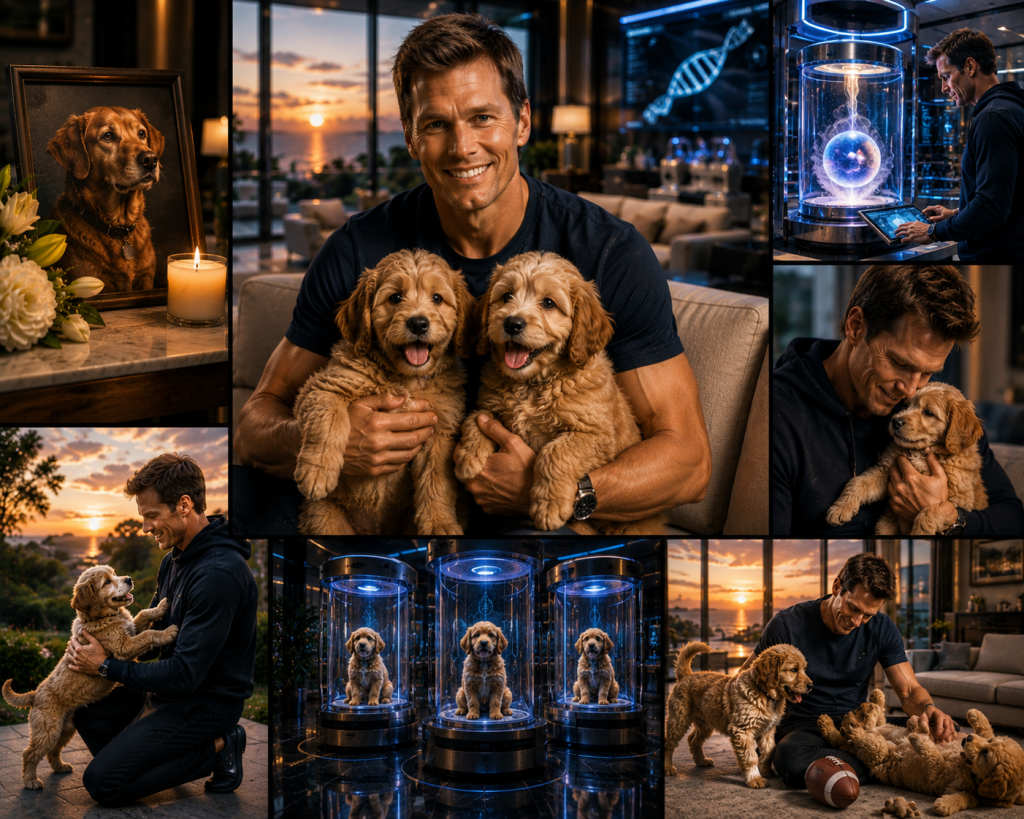
In November 2025, Tom Brady told the world that his dog Junie is not just any pit bull mix. She is a genetic clone of Lua, the family pet who died in December 2023. Before Lua passed, Brady had a blood sample collected and sent to Colossal Biosciences, a Dallas-based biotech company where he serves as an investor. Colossal produced an exact copy. The price, based on standard cloning fees, was approximately $50,000. The Tom Brady dog clone longevity story broke across every major outlet within hours, and the reactions split cleanly between people who thought it was touching and people who thought it was unhinged. Both groups missed the point.
Brady did not clone his dog because he is sentimental (though he may be). He cloned his dog because he is an investor in the company that cloned it, and that company is not in the pet business. Colossal Biosciences is in the de-extinction business. They claim to have brought back dire wolves from 12,500 years of absence. Their mission statement talks about “reawakening the lost wilds of Earth.” Pet cloning is a revenue line that funds research into cellular reprogramming, genetic editing, and species resurrection. Brady’s $50,000 dog is a proof of concept for technology that, if it works at scale, could reshape human medicine. That is the longevity billionaire play. And Brady made it with a pit bull.
From Lua to Junie: How the Clone Happened
Lua was a pit bull mix adopted during Brady’s marriage to Gisele Bundchen. The dog appeared in a 2014 Ugg Australia commercial with Brady, became a fixture on both parents’ social media accounts, and was a regular presence in the lives of their children, Benjamin (now 16) and Vivian (now 13). Bundchen announced Lua’s death on Instagram on December 23, 2023, writing that their “little Lulu, our guardian angel is gone to heaven.”
Before Lua died, Brady had coordinated with Colossal Biosciences to preserve her DNA through a blood draw. Colossal’s non-invasive cloning technology uses somatic cell nuclear transfer, the same fundamental process that produced Dolly the Sheep at Scotland’s Roslin Institute in 1996. A donor egg is emptied of its original genetic material and replaced with DNA from the animal being cloned. The resulting embryo is implanted in a surrogate. Months later, Junie arrived.
“I love my animals. They mean the world to me and my family,” Brady said. “Colossal gave my family a second chance with a clone of our beloved dog.” The announcement coincided with Colossal’s acquisition of Viagen Pets and Equine, the dominant player in commercial pet cloning. Viagen previously cloned dogs for Barbra Streisand (who duplicated her dog Samantha after her death in 2017) and Paris Hilton (whose Diamond Baby was replicated after going missing in 2022). Viagen charges $50,000 for dogs and cats, $85,000 for horses.
Colossal Biosciences: The Company Behind the Clone
Colossal Biosciences was founded in 2021 by CEO Ben Lamm with an audacious thesis. Genetic technology can bring extinct species back to life and, in the process, generate tools applicable to human health. The company’s highest-profile claim is the birth of three dire wolves, animals that had been extinct for over 12,500 years. Colossal’s team extracted DNA from a 13,000-year-old tooth and a 72,000-year-old skull, then used genetic editing to produce living puppies.
Scientists have questioned the terminology. New Scientist reported that the animals are “actually grey wolves with genetic edits intended to make them resemble the lost species.” The distinction between de-extinction and genetic approximation matters scientifically but barely registers commercially. What matters for the Tom Brady dog clone longevity story is the technology itself. Cellular reprogramming, genetic editing, and cloning are the same foundational tools that Altos Labs (backed by Jeff Bezos) and Retro Biosciences (backed by Sam Altman) use to pursue human aging reversal.
Brady’s investment in Colossal places him in the same category as the tech billionaires writing nine-figure checks to longevity labs. His check is smaller. His approach is different. But the underlying bet is identical: that biological engineering will become as routine as software engineering, and that early investors in the field will benefit from the compounding. Colossal’s pet cloning division generates immediate revenue. Its de-extinction research generates scientific credibility. Both feed into the long-term vision of commercializing genetic technology at scale.
TB12: The Original Longevity Brand
Long before the dog clone, Brady built the most successful athlete-driven wellness brand in history. Brady founded TB12 Sports in 2013 to promote his personal training methodology. The brand offers workout programs, supplements, nutrition products, and the New York Times bestselling book “The TB12 Method.” The brand’s core thesis centers on pliability, a concept Brady and his trainer Alex Guerrero developed together. Their claim: that pliability training can extend athletic performance and slow physical decline.
Brady played professional football until age 45, winning his seventh Super Bowl at 43. That longevity was itself a proof of concept. Every season he played past 40 was an advertisement for the idea that biological aging can be resisted through discipline, nutrition, and the right protocols. TB12 was the commercial vehicle for that message. In 2024, TB12 merged with NOBULL, a venture-backed fitness brand valued at over $500 million. Brady became the second-largest shareholder of the combined entity.
The TB12 brand positions Brady differently from Bryan Johnson or Daymond John in the longevity conversation. Johnson is the scientist. John is the survivor. Brady is the proof. He did not talk about longevity. He demonstrated it on a football field in front of 100 million viewers. The dog clone extends the narrative from human performance to biological engineering, from resisting aging in his own body to resisting death in the bodies of the animals he loves.
Tom Brady Net Worth: $350 Million and a Longevity Portfolio
Brady’s net worth in 2026 is estimated between $300 million and $350 million. His NFL career generated approximately $333 million in salary. A 10-year, $375 million contract with Fox Sports (the largest broadcasting deal in sports history) pays $37.5 million annually. Endorsement partnerships with Under Armour, Tag Heuer, and other global brands have contributed $150 million to $200 million over his career. His full financial profile includes minority ownership stakes in the Las Vegas Raiders, the WNBA’s Las Vegas Aces, Birmingham City FC, and Major League Pickleball.
The longevity-relevant portfolio is smaller but strategically positioned. His investment in Colossal Biosciences sits alongside TB12/NOBULL (wellness and fitness), BRADY Brand (now folded into NOBULL), 199 Productions (media), and Autograph (digital collectibles). Brady’s approach to longevity investing mirrors his approach to football: conservative entry, long time horizon, and absolute conviction that the fundamentals are correct.
For a man who earned less per year than many quarterbacks because he consistently took pay cuts to fund better rosters, the $50,000 dog clone is perfectly on brand. Brady has never been the highest-paid player in any category. He has always been the smartest allocator of the resources available to him. Cloning Lua was not a vanity project. It was a strategic demonstration of a technology he believes in, executed through a company he owns equity in, and announced at the exact moment that company acquired the market leader in pet cloning. The timing was not sentimental. It was commercial.
Why Cloning Your Dog Is a Longevity Statement
Pet cloning occupies a strange position in the public imagination. It reads as excess. Fifty thousand dollars to copy a dog when shelters are full of animals who need homes. The criticism is valid on one axis and completely irrelevant on another. What pet cloning actually demonstrates is that cellular reprogramming works. A living, breathing animal exists because scientists took DNA from an aging body and used it to produce a genetically identical young one. That is not a pet story. That is a proof of concept for the most important medical technology of the century.
The Tom Brady dog clone longevity connection runs deeper than brand association. Colossal’s acquisition of Viagen consolidates pet cloning and de-extinction under one roof. The data generated from thousands of pet cloning procedures (Viagen has cloned animals for years) feeds directly into research on cellular reprogramming in other species. Every cloned dog is a data point. Every successful birth validates a technique that, with modification, could be applied to human cells.
For the wealthy East End audience reading this, Brady’s play illuminates a category that barely existed five years ago: longevity-adjacent investing. Not every longevity bet involves a supplement company or a concierge clinic. Some involve biotech companies whose consumer products (cloned pets) fund research into technologies (cellular reprogramming) that could transform human medicine. Brady saw that structure and wrote a check. The dog was the proof of concept. The portfolio position was the real investment.
What Brady’s Move Means for the East End
The technology behind the Tom Brady dog clone longevity story connects directly to services available at Hamptons wellness clinics. Cellular reprogramming is the high end of the longevity science spectrum. But the downstream applications, NAD+ therapy, exosome treatments, peptide protocols, and epigenetic counseling, are already offered at Hamptons BioMed at 223 Hampton Road in Southampton. Exosomes, in particular, represent a commercially available form of cellular signaling technology that shares conceptual DNA with the reprogramming work Colossal performs.
For East End pet owners (and the Hamptons has no shortage of deeply loved, extravagantly maintained dogs), the cloning story opens a new conversation about biological preservation. Viagen’s services are available now. A genetic preservation kit can be ordered for a few hundred dollars. The full cloning process costs $50,000 for dogs and $85,000 for horses. For a population that routinely spends six figures on summer rentals and seven figures on real estate, these numbers are not prohibitive.
Social Life Magazine covers the full spectrum of the longevity economy on the South Fork, from the billionaires funding the research to the clinics offering the treatments. Brady’s cloning decision is one data point in a much larger pattern: wealthy, health-conscious individuals treating biological decline as a problem with a solution, not a fact to accept. Whether the solution is a cold plunge, a NAD+ drip, or a $50,000 clone, the underlying mindset is identical. And it is reshaping how money moves on the East End.
Where The Conversation Continues
Brady’s story connects longevity science, biotech investing, and personal conviction in a way that no other figure in this series does. Social Life Magazine is building the most comprehensive editorial treatment of the longevity economy in the Hamptons. Every spoke in this series adds another dimension to the picture.
If you operate in the longevity, wellness, biotech, or veterinary space and want editorial visibility with the East End audience, reach out at [email protected].
For brands seeking premium placement, explore our Paid Feature options. A feature in Social Life Magazine places your name inside the conversation shaping the South Fork.
Stay current on longevity, luxury, and everything in between at sociallifemagazine.com.
Polo Hamptons returns July 18 and 25, 2026, at 900 Lumber Lane, Bridgehampton. BMW is the title sponsor. For sponsorship inquiries, visit polohamptons.com.
Already a reader? Share this piece or subscribe to Social Life Magazine for five summer issues and Fall/Winter editions delivered to your door.
If this journalism matters to you, support it directly via PayPal. Independent publishing on the East End runs on readers who believe the story is worth telling.
Frequently Asked Questions
Did Tom Brady really clone his dog?
Yes. In November 2025, Brady revealed that his current dog Junie is a genetic clone of Lua, a pit bull mix who died in December 2023. Before Lua passed, a blood sample was collected and sent to Colossal Biosciences, a Dallas-based biotech company in which Brady is an investor. Colossal used somatic cell nuclear transfer to produce an exact genetic copy. The cost was approximately $50,000 based on standard cloning fees from Viagen, which Colossal acquired.
What is Colossal Biosciences?
Colossal Biosciences is a Dallas-based biotech company founded in 2021 by CEO Ben Lamm. The company pursues de-extinction (bringing back extinct species using genetic technology) and pet cloning. Colossal claims to have produced the world’s first de-extinction by creating three dire wolves from ancient DNA. The company acquired Viagen Pets and Equine, which has cloned pets for celebrities including Barbra Streisand and Paris Hilton. Tom Brady, Jeff Bezos, and other prominent investors have backed the company.
How much does it cost to clone a dog?
Through Viagen (now owned by Colossal Biosciences), dog cloning costs approximately $50,000. Cat cloning costs the same. Horse cloning runs approximately $85,000. A genetic preservation kit, which collects and stores DNA for potential future cloning, can be ordered for a few hundred dollars. The process uses somatic cell nuclear transfer technology originally developed at Scotland’s Roslin Institute, the lab that created Dolly the Sheep in 1996.
What is Tom Brady’s net worth in 2026?
Tom Brady’s net worth is estimated between $300 million and $350 million in 2026. His NFL career generated approximately $333 million in salary. A 10-year, $375 million Fox Sports broadcasting contract pays $37.5 million annually. Additional wealth comes from endorsement partnerships, minority ownership stakes in the Las Vegas Raiders, the WNBA’s Las Vegas Aces, Birmingham City FC, and Major League Pickleball, plus business ventures including TB12/NOBULL, BRADY Brand, 199 Productions, and Autograph.
Author

Written by
Recent Posts
What Goes Into Planning a Professional Furnace Installation?
Why Sports Card Collecting Is More Than Just a Hobby
From Signature Scents to Scent Wardrobes: The Evolution of Personal Fragrance
Beyond the Booth: How Exhibition Design Is Creating New Brand Experiences
Trading the Hamptons for Hvar: A Summer on Croatia’s Most Glamorous Island
Categories
- Art
- Articles
- Business of Luxury
- Celebrities
- Culture
- Entertainment
- Events
- Faces of Summer 2026
- Fashion
- Fashion & Style
- Featured
- Finance
- Food, Spirits, Wine
- Hamptons
- Hamptons Celebrities
- Health
- Health & Beauty
- Lifestyle
- Luxury Lifestyle
- Press
- Profiles
- Real Estate
- Technology
- The Chronicles
- Travel
- Uncategorized
- Weddings