
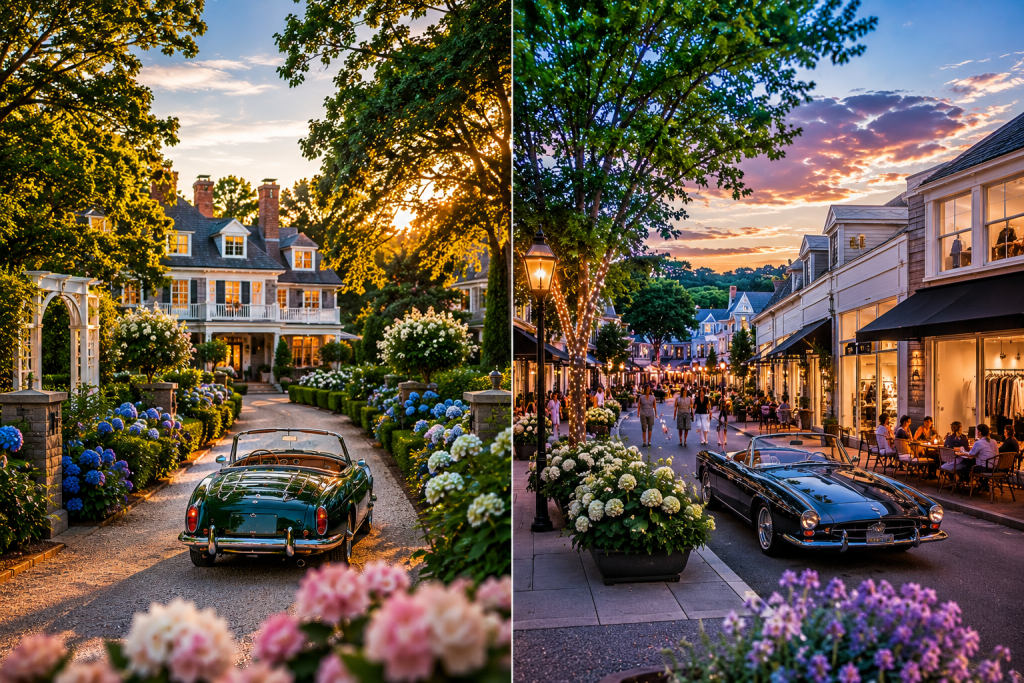
Same Town, Different Universes
The question arrives every spring in the offices of every East End real estate broker: Amagansett vs East Hampton, and why does the answer matter? After all, just five minutes of driving separates the two. Further Lane physically straddles both communities. Guild Hall, the Maidstone Club, and the shops on Newtown Lane are a short drive from Amagansett Square. Yet the people who choose Amagansett over East Hampton Village are making a statement that has nothing to do with geography and everything to do with what they need the Hamptons to be.
This is the comparison piece that the Modern Culture Hamptons Bible demanded. Sag Harbor vs Southampton explored old money versus new authenticity. Bridgehampton’s three-way comparison explored the event economy. Amagansett vs East Hampton is the most intimate contrast in the series: a hamlet that exists inside a town, separated by five minutes and an entire philosophy of how to live.
The Structural Difference: Government vs Absence
Start with the institutions, because the institutions explain everything. East Hampton Village is an incorporated municipality with its own elected government, police department, planning board, historic district commission, and zoning enforcement apparatus. There is a mayor. Public meetings are held regularly. Building permits are issued through a process that involves review, hearings, and the weight of institutional opinion. Consequently, when you build in East Hampton Village, you are building under supervision.
What Amagansett Lacks
Amagansett has none of that. It is an unincorporated hamlet within the Town of East Hampton. There is no village government and no police department (the town provides coverage). Likewise, there is no planning board of its own and no historic district commission reviewing your renovation plans. Instead, what Amagansett offers is the Town of East Hampton’s zoning code and nothing more. For the Tribeca private equity partner who spent two years negotiating a landmark commission in Manhattan over a window replacement, Amagansett’s institutional thinness feels like oxygen. You buy your land, you follow the code, you build. Nobody holds a hearing about your hedgerow height.
This structural difference is not cosmetic. It shapes the character of both communities at every level. On one hand, East Hampton Village’s government produces order, consistency, and architectural cohesion. It also produces meetings, committees, and the friction of democratic process applied to private property. Amagansett’s absence of government produces freedom, inconsistency, and the particular kind of architectural variety that emerges when nobody is coordinating the result. In East Hampton Village, the houses rhyme. In Amagansett, they don’t, and that disorder is the aesthetic.
The Social Architecture: Club vs Crossroads
East Hampton Village’s social life centers on institutions with gates. The Maidstone Club, founded in 1891, is widely considered the most prestigious and most exclusive private club in the Hamptons. Its membership process is opaque, its waiting list is generational, and its rejection roster includes names that would be recognizable to anyone who follows American power. Guild Hall, East Hampton’s cultural center, provides theater, gallery exhibitions, and community programming. Newtown Lane offers shopping at Ralph Lauren, Tiffany, and a constellation of high-end retailers that transforms the village center into an open-air luxury mall from Memorial Day through Labor Day.
The Amagansett Alternative
Amagansett has no private club. No cultural center. No shopping street. Instead, it has a single crossroads where Main Street meets the Montauk Highway, with a handful of restaurants, a farm stand, and a 20-by-20-foot music venue named for a Montaukett walker. The social institutions in Amagansett are the places that resist hierarchy by design. Nobody can buy a better tomato at Amber Waves than the person next to them. Similarly, you can’t reserve a better wave at Indian Wells Beach. You can’t get a VIP section at the Stephen Talkhouse because the room is too small to have one.
For the UES art advisor who spent a decade climbing the Maidstone waiting list (and failed), Amagansett’s institutional vacuum is not a downgrade. It is a relief. Specifically, the absence of gatekeeping institutions means the absence of gatekeeping anxiety. Nobody in Amagansett is wondering whether they’ll get into the club, because there is no club to get into.
The Gramercy Park hedge fund associate tours East Hampton Village on a Saturday in April.
His broker shows him a shingled colonial on Lily Pond Lane. Beautiful. Historic. $22 million.
“The Maidstone is four minutes away,” the broker says. “Guild Hall is five.”
He nods. He writes the note on his phone: “institutions.”
The next morning, the broker drives him to Amagansett. Cranberry Hole Road. A farmhouse. $4.2 million.
>No club nearby. No gallery. No Tiffany. Just a farm stand and a bar with live music.
He buys the farmhouse. His partners at the fund don’t understand.
He doesn’t explain. Explaining would defeat the purpose.
The Real Estate Comparison
The numbers tell a story that the vibes cannot. East Hampton Village’s real estate market operates at a higher median than Amagansett’s, driven by the village’s institutional density, its historic district protections, and the Maidstone adjacency premium. Properties on Lily Pond Lane, where Martha Stewart, Jon Bon Jovi, and David Geffen have owned homes, routinely trade above $20 million. The village center commands premiums that reflect walkability to Newtown Lane shopping and the social circuit.
The Amagansett Numbers
Amagansett’s median listing price is $2.34 million (Movoto, May 2026), with a Zillow Home Value Index of $3.27 million. These numbers are significantly lower than East Hampton Village’s, yet they contain an asterisk the size of Further Lane. The same hamlet that lists cottages for $1.2 million also contains the $115 million Blavatnik parcel, the $32 million Seinfeld estate, and Larry Gagosian’s residence. In other words, Amagansett’s market is not cheaper than East Hampton Village’s. It is wider. The range is the feature.
East Hampton Village’s market is narrow and tall: high prices, consistent quality, institutional backing. Amagansett’s market is wide and unpredictable: a postwar ranch house sits adjacent to a nine-figure oceanfront estate. Consequently, for the buyer who wants predictability and social infrastructure, East Hampton Village is the obvious answer. For the buyer who wants range, freedom, and the ability to exist at any price point without being defined by it, Amagansett is the play.
The Cultural Temperature
East Hampton Village is warm. It runs on social energy, institutional belonging, and the ambient hum of people performing their best lives for an audience of peers. Indeed, the charity gala circuit begins in May and doesn’t stop until September. Restaurant reservations at Nick & Toni’s or Tutto il Giorno carry social significance that extends well beyond the food. In fact, even walking down Newtown Lane is a kind of performance: you are being seen, and you are seeing. Ultimately, for many people, this is precisely what they want from the Hamptons. After all, the social friction generates heat, and the heat feels like belonging.
Amagansett Runs Cool
By contrast, Amagansett runs cool. Certainly, there is no charity gala circuit. No restaurant reservation that doubles as a social credential. No shopping street where being seen matters. Instead, the cultural temperature defaults to the beach, the farm stand, and the Talkhouse. All three are environments where performance is structurally discouraged. Performance fails at the farm stand (the tomato doesn’t care who you are). It fails at the beach (the ocean doesn’t take reservations). At the Talkhouse, you can technically perform, but only if you’re the person on stage, and even then, the photograph of Stephen Talkhouse Pharaoh on the wall reminds you that someone did more with less.
The cultural distinction maps directly onto the buyer profile. East Hampton Village attracts people who want to be part of a scene. Amagansett attracts people who are done with scenes. Naturally, both are valid. But the person who chooses Amagansett has usually already lived in the East Hampton version of their life (in Manhattan, in their career, in their social orbit) and arrived at a particular conclusion: the apparatus is optional. The beach is not.
Further Lane: The Street That Bridges Both
Further Lane complicates the comparison because it refuses to pick a side. The road begins in East Hampton Village and runs east into Amagansett, parallel to the ocean. Barry Rosenstein’s $147 million compound sits in the East Hampton Village section. Jerry Seinfeld’s 12-acre estate, Larry Gagosian’s residence, and Len Blavatnik’s $115 million parcel sit in the Amagansett section. The street’s combined resident wealth exceeds $50 billion, and that wealth is distributed across both communities without regard for the municipal boundary.
What this means for the comparison is significant. Essentially, the wealthiest people on the East End have chosen a road that crosses the line between village and hamlet, suggesting that at a certain level of wealth, the institutional distinction ceases to matter. Rosenstein wanted East Hampton Village’s protections. Seinfeld wanted Amagansett’s freedom. Both chose Further Lane. Evidently, the road doesn’t care about the boundary. Neither do the people who live on it.
Who Chooses Amagansett Over East Hampton
After a decade of covering both communities, a buyer profile emerges. The Amagansett buyer tends to be someone who has already achieved institutional validation elsewhere. The Maidstone is unnecessary because they already belong to clubs in Manhattan. Newtown Lane is redundant because they already shop on Madison Avenue. Similarly, the charity gala circuit is beside the point because they already chair a board. What they need, specifically, is the one thing East Hampton Village cannot offer: the absence of apparatus.
The Amagansett Buyer’s Checklist
The person choosing Amagansett wants ocean access without beach club politics. Restaurant quality without restaurant hierarchy. Neighbors worth billions without neighborhood committees. And they want a hamlet founded in 1680 that still hasn’t incorporated as a village, because the failure to incorporate is the statement. Amagansett is for the person who is done proving things. East Hampton Village is for the person who is still proving them, or who enjoys the proving. Of course, both are honorable positions. The Hamptons have room for both. They always have.
The UES family office director stands at the edge of Indian Wells Beach on a Sunday morning.
Just yesterday she was at Cooper’s Beach in Southampton. Cabanas. Parking hierarchy. Social choreography.
Today she is here. No cabana. No hierarchy. Just sand and the Montaukett spring nearby.
>Her husband asks: “So which one? East Hampton or Amagansett?”
She doesn’t answer immediately. She watches a Further Lane billionaire walk past in board shorts.
Nobody recognizes him. Nobody tries to. That is the answer.
“Amagansett,” she says. “I’m done being recognized.”
He nods. They both know what she means. They start looking at listings on Monday.
Where the Conversation Continues
Social Life Magazine has covered both East Hampton Village and Amagansett for 23 years. Five summer issues, 25,000 copies each, distributed in the restaurants, hotels, and shops of both communities. When the boundary between hamlet and village matters, we’re the publication that understands why.
If your brand serves buyers navigating the East Hampton vs Amagansett decision (luxury real estate, private banking, interior design, architecture, family office services), a feature in Social Life Magazine places you at the exact moment of choice. Learn more at sociallifemagazine.com/submit-a-paid-feature.
Polo Hamptons 2026 returns to Bridgehampton on July 18 and July 25. BMW North America sponsors. Christie Brinkley hosts. Twenty minutes from both East Hampton Village and Amagansett. Reservations at polohamptons.com.
Subscribe at sociallifemagazine.com/subscription for every issue.
Five minutes separate the hamlet from the village. The question isn’t distance. It’s what you’re driving toward and what you’ve decided to leave behind.
Author

Written by
Recent Posts

hiTechMODA Season 16
How to Keep Your Personal Number Private When Booking Events, Rentals and Services
Understanding Compensatory Damages in a Personal Injury Case

When Online Family Therapy Makes Sense for Modern Families

Carrier Oils, Essential Oils, and Oil Blends: What Beauty Brands Need to Know
Categories
- Art
- Articles
- Business of Luxury
- Celebrities
- Culture
- Entertainment
- Events
- Faces of Summer 2026
- Fashion
- Fashion & Style
- Featured
- Finance
- Food, Spirits, Wine
- Hamptons
- Hamptons Celebrities
- Health
- Health & Beauty
- Lifestyle
- Luxury Lifestyle
- Press
- Profiles
- Real Estate
- Technology
- The Chronicles
- Travel
- Uncategorized
- Weddings