
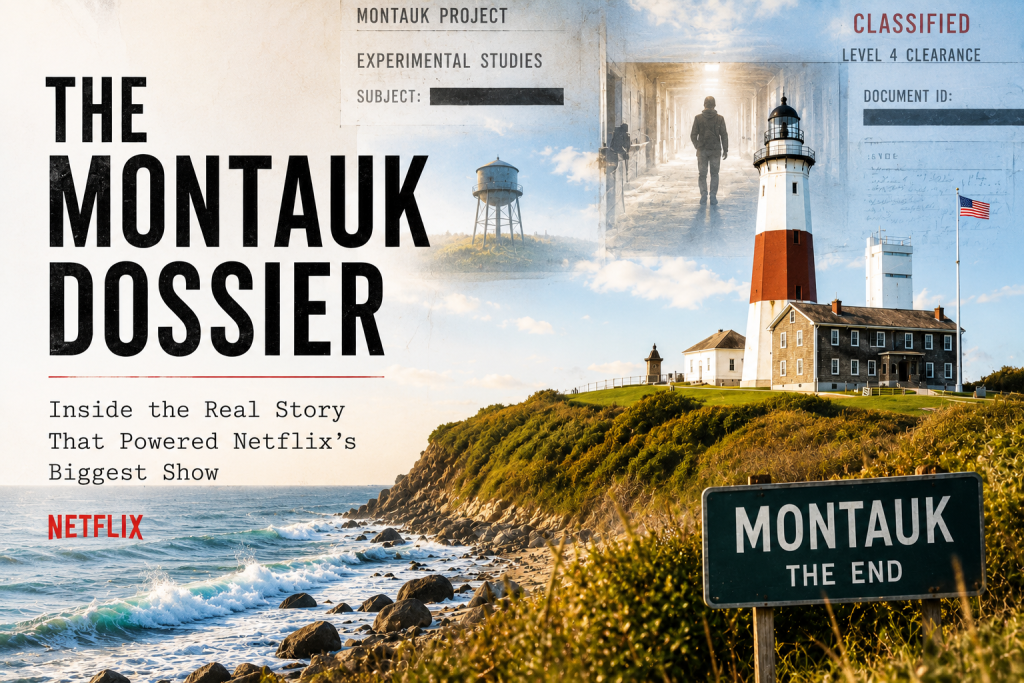
The Show Was Never Supposed to Be Set in Indiana
Before Eleven and the Upside Down. Before 140 million views made Stranger Things the second most-watched English-language series in Netflix history, the show had a different name. In fact, it was called Montauk. And it was set right here, Out East.
The Montauk Project is the conspiracy theory that launched a billion-dollar franchise. According to its believers, the U.S. military ran secret experiments in mind control, time travel, and psychic warfare at Camp Hero on the eastern tip of the South Fork. Children were allegedly abducted. Portals were supposedly opened. A creature from another dimension was reportedly unleashed.
None of it has been proven. But the Duffer Brothers read the story and turned it into the biggest show on the planet. Then, in the series finale that aired New Year’s Eve 2025, they brought it all back to where it started. Hopper told Joyce he wanted to move to Montauk. Fans erupted. As a result, the internet screamed spinoff.
The Duffers shut it down. “There’s no Montauk spinoff,” Ross Duffer told Collider. “That was more of a wink to the fans.”
But here’s what the wink accomplished. It reminded tens of millions of people that every thread of the Stranger Things mythology traces back to one place. Specifically, a decommissioned Air Force station, a 90-foot radar tower, and a quiet fishing village at The End that has never been as quiet as it looks.
Camp Hero: The Base That Became a Legend
Camp Hero sits on 755 acres of wooded land at Montauk Point. Today it operates as a New York State Park. Visitors pay eight dollars to drive in. From the main road, you can walk past sealed buildings covered in “Do Not Enter” signs. Hiking trails also run along 75-foot Atlantic bluffs. On a clear day, the Montauk Lighthouse is visible from the park’s eastern edge.
But before the hiking trails and the parking fee, this was a military installation with a history that stretches back over a century. During the Spanish-American War in 1898, thousands of U.S. soldiers returning from Cuba were quarantined at Montauk because of malaria outbreaks. The remote location made it ideal for isolating sick troops far from population centers.
Later, in World War II, the base was expanded into a full coastal defense station and disguised as a fishing village to avoid aerial detection. Artillery bunkers were built into the bluffs. Gun emplacements pointed toward the Atlantic. After the war, the facility was repurposed for Cold War surveillance, and the installation that conspiracy theorists now call the Montauk Project’s headquarters took shape.
The Radar Tower
The most recognizable structure at Camp Hero is certainly the AN/FPS-35 radar tower. Built during the Cold War, it stands roughly 90 feet tall with a 40-foot steel dish. Its original mission was simple: scan the Atlantic for Soviet submarines and incoming threats.
Of the 12 such towers once scattered across the country, Camp Hero’s is the only one still standing. It eventually became a National Historic Landmark. Although the radar has been inactive since the base was decommissioned in 1981, visitors report that the dish still changes position on its own. Nobody has explained why.
Underground
According to conspiracy believers, the real action happened below ground. Preston Nichols claimed in his 1992 book that secret laboratories extended as many as 12 levels beneath the radar tower. Hundreds of workers allegedly operated in these facilities, yet the town of Montauk supposedly never noticed the construction materials or personnel.
Urban explorers over the years have also reported finding sealed tunnels, unusual documents, and graffiti reading “Stranger Help Me” inside restricted areas of the park. Still, officials insist nothing is hidden. The sealed buildings and fenced perimeters remain. So do the questions.
The Book That Started Everything
In 1992, a man named Preston B. Nichols self-published a book called The Montauk Project: Experiments in Time. It changed the trajectory of American conspiracy culture. Eventually, it also changed television. The book spawned three sequels, a documentary library, a community of self-identified “Montauk survivors,” and an online mythology that grew for two decades before the Duffer Brothers ever heard of it.
Nichols claimed to have recovered suppressed memories of his time as a researcher at Camp Hero. According to his account, the classified program involved experiments in mind control and telepathy. It also allegedly included opening space-time portals to other dimensions. Perhaps most disturbingly, Nichols described the abduction of children from surrounding communities.
Duncan Cameron and the Monster
At the center of Nichols’ narrative was a man named Duncan Cameron, described as possessing genuine psychic abilities. Believers claim Cameron could open time portals with his mind. According to the book, one experiment went catastrophically wrong. Cameron allegedly summoned a creature from his own subconscious into physical existence. As a result, the creature went on a rampage.
After that incident, the underground facilities were supposedly flooded with cement. The project was then shut down. Everyone involved allegedly had their memories erased using electromagnetic frequencies.
Nichols and his co-author Peter Moon knew exactly what they were doing with the ambiguity. In their first chapter, they wrote: “Whether you read this as science fiction or non-fiction, you are in for an amazing story.” Although Preston Nichols died in 2018, his book remains in print. Its influence keeps growing.
The Philadelphia Experiment: Where the Timeline Begins
The Montauk Project mythology doesn’t start in Montauk. Instead, according to conspiracy theorists, it started in Philadelphia in 1943 with an experiment on a Navy destroyer escort called the USS Eldridge. Believers insist that everything at Camp Hero was a continuation of research that began during World War II.
Known as the Philadelphia Experiment, it stands as one of America’s oldest military conspiracy theories. The basic claim: the U.S. Navy attempted to make the Eldridge invisible to radar. But the experiment allegedly went further than planned. Instead of simply disappearing from radar, the ship reportedly vanished entirely. It supposedly teleported from Philadelphia to Norfolk, Virginia, then reappeared.
The Human Cost
The consequences for the crew were allegedly horrific. Sailors reportedly fused into the ship’s bulkheads. Others suffered permanent psychological damage. Some supposedly vanished entirely. Yet no credible evidence supports any of this. Indeed, the Navy has publicly denied the experiment ever occurred.
Still, the story gained traction for decades. In 1984, a B-movie called The Philadelphia Experiment dramatized the legend. When a man named Al Bielek watched the film in 1988, he claimed to experience overwhelming memories of participating in the original experiment. Bielek then connected his “recovered memories” to the Montauk Project, specifically asserting that survivors from the 1943 test were transferred to Camp Hero for continued research.
This narrative bridge, however implausible, gave the Montauk mythology a deeper timeline. It also gave the Duffer Brothers a richer story to draw from when they eventually began developing their show.
MKUltra: The Part That Was Actually Real
Here’s where the conspiracy meets documented history. While the Montauk Project remains unverified, the CIA’s Project MKUltra was certainly real. Declassified documents confirm everything the conspiracy theorists claimed about it (and then some).
MKUltra launched in the early 1950s as a program to develop mind control techniques for Cold War intelligence operations. Specifically, the CIA tested LSD, sensory deprivation, electroshock therapy, and hypnosis on unwitting American citizens. Over 80 institutions participated, including universities, hospitals, and prisons. Most of the program’s records were destroyed in 1973. What survived came to light through congressional investigations and a cache of 20,000 misfiled budget documents found via a Freedom of Information Act request in 1977.
Eleven’s Origin Story
In Stranger Things, MKUltra is indeed referenced by name. Chief Hopper discovers that Eleven’s mother, Terry Ives, was an unwitting MKUltra test subject while pregnant. Dr. Brenner’s experiments at Hawkins National Laboratory are essentially a fictionalized extension of the real program. Matt Duffer told Vulture that the show grew out of conversations about “mysterious government experiments at the tail end of the Cold War.”
The overlap between fiction and reality is precise. MKUltra’s sensory deprivation tanks became Eleven’s flotation chamber. Similarly, the program’s documented use of children in testing became the show’s most disturbing plot element. The CIA’s destruction of evidence also became the government cover-up that drives the show’s entire narrative.
After MKUltra officially ended in the 1970s, the CIA continued psychic research through the Stargate Project (1978-1995), which investigated “remote viewing” as an intelligence tool. Remote viewers were tasked with describing distant locations using only their minds. Some sessions allegedly produced accurate intelligence on Soviet military facilities. Stranger Things is set in 1983, squarely in the Stargate era. Eleven’s abilities mirror the remote viewing capabilities the CIA was actively trying to develop. In other words, this wasn’t ancient history. It was happening in real time.
How the Duffer Brothers Built the Show
The creative pipeline from Montauk to Hawkins is well documented. Matt and Ross Duffer initially became fascinated with the Montauk Project conspiracy while researching Cold War-era government programs. Their first concept was a found-footage film called The Montauk Experiment, featuring a character closely modeled on Duncan Cameron.
The pilot script was set in Montauk in 1980. Initially, Hopper was a conspiracy-obsessed projectionist investigating Camp Hero. The show’s working title was simply Montauk. David Harbour, who ultimately played Hopper, said in a 2025 interview that he thought the original title was “so strong.”
The Name Change
Several factors drove the shift to Hawkins, Indiana. The Duffers wanted a suburban Spielberg feel that Montauk’s coastal setting couldn’t provide. In addition, a plagiarism lawsuit from filmmaker Charlie Kessler (who had produced a short film called The Montauk Project) complicated the use of the name. The time period also moved from 1980 to 1983 to align with the release of Red Dawn, a Cold War paranoia film that influenced the show’s tone.
But the DNA stayed pure Montauk. Hawkins National Laboratory is essentially Camp Hero. Eleven is the Montauk Boys. The Upside Down is the portal that Duncan Cameron allegedly opened with his mind. The Duffer Brothers recently appeared on the Happy Sad Confused podcast in May 2026 to discuss the name change, confirming that the Montauk inspiration was indeed foundational from day one.
The Series Finale: Full Circle
On New Year’s Eve 2025, the Stranger Things series finale (“Chapter Eight: The Rightside Up”) gave Montauk its moment in front of the largest audience in the show’s history. Season 5 aired across three premiere windows, with the first four episodes dropping on November 26, three more on Christmas Day, and the two-hour finale closing out the year. Netflix reportedly crashed under the traffic volume.
In the epilogue, Hopper sits across from Joyce at Enzo’s restaurant. He reveals that he’s been offered a new position as Chief of Police in Montauk. He then asks her to move there. She says yes. It’s a quiet scene. But for fans who knew the show’s origin story, it was seismic.
The Spinoff That Isn’t
Fan reaction was instant and especially intense. Social media platforms flooded with theories about a Montauk-set spinoff. Dan’s Papers ran a feature about the “full circle moment for Hamptonites.” Patch also published local resident accounts of growing up near Camp Hero.
Ross Duffer put it to rest in interviews with both Collider and Deadline. “There’s no Montauk spinoff,” he confirmed. “This is the end of the story of these characters.” Matt Duffer added that the Montauk reference was Ross’s idea, and he’d warned that fans would certainly misinterpret it. “But I actually think it’s really cute,” Matt said. “I’m glad we have it.”
The franchise isn’t over, though. Netflix has an animated spinoff (Stranger Things: Tales from ’85) set for 2026 and also a live-action spinoff with “a different mythology” in development. Every new release will send millions of fans back to the origin story. Back to the Montauk Project.
The Conspiracy Corridor: What Else Is Out Here
Camp Hero isn’t the only mysterious facility on the East End. Indeed, within a 50-mile radius, you’ll find at least three other sites that have fueled decades of conspiracy speculation. Taken together, they form what might be called the East End’s conspiracy corridor: a stretch of Long Island coastline that has hosted more classified government programs, secret laboratories, and unexplained incidents per square mile than anywhere else in America. Each site feeds the others’ mythology. And each one connects back to the Montauk Project in ways that keep the conspiracy community producing content year after year.
Plum Island
Sitting just off the North Fork in Long Island Sound, Plum Island has housed a federal Animal Disease Center since 1954. Its official mission involves protecting U.S. livestock from foreign diseases. But the conspiracy version involves Nazi scientist Erich Traub (recruited through Operation Paperclip), biological warfare experiments, and the accidental release of Lyme disease. Now the facility is being decommissioned. Eventually, the island will become one of the biggest parcels of available real estate on Long Island Sound.
The Montauk Monster
In July 2008, a hairless, bloated carcass with a beak-like snout washed ashore at Ditch Plains beach. Soon after, Gawker published a post titled “Dead Monster Washes Ashore in Montauk.” Fox News picked it up. Conspiracy theorists then linked the creature to Plum Island experiments, since the facility sits just miles away. A cryptozoologist arrived to examine it. But the body vanished before any formal analysis could be completed. Experts later suggested it was a decomposed raccoon. Still, the legend persists.
Tesla’s Wardenclyffe Tower
In 1901, Nikola Tesla built a 187-foot transmission tower in Shoreham, Long Island, because he believed he could transmit free wireless energy to the entire planet. J.P. Morgan initially funded the project but later pulled support when he realized free energy eliminated the need for meters. The tower was demolished in 1917. Although the laboratory building still stands, it sat neglected for decades before being added to the National Register of Historic Places. Conspiracy theorists have since connected Tesla’s electromagnetic research to the Camp Hero radar experiments. The Tesla Science Center at Wardenclyffe is currently developing a museum on the grounds.
The Montauk Experience: What to See Now
Camp Hero State Park is open year-round. The eight-dollar vehicle entry fee gets you onto the paved roads of the former military base. You can walk past the sealed barracks and also explore the abandoned bowling alley. The radar tower stands behind a fence but is clearly visible from multiple angles. The bluffs at Turtle Cove offer some of the most dramatic ocean views on the South Fork.
New York State Parks recently announced a request for proposals to develop camping and glamping facilities on the grounds. Since the Stranger Things finale aired, fans have been making the pilgrimage in growing numbers. TripAdvisor reviews consistently reference the show. Travel bloggers have also produced detailed guides framing Camp Hero as essential Montauk content. For the visitor who grew up watching Eleven fight monsters in a fictional Indiana town, standing in front of the real radar tower at sunset is a different kind of experience entirely. You can feel why the Duffers started here.
Beyond Camp Hero
Montauk itself has become one of the most sought-after destinations on the East End. Gurney’s Resort and Seawater Spa sits on the oceanfront. The Surf Lodge draws the sunset crowd. Duryea’s Lobster Deck serves lunch on the dock at Fort Pond Bay. And Ditch Plains, where the Montauk Monster washed ashore, still offers some of the best surfing on the Atlantic coast.
Andy Warhol bought a compound here in 1972 for $225,000 and named it Eothen, from the Greek for “from the east.” Jackie Onassis spent a summer there with her children, Caroline and John Jr. The Rolling Stones rehearsed in the main house while groupies hid in the bushes outside. Liza Minnelli, Elizabeth Taylor, John Lennon, and Halston were all regulars. Truman Capote drank vodka on the porch while the rest of the crowd sipped French rose. Today the property is valued at approximately $85 million. It’s a celebrity origin story in itself.
Montauk was never just a fishing village. Initially, it was a military installation disguised as a fishing village. Then it became a conspiracy theory disguised as a state park. Later, it became a Netflix show disguised as fiction. Now, of course, it’s all of those things at once. And if the Stranger Things franchise keeps expanding (which it will), Montauk’s role in the story will only grow louder.
Where the Conversation Continues
If the Montauk Dossier tells you anything, it’s that the best stories are the ones with roots. The Montauk Project started as whispered lore at the end of Long Island. It became a self-published book, then a Netflix pitch. Eventually it became a global franchise. And ultimately it became a cultural moment that put Montauk in front of every streaming household on Earth.
Social Life Magazine has covered the East End for 23 years. Five summer issues hit newsstands from Memorial Day through Labor Day, reaching 25,000 readers per issue from Westhampton to Montauk. Our Fall and Winter issues also go to 15,000 Upper East Side doorman buildings. The stories that matter Out East land here first.
If you have a story, a brand, or a project that belongs in these pages, reach out at sociallifemagazine.com/contact.
For brands looking for premium editorial placement, our paid feature submission portal is open at sociallifemagazine.com/submit-a-paid-feature/.
Stay in the loop with our weekly email blast covering events, openings, and who’s doing what Out East. Sign up at enflyer.sociallifemagazine.com.
Polo Hamptons 2026 returns to Bridgehampton on July 18 and July 25 with BMW as title sponsor. For event details and sponsorship opportunities, visit polohamptons.com.
Never miss a feature, a profile, or a party recap. Subscribe to Social Life Magazine at sociallifemagazine.com/subscription.
If the work we do matters to you, you can support independent East End journalism directly via PayPal.
Author

Written by
Recent Posts

hiTechMODA Season 16
How to Keep Your Personal Number Private When Booking Events, Rentals and Services
Understanding Compensatory Damages in a Personal Injury Case

When Online Family Therapy Makes Sense for Modern Families

Carrier Oils, Essential Oils, and Oil Blends: What Beauty Brands Need to Know
Categories
- Art
- Articles
- Business of Luxury
- Celebrities
- Culture
- Entertainment
- Events
- Faces of Summer 2026
- Fashion
- Fashion & Style
- Featured
- Finance
- Food, Spirits, Wine
- Hamptons
- Hamptons Celebrities
- Health
- Health & Beauty
- Lifestyle
- Luxury Lifestyle
- Press
- Profiles
- Real Estate
- Technology
- The Chronicles
- Travel
- Uncategorized
- Weddings