
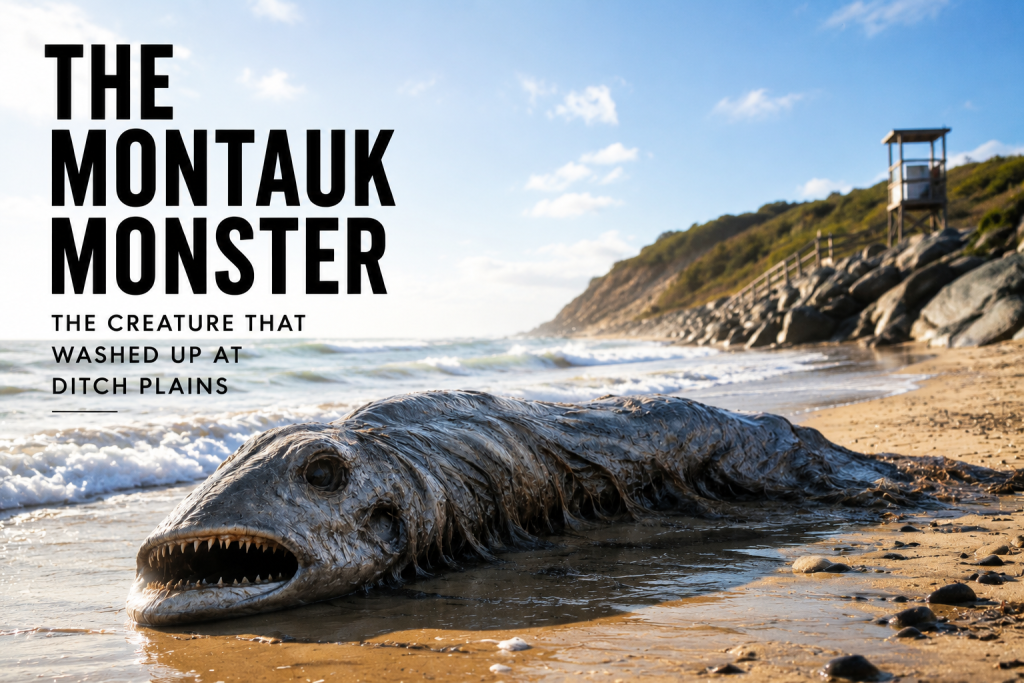
Something Washed Up at Ditch Plains
On July 12, 2008, Jenna Hewitt and three friends were walking along Ditch Plains beach in Montauk when they spotted something that didn’t belong. Lying on the sand near the Surfside restaurant was a carcass. It was hairless, bloated, and roughly the size of a large dog. But it didn’t look like a dog.
Instead of a snout, the creature appeared to have a beak. Its limbs ended in elongated, claw-like digits. In addition, the skin was smooth and leathery, stripped of fur. The eye sockets were hollow. In fact, nothing about the creature matched any animal Hewitt recognized. She took a photograph. Soon after, that single image would reach millions of people. And the Montauk Monster would become one of the strangest mysteries on the East End.
The creature washed ashore at one of Montauk’s most popular beaches, just two miles from Camp Hero State Park, the former military base that inspired Netflix’s Stranger Things. It landed in a community already steeped in conspiracy lore. Indeed, the timing, the location, and the sheer weirdness of the carcass were enough to turn a dead animal into a global news event.
How the Story Went Viral
The East Hampton Independent was the first outlet to cover the discovery. Their headline played it for local charm: “The Hound of Bonacville,” a nod to the nearby Bonacker community and Conan Doyle’s classic. The story made some local waves but initially stayed small.
Then Gawker got involved. On July 29, 2008, the site published a brief post titled “Dead Monster Washes Ashore in Montauk.” The article was only 87 words long and heavily suggested the whole thing was a marketing stunt. But the photograph did all the work. It showed a creature that defied easy identification, lying on a patch of sand with rocks scattered around it.
The image spread across blogs, email chains, and early social media platforms within days. Fox News ran segments. Eventually, the Huffington Post picked it up too. Cryptozoologist Loren Coleman at the blog Cryptomundo coined the name “Montauk Monster” on July 29, and the term stuck immediately. By August, the story had gone international. A dead animal on a Montauk beach had become front-page news.
What Did People Think It Was?
Theories ranged from the plausible to the genuinely unhinged. Specifically, the speculation broke down into roughly four camps, each with its own logic and its own audience.
The Plum Island Theory
This was the theory that gained the most traction in conspiracy circles. Plum Island sits just off the North Fork in Long Island Sound, approximately 10 miles from Ditch Plains. Since 1954, the federal government has operated the Plum Island Animal Disease Center there. Its official mission involves studying foreign animal diseases to protect U.S. livestock.
But Plum Island has its own conspiracy mythology. Critics have long alleged that the facility conducted biological warfare experiments, including work by Nazi scientist Erich Traub, who was reportedly recruited through Operation Paperclip after World War II. Some researchers have also connected the island to the emergence of Lyme disease, since the first documented outbreak occurred in nearby Lyme, Connecticut.
For Montauk Monster believers, the proximity was too perfect to ignore. A mysterious creature washes ashore just miles from a classified government biolab? The implication was obvious, even if the evidence was not. Jesse Ventura’s show Conspiracy Theory later dedicated an entire episode to the Plum Island connection.
The Alien and Cryptid Theories
Some observers went further. Online forums and early YouTube channels speculated that the creature was an extraterrestrial, a previously undiscovered species, or something that had escaped from the underground laboratories allegedly beneath Camp Hero. These theories drew a direct line between the Montauk Monster and the Montauk Project conspiracy, suggesting that experiments at the former Air Force station had produced biological anomalies.
While no credible evidence supported any of these claims, they kept the story alive in conspiracy communities for years. The Montauk Monster became a permanent fixture in cryptozoology forums alongside Bigfoot, the Chupacabra, and the Loch Ness Monster.
The Marketing Stunt Theory
Gawker’s initial post suggested that the whole event might be a publicity stunt, possibly tied to a viral marketing campaign for a film or product launch. This theory circulated widely but was never confirmed. No company or production ever claimed responsibility. If it was a stunt, whoever designed it left money on the table by staying silent.
The Decomposed Raccoon Theory
Scientists and veterinary experts who examined the photographs generally agreed on a far less exciting explanation. The creature’s skeletal structure, tooth pattern, and limb proportions were consistent with a raccoon that had undergone extensive decomposition in saltwater. Marine exposure strips fur, softens tissue, and distorts facial features in ways that can make familiar animals look alien.
The “beak” that captivated viewers was likely the exposed upper jaw of a raccoon after the lips and soft tissue had decomposed. The elongated fingers were consistent with raccoon paws after skin shrinkage. Several experts concluded that the Montauk Monster was almost certainly a waterlogged raccoon.
But there was a problem with certainty. No physical examination ever took place.
The Body That Vanished
This is the detail that keeps the Montauk Monster alive in conspiracy culture. After the photographs went viral and media attention intensified, the carcass disappeared.
According to Hewitt, the last person to see the body was a local man who claimed to have taken it to the woods behind his house. When reporters and curiosity seekers tried to track down the carcass, they hit dead ends at every turn. The man was never publicly identified. The body was never recovered. No formal necropsy or DNA analysis was ever performed.
Without physical evidence, definitive identification became impossible. Experts could only speculate based on photographs. And photographs, as anyone who has followed internet mysteries knows, are never enough to settle anything. The absence of a body turned a potential non-story (dead raccoon found on beach) into an enduring legend with just enough ambiguity to survive indefinitely.
Why Ditch Plains?
Ditch Plains is not a random beach. It’s one of the most iconic stretches of coastline on the South Fork, especially among surfers. The break at Ditch Plains is known for its long, rolling waves that are perfect for longboarding and intermediate riders. On any given summer day, the lineup is packed.
The beach sits at the eastern end of Montauk, roughly two miles west of Camp Hero State Park and the radar tower that ultimately inspired Stranger Things. It’s also part of the Rheinstein Estate Park, owned by the town of East Hampton. The Surfside restaurant, near where Hewitt found the carcass, is a local landmark.
For anyone already familiar with the Montauk Project conspiracy, a mysterious creature washing ashore at Ditch Plains felt like confirmation. The beach sits in the geographic sweet spot between Camp Hero (alleged government experiments) and Plum Island (alleged biological warfare). The Montauk Monster landed in precisely the location most likely to generate maximum conspiracy fuel.
The Aftermath
Since 2008, similar carcasses have washed up on American and Canadian shores. In some Indigenous communities, these creatures are called omajinaakoos, meaning “the ugly one,” and are considered omens of bad luck. Each new discovery briefly reignites interest in the original Montauk Monster.
The story has been featured on National Geographic’s Wild X Files, multiple YouTube documentaries, and at least one low-budget horror film. It remains a reliable traffic driver for conspiracy blogs and a permanent entry in the Montauk mythology.
In 2009, a man came forward through blogger Drew Grant claiming that he and his friends had created the Montauk Monster. According to his account, they found a dead raccoon on nearby Shelter Island, placed it on an inflatable toy duck, set the whole thing on fire, and pushed it out to sea. The carcass allegedly washed ashore at Ditch Plains two weeks later. But this explanation raised its own questions. Would a burned, waterlogged raccoon look like the creature in Hewitt’s photograph? And why did the body disappear so quickly after going viral?
Like everything connected to Montauk, the answers created more questions. The Montauk Monster remains officially unidentified.
The Conspiracy Corridor Runs Through Ditch Plains
The Montauk Monster doesn’t exist in isolation. It belongs to a broader pattern of unexplained events and government secrecy on the East End that stretches back decades. Camp Hero’s alleged underground laboratories sit two miles to the east. Plum Island’s classified research facility sits 10 miles to the north. Tesla’s demolished Wardenclyffe Tower, where he attempted to transmit free wireless energy before J.P. Morgan shut him down, stood 70 miles to the west in Shoreham.
Each of these sites feeds the others’ mythology. The Montauk Project conspiracy gives Plum Island a darker context. Plum Island gives the Montauk Monster a plausible (if unproven) origin story. The Monster gives Camp Hero visitors one more reason to glance nervously at the sealed buildings behind the fences. And all of it gave the Duffer Brothers the raw material for a show that changed television.
Ditch Plains beach is still open. The surfing is still excellent. The sunset still stops traffic on Old Montauk Highway. And if something strange washes up on the sand again, you can be sure the internet will know about it before the tide goes out.
Where the Conversation Continues
The Montauk Monster is one chapter in a much larger story about what’s been happening at the end of Long Island for over a century. Social Life Magazine has covered the East End for 23 years, from Memorial Day through Labor Day and beyond. Five summer issues reach 25,000 readers per issue from Westhampton to Montauk. Our Fall and Winter editions also go to 15,000 Upper East Side doorman buildings.
If you have a story, a brand, or a project that belongs in these pages, reach out at sociallifemagazine.com/contact.
For brands looking for premium editorial placement, our paid feature submission portal is open at sociallifemagazine.com/submit-a-paid-feature/.
Stay in the loop with our weekly email blast covering events, openings, and who’s doing what Out East. Sign up at enflyer.sociallifemagazine.com.
Polo Hamptons 2026 returns to Bridgehampton on July 18 and July 25 with BMW as title sponsor. For event details and sponsorship opportunities, visit polohamptons.com.
Never miss a feature, a profile, or a party recap. Subscribe to Social Life Magazine at sociallifemagazine.com/subscription.
If the work we do matters to you, you can support independent East End journalism directly via PayPal.
Author

Written by
Recent Posts

hiTechMODA Season 16
How to Keep Your Personal Number Private When Booking Events, Rentals and Services
Understanding Compensatory Damages in a Personal Injury Case

When Online Family Therapy Makes Sense for Modern Families

Carrier Oils, Essential Oils, and Oil Blends: What Beauty Brands Need to Know
Categories
- Art
- Articles
- Business of Luxury
- Celebrities
- Culture
- Entertainment
- Events
- Faces of Summer 2026
- Fashion
- Fashion & Style
- Featured
- Finance
- Food, Spirits, Wine
- Hamptons
- Hamptons Celebrities
- Health
- Health & Beauty
- Lifestyle
- Luxury Lifestyle
- Press
- Profiles
- Real Estate
- Technology
- The Chronicles
- Travel
- Uncategorized
- Weddings