
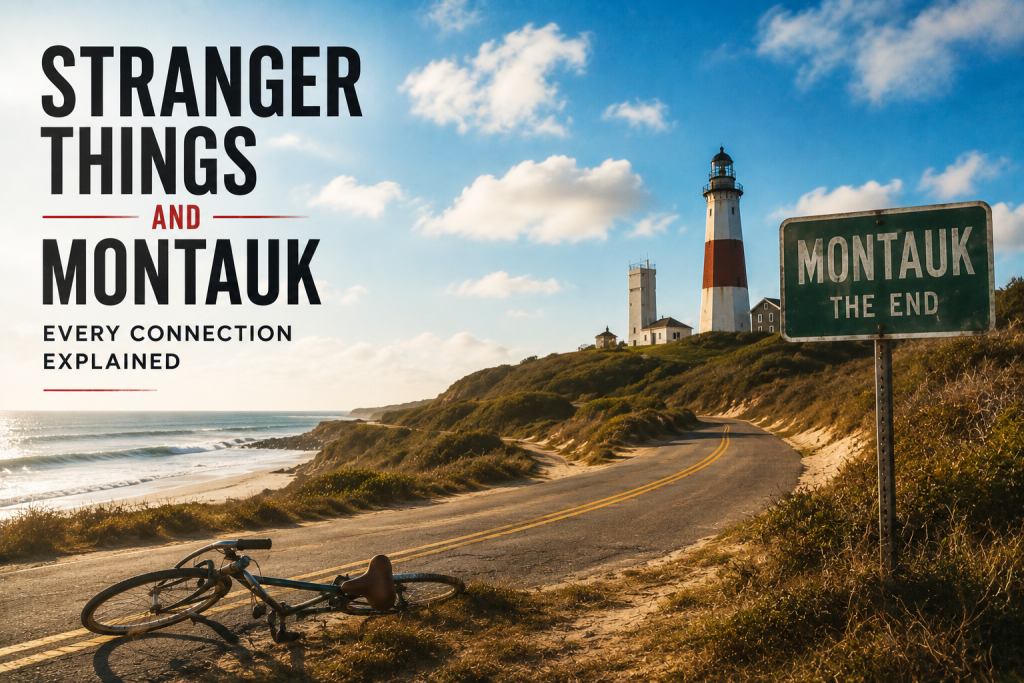
Hopper Said “Montauk” and the Internet Lost Its Mind
In the final minutes of the Stranger Things series finale, Jim Hopper sits across from Joyce Byers at Enzo’s restaurant. He tells her he’s been offered a new job. Chief of Police. In Montauk. He asks her to move there with him. She says yes. It’s a quiet scene in a two-hour episode full of explosions and interdimensional warfare. But for fans who knew the show’s origin story, that single word landed harder than anything the Upside Down ever threw at Hawkins.
Because Stranger Things was never supposed to be set in Indiana. The show was originally titled Montauk. It was set on the East End. And every major plot element, from the secret government laboratory to the psychic children to the creature from another dimension, traces directly back to a real conspiracy theory about a decommissioned Air Force station at the tip of the South Fork.
Here’s every connection between Stranger Things and Montauk, from the original pilot script through the Season 5 finale and beyond.
The Show Was Originally Called “Montauk”
Before Hawkins, Indiana existed in the cultural imagination, the Duffer Brothers pitched their show under a different name. Initially, the working title was simply Montauk. The setting was Long Island, not the Midwest. And the year was 1980, not 1983.
Matt and Ross Duffer became fascinated with the Montauk Project conspiracy while researching Cold War-era government programs. Their initial concept was a found-footage film called The Montauk Experiment, built around a character closely modeled on Duncan Cameron, a man who allegedly possessed psychic abilities and opened portals at Camp Hero. That concept eventually evolved into a serialized television pitch.
In a 2025 interview, David Harbour (who plays Hopper) revealed that he thought the original title “Montauk” was “so strong.” The Duffer Brothers discussed the name change on the Happy Sad Confused podcast in May 2026, confirming that the Montauk inspiration remained foundational even after the setting shifted to fictional Hawkins.
Why the Name Changed
Several factors pushed the Duffers away from the Montauk setting. First, they wanted a suburban Spielberg aesthetic, specifically the small-town, bike-riding, walkie-talkie energy of films like E.T. and Stand By Me. Montauk’s coastal landscape didn’t quite fit that visual template.
In addition, filmmaker Charlie Kessler filed a plagiarism lawsuit against the brothers, alleging they had borrowed from his short film The Montauk Project. Although the suit was eventually dismissed, it complicated the use of the name during the show’s early development. The time period also moved from 1980 to 1983, specifically to align with the release of Red Dawn, a Cold War paranoia film that influenced the show’s tone.
But the DNA stayed pure Montauk. The Duffers changed the geography and the title. They didn’t change the story.
The Original Pilot: A Very Different Show
The Montauk-era pilot script looked significantly different from what eventually aired in July 2016. Hopper was originally conceived as a conspiracy-obsessed projectionist at a local movie theater, described in early notes as having “the looks of a serial killer” with “balding hair and big oval glasses.”
In that version, Hopper (then called Terry Ives in some early materials) had been investigating Camp Hero for a decade. He was initially derided by other characters as a paranoid loner. But he ultimately became “an unexpected, albeit reluctant, hero in the dark days ahead.” The character arc was eventually split between Hopper the cop and Terry Ives the mother, who became Eleven’s biological parent and an MKUltra test subject.
The pilot was also set in early October 1980, not November 1983. The first episode took place during the week of Halloween, giving the original version a seasonal horror flavor that the final show only incorporated in its second season. These changes, while significant on the surface, still left the core Montauk mythology intact beneath the Indiana veneer.
Camp Hero Is Hawkins National Laboratory
The parallels between the real Camp Hero and the fictional Hawkins National Laboratory are not subtle. Both are government facilities operated on the outskirts of small communities. Each allegedly conducted classified experiments on human subjects. Both feature underground levels and restricted corridors. And both serve as the origin point for interdimensional threats.
Camp Hero’s AN/FPS-35 radar tower, the last of its kind still standing in America, is essentially the visual prototype for the Hawkins Lab facility. In the Montauk Project conspiracy, Preston Nichols claimed the radar array was modified to operate at 410-420 MHz frequencies for the purpose of generating psychic phenomena. In Stranger Things, Hawkins Lab uses electromagnetic equipment to amplify Eleven’s abilities.
Brookhaven National Laboratory, a real Department of Energy facility approximately 60 miles west of Camp Hero, adds another layer. The Long Island Press has noted that both facilities “are steeped in mystery” and “both feature mind-blowing facilities and equipment.” In the Montauk mythology, Brookhaven is sometimes referenced as a secondary research site connected to the Camp Hero experiments.
Eleven Is the Montauk Boys
The most disturbing element of the Montauk Project conspiracy involves the alleged abduction and experimentation on children, known in conspiracy circles as “the Montauk Boys.” According to Preston Nichols’ account, children were taken from surrounding communities and subjected to electromagnetic frequency experiments in underground laboratories beneath the radar tower. They were supposedly programmed into psychic soldiers.
Eleven’s origin story in Stranger Things maps directly onto this narrative. She is a child raised in captivity inside a government laboratory. Her psychic abilities were developed through experimentation. She was used as a weapon. When she eventually escaped, the laboratory tried to recapture her. The fictional version softens the conspiracy’s darkest implications, but the structural parallels are unmistakable.
In fact, the show makes the connection explicit. In Season 1, we learn that Eleven’s mother was a participant in the real CIA program MKUltra. Dr. Brenner’s experiments on Terry Ives while she was pregnant gave Eleven her abilities. The show doesn’t just borrow from the Montauk mythology. It weaves documented history (MKUltra) into conspiracy fiction (the Montauk Project) to create something that feels uncomfortably plausible.
The Upside Down Is the Portal
In the Montauk Project narrative, Duncan Cameron allegedly used his psychic abilities to open a portal to another dimension during an experiment at Camp Hero. According to Preston Nichols, Cameron’s subconscious mind materialized a creature that physically entered the laboratory. As a result, the experiment spiraled out of control. A creature caused destruction throughout the facility. According to Nichols, the underground complex was supposedly sealed with cement.
In Stranger Things, Eleven opens a gate to the Upside Down during a sensory deprivation experiment at Hawkins Lab. A creature (the Demogorgon) enters the physical world through the portal. Hawkins Lab loses control of the situation. In fact, the parallel is almost one-to-one. Essentially, the Duffer Brothers took the climactic event of the Montauk Project conspiracy and used it as the inciting incident for their entire series.
Even the geography echoes. In the conspiracy, the portal opens beneath a radar tower at the eastern tip of Long Island. In the show, the gate opens beneath a government laboratory in a small Midwestern town. Both locations are presented as ordinary places hiding extraordinary (and terrifying) secrets underneath.
The Season 5 Finale: Coming Home
Season 5 of Stranger Things aired across three premiere windows in late 2025. Volume 1 dropped on November 26 (four episodes). Volume 2 arrived on Christmas Day (three episodes). The two-hour finale, “Chapter Eight: The Rightside Up,” closed out the year on New Year’s Eve. Netflix reportedly crashed under the traffic volume.
In the epilogue, after the final battle with Vecna, the show checks in with its surviving characters. Hopper and Joyce sit at Enzo’s, the restaurant that defined their relationship across the series. Hopper reveals his plan to become Chief of Police in Montauk. He proposes. Joyce accepts. They agree to leave Hawkins for good.
Fan reaction was immediate. Social media platforms erupted with theories about a Montauk-set spinoff. Dan’s Papers ran a feature noting the “full circle moment” for East End residents. Patch published accounts from locals who had grown up near Camp Hero. Eagle-eyed fans also recognized that the Montauk reference functioned as both a romantic ending and a meta-textual callback to the show’s origins.
The Duffers Shut Down the Spinoff Rumors
Ross Duffer addressed the speculation directly in interviews with both Collider and Deadline. “There’s no Montauk spinoff,” he confirmed. “That was more of a wink to the fans, deep-cut fans.” Matt Duffer admitted he’d warned his brother that fans would misinterpret the reference. “But I actually think it’s really cute,” Matt said. “I’m glad we have it.”
Still, the franchise continues to expand. Netflix has an animated spinoff called Stranger Things: Tales from ’85 set for release later in 2026. A live-action spinoff with “a different mythology” is also in development, although its setting and characters remain under wraps. The Duffers have hinted at an Easter egg in Season 5 that points to the spinoff concept, but they’ve been deliberately vague about which scene contains the clue.
What It Means for Montauk
The Stranger Things franchise generates approximately 20 million searches per month according to SEMrush data. Even a fraction of that search volume flowing toward Montauk-related queries represents significant attention for the East End. Camp Hero State Park has seen increased visitor traffic since the finale aired. TripAdvisor reviews consistently reference the show. Travel bloggers have published fresh guides framing Camp Hero as a must-visit destination.
New York State Parks has also announced a request for proposals to develop camping and glamping concessions at Camp Hero. The combination of Stranger Things tourism, the park’s natural beauty (75-foot Atlantic bluffs, views of the Montauk Lighthouse), and the conspiracy mystique creates a destination experience that no other state park on the East Coast can match.
Montauk was already one of the South Fork’s most coveted destinations. Gurney’s sits on the oceanfront. Duryea’s serves lobster on the dock. Ditch Plains draws surfers from across the Northeast. Andy Warhol’s former compound sold for $85 million. But the Stranger Things connection adds a cultural layer that transcends the typical beach-town appeal. It gives Montauk a mythology. And mythologies, unlike beach seasons, don’t end in September.
Where the Conversation Continues
Stranger Things and Montauk will be connected forever. The show started here, in the conspiracy lore of Camp Hero and the pages of Preston Nichols’ book. It ended here, with Hopper choosing Montauk as the place to begin again. Social Life Magazine has covered the East End for 23 years, and the stories that matter Out East land in these pages first.
If you have a story, a brand, or a project that belongs in these pages, reach out at sociallifemagazine.com/contact.
For brands looking for premium editorial placement, our paid feature submission portal is open at sociallifemagazine.com/submit-a-paid-feature/.
Stay in the loop with our weekly email blast covering events, openings, and who’s doing what Out East. Sign up at enflyer.sociallifemagazine.com.
Polo Hamptons 2026 returns to Bridgehampton on July 18 and July 25 with BMW as title sponsor. For event details and sponsorship opportunities, visit polohamptons.com.
Never miss a feature, a profile, or a party recap. Subscribe to Social Life Magazine at sociallifemagazine.com/subscription.
If the work we do matters to you, you can support independent East End journalism directly via PayPal.
Author

Written by
Recent Posts

hiTechMODA Season 16
How to Keep Your Personal Number Private When Booking Events, Rentals and Services
Understanding Compensatory Damages in a Personal Injury Case

When Online Family Therapy Makes Sense for Modern Families

Carrier Oils, Essential Oils, and Oil Blends: What Beauty Brands Need to Know
Categories
- Art
- Articles
- Business of Luxury
- Celebrities
- Culture
- Entertainment
- Events
- Faces of Summer 2026
- Fashion
- Fashion & Style
- Featured
- Finance
- Food, Spirits, Wine
- Hamptons
- Hamptons Celebrities
- Health
- Health & Beauty
- Lifestyle
- Luxury Lifestyle
- Press
- Profiles
- Real Estate
- Technology
- The Chronicles
- Travel
- Uncategorized
- Weddings