
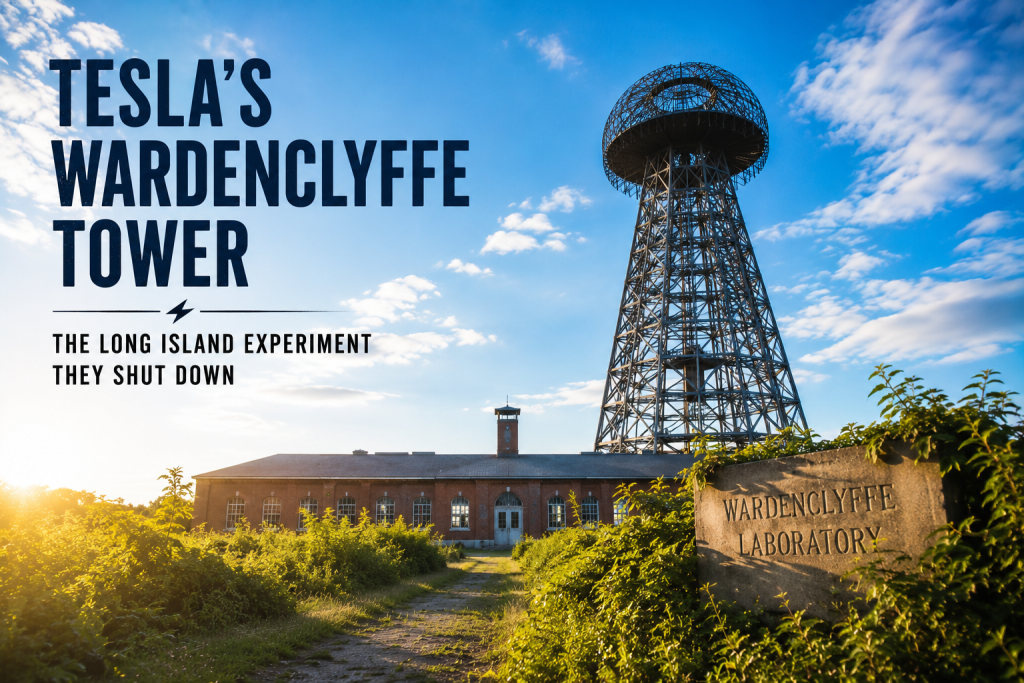
The Tower J.P. Morgan Didn’t Want You to Have
In 1901, Nikola Tesla purchased 200 acres of land in Shoreham, a small village on the North Shore of Long Island, and began building a tower that was supposed to change the way human civilization worked. The structure stood 187 feet tall, topped with a 55-ton copper dome, designed by the architect Stanford White (who was, at that point, one of the most famous architects in America and would, within five years, be murdered at Madison Square Garden by a jealous husband in one of the most sensational crimes of the Gilded Age). The project was called Wardenclyffe. And it was funded, initially, by the richest man on the planet.
J.P. Morgan gave Tesla $150,000 in 1901 (roughly $5 million today) to build a wireless communications facility that would compete with Guglielmo Marconi’s transatlantic radio system. Morgan saw a business opportunity. Tesla saw something much larger. His actual goal, which he did not fully disclose to Morgan at the time, was to use the Wardenclyffe Tower to transmit free wireless electrical power to the entire planet.
Free. Wireless. Power. To the entire planet. No meters, no wires, no utility bills. In other words, no centralized control over who gets electricity and who doesn’t.
Morgan pulled his funding. The tower was demolished. Tesla died alone in a hotel room. And the question of what might have happened if Wardenclyffe had been completed has haunted engineers, conspiracy theorists, and Long Island historians for over a century.
What Tesla Was Actually Trying to Do
Tesla’s vision for Wardenclyffe extended far beyond simple radio transmission. Based on experiments he had conducted at his Colorado Springs laboratory in 1899, Tesla believed he could transmit electrical energy through the Earth’s upper atmosphere and through the ground itself, using the planet as a conductor.
The concept worked like this. The Wardenclyffe Tower would pump massive electromagnetic pulses into the Earth. These pulses would travel through the ground to any location on the planet. At the receiving end, a relatively simple antenna and ground connection would tap into the energy. There would be no power lines, no substations, no monthly bills. Customers would receive electricity the way they received sunlight: as a feature of the environment.
In addition to power transmission, the tower would also serve as a communications hub. Tesla envisioned sending messages, images, and eventually voice transmissions wirelessly across the Atlantic and beyond. He called the concept his “World Wireless System.” Had it worked, it would have predated commercial radio broadcasting by two decades and wireless internet by a century.
Tesla had, in fact, demonstrated wireless power transmission at Colorado Springs. He lit electric bulbs mounted outside his laboratory building using no wires at all. But those demonstrations were small-scale. Whether the technology could work at continental or global distances remained unproven. Tesla certainly believed it could. His supporting mathematics were, by most accounts, sound. Yet he never got the chance to test at full scale. The question of whether Wardenclyffe would have worked remains one of the great unanswered problems in the history of electrical engineering.
The Morgan Problem
The relationship between Tesla and J.P. Morgan is one of the most studied patron-inventor dynamics in American history. And the standard narrative, while dramatic, is slightly more complicated than the conspiracy version suggests.
Morgan invested $150,000 specifically for wireless communications infrastructure. He expected a return on investment. Specifically, he expected to make money from a system that would allow him to send and receive messages from London and from ships at sea. John Jacob Astor IV (who would die on the Titanic 11 years later) also provided smaller-scale funding. Both men understood the project as a business venture, not a humanitarian mission.
Tesla’s Hidden Agenda
Tesla, however, had a different agenda entirely. He used Morgan’s communications funding to pursue his real ambition: wireless power transmission. When construction costs ran over budget (Tesla had underestimated material expenses, and rising commodity prices certainly didn’t help), he went back to Morgan for additional support. This time, he finally revealed his true vision: free electricity for the world. It was, by any measure, a spectacular miscalculation of his audience.
Morgan declined. The reasons were almost certainly financial rather than conspiratorial. Free electricity meant no meters. No meters meant no revenue. As a result, there would be no return on investment. Morgan was a banker, not a philanthropist. He had funded a communications company and instead discovered he was funding a power-distribution revolution. The economics simply didn’t work for him.
Still, the conspiracy community has interpreted Morgan’s withdrawal as deliberate suppression of technology that would have liberated humanity from centralized energy control. In this telling, Morgan didn’t just decline to invest further. Instead, he actively prevented Tesla from finding alternative funding, using his influence over the banking system to ensure that no one else would back the project either. Whether this is true remains debated. But what’s not debated is that Tesla never secured replacement funding. Wardenclyffe was never completed. And the tower eventually came down.
The Demolition
After Morgan’s withdrawal, Tesla spent years trying to find new investors. He approached other wealthy industrialists and filed patents. He also published articles making the case for his technology. None of it worked. By 1905, the project had stalled. By 1906, most of the staff had been let go and the laboratory was essentially abandoned.
In December 1901, Marconi had already succeeded in transmitting the letter “S” wirelessly from England to Newfoundland. As a result, much of the commercial momentum that Tesla needed was gone. The Wardenclyffe project then lost relevance in the eyes of potential investors. Why fund Tesla’s grand vision when Marconi had already proven the simpler version?
The tower stood unused for over a decade. Eventually, in 1917, it was demolished by the Smerley Company, which had acquired the property to recover the debt Tesla owed. The structure was dynamited and sold for scrap. Tesla reportedly wept when he learned the tower had been destroyed. He was 61 years old. He would live another 26 years, increasingly isolated and impoverished, consumed by ideas that nobody would fund.
Tesla died on January 7, 1943, of coronary thrombosis, alone in Room 3327 of the New Yorker Hotel. He was 86. His papers were immediately seized by the Office of Alien Property, since Tesla was a Serbian immigrant and the wartime government was paranoid about foreign-born scientists. The FBI then investigated whether any of Tesla’s documents contained information relevant to national security. Some of those files reportedly remain classified to this day.
The Underground Tunnels
One of the more persistent rumors about the Wardenclyffe site involves a network of underground passages. According to Atlas Obscura, underground tunnels “are said to extend from deep below the laboratory all the way to the beachfront.” The purpose of these tunnels has never been confirmed, although Tesla’s design for the tower included a shaft extending 120 feet into the Earth, which was essential to his theory of using the planet as a conductor.
For conspiracy theorists who also follow the Montauk Project mythology, the underground element creates an irresistible parallel. Camp Hero allegedly featured underground laboratories extending 12 levels beneath the radar tower. Wardenclyffe allegedly featured underground tunnels extending from the laboratory to the waterfront. Both facilities were on Long Island. Each involved electromagnetic experimentation. And both were eventually shut down under circumstances that the government has not fully explained.
There is no credible evidence linking the two facilities. Camp Hero’s radar tower was built decades after Wardenclyffe’s demolition, and the two sites are roughly 70 miles apart. But in the conspiracy imagination, geography is more flexible than it is on Google Maps. The idea that Long Island’s North Shore hosted a suppressed energy experiment while its eastern tip hosted a suppressed psychic experiment feels, to believers, like two chapters of the same story.
What’s There Now
Tesla’s laboratory building still stands at the corner of Tesla Street and Route 25A in Shoreham. The tower is gone, but its octagonal concrete foundation is still visible behind the brick building. The site was added to the National Register of Historic Places in 2018.
In 2013, a grassroots campaign (supported by a viral fundraiser that raised over $1.3 million from 33,000 donors in 45 days) succeeded in purchasing the property to prevent commercial development. That outpouring of public support demonstrated something the investment community had missed for a century: Tesla’s name still carries enormous cultural weight. Today the site is owned by the Tesla Science Center at Wardenclyffe, a nonprofit organization working to restore the laboratory. Their goal is to develop a science museum and education center on the grounds that would attract visitors from around the world. When completed, it will be the only Tesla museum in the Western Hemisphere.
The restoration project is ongoing. Environmental remediation (the site has some industrial contamination from its various uses over the past century) has been a significant challenge. But the vision is to create a destination that honors Tesla’s legacy and educates visitors about his contributions to electrical engineering, wireless communications, and the dream of universal access to energy.
Shoreham is approximately 65 miles from Brooklyn and roughly 70 miles from Camp Hero in Montauk. A visitor could, in theory, drive from Tesla’s laboratory to Camp Hero’s radar tower in under two hours, covering the full span of Long Island’s conspiracy corridor in a single afternoon. First, the laboratory where Tesla tried to give the world free energy. Then the military base where the government allegedly experimented on children. And finally, the state park where the radar tower still turns on its own. Same island. Same questions. Different centuries.
Why It Matters for the East End
Tesla’s Wardenclyffe Tower is the oldest node in the Long Island conspiracy corridor. It predates Camp Hero by decades. It predates Plum Island by half a century. But it establishes the template that the later conspiracies follow: a brilliant mind, a powerful institution, a project shut down before completion, and a permanent question about what might have happened if the work had been allowed to continue.
The Montauk Project borrowed Tesla’s electromagnetic framework. Camp Hero’s radar tower operates on frequencies that conspiracy theorists have connected to Tesla’s research. Plum Island’s biological experiments add a different dimension, but the structure is the same: government facility, classified research, public left in the dark.
For visitors to the East End who are interested in the mythology that eventually powered Stranger Things, the Wardenclyffe laboratory is where the story begins. Not with a Netflix show. Not with a self-published book in 1992. But with a 187-foot tower on the North Shore of Long Island, built by a Serbian immigrant who believed he could give the world free electricity, and the banker who decided the world wasn’t ready to have it. Tesla’s tower is gone. But the foundation remains. And the questions it raised about power, access, and who gets to decide are still very much alive.
Where the Conversation Continues
The conspiracy corridor runs from Shoreham to Montauk Point, and Social Life Magazine covers every mile of it. We’ve been the East End’s publication of record for 23 years. Five summer issues reach 25,000 readers per issue from Westhampton to The End.
If you have a story, a brand, or a project that belongs in these pages, reach out at sociallifemagazine.com/contact.
For brands looking for premium editorial placement, our paid feature submission portal is open at sociallifemagazine.com/submit-a-paid-feature/.
Stay in the loop with our weekly email blast covering events, openings, and who’s doing what Out East. Sign up at enflyer.sociallifemagazine.com.
Polo Hamptons 2026 returns to Bridgehampton on July 18 and July 25 with BMW as title sponsor. For event details and sponsorship opportunities, visit polohamptons.com.
Never miss a feature, a profile, or a party recap. Subscribe to Social Life Magazine at sociallifemagazine.com/subscription.
If the work we do matters to you, you can support independent East End journalism directly via PayPal.
Author

Written by
Recent Posts
hiTechMODA Season 16
How to Keep Your Personal Number Private When Booking Events, Rentals and Services
Understanding Compensatory Damages in a Personal Injury Case

When Online Family Therapy Makes Sense for Modern Families

Carrier Oils, Essential Oils, and Oil Blends: What Beauty Brands Need to Know
Categories
- Art
- Articles
- Business of Luxury
- Celebrities
- Culture
- Entertainment
- Events
- Faces of Summer 2026
- Fashion
- Fashion & Style
- Featured
- Finance
- Food, Spirits, Wine
- Hamptons
- Hamptons Celebrities
- Health
- Health & Beauty
- Lifestyle
- Luxury Lifestyle
- Press
- Profiles
- Real Estate
- Technology
- The Chronicles
- Travel
- Uncategorized
- Weddings