
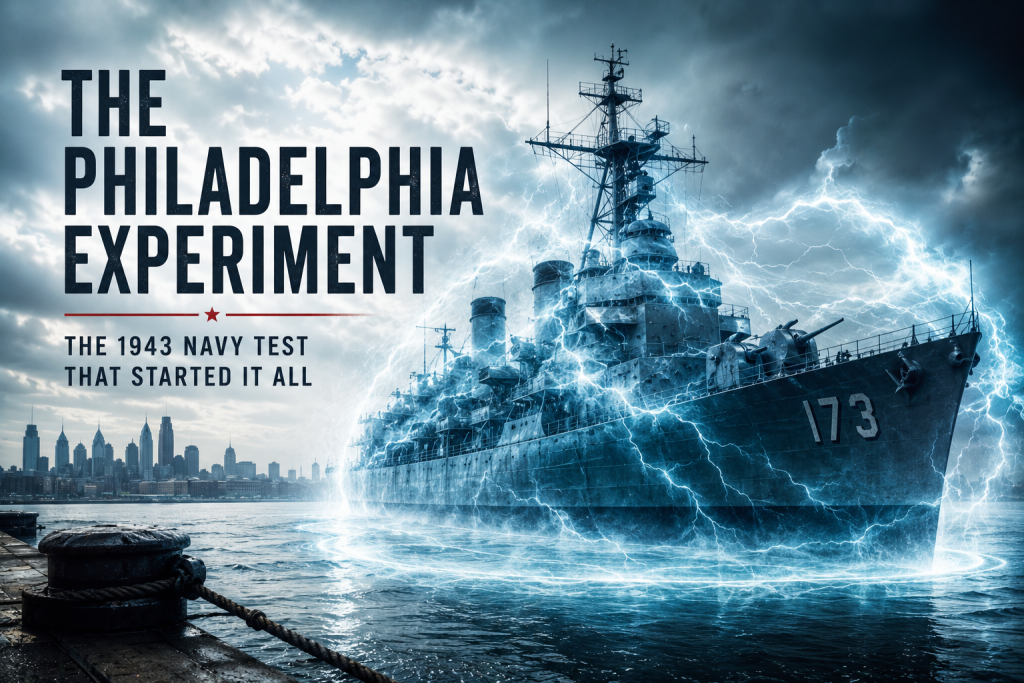
The Ship That Disappeared
In October 1943, according to one of the most persistent military conspiracy theories in American history, the U.S. Navy attempted to make a destroyer escort called the USS Eldridge invisible to radar at the Philadelphia Naval Shipyard. But the experiment allegedly went further than anyone intended. Instead of simply vanishing from radar, the ship reportedly disappeared entirely. It then supposedly teleported from Philadelphia to Norfolk, Virginia, before reappearing at the shipyard. The consequences for the crew were, by all accounts, catastrophic.
No credible source has ever verified the Philadelphia Experiment. The Navy has publicly denied it ever occurred. Yet the legend has persisted for over 80 years. It inspired a 1984 film and dozens of books. It also spawned an entire mythology connecting World War II naval research to the Cold War experiments allegedly conducted at Camp Hero in Montauk. For conspiracy theorists, the Philadelphia Experiment is where the timeline begins. Everything that came after, including the program that inspired Netflix’s Stranger Things, traces its roots back to a destroyer escort at a Philadelphia dock in 1943.
The Origin of the Legend
The story first surfaced through a man named Carlos Miguel Allende (who also used the name Carl Allen). In 1955, Allende began writing letters to Morris K. Jessup, an astronomer and UFO researcher. Jessup had published a book called The Case for the UFO. In these letters, Allende claimed to have witnessed the Philadelphia Experiment firsthand from a nearby ship, the SS Andrew Furuseth.
According to Allende’s account, the Navy used Einstein’s Unified Field Theory to bend light around the Eldridge. The goal was to render the ship invisible to radar. But the experiment allegedly produced terrifying side effects. Sailors reportedly became “frozen” in place, unable to move. Others allegedly fused into the ship’s bulkheads, their bodies merging with steel. Some crew members supposedly caught fire. Still others went permanently insane. A few allegedly vanished entirely and were never seen again.
Allende’s letters were rambling, inconsistent, and filled with erratic capitalizations. Jessup took them seriously enough to investigate but was never able to confirm any of the claims. In 1959, Jessup was found dead in his car in a park in Coral Gables, Florida. The death was ruled a suicide. Conspiracy theorists have questioned that ruling ever since, arguing that Jessup was silenced because he was getting too close to the truth. No evidence supports this claim. But the suspicious death of a researcher investigating the Philadelphia Experiment has become part of the mythology itself.
What the Navy Actually Says
The Navy’s official position has been consistent for decades. According to the Naval History and Heritage Command, no experiment involving invisibility or teleportation was ever conducted on the USS Eldridge. The ship’s deck logs, which are publicly available, show that the Eldridge was nowhere near Philadelphia in October 1943. It was, in fact, on its maiden shakedown cruise in the Bahamas.
However, the Navy has acknowledged that degaussing experiments were routinely conducted on warships during World War II. Degaussing involves wrapping a ship’s hull with electrical cables to neutralize its magnetic signature, making it invisible to magnetic mines and torpedoes. These experiments were conducted at multiple naval facilities, including Philadelphia. To an uninformed observer, the visual effect of degaussing equipment (bright electrical discharges, unusual coils wrapping the hull) might have looked like something far more exotic.
Skeptics have also pointed out that the Eldridge and the Andrew Furuseth were never docked in Philadelphia at the same time, making Allende’s claim of witnessing the experiment physically impossible. Yet the legend has proven immune to debunking. The story is simply too good to die.
Al Bielek and the Montauk Connection
The Philadelphia Experiment might have remained a minor footnote in UFO literature if not for a man named Al Bielek. In fact, in 1988, Bielek attended a screening of the 1984 B-movie The Philadelphia Experiment and claimed to experience a flood of recovered memories. According to Bielek, he was actually Edward Cameron, a Navy sailor who had served aboard the USS Eldridge during the original experiment.
Bielek’s claims were, of course, extraordinary even by conspiracy standards. He alleged that during the experiment, he and his brother Duncan Cameron were thrown forward in time to 1983. Specifically, they landed at Camp Hero in Montauk. There, he said, they were incorporated into the Montauk Project, a secret program involving mind control, time travel, and psychic warfare conducted in underground laboratories beneath the base’s radar tower.
According to Bielek, the Montauk Project was a direct continuation of the Philadelphia Experiment research. According to Bielek, the scientists who had teleported a Navy destroyer in 1943 spent four decades refining the technology at Camp Hero. The same electromagnetic principles that allegedly made the Eldridge disappear were supposedly used to open portals to other dimensions in the 1980s.
None of Bielek’s claims have been independently verified. His real identity was Alfred Bielek, born in 1927. Indeed, records show no connection to the Navy or to Camp Hero. But his narrative provided the crucial bridge between the Philadelphia Experiment and the Montauk Project. It gave the Montauk conspiracy a historical origin story. And it gave the Duffer Brothers, decades later, a deeper mythology to draw from when they were building Stranger Things.
The Einstein Connection
One of the more intriguing elements of the Philadelphia Experiment mythology involves Albert Einstein. Allende claimed in his letters that the experiment was based on Einstein’s Unified Field Theory, a theoretical framework that would unify gravity and electromagnetism into a single set of equations. Einstein did, in fact, work on a unified field theory during the 1940s. He never completed it.
The conspiracy narrative holds that Einstein had actually solved the unified field theory but suppressed his findings after learning how the Navy intended to use them. In some versions, Einstein directly consulted with the Navy on the Eldridge experiment. In others, his work was stolen and applied without his knowledge.
There is, of course, no credible evidence that Einstein was involved in any experiment on the USS Eldridge. But his name gives the legend scientific legitimacy it wouldn’t otherwise have. In conspiracy culture, association with genius is a form of authentication. If Einstein was involved, the experiment was serious. If the experiment was serious, the cover-up is justified. The logic is circular, but it is also effective. The idea that the greatest physicist of the twentieth century might have accidentally created a teleportation device adds a weight to the conspiracy that Carlos Allende’s letters alone could never provide.
Why It Matters for Stranger Things
The Philadelphia Experiment provides the deepest layer of the mythology that eventually became Stranger Things. The show’s narrative architecture works like this: the U.S. government conducted electromagnetic experiments that produced catastrophic, unintended consequences (the Philadelphia Experiment, 1943). Those experiments continued at Camp Hero as the Montauk Project (1970s-1980s). The research was connected to real CIA programs like MKUltra (1953-1973). Children with psychic abilities were used as test subjects. A portal was opened to another dimension.
In Stranger Things, Hawkins National Laboratory is the fictional descendant of this entire lineage. Dr. Brenner’s experiments on Eleven use electromagnetic equipment and sensory deprivation tanks that echo the technology allegedly used in both the Philadelphia Experiment and the Montauk Project. The Upside Down, the show’s alternate dimension, mirrors the portals that Duncan Cameron supposedly opened at Camp Hero. And the government cover-up in the show mirrors the Navy’s denial of the Philadelphia Experiment and the CIA’s destruction of MKUltra files.
The Duffer Brothers didn’t need any of this to be true. They needed it to be believed. And the Philadelphia Experiment gave their story a historical anchor that stretched back to World War II. It transformed Stranger Things from a show about a small town with a secret laboratory into a show about an 80-year government conspiracy that just happened to surface in Hawkins, Indiana. And tens of millions of people believe enough of it to make Stranger Things feel like something more than fiction.
Where the Conversation Continues
The Philadelphia Experiment is the first chapter in a conspiracy timeline that runs from a 1943 Navy dock to a Montauk radar tower to a Netflix writers’ room. Social Life Magazine has covered the East End for 23 years, and the stories at the intersection of history, conspiracy, and culture land here first.
If you have a story, a brand, or a project that belongs in these pages, reach out at sociallifemagazine.com/contact.
For brands looking for premium editorial placement, our paid feature submission portal is open at sociallifemagazine.com/submit-a-paid-feature/.
Stay in the loop with our weekly email blast covering events, openings, and who’s doing what Out East. Sign up at enflyer.sociallifemagazine.com.
Polo Hamptons 2026 returns to Bridgehampton on July 18 and July 25 with BMW as title sponsor. For event details and sponsorship opportunities, visit polohamptons.com.
Never miss a feature, a profile, or a party recap. Subscribe to Social Life Magazine at sociallifemagazine.com/subscription.
If the work we do matters to you, you can support independent East End journalism directly via PayPal.
Author

Written by
Recent Posts

hiTechMODA Season 16
How to Keep Your Personal Number Private When Booking Events, Rentals and Services
Understanding Compensatory Damages in a Personal Injury Case

When Online Family Therapy Makes Sense for Modern Families

Carrier Oils, Essential Oils, and Oil Blends: What Beauty Brands Need to Know
Categories
- Art
- Articles
- Business of Luxury
- Celebrities
- Culture
- Entertainment
- Events
- Faces of Summer 2026
- Fashion
- Fashion & Style
- Featured
- Finance
- Food, Spirits, Wine
- Hamptons
- Hamptons Celebrities
- Health
- Health & Beauty
- Lifestyle
- Luxury Lifestyle
- Press
- Profiles
- Real Estate
- Technology
- The Chronicles
- Travel
- Uncategorized
- Weddings