
What’s Behind the Fences
If you visit Camp Hero State Park in Montauk, you will notice two things almost immediately. First, the AN/FPS-35 radar tower, standing roughly 90 feet tall with a 40-foot steel dish, visible from nearly every trail in the park. Second, the fences. Chain-link fences topped with barbed wire surround multiple structures across the former military base. “Do Not Enter” signs are bolted to sealed doors. Concrete bunkers sit overgrown with scrub oak. A bowling alley, a mess hall, and barracks buildings are all locked, boarded, and inaccessible. In other words, the surface of Camp Hero tells you exactly two things: something important used to happen here, and you are not allowed to know what it was.
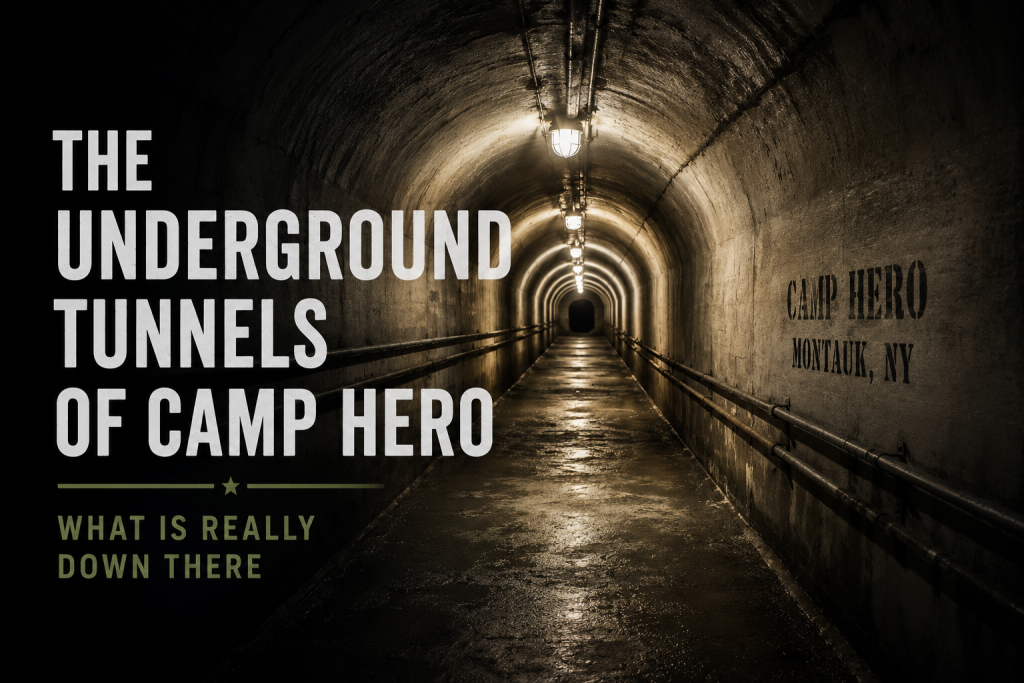
But the real question at Camp Hero has never been about what’s above ground. According to the Montauk Project conspiracy, the most important parts of the facility are underground. Preston Nichols claimed in his 1992 book that secret laboratories extended as many as 12 levels beneath the radar tower. These underground levels allegedly housed hundreds of workers conducting experiments in mind control, time travel, and psychic warfare. And when the project was shut down, the tunnels were supposedly flooded with cement.
The Camp Hero tunnels are the physical foundation of every claim the Montauk Project conspiracy makes. Without underground laboratories, there’s no place for the experiments to have happened. With them, the conspiracy has a location, an infrastructure, and a reason the evidence has never been found: it’s buried under concrete, 12 stories below a state park.
What We Know Is Down There
Some underground infrastructure at Camp Hero is, in fact, not disputed. The military base was originally built as a coastal defense installation during World War II. Standard construction for facilities of this era included underground ammunition storage, utility tunnels, and command bunkers. Battery 113, a heavy gun emplacement on the bluffs, featured underground magazines and tunnels connecting firing positions to supply rooms.
In addition, the AN/FPS-35 radar installation required below-grade infrastructure. The tower’s electronics, power supply, and control systems were housed in reinforced structures at or below ground level. A shaft extended beneath the tower as part of its operational design. This much is documented in military engineering records. Indeed, similar below-grade infrastructure is consistent with Cold War-era radar installations across the country.
After the base was decommissioned in 1981, these underground spaces were sealed. As a result, New York State Parks inherited a property with dozens of above-ground buildings and an unknown quantity of below-grade infrastructure. The sealed tunnels and bunkers were simply never opened for public access. They were simply fenced off, posted with warning signs, and left to decay.
What Urban Explorers Have Found
Despite the fences and the warnings, urban explorers have been entering Camp Hero’s restricted areas for decades. Their findings, while not scientifically verified, have fueled the conspiracy narrative for years. Specifically, their reports form the evidentiary backbone of the tunnel mythology.
Among the most frequently cited discoveries: sealed doorways in the floor of above-ground buildings that appear to lead to lower levels. In addition, corridors that extend beyond what the visible building footprint would suggest. Unusual graffiti, including the phrase “Stranger Help Me” reportedly found on a wall inside one of the sealed structures. Documents and equipment left behind when the military departed, including what some explorers have described as electronic components that don’t match standard Cold War radar hardware.
In 2014, a documentary crew obtained permission from New York State Parks to access some of the restricted buildings. Their footage showed deteriorating interiors, standing water, and sealed passages leading downward. The crew was not permitted to enter the below-grade areas. State Parks officials cited safety concerns including structural instability, asbestos, and potential chemical contamination.
Yet whether these underground spaces extend to 12 levels, as Nichols claimed, remains completely unverified. Indeed, no independent engineering survey has been published. The military’s own construction records for the site have not been fully declassified. And the State of New York, which now owns the property, has shown no interest in settling the question one way or another.
The Cement Story
According to Preston Nichols, the underground levels of Camp Hero were flooded with cement after the Montauk Project was shut down in 1983. The triggering event, he claimed, was Duncan Cameron’s accidental summoning of a creature from another dimension. After the creature was contained, the decision was made to seal the entire underground complex permanently.
Nichols described the cement operation as massive, requiring hundreds of truckloads of concrete delivered to the site over a period of weeks. Of course, he acknowledged that an operation of this scale would have been difficult to conceal from the town of Montauk. His explanation: the deliveries were disguised as construction materials for a renovation project, and the workers involved had their memories erased using the same electromagnetic technology that powered the experiments.
There is, of course, no independent confirmation of any cement operation. Local residents from that era have not corroborated reports of unusual construction activity. However, several urban explorers have noted that certain below-grade passages appear to terminate abruptly in solid concrete, which they interpret as evidence of deliberate sealing. Skeptics counter that military facilities routinely seal underground spaces with concrete when decommissioning for safety reasons. The practice is standard. The question is whether the sealing at Camp Hero was standard decommissioning or something more deliberate. Without an engineering survey, the question remains open.
The Radar Tower Mystery
Visitors to Camp Hero consistently report a detail that neither the State Parks system nor the military has fully explained. The AN/FPS-35 radar dish, which has been inactive since the base was decommissioned in 1981, still changes position. The dish is visibly oriented in a different direction on different days. Park visitors have documented this with photographs. Still, the movement is slow enough that nobody has captured it on video. But the evidence across multiple visits is clear: something is turning the dish.
The most likely explanation is wind. A 40-foot steel dish mounted on a tower at the eastern tip of Long Island is exposed to significant Atlantic winds. If the locking mechanism has deteriorated over four decades, wind pressure could rotate the dish incrementally. Engineers who have examined the question (informally, not as part of any official study) have suggested this is plausible.
But for visitors already primed by the Montauk Project mythology, a moving radar dish on a decommissioned base feels like confirmation. If the base is truly abandoned, why is the equipment still operational? And if the equipment isn’t operational, what’s moving it? The question has no definitive answer. In Montauk, that is usually enough. The absence of explanation becomes its own form of evidence. And for visitors who have just walked past sealed bunkers and “Do Not Enter” signs, a moving radar dish is the detail that follows them home.
The Stranger Things Echo
The underground tunnels of Camp Hero are the direct architectural inspiration for Hawkins National Laboratory in Stranger Things. In the show, the government laboratory extends deep underground. Its corridors are institutional, fluorescent-lit, and maze-like. The gate to the Upside Down opens in the basement level. In other words, the deeper you go, the stranger things get.
This vertical architecture, where surface normality conceals underground horror, maps directly onto the Camp Hero mythology. Above ground, it’s a state park with hiking trails and ocean views. Below ground, allegedly, it’s something else entirely. The Duffer Brothers used this structural metaphor throughout the series. Hawkins looks like a normal small town. The laboratory beneath it is where the nightmares live.
Even the visual of the sealed doors at Camp Hero echoes the show. In Stranger Things, heavy steel doors with institutional locks separate the laboratory’s levels. At Camp Hero, heavy steel doors with institutional locks separate the public park from whatever lies behind the fences. The difference is that in the show, someone eventually opens the door. At Camp Hero, nobody has. Or at least nobody who has talked about it publicly. The sealed doors remain the most photographed feature of the park after the radar tower itself. Every photograph is a question without an answer.
Where the Conversation Continues
The Camp Hero tunnels remain the most debated physical feature of the Montauk Project conspiracy. Whether they extend 12 levels deep or just a few feet, they sit beneath a state park that is open to the public 365 days a year. Social Life Magazine has covered the East End for 23 years, and the stories that matter Out East land here first.
If you have a story, a brand, or a project that belongs in these pages, reach out at sociallifemagazine.com/contact.
For brands looking for premium editorial placement, our paid feature submission portal is open at sociallifemagazine.com/submit-a-paid-feature/.
Stay in the loop with our weekly email blast covering events, openings, and who’s doing what Out East. Sign up at enflyer.sociallifemagazine.com.
Polo Hamptons 2026 returns to Bridgehampton on July 18 and July 25 with BMW as title sponsor. For event details and sponsorship opportunities, visit polohamptons.com.
Never miss a feature, a profile, or a party recap. Subscribe to Social Life Magazine at sociallifemagazine.com/subscription.
If the work we do matters to you, you can support independent East End journalism directly via PayPal.
Author

Written by
Recent Posts

House Closing Process: What Sellers Should Expect From Start to Finish
What to Know Before Buying a Home in Brantford
When Does Using a Travel Advisor Make the Biggest Difference
What to Look for When Choosing Your First Red Light Therapy Panel

Experience the luxury of exploring Aruba’s coast by private yacht
Categories
- Art
- Articles
- Business of Luxury
- Celebrities
- Culture
- Entertainment
- Events
- Faces of Summer 2026
- Fashion
- Fashion & Style
- Featured
- Finance
- Food, Spirits, Wine
- Hamptons
- Hamptons Celebrities
- Health
- Health & Beauty
- Lifestyle
- Luxury Lifestyle
- Press
- Profiles
- Real Estate
- Technology
- The Chronicles
- Travel
- Uncategorized
- Weddings