
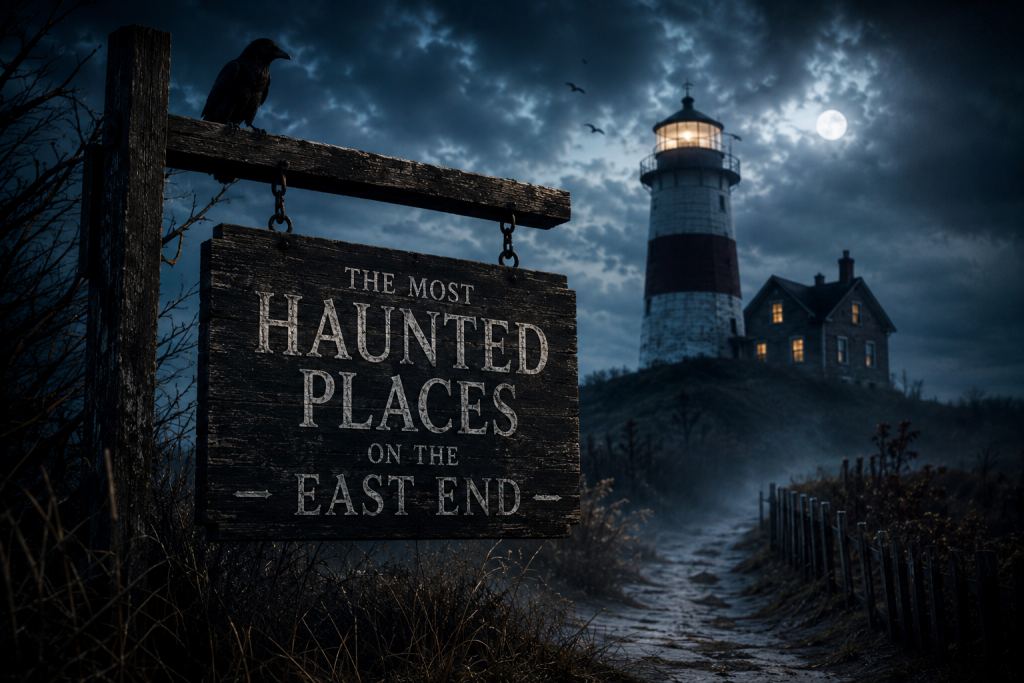
The South Fork After Dark
The Hamptons sell a particular fantasy. White linen, golden light, champagne on a porch overlooking the Atlantic. But the East End has another register entirely, one that emerges when the summer crowds leave and the nights get long. Before the beach houses and the farm stands and the $50 rose at sunset, this was a landscape of military installations, quarantine camps, shipwrecks, and Revolutionary War skirmishes. People have been dying out here in unusual ways for over three centuries. And some of them, according to local lore, never quite left. In fact, the density of reported hauntings per square mile on the East End rivals any region in New England.
These are the most haunted places on the East End, from Montauk to Riverhead, from decommissioned military bases to Colonial-era manors. Some of these stories are documented in historical records. Others survive only as whispered accounts passed between families who have lived on the South Fork for generations. All of them sit within driving distance of each other, which makes the East End one of the most concentrated ghost geographies on the Atlantic coast.
Camp Hero State Park, Montauk
No list of haunted places on the East End starts anywhere else. Camp Hero, the decommissioned Air Force station that inspired the Montauk Project conspiracy and ultimately Netflix’s Stranger Things, sits on 755 acres at the eastern tip of the South Fork. The base was active from World War II through 1981. During that time, hundreds of military personnel lived and worked on the grounds. In some cases, they also died there.
Visitors consistently report unusual experiences at Camp Hero. The AN/FPS-35 radar dish, inactive since 1981, still changes position on its own. Sealed buildings creak and groan in ways that seem disproportionate to the wind. Hikers on the trails along the Atlantic bluffs have described feeling watched, hearing voices, and experiencing sudden drops in temperature near the underground bunker entrances.
Whether these experiences are genuinely supernatural or simply the natural consequence of walking through an abandoned military base in fog is, of course, a matter of personal interpretation. But the Montauk Project conspiracy adds a layer that most haunted locations don’t have. If you believe the conspiracy, the people who suffered in the underground laboratories might still be down there. The tunnels were sealed with cement. Nobody checked to make sure they were empty first.
Montauk Manor, Montauk
Carl Fisher built Montauk Manor in 1927. Fisher was the same developer who had turned Miami Beach into a resort destination. He designed the Tudor Revival hotel as the centerpiece of his plan to transform Montauk into “the Miami Beach of the North.” The hotel sits on a hilltop overlooking the village. Its 140 rooms have hosted guests for nearly a century.
The hotel’s haunted reputation centers on the upper floors, which were originally staff quarters. Guests have reported hearing footsteps in empty hallways. Doors open and close on their own. Some visitors have also described the sound of a woman crying in rooms that are unoccupied. One persistent account involves a female apparition seen standing at a window on the top floor, looking out toward the ocean.
Montauk Manor now operates as a condominium hotel. Still, the original architecture gives the building an unmistakable atmosphere. Heavy Tudor beams, narrow corridors, and a vaulted lobby combine into something that even skeptics describe as eerie. The combination of 1920s grandeur and decades of decline (the hotel went through several periods of disrepair before its conversion) creates exactly the kind of space where ghost stories take root.
The Montauk Lighthouse, Montauk
The Montauk Point Lighthouse was commissioned by George Washington in 1792 and completed in 1796. It is the oldest lighthouse in New York State and also the fourth oldest in the country. It has operated continuously for 230 years. During that time, dozens of lighthouse keepers and their families lived in the keeper’s dwelling. Winter months brought extreme isolation.
The haunted reputation of the lighthouse focuses on the keeper’s quarters. Visitors and staff have reported the smell of pipe tobacco in rooms where no one is smoking. Others describe the sound of heavy boots walking upstairs when the building is empty. Some have also felt the sensation of being touched by an unseen hand. One former museum volunteer described seeing a figure in nineteenth-century clothing standing at the top of the interior staircase, then vanishing when she looked directly at it.
The lighthouse sits at the easternmost point of the South Fork, where the Atlantic meets Block Island Sound. On foggy nights, the foghorn and the rotating beam combine with the 110-foot cliff drop. The atmosphere would make anyone believe in ghosts. Whether the lighthouse is actually haunted is secondary to the fact that it feels haunted in a way that few buildings in America can match.
Sagtikos Manor, Bay Shore
Sagtikos Manor dates to approximately 1697. It is, in fact, one of the oldest surviving estates on Long Island. The property spans 10 acres. Its main house has been expanded and modified across three centuries of continuous occupation. George Washington reportedly slept at the manor during his tour of Long Island in 1790. So did several British officers during the Revolutionary War occupation.
The haunted activity at Sagtikos centers on the oldest section of the house, where visitors have reported cold spots, moving shadows, and the sound of a harpsichord playing in an empty room. Similarly, docents who lead tours have described doors that refuse to stay closed. Objects reportedly change position overnight. One account involves a portrait whose eyes reportedly follow visitors across the room, though this may owe more to the painting technique than to the supernatural.
Sagtikos Manor is now a Suffolk County park. Guided tours are available during the warmer months. The combination of its extreme age (over 325 years), its Revolutionary War history, and its three centuries of family occupancy gives the property a density of human experience that few East End locations can match. If ghosts are memories embedded in architecture, Sagtikos has enough raw material for an army of them.
The Amityville Horror House, Amityville
Technically on the South Shore rather than the South Fork, the house at 108 (formerly 112) Ocean Avenue in Amityville is too significant to the haunted geography of Long Island to exclude. On November 13, 1974, Ronald DeFeo Jr. murdered six members of his family there. Then, thirteen months later, George and Kathy Lutz moved in with their three children. They lasted 28 days.
The Lutzes’ account of their experience, published in Jay Anson’s 1977 book The Amityville Horror, described swarms of flies, green slime oozing from walls, demonic voices, levitation, and a hidden “Red Room” in the basement. The book sold over 10 million copies and spawned a franchise of films, sequels, and remakes. Subsequent investigations have cast significant doubt on the Lutzes’ claims. William Weber, DeFeo’s defense attorney, later admitted that he and the Lutzes had fabricated much of the story “over many bottles of wine.”
Still, the house remains the most famous haunted location on Long Island and one of the most well-known in the world. It has been renovated, renumbered, and resold multiple times. Subsequent owners have reported no paranormal activity. But the address continues to attract curiosity seekers, and the story continues to drive search traffic that benefits any content connected to the haunted geography of the region.
Execution Rocks Lighthouse, Long Island Sound
Execution Rocks Lighthouse sits on a rocky reef in Long Island Sound between Sands Point and New Rochelle. It was built in 1850 on a site with a genuinely disturbing history. According to local legend, the rocks were in fact used as an execution site during the Colonial era. Prisoners were chained to the rocks at low tide and left to drown as the water rose. Whether this actually happened is debated by historians, but the name predates the lighthouse by at least a century.
The lighthouse’s more recent history includes its own share of darkness. In 2006, New York City police investigated the lighthouse in connection with a serial murder case. The suspect, a New York City firefighter, allegedly used the island as a disposal site. The investigation confirmed that human remains were present on the island.
Execution Rocks is visible from the North Shore beaches of Long Island and from certain points in Westchester County. It is not open to the public. The lighthouse was deactivated by the Coast Guard but continues to operate as an automated navigational aid. Its reputation as one of the most haunted lighthouses in the Northeast draws consistent search interest, particularly during the Halloween season.
The East End Ghost Map
What makes the East End’s haunted geography unusual is its density. Within a 100-mile stretch of Long Island, you can visit a decommissioned military base where the government allegedly experimented on children (Camp Hero), a 1920s hotel built by the man who invented Miami Beach (Montauk Manor), the oldest lighthouse in New York State (Montauk Point), a Revolutionary War manor where George Washington slept (Sagtikos), and the most famous haunted house in American history (Amityville).
Add the conspiracy corridor, including Plum Island (the government biolab where Nazi scientists allegedly worked), Tesla’s Wardenclyffe Tower (the suppressed free-energy experiment in Shoreham), and Brookhaven National Laboratory (the Department of Energy facility with its own mythology), and you have a landscape where documented history, conspiracy lore, and ghost stories overlap in ways that are unique in the United States.
For visitors planning a trip around these locations, most are accessible by car from New York City in under three hours. Camp Hero, the Montauk Lighthouse, and Montauk Manor are all within minutes of each other. Sagtikos Manor is roughly an hour west. The Amityville house (now a private residence, viewed from the street only) sits another 30 minutes west. A dedicated traveler could cover the entire haunted map in a single long weekend.
Where the Conversation Continues
The East End has been producing ghost stories since before it had electricity. Social Life Magazine has covered this territory for 23 years, five summer issues from Memorial Day through Labor Day, plus Fall and Winter editions reaching 15,000 Upper East Side doorman buildings. The stories that matter Out East land here first.
If you have a story, a brand, or a project that belongs in these pages, reach out at sociallifemagazine.com/contact.
For brands looking for premium editorial placement, our paid feature submission portal is open at sociallifemagazine.com/submit-a-paid-feature/.
Stay in the loop with our weekly email blast covering events, openings, and who’s doing what Out East. Sign up at enflyer.sociallifemagazine.com.
Polo Hamptons 2026 returns to Bridgehampton on July 18 and July 25 with BMW as title sponsor. For event details and sponsorship opportunities, visit polohamptons.com.
Never miss a feature, a profile, or a party recap. Subscribe to Social Life Magazine at sociallifemagazine.com/subscription.
If the work we do matters to you, you can support independent East End journalism directly via PayPal.
Author

Written by
Recent Posts

hiTechMODA Season 16
How to Keep Your Personal Number Private When Booking Events, Rentals and Services
Understanding Compensatory Damages in a Personal Injury Case

When Online Family Therapy Makes Sense for Modern Families

Carrier Oils, Essential Oils, and Oil Blends: What Beauty Brands Need to Know
Categories
- Art
- Articles
- Business of Luxury
- Celebrities
- Culture
- Entertainment
- Events
- Faces of Summer 2026
- Fashion
- Fashion & Style
- Featured
- Finance
- Food, Spirits, Wine
- Hamptons
- Hamptons Celebrities
- Health
- Health & Beauty
- Lifestyle
- Luxury Lifestyle
- Press
- Profiles
- Real Estate
- Technology
- The Chronicles
- Travel
- Uncategorized
- Weddings