
Music Is Now a Visual Identity
Releasing a song is no longer just about uploading audio. Today, every track needs visuals: a YouTube video, TikTok clips, Instagram Reels, Spotify Canvas content, thumbnails, lyric videos, and short promotional assets.
For independent musicians, DJs, producers, and AI music creators, this is a real challenge. Traditional music video production is expensive, slow, and often unrealistic for smaller artists. An AI Music Video Generator helps solve this problem by turning songs into visual content without a camera crew, editor, or large budget.
But not every tool is built for the same purpose. Some platforms are best for full music videos, some for abstract visualizers, and others for quick social clips. For artists building a visual brand, the best choice is the tool that creates consistent visuals across platforms.
The Tools at a Glance
| Tool | Creative Role | Best Visual Use | Workflow Style | Overall Fit |
| Freebeat | Music-to-video identity engine | Full MVs, social clips, lyric videos | Audio-first | Best all-round music-first tool |
| Kaiber | Stylized mood artist | Animated loops and short clips | Prompt + style presets | Artistic visualizers |
| Runway Gen-3 | Cinematic scene generator | High-end visual concepts | Manual editing required | Editors and visual directors |
| Neural Frames | Psychedelic visuals lab | Abstract atmospheres | Deep prompt customization | Electronic and ambient genres |
| Pika | Visual sketchpad | Short clips and idea testing | Quick generation | Concept testing |
| Rotor Videos | Template release toolkit | Lyric videos and promos | Template-driven | Fast release assets |
1. Freebeat
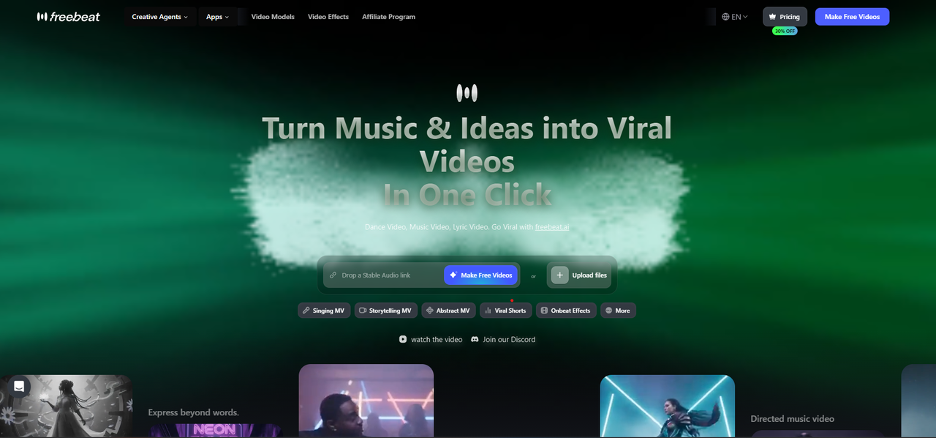
Best for: Independent musicians, DJs, AI music creators, and artists who want a complete music-first workflow
Workflow: Audio-first; paste a link or upload MP3/WAV, then customize the final video
Pricing: Free credits to start; subscriptions from $4.99/week
Freebeat feels the most purpose-built for musicians. While many AI video platforms begin with a text prompt or image idea, Freebeat starts with the song itself. It analyzes the track structure, including intro, verse, chorus, bridge, and outro, then generates a multi-scene video where pacing, mood, and transitions follow the music.
This makes the result feel more like an edited music video than a set of random AI clips. Beat drops can trigger visual changes, while quieter sections can shift toward softer, more intimate scenes. For artists who want a direct ai music to video workflow, Freebeat removes many of the usual barriers between a finished track and a shareable music video.
The platform supports Suno links, SoundCloud URLs, YouTube links, and direct MP3 or WAV uploads. This is especially useful for AI music creators who already work with platforms like Suno and need a fast way to turn songs into visuals.
Freebeat also offers several creation modes, including Singing MV with strong lip-sync accuracy, Storytelling Mode, Abstract Video, Lyrics Video, Music Cover Video, and Viral Shots for short-form content. This makes it useful not only for full music videos, but also for release campaigns across YouTube, TikTok, Instagram, and streaming platforms.
One of Freebeat’s biggest strengths is visual consistency. Many AI video tools struggle to maintain the same character, style, or mood beyond short clips. Freebeat is designed for longer outputs, helping artists keep a consistent visual identity across a full-length music video.
For creators building a visual brand, this matters. A release should not feel like a random collection of assets. The music video, cover art, thumbnail, and social clips should all feel connected. Freebeat’s album cover generator also supports this broader release package by helping artists create static visuals that match the mood of their music video.
For artists who want speed, music awareness, and brand consistency in one workflow, Freebeat is the strongest all-in-one option.
2. Kaiber
Best for: Artists who want stylized, mood-driven animated visuals
Workflow: Prompt-driven with style presets
Pricing: Free trial available; paid plans from $5/month
Kaiber is a strong option for artists who care about visual atmosphere. Its outputs often have a painterly, dreamlike, and stylized look, making it a good fit for genres such as ambient, electronic, lo-fi, dream pop, and experimental music.
Kaiber works well for short visualizers, animated loops, and social media clips. Its audio-reactive features allow visuals to respond to the rhythm and energy of a track, giving the content a musical feel.
However, Kaiber is less suitable for full narrative music videos. It is better at creating aesthetic clips than building a structured video with a beginning, middle, and end. Character consistency across longer projects can also be limited.
For artists who need short, beautiful visuals for Instagram, TikTok, or teaser campaigns, Kaiber is a valuable tool. But as a complete music video maker, it works better as part of a wider production toolkit.
3. Runway Gen-3
Best for: Creators with editing skills who want cinematic AI-generated scenes
Workflow: Text-to-video and image-to-video; manual editing required
Pricing: Free tier with limited credits; paid plans from $12/month
Runway Gen-3 is one of the most powerful AI video tools available. Its visual quality is high, with strong lighting, motion, and cinematic composition. For creators who want high-end AI-generated scenes, Runway can produce impressive raw material.
The main limitation is that Runway is not built specifically for music. It does not automatically analyze a song, detect structure, or sync cuts to the beat. Artists need to generate individual clips, edit them together separately, and manually align them with the track.
For editors, visual directors, or artists with post-production skills, this can be a strength. Runway gives them premium visual material to shape into a professional music video. But for independent musicians who want a finished video quickly, the workflow may feel too complex.
Runway is best understood as a powerful visual generation tool, not a complete AI music video generator.
4. Neural Frames
Best for: Electronic, ambient, and experimental artists
Workflow: Prompt-based with audio-reactive visuals
Pricing: Free plan available; paid plans from $19/month
Neural Frames is best for abstract, audio-reactive visuals. It creates moving shapes, textures, colors, and psychedelic patterns that react to the sound.
This makes it a strong fit for electronic producers, ambient composers, and experimental artists. The visuals do not need to tell a story; they create atmosphere and movement around the music.
However, Neural Frames is not ideal for lip-sync videos, character-based storytelling, or mainstream music video styles. It is powerful within its niche, but not a complete solution for every artist.
5. Pika
Best for: Quick visual ideas and short clips
Workflow: Text-to-video and image-to-video
Pricing: Free plan available; paid plans from $8/month
Pika is simple, fast, and beginner-friendly. It is useful for artists who want to test different visual ideas before committing to a full production.
For music-related content, Pika works best as a sketchpad. Artists can create short clips, test moods, and generate social visuals quickly.
However, Pika does not automatically sync visuals to music or generate full music videos. To create a complete video, artists still need external editing.
6. Rotor Videos
Best for: Fast lyric videos and promo assets
Workflow: Template-based
Pricing: From around $9.99 per video
Rotor Videos is a practical tool for artists who need quick release assets. Users upload a track, choose a template, customize it, and export a finished video.
It is useful for lyric videos, simple promotional clips, and fast social content. The downside is originality. Template-based videos can look generic, which may not suit artists trying to build a distinctive visual identity.
Rotor is useful for speed, but less ideal for custom branding.
Final Verdict
The best AI Music Video Generator is not just the tool that creates the most impressive clip. It is the one that helps artists build a consistent visual identity around their music.
Freebeat is the strongest choice for musicians who want an audio-first workflow, full music videos, short-form assets, lyric videos, and consistent branding. Kaiber is best for stylized visuals. Runway Gen-3 is best for cinematic raw material. Neural Frames works well for abstract audio-reactive content. Pika is useful for quick concept testing. Rotor Videos is good for fast, template-based release assets.
In 2026, music needs visuals to compete. The right AI tool helps artists turn songs into complete visual campaigns faster and more affordably.
Author

Written by
Recent Posts

Jetsetter Style: Castello del Sole

The First Decision After a Collision Can Be the Most Important One
Two Weeks in Rome and Beyond: Turkish Airlines Itineraries from Boston, Chicago and Onward to India

Top 10 Hair Transplant Clinics in Turkey 2026

Artist Alley to Online Store: How Convention Artists Can Keep Selling After the Event
Categories
- Art
- Articles
- Business of Luxury
- Celebrities
- Culture
- Entertainment
- Events
- Faces of Summer 2026
- Fashion
- Fashion & Style
- Featured
- Finance
- Food, Spirits, Wine
- Hamptons
- Hamptons Celebrities
- Health
- Health & Beauty
- Lifestyle
- Luxury Lifestyle
- Press
- Profiles
- Real Estate
- Technology
- The Chronicles
- Travel
- Uncategorized
- Weddings