
Sometime in late 2025, a senior marketing director at a luxury brand received an email about Polo Hamptons 2026. She had seen pitches like this before. Events in the Hamptons. VIP audiences. Premium positioning. The usual architecture of an event sponsorship ask.
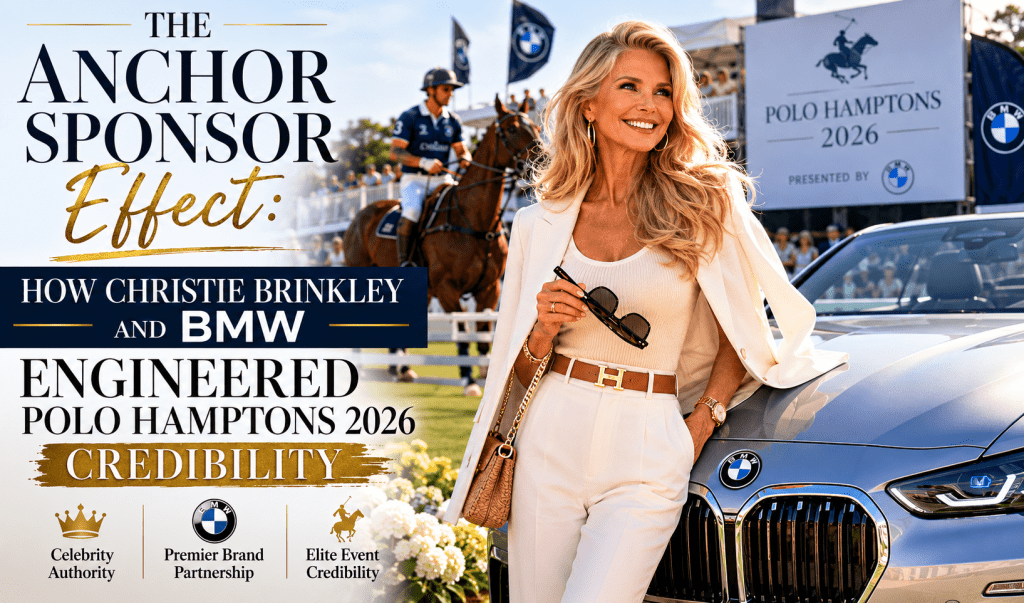
She read two lines and stopped. Christie Brinkley was hosting. BMW was the title sponsor.
She forwarded it to her events team within four minutes.
She did not forward it because the audience metrics were compelling, though they are. The activation options were not particularly novel either. She forwarded it because two facts in two sentences had changed the entire risk calculation. If BMW has already committed, the event is real. If Christie Brinkley is hosting, the cultural positioning is already established. The due diligence that would normally take three weeks had been compressed into a single inference.
This is the anchor sponsor effect. It is one of the most powerful mechanics in luxury event marketing, it is almost never discussed in those terms, and it is the reason that Polo Hamptons 2026 sponsor strategy was architected the way it was.
What an Anchor Signal Actually Does
In behavioral economics, an anchor is a reference point that shapes subsequent judgments. Tversky and Kahneman established the anchoring effect in 1974 — the finding that initial information disproportionately influences how people evaluate everything that follows. Present someone with a high number first and their subsequent estimates will be higher. Present a low number and estimates fall.
In luxury event sponsorship, the anchor works on a different variable: perceived credibility and risk. The first major commitment to an event, specifically a commitment from a brand or individual with established credibility in that market, recalibrates how every subsequent potential sponsor assesses the opportunity. The question shifts from “is this event legitimate?” to “what kind of brand do I want to be in this context?”
The Credibility Transfer
BMW’s title sponsorship of Polo Hamptons 2026 performs this function at the brand level. BMW does not sponsor events without a vetting process. Their brand standards for partner events are documented and enforced. When BMW says yes to an event, it is communicating, to every brand that encounters that information, that the event has cleared a credibility threshold. The BMW logo on the event materials is not just advertising. It is a certification signal.
Christie Brinkley’s hosting role performs the same function at the cultural and social capital level. Her forty-plus years in the Hamptons are not a career fact. They are a trust credential, built in this specific geography. She has been part of this specific geography, these specific communities, these specific social networks, for longer than most luxury brand managers have been alive. When she attaches her name to an event, she is vouching for its belonging in the Hamptons summer. Her presence says: this is not a brand importing itself into a geography it does not understand. This is an event that the people who actually live this summer are endorsing.
Together, BMW and Christie Brinkley function as what the signal economy produces at its most efficient. It is a two-source credibility architecture. Any subsequent sponsorship conversation starts from a fundamentally different place than a cold pitch.
The Math That Nobody Does
There is a calculation that luxury brand marketers almost never run explicitly, but that drives their decisions implicitly. It is the cost of being wrong.
When a brand sponsor commits to an event that underdelivers, the costs are multiple: budget wasted, team time lost, potential brand association damage if the event fails publicly. The reputational cost of having made a bad judgment call, which in some organizations is higher than the financial cost.
Because of these costs, sponsorship decisions at the luxury brand level are risk-weighted heavily toward caution. The default position is no. The threshold for yes is high. And the most efficient way to clear that threshold is not a better deck or a lower price point. It is proof that someone credible has already said yes.
Risk Reduction as Strategy
BMW’s title sponsorship reduces the perceived risk of every subsequent commitment. Not because BMW has endorsed the subsequent brands specifically, but because its presence in the same event architecture implies a quality floor that reduces the probability of catastrophic failure. An event with BMW as title sponsor will not be poorly organized. It will not attract the wrong audience or embarrass its participants. The BMW brand standard is itself a risk mitigation tool for everyone else at the table.
Christie Brinkley’s hosting role reduces a different kind of risk: the cultural fit risk. For a brand that is new to the Hamptons market, or that is building its Hamptons positioning for the first time, the question of whether an event actually belongs in the Hamptons summer is non-trivial. Getting this wrong produces something worse than a missed opportunity. It produces a misalignment signal — an association that suggests the brand does not yet understand this geography and this audience.
Christie Brinkley’s presence eliminates that risk. There is no version of Polo Hamptons with Christie Brinkley hosting that does not belong in the Hamptons summer. Her presence is the cultural proof of belonging that no brief or deck can manufacture.
Why Two Spots Remaining Is Not a Sales Tactic
There are two sponsorship positions remaining for Polo Hamptons 2026. This fact will be interpreted, by some brands receiving this information, as a closing tactic. Limited availability. Urgency pressure. Standard sales mechanics.
That interpretation misses the signal entirely.
Two remaining positions, in the context of an anchor sponsor framework, communicates something specific about the event’s sponsorship architecture. The positions that have been filled set the peer group for the positions that remain. A brand that sponsors Polo Hamptons 2026 is not just buying event presence. It is joining a specific company — BMW, Christie Brinkley, and whatever brands have already committed to the remaining sold positions.
Because the company you keep is part of the brand signal, the event produces a different result for each brand depending on who it appears alongside. A brand in a field with BMW and Christie Brinkley makes a statement about its own positioning. One in a field with mismatched co-sponsors makes a different one. The anchor sponsors determine the quality of the peer group, and the quality of the peer group determines the value of every remaining position.
In signal economics, scarcity increases signal value when it is genuine. Two remaining positions means that the sponsorship is not available to everyone who wants it. That unavailability is itself a signal — about the caliber of the brands that have already committed, about the selectivity of the curation, about the difference between this event and one that will take any brand willing to write a check.
Because the positions fill in order, the first brand to commit gets the strongest peer group signal. The last brand to commit gets an anchor that has already been eroded by completion. This is not urgency pressure. It is signal economics operating exactly as Sutherland described.
The Activation Calculus at Fishel Estate
The Fishel Estate at 900 Lumber Lane in Bridgehampton is not a generic event venue. It is a specific address with a specific reputation in the specific social geography of the East End. Events held there carry the location’s own signal — the history of what has happened in that setting, the associations the address holds for people who have attended events there, the implied statement that a brand making this choice understands where it is placing itself.
Brand activations at Polo Hamptons are not booths at a trade show. They are presences in a curated outdoor environment that has been designed to read as a Hamptons summer afternoon, not as a marketing event. The activation station that succeeds in this setting is the one that looks like it belongs there — that offers something genuine, something that serves the guest rather than the brand, something that earns its place in the environment the way the environment itself has earned its place in the summer.
A beauty brand offering a sunscreen application station at a polo match in July earns its presence because the service is real and the timing is right. A spirits brand pouring something cold and specific in the late afternoon earns its presence because it is doing what that brand is supposed to do in that setting. The activation that fails is the one that imports its trade-show mechanics into a context that has no tolerance for them.
Designing the Right Presence
For brands evaluating the remaining positions at Polo Hamptons 2026, the activation question is not “how do we maximize impressions?” It is “what can we offer these specific people, in this specific setting, that would make them glad we were there?”
Answer that question correctly, and the anchor signal of BMW and Christie Brinkley will work on your behalf for the remainder of the summer.
Contact Social Life Magazine’s business development team to discuss the remaining Polo Hamptons 2026 positions. July 18 and July 25. Fishel Estate, Bridgehampton. Two spots. The anchor is set. The question is whether your brand belongs in that company.
Where The Conversation Continues
Anchor sponsor effects are one dimension of how costly signaling creates luxury brand credibility in the Hamptons. The full framework lives in the hub: The Signal Economy: Why the Most Powerful Luxury Marketing Looks Like It Isn’t Marketing.
Broader signal economy mechanics — from the peacock’s tail to the Ralph Lauren Job’s Lane opening — are in that hub piece. The other two spokes in this cluster examine signaling through different lenses:
– How what a brand serves at a Hamptons event communicates more than its label ever could: Why the Most Expensive Champagne at a Hamptons Party Is Never the Point (FUTURE) – How a single Social Life Magazine feature changes the way luxury buyers permanently categorize your brand: The Press Clip Effect (FUTURE)
The pillar on luxury brand psychology across the full Hamptons market: Why Luxury Brands That Ignore Psychology Lose the Hamptons Every Summer.
Author

Written by
Recent Posts
How to Book an Inspirational Speaker for an Event

Why Quiet Luxury Brands Win the Hamptons (And What the Loud Ones Get Wrong)
The Signal Economy: Why the Most Powerful Luxury Marketing Looks Like It Isn’t Marketing

The Anchor Sponsor Effect: How Christie Brinkley and BMW Engineered Polo Hamptons 2026 Credibility

Why the Most Expensive Champagne at a Hamptons Party Is Never the Point
Categories
- Art
- Articles
- Celebrities
- Entertainment
- Events
- Fashion
- Fashion & Style
- Featured
- Food & Beverage
- Food, Spirits, Wine
- Hamptons
- Hamptons Celebrities
- Hamptons Lifestyle
- Health
- Health & Beauty
- Lifestyle
- Luxury Brand Strategy
- Luxury Lifestyle
- Press
- Profiles
- Real Estate
- Technology
- The Chronicles
- Travel
- Uncategorized
- Weddings