
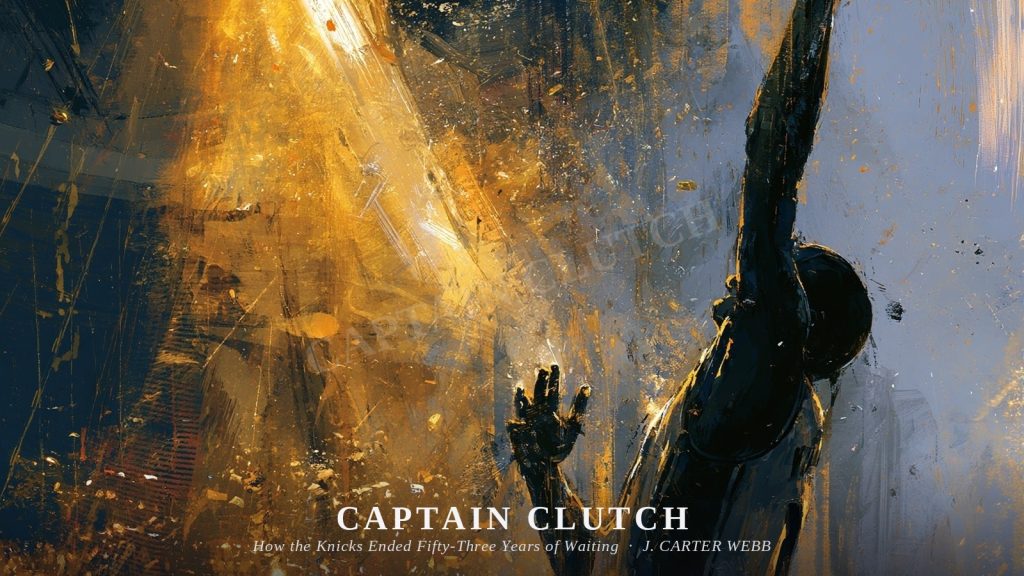
By the Editors · Entertainment & Culture · Books
In the summer of 2024, Jalen Brunson did something the basketball industry found almost impossible to explain. He signed a contract worth roughly a hundred and thirteen million dollars less than he could have commanded by waiting a single additional year. He gave the money away on purpose — so that the New York Knicks could afford to keep building a champion around him.
Two years later, standing on a court in San Antonio with a towel pulled over his head and fifty-three years of waiting finally over, the decision no longer needed explaining.
That sacrifice — and the title it bought — is the subject of Captain Clutch: How Jalen Brunson and the New York Knicks Ended Fifty-Three Years of Waiting, the new book by J. Carter Webb, available now on Amazon Kindle.
“He gave away $113 million. Then he won everything.”
A $113 Million Bet That Built a Champion
By the cold economics of professional basketball, the choice bordered on irrational. Had Brunson waited one more season, he would have become eligible in 2025 for a supermax extension projected at roughly $269 million over five years — the highest tier of compensation the sport offers, sitting there and requiring nothing of him but patience. Instead, he signed that summer for about $156.5 million. The gap was approximately $113 million: nearly twice what he had earned across his entire career to that point.
The reason was specific and unsentimental. The league’s salary rules meant a team paying its star the full supermax would have almost no room to pay anyone else. The Knicks could have Brunson at $269 million, or they could have Brunson at a discount plus a supporting cast capable of winning a title. The math did not permit both. By taking less, Brunson financed the contender assembled around him — effectively paying his own teammates’ salaries out of money that could have been his.
Fifty-Three Years of Heartbreak
To understand why that mattered, you have to understand what the Knicks had become. The franchise had not won a championship since 1973. In the half-century that followed, it grew into one of the great cautionary tales in American sports: the team with the biggest market, the most famous arena, and effectively unlimited money that nonetheless could not win the one thing that finally counts.
The drought had a particular cruelty to it. The Patrick Ewing teams of the 1990s were not sad-sack losers — they were very good, for a very long time, which was precisely the problem. They reached the brink again and again, a Game 7 here, a Finals there, a last-second shot — and they fell, year after year, in ways that seemed designed to maximize the pain. A blocked shot at the buzzer in 1994. A two-for-eighteen shooting night in Game 7. An eighth-seeded 1999 run to the Finals that ended, fittingly, against the San Antonio Spurs. New York specialized, for a generation, in losing the games that hurt most to lose.
The Guard Nobody Wanted
Webb’s book is, at its heart, a story about being undervalued. Brunson stood six feet tall in a league where championship guards are routinely four to six inches taller. He was the thirty-third pick of the 2018 draft, passed over by every team in the league once and most of them twice. The scouting consensus was consistent across his whole career: not big enough, not fast enough, not athletic enough to be the best player on a team that wins it all.
He had been built to outlast exactly that doubt. His father, the journeyman NBA guard Rick Brunson, taped his young son’s dominant right thumb to his hand to force him to develop his off hand — the kind of obsessive, forward-looking instruction that produced the ambidextrous, footwork-obsessed craftsman who would one day refuse to be limited by his physical disadvantages. Jalen learned early, watching his father fight every year to hold a roster spot, that talent without work is nothing and that doubters are to be answered rather than believed.
Seven Seconds in San Antonio
The vindication arrived in Game 5 of the 2026 Finals. Brunson scored 45 points that night — a Knicks Finals record, enough to tie Michael Jordan for the most ever in a Finals-clinching game on the road. For most of the evening, New York had been losing; it was the fourth time in five games that the Knicks erased a double-digit deficit to beat a Spurs team built around the seven-foot-four phenomenon Victor Wembanyama. The final read 94–90.
When it ended, Brunson’s first act as a champion was to disappear — to pull a towel over his head and vanish beneath it, wanting one private moment for a feeling he could not control. When he lowered it, the cameras found a man who had carried something for a very long time and had finally been allowed to set it down.
“The story of how an undersized guard nobody wanted gave a city back its heart.”
Why This Book Matters
Drawing entirely on the public record — press conferences, broadcasts, and published reporting — Captain Clutch makes a clear, arguable case: that the 2026 championship was made possible, more than by any single shot or game, by a financial sacrifice the basketball world initially failed to understand. The games were how the title was won. The sacrifice was why it could be won at all.
But the deeper reason the story resonates has nothing to do with basketball. Almost everyone, at some point, has been measured by others and found wanting in ways that did not capture the truth. Brunson’s answer — to convert doubt into fuel, and finally to take the question of his own value into his own hands — is a story for anyone who has ever been counted out.
Captain Clutch by J. Carter Webb is available now on Amazon Kindle ($6.99), with the paperback edition arriving Tuesday.
Read it here →
Author

Written by
Recent Posts
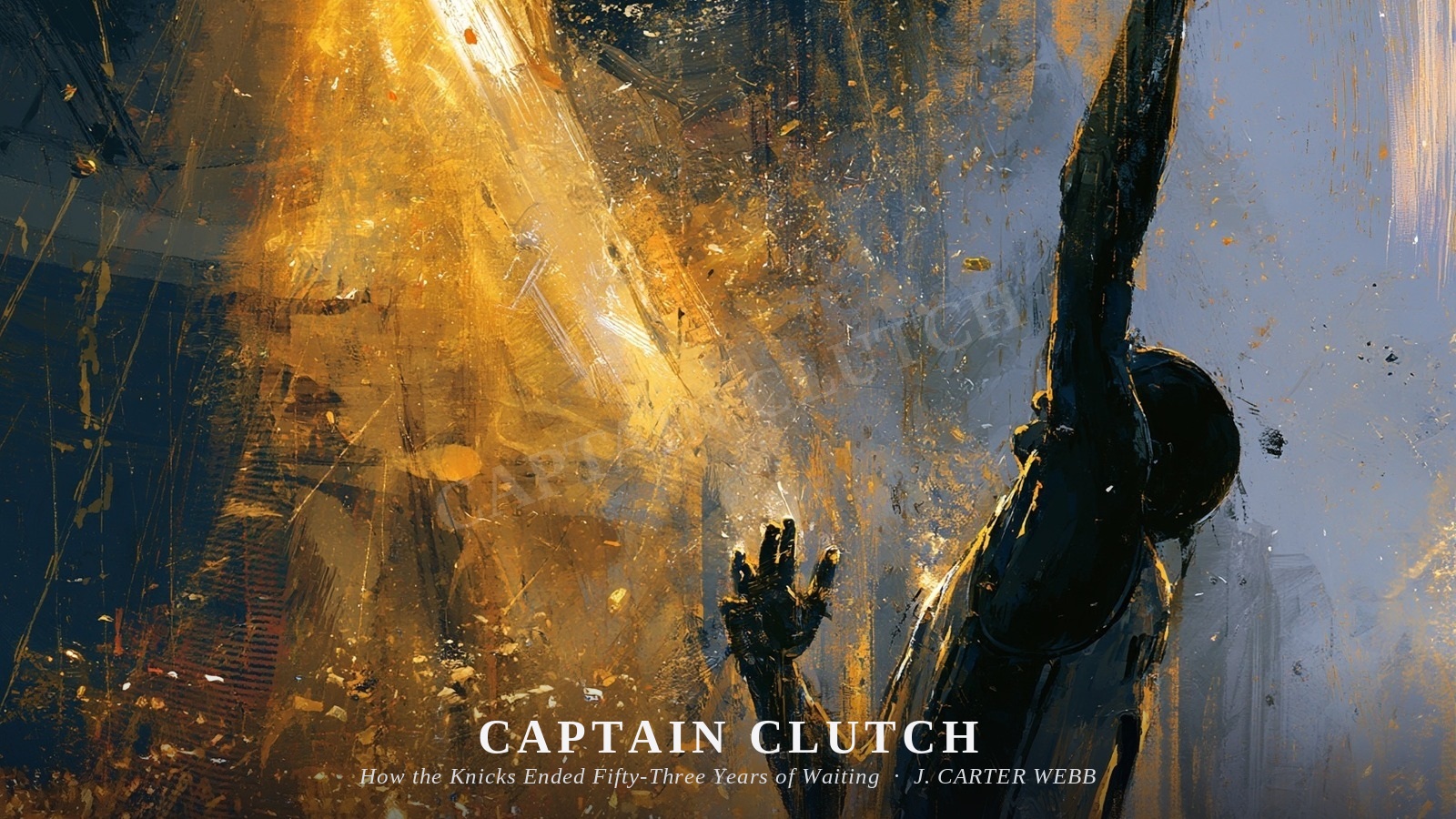
Captain Clutch: How Jalen Brunson and the Knicks Ended 53 Years of Waiting.
Common Stucco Problems Homeowners Should Fix Early
The Complete Body Skin Care Routine for Soft, Healthy Skin
Summer in the City: Shopbop’s Edit for Warm-Weather Days That Never Slow Down
Shoulder Pain That Won’t Go Away: When It’s Time to See a Specialist
Categories
- Art
- Articles
- Business of Luxury
- Celebrities
- Entertainment
- Events
- Fashion
- Fashion & Style
- Featured
- Food, Spirits, Wine
- Hamptons
- Hamptons Celebrities
- Hamptons Lifestyle
- Health
- Health & Beauty
- Lifestyle
- Luxury Lifestyle
- Press
- Profiles
- Real Estate
- Social Scene
- Technology
- The Chronicles
- Travel
- Uncategorized
- Weddings