
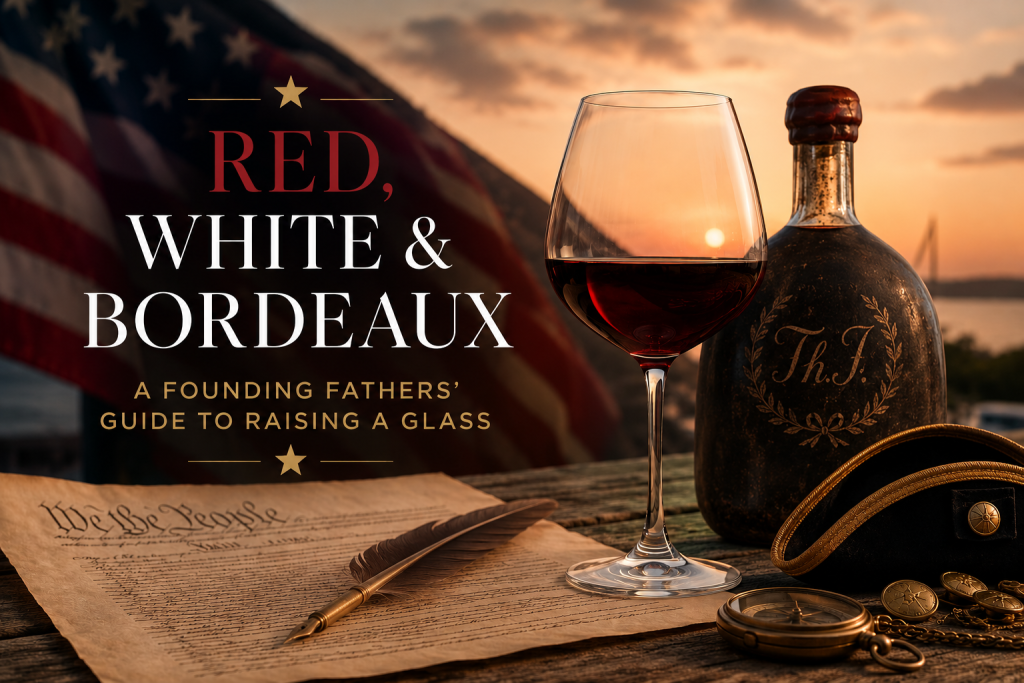
Two days before they signed the Constitution, George Washington and 54 delegates ran up the most consequential bar tab in American history. The bill from City Tavern in Philadelphia, dated September 15, 1787, does not suggest restraint. The founding fathers’ wine order alone totaled 114 bottles: 54 Madeira, 60 claret. After that came 8 bottles of whiskey, 8 of hard cider, 12 of beer, and seven “large bowls” of punch. There was also a separate charge for broken glasses. Still, the republic could wait until morning.
Gordon Lloyd found the original bill while researching the papers of Independence Hall. Total: 89 pounds, four shillings, two pence, or roughly $15,400 in today’s money. That works out to $280 per person for what was, technically, a working dinner. The bill covered food, wages for musicians and servers, and, as noted, the glassware situation. The Founders, it turns out, partied like Founders.
Founding Fathers Wine: What They Ordered and Why
Most Americans in the late eighteenth century drank alcohol daily, and largely out of necessity. Water supplies were frequently contaminated. Beer, cider, and rum were safer, cheaper, and reliably available.
Thomas Jefferson famously said: “My measure is a perfectly sober 3 or 4 glasses at dinner.” That line rewards a second reading. Not because the math is alarming, but because the word “sober” appears in it at all.
The imported wine carried the kind of social weight that doesn’t show up on an invoice. Specifically, Madeira and claret were the prestige markers of the colonial elite. Think of a well-aged bottle in a governor’s cellar, the glass raised at a state dinner, the quiet announcement that a man of means had connections abroad and the income to maintain them. In the social vocabulary of the colonies, good Madeira was roughly equivalent to a cellar membership at a Michelin-starred restaurant today. Indeed, it said something specific about you. Everyone present understood what.
Thomas Jefferson, America’s First Wine Obsessive
Yet Jefferson was not simply a wine drinker. He was a wine project.
He served as America’s Minister to France shortly before the French Revolution and came home with a fully formed set of opinions. During that time, Jefferson arranged for his chef, James Hemings, to train under French kitchen professionals in Paris. He also embarked on a three-month personal tour of the wine regions of Bordeaux, Burgundy, the Rhône Valley, and Piedmont. Meticulous notes followed. Strong views came home with him, and he had no intention of keeping them to himself.
Jefferson also believed cheap wine made sober nations. He famously argued: “No nation is drunken where wine is cheap; and none sober, where the dearness of wine substitutes ardent spirits as the common beverage.” Lower import duties, in his view, would make wine accessible to ordinary Americans as a healthier alternative to hard spirits. Yet his own tastes remained decidedly aristocratic. The gap between the policy and the cellar was, in Jefferson’s case, considerable.
Back in Virginia, he continued ordering European wines at scale. He supplied George Washington with selected vintages and maintained his own cellar at Monticello. According to records cited in The New Yorker, Jefferson spent $7,500 on wine during his first presidential term. Today, that figure is approximately $120,000.
Not all the Founding Fathers shared his enthusiasm. After dining with Jefferson in 1807, John Quincy Adams wrote in his diary: “There was, as usual, a dissertation upon wines. Not very edifying.” Two lines that say more about the dinner table than any formal account could.
The Jefferson Bottles and the $157,500 Question
In 1985, a cache of eighteenth-century Bordeaux bottles turned up in a walled-up cellar in Paris. Each one bore engraved initials: “Th. J.” The wine world electrified. Auctioneers and collectors concluded, or strongly wanted to conclude, that the bottles had once belonged to Thomas Jefferson.
The same year, a bottle of 1787 Château Lafite from the cache sold at auction for $157,500. At the time, it was the most expensive single bottle of wine ever sold.
Then came the 1787 Château Margaux. It never made it to an auction. William Sokolin, a New York wine merchant with a flair for theater, brought the bottle to a black-tie dinner at the Four Seasons Restaurant in 1989. He carried it in like a trophy. A waiter knocked it off the table. The bottle was insured for $225,000. Sokolin filed the claim. The insurance company settled. Some collectors suspected he knew exactly what he was doing.
The reckoning came eventually. Microscopic analysis of the “Th. J.” engraving told a different story: the cut pattern matched a modern rotary tool, not an eighteenth-century instrument. The Thomas Jefferson Foundation at Monticello also declined to support the claim. No documentary evidence could connect the bottles conclusively to Jefferson. Most experts now attribute the collection to Hardy Rodenstock, a German wine dealer. He had a long record of surfacing rare discoveries that didn’t survive scientific scrutiny. Benjamin Wallace’s The Billionaire’s Vinegar covers the full story.
Rodenstock was, depending on the source, either the greatest wine collector of the twentieth century or its most audacious fraudster. Possibly both.
When Bottles Become Assets: The Auction Record
Eighteenth-century wine in drinkable condition is, of course, extraordinarily rare. But certain bottles circa Civil War-era still taste remarkably well when stored correctly. At auction, those bottles now command prices that require a moment of reflection before bidding.
In October 2010, a single bottle of Château Lafite 1869 sold at Sotheby’s Hong Kong for $233,972. The pre-sale estimate had been $60,000. An anonymous collector ultimately purchased three bottles from the same vintage for a combined $700,000.
That same year, divers exploring a nineteenth-century shipwreck near the Åland Islands in the Baltic Sea made an unusual discovery. Among the 168 recovered bottles: Veuve Clicquot and the now-defunct House of Juglar, both dating to the 1830s and 1840s. Historians believe the cargo was bound for the Imperial Russian court. Since the Baltic runs cold and dark at depth, many bottles survived in remarkable condition. In 2011, a recovered Veuve Clicquot sold for €30,000 at an auction in Mariehamn. A bottle of Juglar commanded €24,000 at the same sale. Bidders flew in from Singapore and the United States. The Åland Islands were briefly the most consequential address in the wine world.
Historic American spirits have also followed the same arc. Pre-Prohibition rye whiskeys now routinely reach five- and six-figure prices at auction. Rare bourbons have crossed the million-dollar mark. Madeira was the founding fathers’ wine for public celebrations and private dinners alike. It is now one of the more contested categories in the historic spirits market. The cellar you didn’t start twenty years ago is the one you’re watching appreciate right now.
Owning a bottle like this offers more than prestige. The question is always the same: preserve it as an appreciating asset, or yield to the temptation of uncorking history itself.
What to Pour Out East on the Fourth
If you haven’t secured a six-figure bottle for the weekend, there are still plenty of democratic options on the shelf to cheer in the revolutionary style.
Jefferson’s Ocean Aged bourbon pays tribute to Jefferson’s long fascination with transatlantic trade. Authentic Madeira from Blandy’s, Barbeito, or Henriques & Henriques is still accessible at reasonable price points. It offers the taste of what the architects of the republic were drinking on their best nights. That connection counts for something on America’s 250th.
Out East, Blandy’s 10-Year Malmsey is worth tracking down before the Fourth. Jefferson’s Ocean can also be found at several Hamptons wine shops and makes a natural conversation-starter at any July table. Of course, neither requires insurance.
For those who prefer a taste of the Riviera, Château Léoube‘s organically farmed Provençal rosés and whites are worth knowing. Long favored for elegant summer entertaining and available in the U.S. through Léoube’s American distribution, they feel perfectly at home on a Hamptons table overlooking the water.
The Founding Fathers’ wine tab at City Tavern came out to $280 per head. At a working dinner. In 1787. The republic they assembled that week has, against considerable odds, lasted 250 years. So toast it accordingly.
Where The Conversation Continues
The people who read this magazine are the ones who already know the difference between good wine and the right wine. They understand that a bottle chosen with intention, at a summer table Out East, is about more than what’s in the glass. That’s exactly who Social Life Magazine has been writing for, in print, for over 23 years.
If your brand, your story, or your product belongs in that conversation, Social Life Magazine’s editorial pages are where it lives. We reach the decision-makers, the tastemakers, and the checkbook-holders of the Hamptons social season, in print and online. Reach out here to start the conversation.
Want your story told on your own terms? Our paid feature program places your brand narrative directly in front of 25,000 summer print readers and 82,000 email subscribers. Done well, it reads like editorial. Because it is.
The Social Life email list delivers Out East intelligence every week through the summer season. Join 82,000 readers here.
On the Lawn and In the Tent
This July 18th and July 25th, Polo Hamptons returns to Fishel Estate in Bridgehampton with Christie Brinkley as host. It is, by several measures, the most photographed lawn on the East End. Sponsorship inquiries and Corporate Cabana reservations are open now at polohamptons.com.
The summer print edition of Social Life Magazine reaches 25,000 readers across the East End, from Westhampton to Montauk, from Memorial Day through Labor Day. Subscribe to the print edition here.
If Social Life Magazine has introduced you to a story worth knowing, from founding fathers wine culture to the people defining the East End this season, consider supporting independent luxury publishing here. Independent voices Out East survive because the right readers understand their value.
Yuliya Barycheuskaya is a Ph.D. candidate in History at the CUNY Graduate Center. She specializes in the stories where history meets everyday life, from political revolutions and popular culture to the bottles once uncorked by the Founding Fathers. She has taught American and World History at Hunter College, Baruch College, and Touro University.
Author

Written by
Recent Posts
Vanderbilt & Seewald
Alberto Luzzi Opening of Fine Jewelry Room
The Victor dE Souza 2027 Spring Summer Collection

Malan Breton Presents “Garden of a Thousand Tomorrows”
What to Wear to a Summer Wedding as a Guest: A Hamptons Dress Code Guide
Categories
- Art
- Articles
- Business of Luxury
- Celebrities
- Culture
- Entertainment
- Events
- Faces of Summer 2026
- Fashion
- Fashion & Style
- Featured
- Finance
- Food, Spirits, Wine
- Hamptons
- Hamptons Celebrities
- Health
- Health & Beauty
- Lifestyle
- Luxury Lifestyle
- Press
- Profiles
- Real Estate
- Technology
- The Chronicles
- Travel
- Uncategorized
- Weddings