
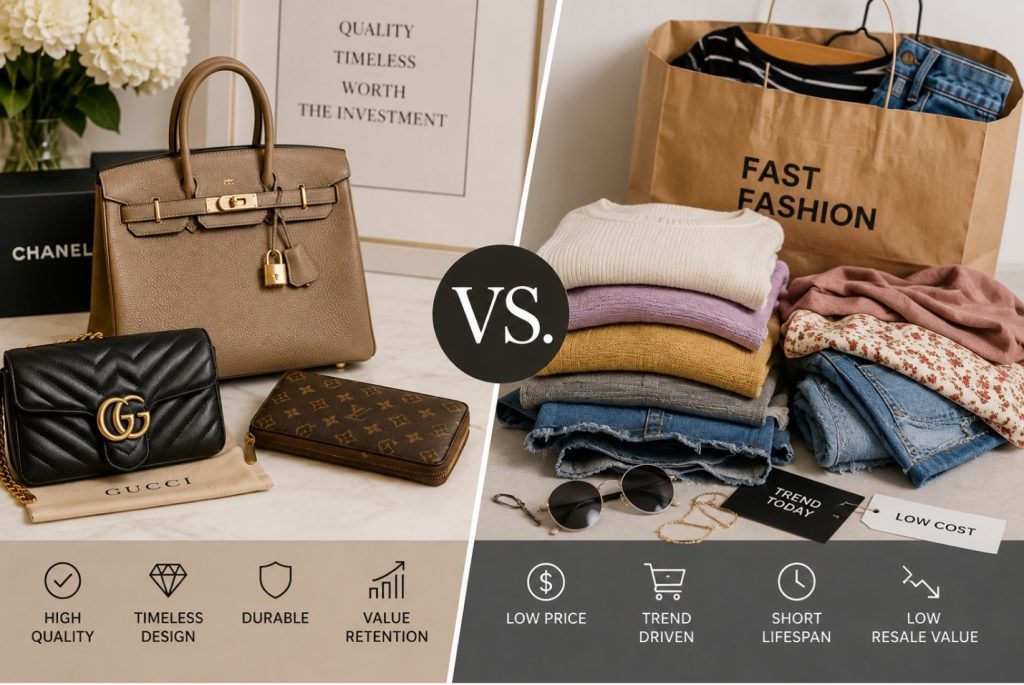
With fast changing trends in 2026, fashion lovers are often at a crossroads: do they save hard for an expensive fashion item, or spend quite a bit of money on multiple cheap items? Designer bags vs fast fashion isn’t a fashion matter; it is a choice between two completely different consumption mindsets.
With fast fashion, you’ll have a new outfit within days, but with a designer handbag, it’s more of an investment in money and the environment.
Why Buy Designer Bags in Dubai: The Luxury Resale Market Is Booming
Dubai is one of the fastest-growing luxury handbag markets in the world, and it’s not surprising to see that shoppers in the region increasingly choose to buy designer bags in Dubai over mass-market options.
The duty-free rates, variety of authorized stores and the strong secondary market make it an attractive destination for getting the real value for money.
It’s not only a Dubai phenomenon, but it’s also a global one. The luxury handbag resale market is growing at a rate of nearly three times that of the primary retail market and is expected to double almost up to 2030.
Limited editions from Hermes, Chanel, and Louis Vuitton are often able to command 60-980% of the retail price, and some have even sold for more than what the original customer paid. However, for UAE consumers, owning authentic designer handbags locally with an original receipt and packaging intact is the best way to ensure resale value in the future.
Cost-Per-Wear: Why Cheap Bags Actually Cost More
So, the only way to find out which one is worth your money is to see how they’re manufactured and how long they last.
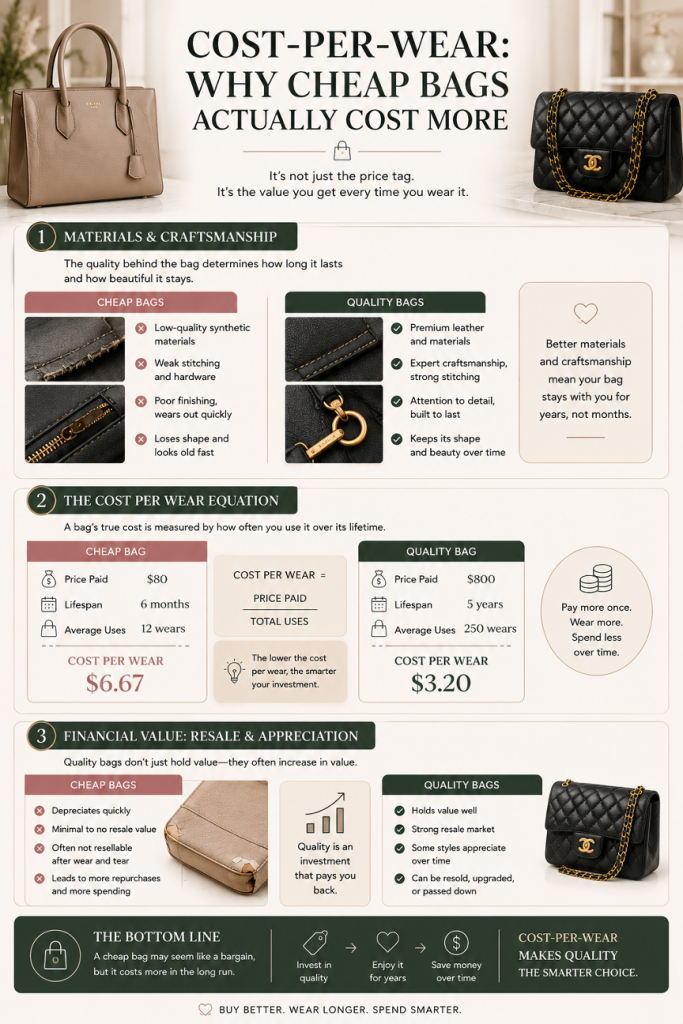
1. Materials and Craftsmanship
Skilled artisans create designer handbags from high-quality materials such as full-grain leather, high-quality hardware, and hand-stitched details that are built to last for many years.
In contrast, fast fashion bags are made largely from synthetic alternatives such as polyurethane (PU) plastic, low-quality zinc-alloy zippers and bad-chemistry glues. PU leather peels after 1-2 months of moderate usage, straps fray and zippers break, making the bag unusable.
2. The Cost Per Wear Equation
A straightforward equation reveals the conundrum of ‘fast fashion’ being cheap:
Cost Per Wear = Cost of Up-front Purchase Price / Number of Times Worn
- The Fast Fashion Bag: You purchase a trendy bag for $40. It is paired with 3 outfits, worn 10 times and the strap tears. Cost per wear: $4.00.
- Designer Bag: You spend $2,000 on a classic and versatile shoulder bag. It is worn 780 times (three times per week for 5 years). Cost per wear: $2.56.
A premium product didn’t become more expensive over time; it became more affordable.
Financial Value: Resale and Appreciation
The biggest difference between the two markets is in the value retention. Fast Fashion bags cannot be resold and are considered a sunk cost.
However, luxury bags are more like alternative assets. The second-hand luxury handbags market will hit the $33 billion mark by 2034, as per the extensive Investment-Grade Handbag Resale Market Report. Luxury brands tend to put up price hikes every year so you could end up getting taxed more for it today but if you sell it later, it can appreciate in value.
The Environmental and Ethical Cost of Fast Fashion
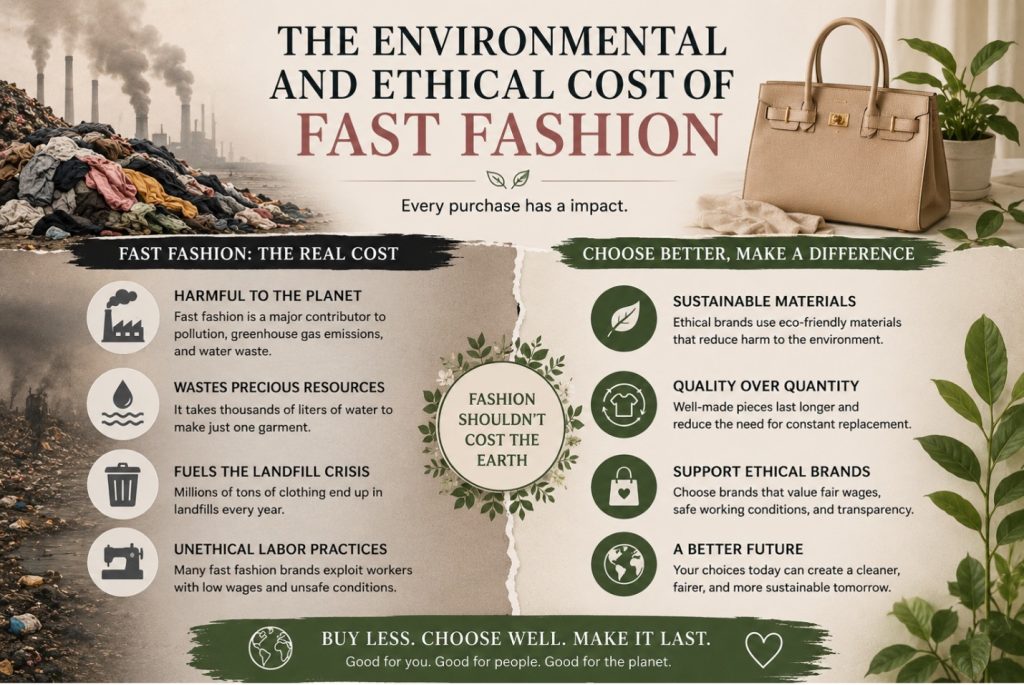
The cost is not the only factor; durability also has an environmental dimension. Fast fashion’s business model is built around quick production times and inexpensive fabrics that are meant for disposable use.
Research compiled by Earth.Org shows that of the roughly 100 billion garments and accessories produced each year globally, about 92 million tonnes end up in landfills, with global fashion-related emissions on track to double by the end of the decade if consumption patterns don’t change.
When it comes to fashion accessories, such as bags, fast fashion is designed to last for only a few uses, and then it’s done; glue will come off, zippers will break, and synthetic materials will be worn out.
Full grain leather and reinforced stitching make designer bags built to be repaired, restored, and handed down. Your wardrobe’s longevity directly depletes the amount of waste it will generate at the landfill.
Comparison of Designer Bags vs. Fast Fashion at a Glance
| Feature | Designer Handbags | Fast Fashion Bags |
| Average Lifespan | Decades (with proper care) | 3 to 12 months |
| Material Quality | Full-grain leather, solid brass/gold plating | Synthetic PU plastic, cheap alloys |
| Resale Value | High (60% to 130%+ of retail) | 0% (Non-resellable) |
| Environmental Impact | Low (Circular, long lifespan) | High (Landfill waste, microplastics) |
| Upfront Cost | High investment | Very low |
Which is really worth it?
The truth depends on the piece, and not solely on the price tag!
- If it is a trendy style that is only in the market season once a year, or if you just don’t have the money for a quality option at this time, opt for fast fashion.
- Opt for designer items for daily use and durability, such as totes, crossbodies, and structured bags that will last for years. The classics are always in neutral leather from the trusted brands and they offer the best durability and resale value.
Don’t go with middle-of-the-road “aspirational” bags that are too affordable to be reusable and too flimsy to be kept around or, even better, resold.
Final Verdict
Fast fashion is the winner when it comes to price at the beginning. Designer bags take the win in cost per wear, resale value, durability and environmental impact. A well-made designer purse is often a better long-term investment than it is a more glamorous one, particularly if you’re seeking to create a wardrobe that will endure, and especially if you’re looking for authenticated luxury in a market with high demand levels, such as Dubai.
Author

Written by
Recent Posts
The First Decision After a Collision Can Be the Most Important One
Two Weeks in Rome and Beyond: Turkish Airlines Itineraries from Boston, Chicago and Onward to India

Top 10 Hair Transplant Clinics in Turkey 2026
Artist Alley to Online Store: How Convention Artists Can Keep Selling After the Event
When an 18-Wheeler Crash Leaves Lasting Consequences
Categories
- Art
- Articles
- Business of Luxury
- Celebrities
- Culture
- Entertainment
- Events
- Faces of Summer 2026
- Fashion
- Fashion & Style
- Featured
- Finance
- Food, Spirits, Wine
- Hamptons
- Hamptons Celebrities
- Health
- Health & Beauty
- Lifestyle
- Luxury Lifestyle
- Press
- Profiles
- Real Estate
- Technology
- The Chronicles
- Travel
- Uncategorized
- Weddings