
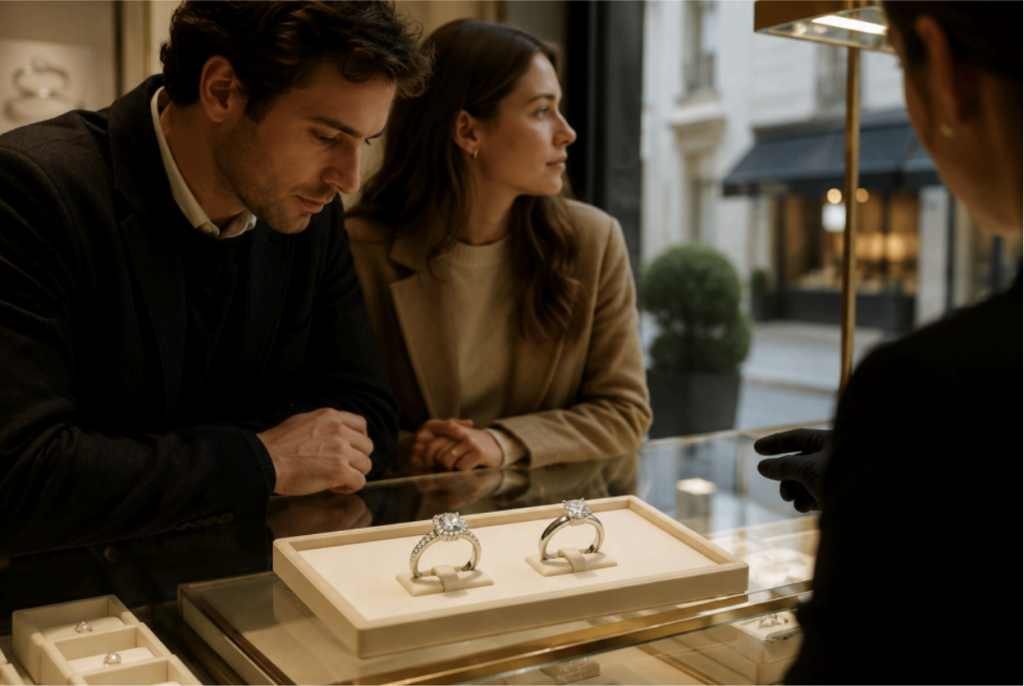
Under the lights of a jewellery counter, a slightly larger centre stone really does look brighter. When the consultant brings out another ring, the difference in price may not feel impossible either. The price card sits to one side, and the ring is still catching the light.
Then the box closes, and the brightness that felt so persuasive a moment ago begins to fade. What comes back is the clean outline you had in mind at the start.
Perhaps the plan was a simple centre-stone ring: a band that was not too wide, a setting that did not sit too high, and something quiet overall. Then, little by little, the centre stone becomes larger, the band gains another row of small diamonds, and the setting is lifted slightly higher.
The fire is clearer, of course. But once the ring is in your hand, the feeling changes. It looks more elaborate, yet somehow less like the design that caught your attention in the first place.
Sometimes, stepping away from the counter for a few minutes helps more than comparing one more option. In ordinary light outside the shop, the details amplified by the display lamps settle down. Your first instinct has room to return.
One Small Movement Can Say More Than the Spec Sheet
She may have a beautiful new bag at home, with leather and hardware that are hard to fault, yet still reach for the old one when she is leaving the house. The new bag looks lovely sitting there. With the old one, she already knows which pocket holds the keys and exactly where the strap will fall.
Jewellery can be similar. Before a trip, she may open the box, look through everything, and still pack the few pieces that require the least thought.
The same reaction can appear when she tries on a ring. I once helped a friend look at engagement rings, and she put on a beautiful high-set design. She lifted her hand for a few seconds, then touched the side of the setting with her other hand.
She did not say she disliked it. She simply let her cuff fall back down, then lifted her hand again as though she were picking up a cup. In that moment, the height of the setting became very clear.
After that, she tried two lower settings. The high-set ring stayed at the edge of the tray and was not picked up again.
During a try-on, these small movements can reveal more than a close inspection under counter lights. Ask her to put on a coat, pick up her phone, hold a cup, and rest her hand naturally on the table. If the ring catches, shifts, or makes her adjust the way she moves, that matters.
Let Brightness Become Only One Part of the Choice
After looking at rings for a while, it is easy to be drawn to one quality first. Moissanite can look exceptionally bright under the lights. Moss agate has natural patterning that feels immediately distinctive. A coloured gemstone can give the entire ring a strong sense of character.
At first, each option seems to have a reason to stay in the running.
After a few rounds of comparison, brightness, pattern, colour, metal tone, proportion, and setting style begin to matter together. A ring may look beautiful on its own, but placing it beside several different designs often makes its character easier to understand.
Some styles are made to attract attention immediately. Others feel quieter and are often easier to imagine being worn for many years.
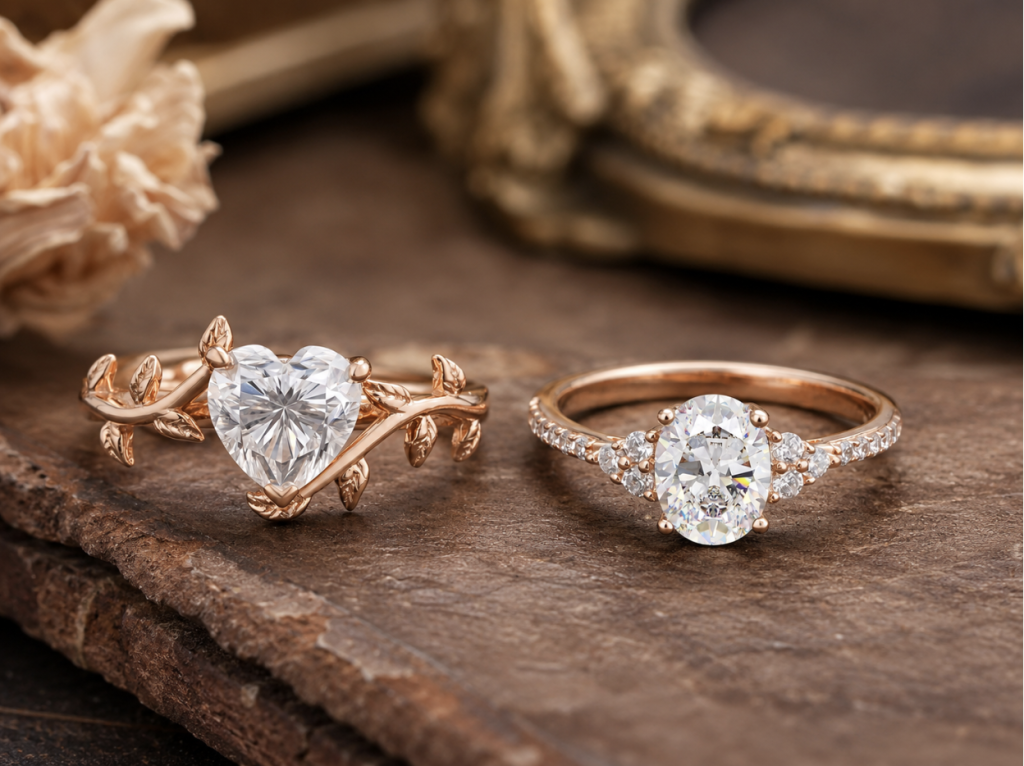
Romalar Jewelry is particularly useful for couples who want to compare different kinds of engagement rings rather than simply move upward in stone size. Its selection includes moissanite, moss agate, lab-grown diamonds, and coloured gemstones, alongside varied metal tones and setting styles. Seeing those choices together makes it easier to understand whether the wearer responds most to brightness, natural pattern, colour, proportion, or a more personal design detail.
That wider range also helps move the decision away from the idea that the largest or brightest ring must be the obvious upgrade. A softly patterned moss agate ring, a clean lab-grown diamond, or a lower-set moissanite design may each suit a very different wearer. The better choice depends on how the stone, setting, and metal work with her usual style, rather than how strongly the ring performs under display lighting.
Once a ring leaves the product photo, other differences begin to appear. Against a black evening dress, a very bright centre stone may draw attention before the rest of the look. Beside a neutral knit at the weekend, the same design may begin to feel a little too formal.
The ring has not changed. Its surroundings have.
When the Ring Becomes the Whole Conversation
Some rings look wonderful on the tray, but once they are on the hand, the conversation moves straight to the ring itself.
At dinner, she may simply pass a menu back across the table, and everyone’s attention lands on the centre stone. Someone says it has real presence, and the conversation stops there.
That small hesitation is not always spoken aloud. She may lower her hand quite quickly after trying it on. She may look in the mirror and keep checking whether the ring stands out too much, rather than looking at the overall effect. She may say, “It’s beautiful,” and then never turn back to it.
A ring can be larger, brighter, and more expensive while still being beautiful. But when the first reactions all stop at “it looks expensive” or “it really stands out,” the person wearing it can begin to disappear behind the design.
Romalar Jewelry also supports a more personal approach through varied stone types, nature-inspired styles, and customisable details. This gives couples room to shape a ring around the wearer’s preferences rather than treating a larger centre stone as the automatic next step.
That may mean choosing a lower setting, a quieter stone pattern, a different metal tone, or a more balanced band width. These details may attract less attention from across the room, but they often help the ring feel more natural once it becomes part of everyday life.
It Still Has to Return to Her Everyday Hand
The proposal photographs may be looked at again and again. After that, the ring is more likely to appear beside keys, coats, phone screens, and travel bags, with no display tray nearby and no one arranging the angle for her.
Once a ring leaves the try-on tray, its height, balance, and comfort become easier to notice during ordinary movements. A setting catches on a cuff. A knit pulls slightly against it. At the table, she finds herself turning the ring straight again or keeping her hand lower than usual.
Those small movements get remembered.
Then there are rings that simply fit into the day. She puts one on before leaving the house, picks up her bag, and walks out.
Later, you may remember less about the bigger ring that looked so convincing under the counter lights, and more about the one she put on without going back to the mirror.
Author

Written by
Recent Posts

The First Decision After a Collision Can Be the Most Important One
Two Weeks in Rome and Beyond: Turkish Airlines Itineraries from Boston, Chicago and Onward to India

Top 10 Hair Transplant Clinics in Turkey 2026
Artist Alley to Online Store: How Convention Artists Can Keep Selling After the Event
When an 18-Wheeler Crash Leaves Lasting Consequences
Categories
- Art
- Articles
- Business of Luxury
- Celebrities
- Culture
- Entertainment
- Events
- Faces of Summer 2026
- Fashion
- Fashion & Style
- Featured
- Finance
- Food, Spirits, Wine
- Hamptons
- Hamptons Celebrities
- Health
- Health & Beauty
- Lifestyle
- Luxury Lifestyle
- Press
- Profiles
- Real Estate
- Technology
- The Chronicles
- Travel
- Uncategorized
- Weddings