
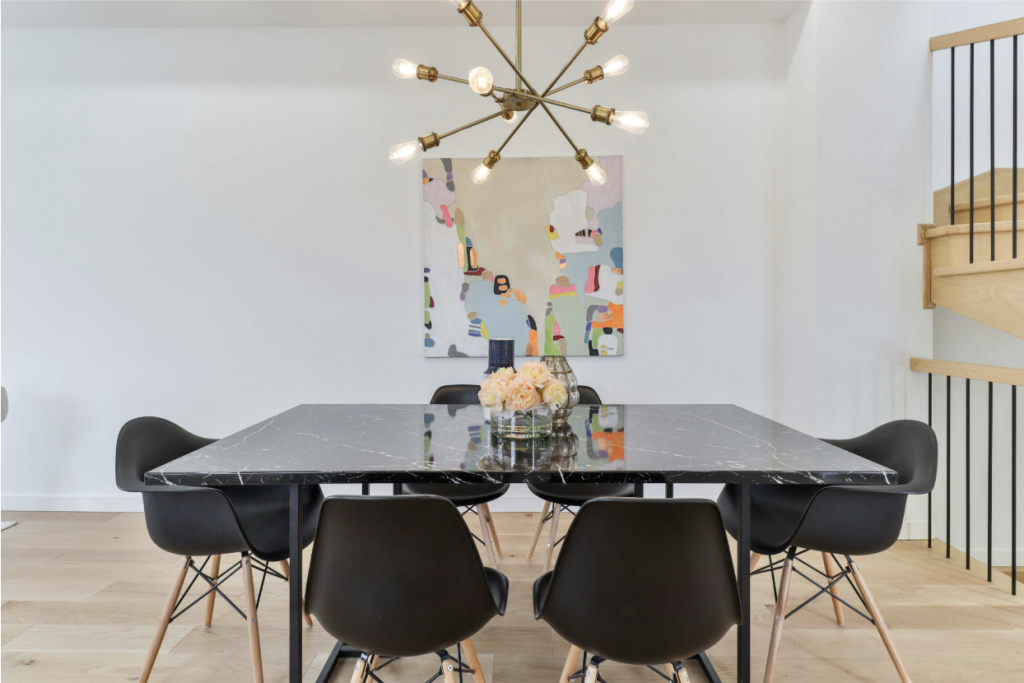
The farmhouse table has had its decade
The reclaimed wood dining table has quietly dominated expensive interiors for years.
You know the type. Reclaimed oak from a French farmhouse. Elm from a Belgian barn. Pine from a nineteenth-century factory floor. A provenance story on the tag. A generous, rugged surface that promises warmth, honesty and effortless taste.
For a while, it worked.
But in 2026, the homes that actually host are moving on. The twelve-person dinners, anniversary meals, long lunches, and holiday weekends need a table that performs, not just one that tells a good story.
Serious entertainers are moving to marble.
Why reclaimed wood stopped working
The visual fatigue problem
The reclaimed table became so common that it lost the very character that made it appealing. At a glance, one expensive farmhouse table now looks much like the next.
The story may be different. The effect is not.
Luxury interiors are shifting towards materials with real visual specificity. Reclaimed wood has become a category look. Marble still gives you an individual surface.
The entertaining problem
Distressed wood is harder to host on than people like to admit.
Its texture catches crumbs, water rings, wine marks, and oil stains. Formal place settings sit less cleanly. Candlelight is absorbed rather than reflected.
Marble does the opposite. It gives glassware, flowers, silver, linen, and candlelight a better stage.
The permanence problem
Reclaimed wood often arrives feeling soulful and important. A few years later, it can start to read as casual and overfamiliar.
Marble keeps its authority. It brings weight, polish, and permanence to a room in a way timber rarely matches.
Why marble is the dining table return that matters
The marble dining table has returned because it solves real entertaining problems.
It has historical weight, from Renaissance palazzi to country houses and grand European dining rooms. That is not nostalgia. It is proof that marble has always understood the dining room as a theatre.
It catches light beautifully. It gives food, flowers, and place settings a clean visual base. It works for breakfast, Sunday lunch, and a serious dinner party without changing costumes.
Yes, marble needs care. But properly finished marble is more practical than its anxious reputation suggests, especially for households already willing to use coasters, placemats, and decent common sense.
The marble choices are worth looking at now
White Carrara is no longer the only answer
Carrara still has its place, but it no longer feels as fresh as it did a few years ago.
For entertaining rooms, the better move is colour, contrast, and stronger veining.
What is actually working
Verde Alpi brings deep green drama to rooms with garden views or rich wall colour.
Rosso Levanto gives burgundy depth to formal dining rooms.
Calacatta Viola sits between classic and bold, with cream, purple, and grey movement.
Blue Roma feels modern without losing the classical marble language.
Arabescato Corchia keeps the white-marble family but adds more visible drama.
Nero Marquina gives black marble its sharpest dining-room argument.
The scale question
A serious dining table should fit the room and the way the household hosts.
For larger homes, that often means 200 cm for eight people, 240 cm for ten, or 300 cm and beyond for twelve. Standard sizing is often where good rooms go slightly wrong.
The specialist maker category to know
Large marble dining tables are not the place for anonymous catalogue buying.
The best examples come from specialist stone furniture makers who understand slab selection, base design, edge detail, weight, and proportion.
In the UK specialist furniture category, Steve Bristow Furniture offers a useful reference point. The Devon-based luxury stone furniture maker produces bespoke marble dining tables in finishes including Verde Alpi, Rosso Levanto, Calacatta Viola, Blue Roma, Arabescato Corchia and Nero Marquina, with custom sizing and base options for formal dining rooms.
It is a useful illustration of where the category is heading: natural stone, custom sizing, architectural bases and dining tables treated as permanent furniture rather than seasonal décor.
What to know before commissioning marble
Choose the stone properly. Every slab is different, so the veining matters as much as the colour name.
Size the table for the room, not the catalogue. A dining room used for eight people twice a week has different needs from one used for twelve people twice a year.
Think about the base. A single pedestal, twin pedestal, plinth, or block base changes both the look and the seating comfort.
Respect the weight. Marble at the dining scale is heavy, and period homes may need practical checks before installation.
Be honest about care. Marble should be sealed, spills should be wiped promptly, and acidic cleaners should stay nowhere near it.
What to do with the reclaimed table
If your reclaimed wood table has hosted brilliantly for ten years, it has not failed. It just may no longer deserve the main dining room.
Move it to the kitchen, breakfast room, covered terrace, or garden dining space.
If you bought it because everyone else had one, be honest. Does it still serve the way you entertain, or is it simply occupying the most important room in the house?
If you are designing a dining room from scratch in 2026, bypass the reclaimed table altogether. Start with marble.
The dinner party now belongs on marble
The reclaimed wood dining table had its decade.
Serious entertainers are quietly moving on because the dining table has to do more than fill a room. It has to hold light, food, flowers, conversation, and ceremony.
Marble does that better.
It carries history without looking tired. It brings surface, scale, and permanence. It gives the dining room its centre back.
The dinner party of 2026 happens on marble. The reclaimed farmhouse table was charming. Serious entertainers are now commissioning what they probably should have commissioned all along.
This article is for general information only. Interior design and furniture purchasing decisions vary by individual taste and specific circumstances. Steve Bristow Furniture is a UK luxury stone furniture maker based in Devon, providing bespoke marble, travertine, granite and sintered stone furniture pieces with UK delivery.
Author

Written by
Recent Posts

The First Decision After a Collision Can Be the Most Important One
Two Weeks in Rome and Beyond: Turkish Airlines Itineraries from Boston, Chicago and Onward to India

Top 10 Hair Transplant Clinics in Turkey 2026

Artist Alley to Online Store: How Convention Artists Can Keep Selling After the Event
When an 18-Wheeler Crash Leaves Lasting Consequences
Categories
- Art
- Articles
- Business of Luxury
- Celebrities
- Culture
- Entertainment
- Events
- Faces of Summer 2026
- Fashion
- Fashion & Style
- Featured
- Finance
- Food, Spirits, Wine
- Hamptons
- Hamptons Celebrities
- Health
- Health & Beauty
- Lifestyle
- Luxury Lifestyle
- Press
- Profiles
- Real Estate
- Technology
- The Chronicles
- Travel
- Uncategorized
- Weddings