
Standard supplier catalogs sell the same bundles, the same lace wigs, and the same textures to every brand on the page. Differentiation gets hard. Custom manufacturing answers that problem by handing a brand control over material, specification, and presentation, so the product carries the brand’s signature instead of a supplier’s. Getting there takes a factory that can read a concept and return a sample. Manufacturers such as APOHAIR build that service around private-label production. The payoff outlasts one purchase order, running into reorders that match on texture, density, and packaging.
Why Standard Product Catalogs Are No Longer Enough for Growing Hair Brands
Standard catalogs stop working once a brand builds a following, because the same catalog stays open to every competitor in the market. A ready-made supplier page lists fixed lengths, fixed textures, and a fixed color range. Five brands can order from it in one week and stock identical inventory. Nothing on the shelf then belongs to any of them.
Ready-made supply still has a place. New sellers use it to test demand without tying up capital, and small salons restock from it every month. The limits show up later. A brand that wants a signature curl pattern, a custom cap size, or a color it can name after its own line gets none of that from a catalog built for volume. Customer experience narrows too. Repeat buyers notice when the unit they loved disappears upstream, and the brand absorbs that complaint without ever owning the decision.
Custom Manufacturing Gives Brands More Control Over Product Identity
Custom manufacturing returns three decisions a catalog keeps for itself: what the hair is, how the product is built, and how it reaches the customer. Each decision compounds on the last. Together they form what buyers come to recognize as a house style.
Material sets the ceiling. Vietnamese human hair carries a thick strand and an intact cuticle layer, so it holds bleach and tone better than heavily processed stock, and a brand can specify single drawn, double drawn, or super double drawn hair to fix how full the ends stay after six months of wear.
Specification follows. Length, color, texture, density, and construction all get written into the order rather than picked from a dropdown. A brand can request 32 inches (about 81 cm) in a texture not in the catalog stocks, or a 13×6 frontal wig, which opens a deeper parting space, at the density its clients actually wear.
Presentation closes the loop. Private-label work puts the brand’s logo, packaging, and product naming on the finished unit. Customization is not a cosmetic layer. It draws the line between a product a brand sells and a product a brand owns.
A Reliable Manufacturing Partner Connects Creativity With Production Control
A reliable manufacturing partner turns a design idea into a written specification, then holds that specification steady for every order that follows. Five capabilities decide whether a factory can do this. It reads a concept and converts it into measurable terms. It produces a physical sample. It adjusts the sample based on feedback. It documents the approved version. It reproduces the result months later at a higher volume.
Sampling is where most partnerships prove themselves. A founder describes a wave pattern in words, the factory returns a unit she can hold, and the two sides then discuss density in numbers rather than adjectives. That loop runs short when the brand speaks directly to the people operating the machines.
Factory-direct production shortens it again. Collection, processing, and packaging all sit under one roof at APOHAIR’s Vietnamese human hair factory, so a revision request reaches the production floor without passing through a trading company. Buyers also see what they are buying, including where the hair was collected, how it was processed, and how it was treated before assembly.
APOHAIR Supports Custom Hair Product Development for Growing Businesses
APOHAIR supports custom development by manufacturing to a client’s written specification inside its own plant rather than sourcing finished goods from third parties. The company has produced Vietnamese human hair for more than 20 years, working from a 355,000 square foot (33,000 m²) factory in Ninh Binh Province with output reaching 22 US tons (20 metric tons) a month. Hair arrives from local collector networks with cuticles intact and aligned in one direction, then moves through sorting, washing, coloring, texturing, and assembly on the same site.
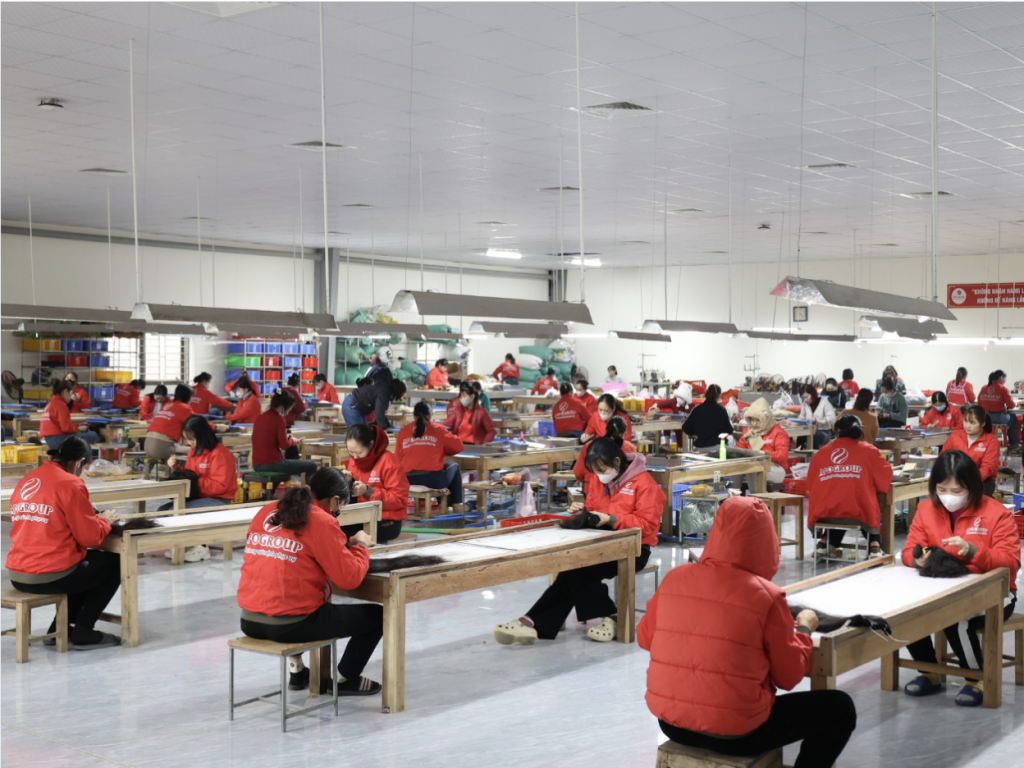
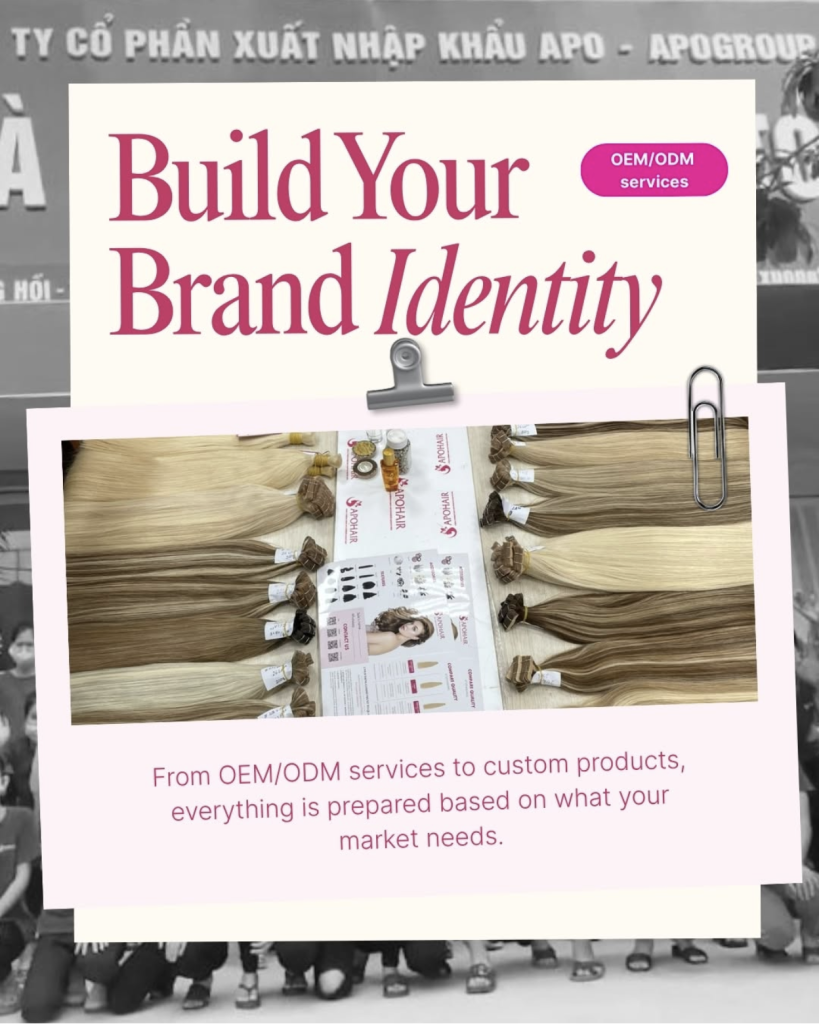
Three service models cover most brand requests. OEM production builds to a client’s own design and specification. ODM production starts from APOHAIR’s development team, which shapes new styles for brands without an in-house product function. Private-label service applies the client’s logo, packaging, and naming to the finished order.
Those models run across the full catalog. A brand can commission weft, tape-in, clip-in, or keratin tip extensions on a single order. The same site is also a human hair wig manufacturer, so one material and color standard carries into 5×5 closure wigs and 13×4 frontal wigs instead of forcing the brand to match two suppliers. Sample orders start at 200 grams, which lets a buyer test the specification before committing to a production run.
Custom Manufacturing Creates Long-Term Value Beyond a Single Product Order
Custom manufacturing pays out across years rather than one purchase order, because every approved specification becomes an asset that the brand keeps. The first order sets the record: Fiber grade, length band, color code, density, and cap size. The second order references it. By the fourth or fifth, the factory reproduces the line without a fresh brief, and lead time drops.
Product evolution draws on the same file. A brand with a proven base texture can extend it into a new length or a seasonal color instead of starting from a blank sample. Customers read all of this as reliability. A returning buyer receives the unit she remembers, in the packaging she recognizes, at the density she expects. That consistency turns a catalog of products into a brand.
Differentiation in the hair market now begins at the factory, not the storefront. A manufacturing partner worth keeping brings material knowledge, flexible production, steady quality, and real development support. APOHAIR shows what that combination looks like from Vietnam: a single-site plant, custom specification work, and private-label capacity for brands building lines they can call their own. Brands that plan for it early spend less time chasing suppliers and more time building a name.
Author

Written by
Recent Posts

The First Decision After a Collision Can Be the Most Important One
Two Weeks in Rome and Beyond: Turkish Airlines Itineraries from Boston, Chicago and Onward to India

Top 10 Hair Transplant Clinics in Turkey 2026
Artist Alley to Online Store: How Convention Artists Can Keep Selling After the Event
When an 18-Wheeler Crash Leaves Lasting Consequences
Categories
- Art
- Articles
- Business of Luxury
- Celebrities
- Culture
- Entertainment
- Events
- Faces of Summer 2026
- Fashion
- Fashion & Style
- Featured
- Finance
- Food, Spirits, Wine
- Hamptons
- Hamptons Celebrities
- Health
- Health & Beauty
- Lifestyle
- Luxury Lifestyle
- Press
- Profiles
- Real Estate
- Technology
- The Chronicles
- Travel
- Uncategorized
- Weddings