
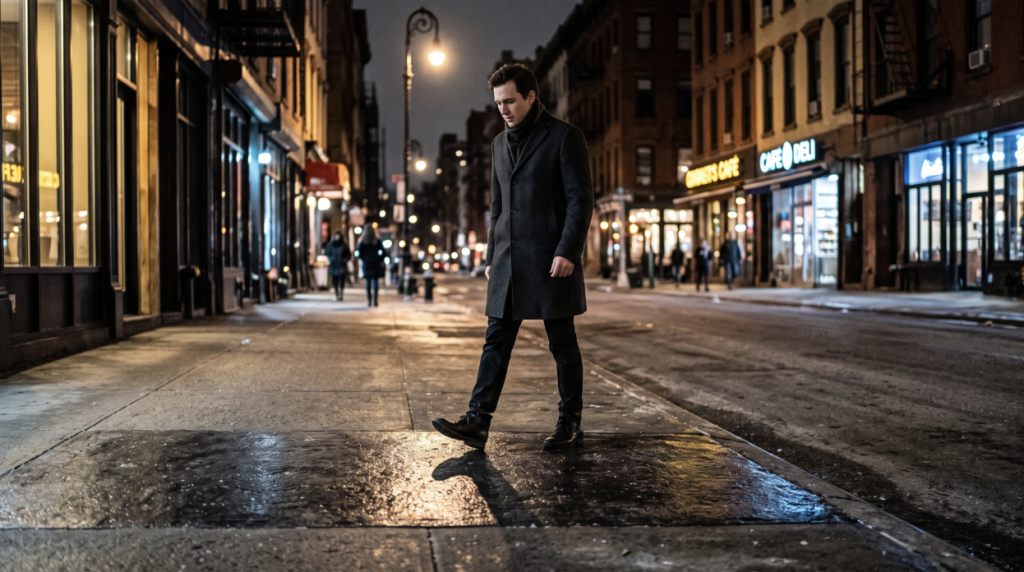
The most dangerous ice in New York City is the ice you cannot see. It forms overnight in a thin, transparent film that takes on the color of whatever is underneath it, which is why a wet-looking patch of dark pavement outside a restaurant at eleven at night is frequently not wet at all.
Black ice does most of its damage in the hours when the city is out. Dinner reservations, gallery openings, the walk from a car service to a front door. These are exactly the hours when temperatures drop through freezing, when melted afternoon snow refreezes, and when the people walking on it are least equipped for a fall, often in leather soles with no tread.
Why Black Ice Behaves Differently From Snow
Snow announces itself. It changes the color of the ground, muffles sound, and tells everyone walking on it to shorten their stride. Black ice does none of that.
It forms when a thin layer of moisture freezes without trapping air. The absence of trapped air bubbles is what makes it clear rather than white, so the pavement, granite, or marble underneath shows straight through it. In a city lit by sodium and LED streetlights, and by the glare of storefronts, a sheet of ice two millimeters thick is effectively invisible.
The refreeze cycle nobody watches
The dangerous night is rarely the night it snows. It is the night after.
Daytime sun melts snow piled against a building. That meltwater runs across the sidewalk. After sunset, the surface temperature drops faster than the air temperature, and the water refreezes into a sheet. The same cycle repeats for days after a storm, which is why a mid-January fall often happens on a clear evening with no precipitation and dry-looking pavement.
Where it concentrates
Black ice gathers in predictable places: at the bottom of curb cuts where water pools, under scaffolding where drips fall in the same spot repeatedly, in entryways where tracked-in slush refreezes on polished stone, and on bridges and elevated walkways that lose heat from beneath as well as above.
What New York City Actually Requires of Property Owners
Sidewalk clearing in New York is not discretionary and it runs on a clock most residents have never read.
Under the city’s rules, owners, lessees, and occupants are responsible for clearing snow and ice from the sidewalk adjacent to their property. The Department of Sanitation publishes the specific deadlines: when snowfall stops between 7:00 a.m. and 4:59 p.m., the sidewalk must be cleared within four hours. When it stops between 5:00 p.m. and 8:59 p.m., the window is fourteen hours. When it stops between 9:00 p.m. and 6:59 a.m., the sidewalk must be clear by 11:00 a.m. A path at least four feet wide is required.
Clearing is not the same as treating
Here is where black ice separates itself from every other winter hazard. A property owner can shovel a sidewalk perfectly, meet the deadline, and still leave behind the exact conditions that produce black ice, because shoveling removes snow while leaving a thin film of moisture that freezes after dark.
Meeting the clearing deadline and making a surface safe are two different things. Salt, sand, or calcium chloride applied before the refreeze is what actually addresses the hazard, and whether it was applied, when, and by whom becomes the central question after someone falls.
An uncleared or untreated walkway can also be reported to the city through 311, which creates a dated record of the condition. That record has value well beyond the complaint itself.
The Evidence Problem That Is Unique to Ice
Almost every other premises hazard stays put. A broken step is still broken the next morning. Ice melts, and by the time an injured person is out of an emergency room, the condition that caused the fall has physically ceased to exist. This is why winter fall claims turn on evidence gathered in the first hours rather than the first weeks.
What matters most: photographs of the actual surface before sunrise, the names of anyone who saw the fall, the precise location relative to a building line and address, and preserved footwear. Building entrances, restaurants, and retail frontages along most Manhattan blocks are covered by exterior cameras, and that footage is routinely overwritten within days. It is frequently the only record that the ice existed at all, and the only way to establish how long it had been there.
Because responsibility can sit with a building owner, a managing agent, a commercial tenant, or a contractor hired to treat the walkway, and because the applicable deadlines are short, people injured this way often consult attorneys who handle sidewalk and premises falls in New York City early, while the record can still be preserved.
Moving Through the City in Freezing Weather
A few habits meaningfully reduce risk during refreeze season. Treat any dark, glossy pavement below freezing as ice until proven otherwise. Shorten your stride and keep your weight over your front foot rather than striding out ahead of your center of gravity. Change into proper footwear for the walk and carry the evening shoes. Use handrails on exterior steps even when they seem unnecessary.
And if you do go down, photograph the ground before you leave it. That single act preserves more useful information than anything that happens afterward.
Author

Written by
Recent Posts
How to Pick a Homecoming Dress for Your Body Type and Feel Amazing in It
How to Prepare a Home for Sale When Major Repairs Are Not Affordable
From Everyday Comfort to Personal Style: My SHEIN Slipper Habit
5 Best Mitsubishi Heat Pump Companies in Seattle
Tech Gadgets as Modern Corporate Gifts: Useful Ideas for Employees and Clients
Categories
- Art
- Articles
- Business of Luxury
- Celebrities
- Culture
- Entertainment
- Events
- Faces of Summer 2026
- Fashion
- Fashion & Style
- Featured
- Finance
- Food, Spirits, Wine
- Hamptons
- Hamptons Celebrities
- Health
- Health & Beauty
- Lifestyle
- Luxury Lifestyle
- Press
- Profiles
- Real Estate
- Technology
- The Chronicles
- Travel
- Uncategorized
- Weddings