
Packing for a weekend away is easier when your lens supplies are sorted before you leave. A current prescription, spare lenses and a small care kit prevent most of the problems people run into.
Ordering online simplifies the process, but the timing catches people out. Verification takes longer than most first-time buyers expect, and an expired prescription cannot be used no matter how urgent the trip.
The five-minute pre-trip check
- A current, valid prescription. The FDA requires one for every contact lens purchase, including cosmetic lenses
- A seller that requests it. Under the FTC Contact Lens Rule, a seller must obtain a copy or verify it with your prescriber
- Factory-sealed, travel-size solution. Not decanted from a larger bottle
- Backup glasses, as recommended in CDC travel guidance
- Spare lenses and a clean case
Get the Prescription Right Before You Order
Your prescription allows you to buy from any retailer, which is the core benefit of the FTC rule, but it must be current and completely accurate.
A contact lens prescription is far more than just a corrective power. It specifies the brand, the base curve, and the diameter—three critical numbers that ensure a lens sits correctly and safely on your eye.
Here is what each field on your prescription slip actually means:
| Field | What it is | Why it matters |
|---|---|---|
| PWR / SPH | Lens power in diopters | Corrects nearsightedness or farsightedness |
| BC | Base curve | The lens curvature, which must match your cornea |
| DIA | Diameter | How wide the lens sits across your eye |
| CYL | Cylinder (toric lenses only) | The degree of astigmatism correction |
| AXIS | Axis (toric lenses only) | The orientation of astigmatism correction (0° to 180°) |
| ADD | Add power (multifocal only) | Additional reading correction strength |
| Brand | The specific product | Not substitutable, even at the exact same power |
Substituting a different brand at the same power is not equivalent, and a reputable retailer will not allow it.
This is where smart filtering matters more than browsing. On EZContacts, you can narrow the catalog by base curve, diameter, and brand. This turns matching a prescription into a quick two-minute job rather than a long scroll through endless product pages.
The Verification Clock
When a seller submits a complete verification request, your prescriber has eight business hours to respond under the FTC rule. If they do not respond within that window, the prescription is treated as verified and the order proceeds.
Crucially, eight business hours does not mean eight standard hours. A request sent on Friday afternoon may not clear until Monday or Tuesday, which is a common reason travelers end up flying without their lenses.
| If you order | Verification typically clears | Order by |
|---|---|---|
| Monday morning | Tuesday | 10 days before travel |
| Friday afternoon | Following Tuesday | Avoid if traveling soon |
| Before a holiday weekend | After the holiday | Two weeks ahead |
Peak seasons make eye appointments harder to book as well. If you are already planning a coastal weekend, add your exam and lens order directly to your calendar.
If your prescription has lapsed and no immediate appointment is available, EZContacts offers an online vision test. However, it is vital to understand its limitations before relying on it. An online test is generally a tool to renew an existing prescription rather than a replacement for a comprehensive eye health exam, and its availability varies by state.
Online tests cannot screen for glaucoma, retinal changes, or other conditions checked during an in-person visit. Treat it purely as a temporary bridge when your prescription runs out, not as a reason to skip your regular exam.
Vet the Retailer, Then Review Your Routine
A compliant retailer strictly asks for your prescription details rather than working around them. Always look for a secure checkout, accessible customer support, clear shipping estimates, and a transparent returns policy regarding unopened boxes.
When comparing contact lenses online, a catalog organized by brand and manufacturer makes finding your exact product considerably faster. EZContacts carries major brands including Acuvue, Air Optix, Biofinity, Biotrue, Precision1, and Dailies across top manufacturers like Alcon, Johnson & Johnson, CooperVision, and Bausch & Lomb. They feature easy filters for daily, monthly, and two-week schedules, as well as toric, multifocal, and color options.
Pack size changes the math more than most shoppers realize. On EZContacts, Acuvue Oasys 1-Day costs $115.95 for a 90-pack versus $45.95 for a 30-pack. Buying three 30-packs to reach 90 lenses totals $137.85—meaning the larger box saves you roughly $22, or about 16 percent.
Contact lenses are also fully FSA and HSA eligible, which is helpful to remember if you have plan funds expiring at the end of the year. Free shipping applies to all USA orders, and their price match guarantee is highly worth invoking rather than assuming you have found the lowest number.
As a quick scale check while comparing, a retailer’s review volume indicates its shipping reliability; the Acuvue Oasys 6-Pack alone carries more than 1,600 EZContacts reviews.
Colored and decorative lenses follow these exact same rules. The FDA advises buying them exclusively from sellers that mandate a prescription listing the brand, measurements, and expiration date. Costume lenses sold without this verification process may not fit correctly and can cause severe eye damage.
TSA Rules and What Belongs in Your Bag
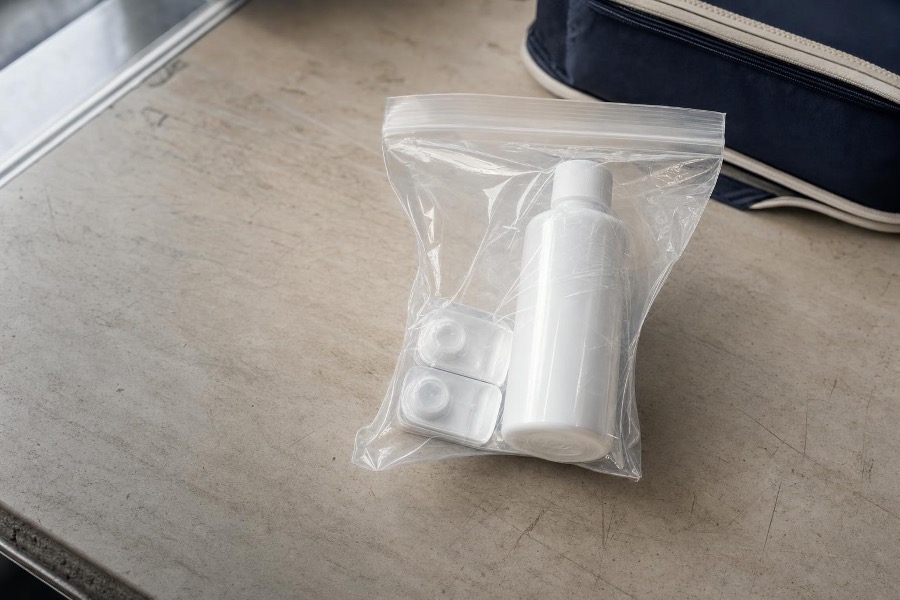
Carry-on liquids must generally be in containers of 3.4 ounces (100 mL) or less, packed inside a single, clear, quart-size bag.
However, contact lens solution qualifies as a medically necessary liquid, exempting it from the standard 3.4-ounce limit. Declare the container to the TSA officer before screening begins, as it may require separate inspection. Even so, the TSA suggests packing larger bottles in checked baggage whenever practical.
The FDA advises against transferring solution into smaller, generic travel bottles because decanting introduces a high risk of bacterial contamination. Purchase factory-sealed travel sizes instead.
Pack this kit: Factory-sealed travel solution, a clean spare case, enough lenses for the entire trip (plus extras for travel delays), backup glasses for sleeping or irritation, and lubricating drops specifically labeled for use with contact lenses.
Salt Water, Pools, and Long Days Outside
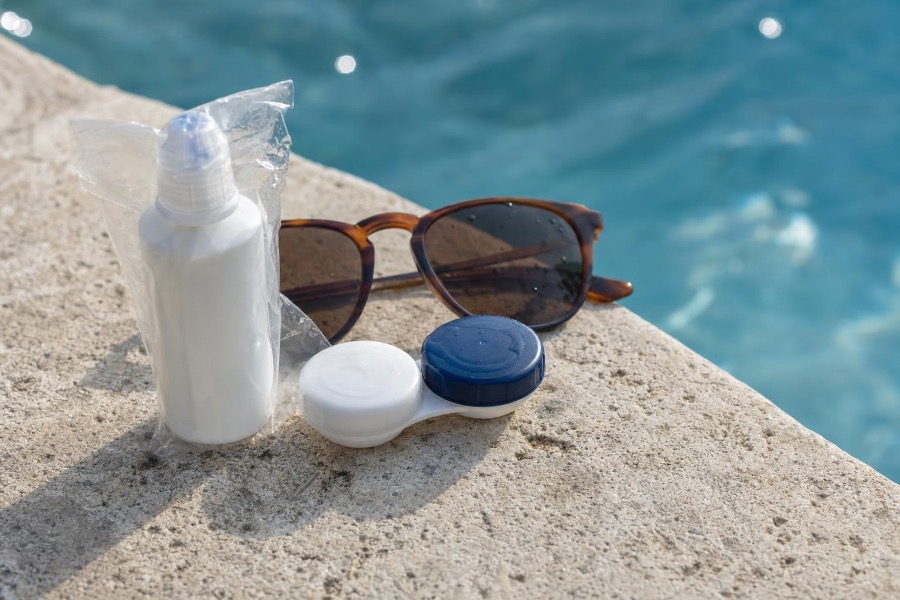
The CDC strongly advises removing contact lenses before swimming or showering. Water harbors microscopic organisms like Acanthamoeba, which can cause rare but severe corneal infections. Lenses should never be rinsed or stored in tap, pool, or ocean water.
Decide on your eye care plan before you hit the water rather than waiting until you are on the sand. Glasses are the safest, simplest choice for a full beach day. If you swim regularly, consider discussing prescription swim goggles with your eye care professional.
If your weekend itinerary takes you along the Sag Harbor beaches or anywhere involving paddleboarding and long afternoons on the water, plan ahead for wet hands and a lack of clean surfaces. This is precisely the scenario where a spare case and factory-sealed solution become essential.
For boat trips and extended outdoor exposure, always wear sunglasses with UV400 protection over your contact lenses. While polarized lenses cut intense glare off the water beautifully, remember that neither replaces a proper lens hygiene routine.
Lens Care That Travels Well
Daily disposables eliminate the need for nightly cleaning, which is why many travelers switch to them. However, changing your lens type still requires guidance from an eye care professional. Schedule a consultation before your trip rather than experimenting while away from home.
If you travel with reusable lenses, always use fresh solution and never “top off” old liquid in the case. Clean and air-dry your storage case as directed, and replace the case at least every three months per CDC guidance.
To prevent running out of supplies, set a reorder reminder for roughly two weeks before your current stock ends. Most online retailers store your exact order history. For instance, EZContacts features a dedicated reorder function that entirely removes the need to hunt down your prescription details on repeat purchases.
FAQ
Do I need a prescription to buy contact lenses online?
Yes. The FDA classifies all contact lenses as medical devices. A valid prescription is mandatory for every purchase, including non-corrective cosmetic or colored lenses. Any seller offering to skip this verification step is operating illegally.
Yes. The FDA classifies all contact lenses as medical devices. A valid prescription is mandatory for every purchase, including non-corrective cosmetic or colored lenses. Any seller offering to skip this verification step is operating illegally.
How long does prescription verification take?
Under the FTC Contact Lens Rule, your prescriber has eight business hours to respond to a retailer’s complete verification request. Because of this window, allow several calendar days for processing, especially around weekends or holidays.
Under the FTC Contact Lens Rule, your prescriber has eight business hours to respond to a retailer’s complete verification request. Because of this window, allow several calendar days for processing, especially around weekends or holidays.
Can I buy a different brand at the same prescription strength?
No. Your prescription specifies the exact brand, base curve, and diameter required for your eyes. Those structural measurements are completely specific to that particular lens design. A different brand at the same power will not fit properly.
No. Your prescription specifies the exact brand, base curve, and diameter required for your eyes. Those structural measurements are completely specific to that particular lens design. A different brand at the same power will not fit properly.
Are contact lenses FSA or HSA eligible?
Yes. Prescription contact lenses, cleaning solutions, and storage cases are fully eligible expenses under FSA and HSA plans. Keep this in mind to maximize your benefits if you have funds expiring at the end of the plan year.
Yes. Prescription contact lenses, cleaning solutions, and storage cases are fully eligible expenses under FSA and HSA plans. Keep this in mind to maximize your benefits if you have funds expiring at the end of the plan year.
What if my prescription expires before my trip?
You will not be able to complete an online order. Contact lens prescriptions typically expire after one to two years depending on state law. Check your document’s expiration date now rather than waiting until checkout.
You will not be able to complete an online order. Contact lens prescriptions typically expire after one to two years depending on state law. Check your document’s expiration date now rather than waiting until checkout.
Can I wear contact lenses swimming if I keep my eyes shut?
No. The CDC strongly advises against wearing contact lenses in any water. The primary threat is harmful microbial contamination on the lens surface rather than water entering your eye. Acanthamoeba infections from water exposure are notoriously difficult to treat.
No. The CDC strongly advises against wearing contact lenses in any water. The primary threat is harmful microbial contamination on the lens surface rather than water entering your eye. Acanthamoeba infections from water exposure are notoriously difficult to treat.
What should I pack for a long flight or a day on the water?
Pack spare lenses, a clean case, factory-sealed travel solution, backup glasses, and rewetting drops specifically labeled for contact lens wear. Always remove your lenses before swimming or showering, and do not sleep in them unless your prescriber has explicitly approved overnight wear.
Pack spare lenses, a clean case, factory-sealed travel solution, backup glasses, and rewetting drops specifically labeled for contact lens wear. Always remove your lenses before swimming or showering, and do not sleep in them unless your prescriber has explicitly approved overnight wear.
Plan Ahead for an Easier Trip
A current prescription and a properly packed care kit ensure you can navigate flights, beach days, and schedule changes without compromising your lens hygiene.
Whether you purchase from an online retailer or your local eye care practice, always confirm that the seller strictly verifies prescriptions. Before your departure, ask your optometrist or ophthalmologist which specific lenses and care products best suit your eyes and your upcoming travel itinerary.
If you are finalizing your travel packing list, I can provide a TSA liquid rule breakdown for contact solutions or list the best rewetting drops for dry airplane cabins. Let me know which details you need next!
Author

Written by
Recent Posts
How to Pick a Homecoming Dress for Your Body Type and Feel Amazing in It
How to Prepare a Home for Sale When Major Repairs Are Not Affordable
From Everyday Comfort to Personal Style: My SHEIN Slipper Habit
5 Best Mitsubishi Heat Pump Companies in Seattle
Tech Gadgets as Modern Corporate Gifts: Useful Ideas for Employees and Clients
Categories
- Art
- Articles
- Business of Luxury
- Celebrities
- Culture
- Entertainment
- Events
- Faces of Summer 2026
- Fashion
- Fashion & Style
- Featured
- Finance
- Food, Spirits, Wine
- Hamptons
- Hamptons Celebrities
- Health
- Health & Beauty
- Lifestyle
- Luxury Lifestyle
- Press
- Profiles
- Real Estate
- Technology
- The Chronicles
- Travel
- Uncategorized
- Weddings