
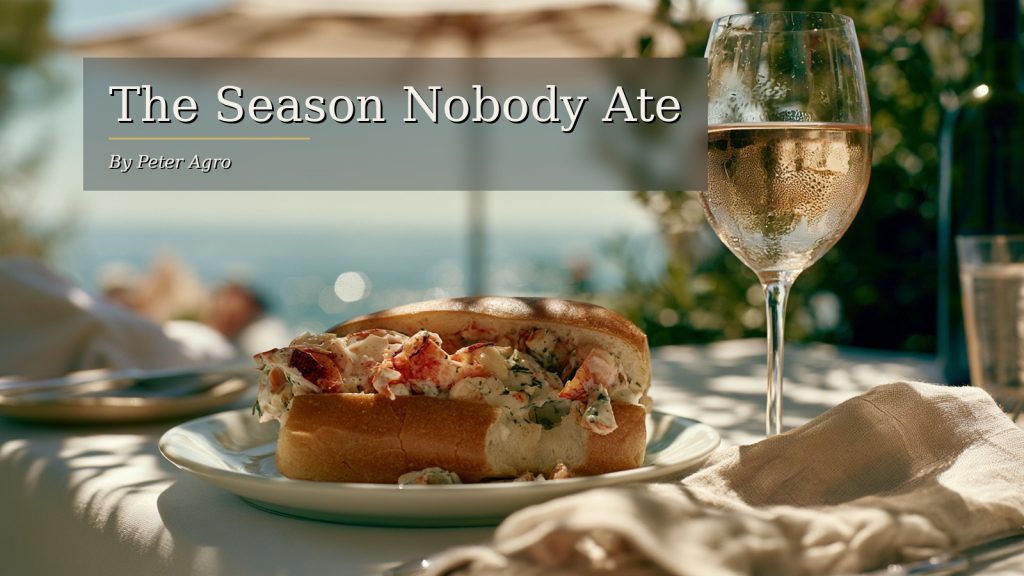
Somewhere around the Fourth of July, I noticed the lobster rolls were coming back to the kitchen with one bite missing.
Not sent back. Nobody sends anything back out here; that would require acknowledging the staff. Just quietly abandoned, the way one abandons a novel after the first chapter. A single crescent of missing bun, a lettuce leaf disturbed, and then the plate sat there through the whole meal like a prop.
The first time, I assumed heat. The fourth time, at a different table, I started counting.
The tell
Every summer has its tell. Some years it was the watch. Some years it was who got the Sunday tee time and who got the Monday one. This year the tell was the untouched plate, and the way its owner had gone from ordering for the table to ordering the branzino, sharing it, and pushing the sharing plate an inch toward whoever was seated closest.
Nobody said the word. That is the first rule of it. The medication that has, by every account I trust, quietly rearranged the appetites of a meaningful fraction of the eastern end of Long Island is discussed the way one discusses a second mortgage: fully understood by everyone and mentioned by no one.
What people will say is “I’ve been doing a protocol.” A protocol. As if there were a binder.
The categories
A social observer is obligated to sort, so I sorted.
The Convert. Down thirty pounds since the Memorial Day rush and radiant about it in a way that is almost evangelical, except that evangelists want you to join and the Convert wants you to notice without asking. The Convert has a new tailor, a new profile photo, and a mild new intolerance for anyone who orders the fries.
The Denier. Also down thirty pounds. Attributes it to Pilates, to cutting out bread, to “finally sleeping.” Has never, in fifteen years of Saturday lunches, cut out anything. The Denier’s beach bag has a small insulated pouch in it that everyone at the table has seen and no one has mentioned, because the Denier’s husband is on the board of something.
The Old Guard. Weighs exactly what they weighed in 1998 and eats exactly what they ate then, which is whatever is in front of them, in normal quantities, with a glass of something cold. Finds the whole conversation slightly vulgar, not on medical grounds but on the grounds that it is a conversation. The Old Guard’s position on the subject is the same as its position on money: if you have to talk about it, you don’t quite have it.
The Newly Serene. The most interesting one. Never had a weight problem, or not a visible one. Started anyway, on the theory that the drug quiets the part of the brain that wants things, and that a quieter brain is worth the monthly cost. Reports, unprompted, that the third glass of rosé no longer appeals. Has stopped checking the phone at dinner. Is, by any measure, more pleasant company than last summer, and I am not sure what to do with that.
The economy of it
Out here the drug has a price the way the house has a price: known, discussed obliquely, and roughly a marker of where you stand. There is the version prescribed by the doctor in the city, filled at the pharmacy on Main Street, paid for by whatever arrangement the family office made. There is the version that arrives by overnight box from a company with a two-syllable name and a website that looks like a meditation app. And there is a third version, discussed in the lower registers, involving a friend of a friend and a vial of uncertain provenance, which is the one that worries me.
The first two are medicine. The third is a Hamptons tradition, in the sense that every summer someone finds a cheaper way to do an expensive thing and every September we hear how it went.
What nobody says
Here is what nobody says at the table, and what I will say here because a column has fewer manners than a dinner.
The medication works. The trials say so, the tailors say so, the abandoned lobster rolls say so. It also has a list of people who should not be anywhere near it, a set of side effects that the radiant Convert will not describe to you over crudo, and a price structure, in the overnight-box version, that is designed by people who know exactly how a person feels in the third week of June after the first white-jean incident of the season.
The Old Guard, as usual, has a point without knowing it: the people doing this most gracefully are the ones who treated it as a medical decision rather than a social one. They asked a doctor. They read the fine print. They understood which version they were buying and from whom. They did not order it the way one orders a table at a restaurant that is hard to get into.
I ended up writing the fine print down, because enough people asked me over enough dinners and I got tired of explaining it between courses. It lives at glp1abc.com: a plain-English guide to how the online programs actually work, what the box costs once the introductory price wears off, and the questions to ask before you pay anyone anything. It is not medical advice. It is the conversation nobody was having at the table, written down so you can have it with your doctor instead.
September
The season is ending now, and the plates are coming back cleaner. Some of that is the weather. Some of it is that the people who started in June have found their level and are eating like normal humans again, just smaller ones. And some of it, I suspect, is that the summer’s great unspoken subject is about to become an ordinary one, discussed in ordinary voices, the way the second mortgage eventually was.
Which is fine. Every tell has its season. By next July there will be a new one, and I will be at a corner table, counting.
Peter Agro writes about Hamptons social life for Social Life Magazine. He is not a physician, and nothing here is medical advice; talk to yours.
Author

Written by
Recent Posts
The Season Nobody Ate
The Quiet Luxury of Slowing Down: Why Mindful, Hands-On Hobbies Are the Hamptons Set’s New Self-Care Ritual

Refined Housewarming Gifts for a Beautiful New Home

22nd Annual Author’s Night

Von Dutch, Women’s Magazine and Reserve Jets Celebrate NYFW With Adriatique
Categories
- Art
- Articles
- Business of Luxury
- Celebrities
- Culture
- Entertainment
- Events
- Faces of Summer 2026
- Fashion
- Fashion & Style
- Featured
- Finance
- Food, Spirits, Wine
- Hamptons
- Hamptons Celebrities
- Health
- Health & Beauty
- Lifestyle
- Luxury Lifestyle
- Press
- Profiles
- Real Estate
- Technology
- The Chronicles
- Travel
- Uncategorized
- Weddings