
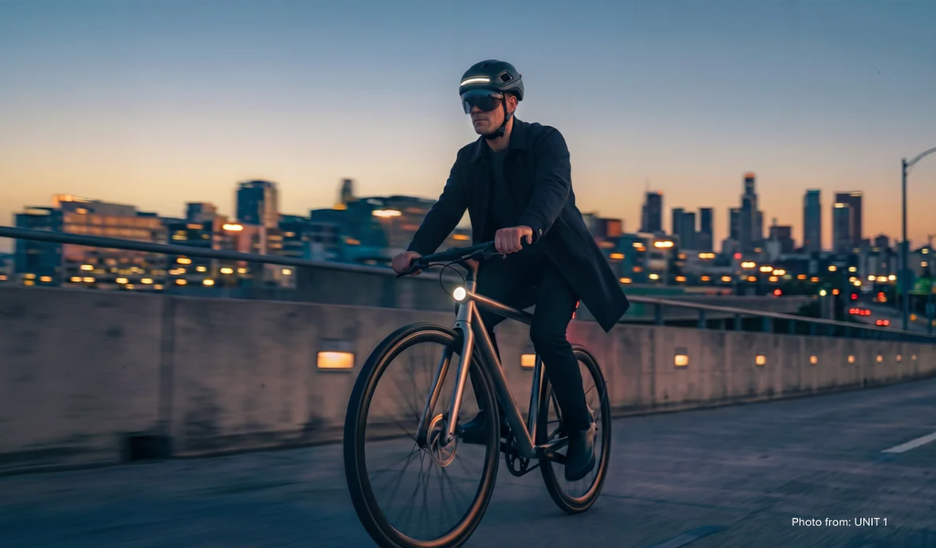
Urban cycling has evolved far beyond basic transportation. Today’s riders demand technology that enhances safety, connectivity, and style, all without compromising the pure joy of riding.
The global cycle tourism market reached $159 billion in 2026, reflecting this shift toward sophisticated, tech-enabled cycling experiences.
Here are five brands leading this transformation, each approaching smart cycling from a different angle while maintaining an unwavering commitment to design excellence.
1. UNIT 1: Building safety around the rider
A cycling helmet has traditionally had one overriding purpose: protecting the rider’s head during an impact. UNIT 1 starts there, but asks what a helmet could do before and after that moment as well.
The Madrid-born company has developed an ecosystem around connected rider safety, encompassing its AURA, FARO and NEON adult smart helmets, SPARKY children’s helmet, Smart Lights and handlebar Remote.
Physical protection remains the foundation. Mips-equipped options are available across UNIT 1’s adult helmet range. Mips technology incorporates a low-friction layer designed to allow a degree of movement during certain angled impacts, helping manage rotational motion that may otherwise be transferred to the head.
UNIT 1 then layers active safety technology around that protection.
Its smart helmets incorporate rear lighting, while AURA and FARO also feature integrated front lights. Compatible helmets can pair with the UNIT 1 Remote to provide turn signals and automatic brake-light functionality, giving riders additional ways to communicate their movements to drivers and other road users.
For commuters increasingly travelling by e-bike, certification is another consideration. AURA and NEON meet the NTA 8776 standard developed specifically around the higher speeds associated with e-bikes, in addition to other relevant helmet certifications.
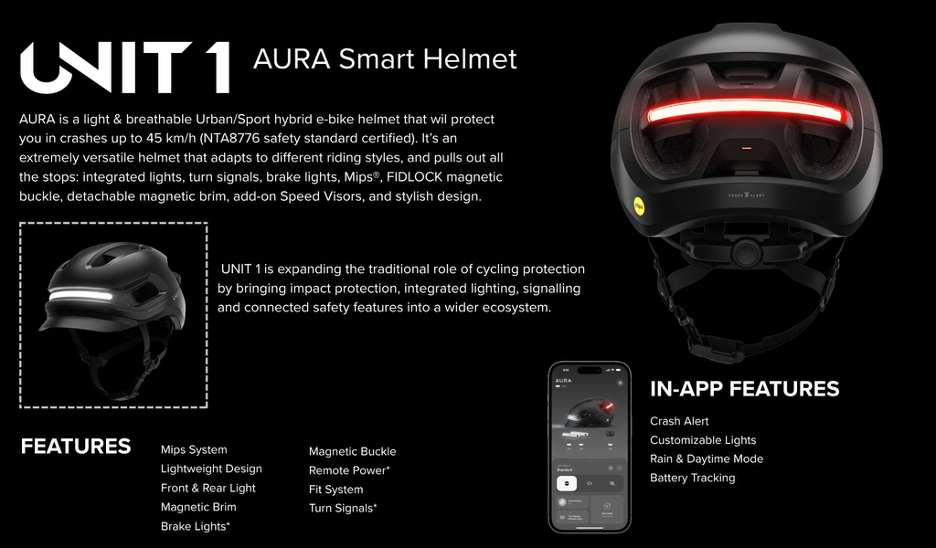
The range also demonstrates that smart safety does not have to mean a single aesthetic. AURA combines front and rear lighting with 14 vents in a relatively streamlined design, while FARO takes a distinctly urban approach, concealing an extensive lighting system beneath its fabric surface. NEON offers a more pared-back interpretation for everyday city riding.
From smart helmet to safety ecosystem
Where UNIT 1 becomes particularly interesting is in how those products work together.
UNIT 1 smart detachable bike light can add front or rear illumination without permanently attaching another accessory to the bike. The same light can operate as white front illumination or red rear illumination depending on how it is positioned, making it easier to move lighting between different setups.
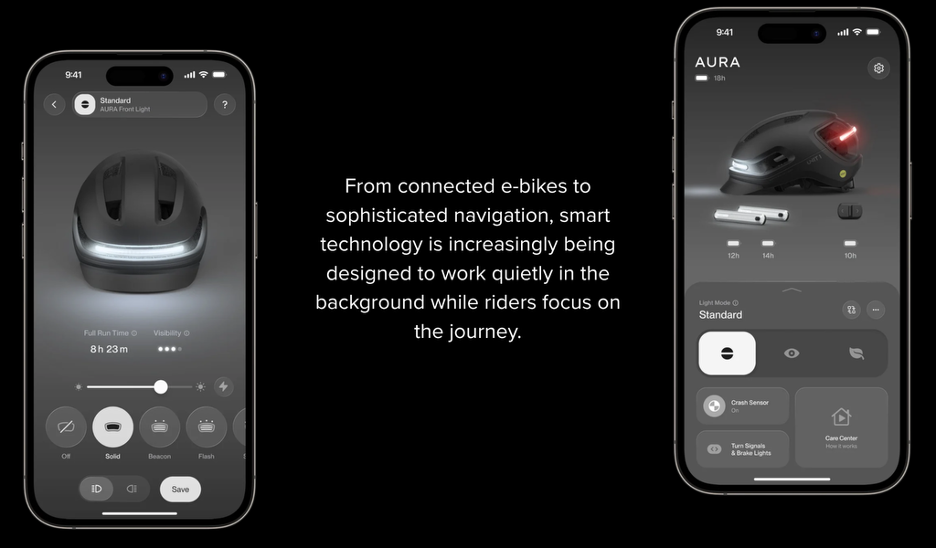
Paired with compatible helmets and the handlebar Remote, lighting, braking and turn signalling can become part of one connected system rather than several unrelated accessories.
Crash Alert extends that thinking beyond visibility. On compatible UNIT 1 helmets, sensors can detect a significant impact and begin a safety countdown through the app. If the rider does not respond, the system can send an SOS with their location to a designated emergency contact.
The result is a different interpretation of cycling protection: help the rider be seen before an incident, protect the head if an impact happens and provide a route to assistance afterwards.
Francisco Abelleira, co-founder of UNIT 1, describes the thinking behind this approach simply: “Through multiple devices working together, AURA helps prevent a crash from happening.”
UNIT 1 has also explored connections beyond its own products, including integration between its smart-helmet technology and connected e-bike systems. It points toward a future in which the bike, helmet, lights and rider no longer function as isolated components.
2. Rapha: Making the fabric do the work
Not all intelligent cycling designs need a battery.
British cycling brand Rapha approaches innovation through what riders wear, using technical fabrics and construction to address temperature regulation, weather protection and comfort without abandoning the clean aesthetic that has become central to its identity.
Its collaboration with GORE-TEX illustrates the approach particularly well. Waterproofing and breathability become part of the garment itself rather than requiring riders to choose between protection from the weather and clothing they actually want to wear.
That matters in an urban setting. Commuter clothing has to perform on the bicycle but often needs to continue working when the rider reaches their destination.
Rapha demonstrates a broader definition of “smart”: understand where friction exists in the experience and use material science and design to quietly remove it.
3. Stromer: Turning the e-bike into a connected vehicle
If UNIT 1 puts intelligence around the rider, Swiss manufacturer Stromer builds it directly into the bicycle.
Its premium speed pedelecs combine powerful electric assistance with connected features designed around longer urban and suburban journeys. Through Stromer’s digital ecosystem, riders can access information about their bike, adjust settings and use connected security functionality.
This is particularly relevant for commuters considering an e-bike as a genuine car alternative rather than simply a recreational bicycle with electrical assistance.
Stromer has also experimented with connections between bike and rider equipment, including integration with UNIT 1’s smart helmet. It is a small but revealing development: the future of connected cycling may depend less on individual smart products than on those products being able to communicate with one another.
4. VanMoof: Intelligence built into the bicycle
VanMoof has long approached the urban e-bike as a single integrated product rather than a conventional bicycle surrounded by aftermarket technology.
Its current generation continues that philosophy. Motor assistance, electronic shifting and torque sensing work together to respond to rider input, while information is incorporated into the bike rather than requiring a conventional cycling computer bolted to the handlebars.
Connectivity also addresses one of urban cycling’s most persistent concerns: theft. App-based functionality provides access to security features and information about the bike, while software updates allow aspects of the riding experience to evolve after purchase.
The appeal is simplicity. The rider does not necessarily need to understand what every sensor is doing. The technology earns its place by making the bicycle easier to live with.
5. Hammerhead: Navigation without the distraction
Getting across a city efficiently is its own technological problem.
Hammerhead addresses it through Karoo, its GPS cycling computer designed to combine detailed mapping, ride data and navigation within an interface that feels closer to a modern smart device than a traditional bike computer.
For urban riders, good navigation has benefits beyond finding the fastest route. Choosing unfamiliar streets can mean discovering quieter roads, cycling infrastructure or more comfortable alternatives to car-dominated routes.
Karoo combines touchscreen mapping with route integration, performance data and compatibility with other cycling components and services. Rerouting can respond when a rider deviates from the planned journey, reducing the need to stop and reach for a phone.
That may be its most important contribution to urban riding: sophisticated technology that allows the cyclist to spend less time interacting with it.
When smart technology becomes invisible
Despite producing very different products, these five brands share an important idea.
UNIT 1 connects impact protection, visibility, signalling and crash response. Rapha uses material technology to make clothing work harder. Stromer and VanMoof embed connectivity into the bicycle itself, while Hammerhead tries to make sophisticated navigation easier to use.
The common goal is not more technology for its own sake. It is removing small points of friction from riding.
That distinction will become increasingly important as cycling and e-bikes take on a larger role in urban transportation. Everyday riders are unlikely to embrace a future in which getting on a bicycle requires managing a collection of gadgets before every journey.
The better alternative is technology that becomes part of the experience: a brake light that activates when it is needed, clothing that adapts to difficult conditions, a bike that looks after aspects of its own security and navigation that quietly guides a rider through an unfamiliar city.
Author

Written by
Recent Posts
What to Wear to a Summer Wedding as a Guest: A Hamptons Dress Code Guide
A Soft Approach to Car Accident Recovery in Durham

Why You May Need a Lemon Law Attorney for Your Vehicle Claim
Cognitive Wellness: Why Digital Calm May Become the Next Luxury
New Rules of Luxury Travel: Why Flexibility and Transparency Matter as Much as the Destination
Categories
- Art
- Articles
- Business of Luxury
- Celebrities
- Culture
- Entertainment
- Events
- Faces of Summer 2026
- Fashion
- Fashion & Style
- Featured
- Finance
- Food, Spirits, Wine
- Hamptons
- Hamptons Celebrities
- Health
- Health & Beauty
- Lifestyle
- Luxury Lifestyle
- Press
- Profiles
- Real Estate
- Technology
- The Chronicles
- Travel
- Uncategorized
- Weddings