
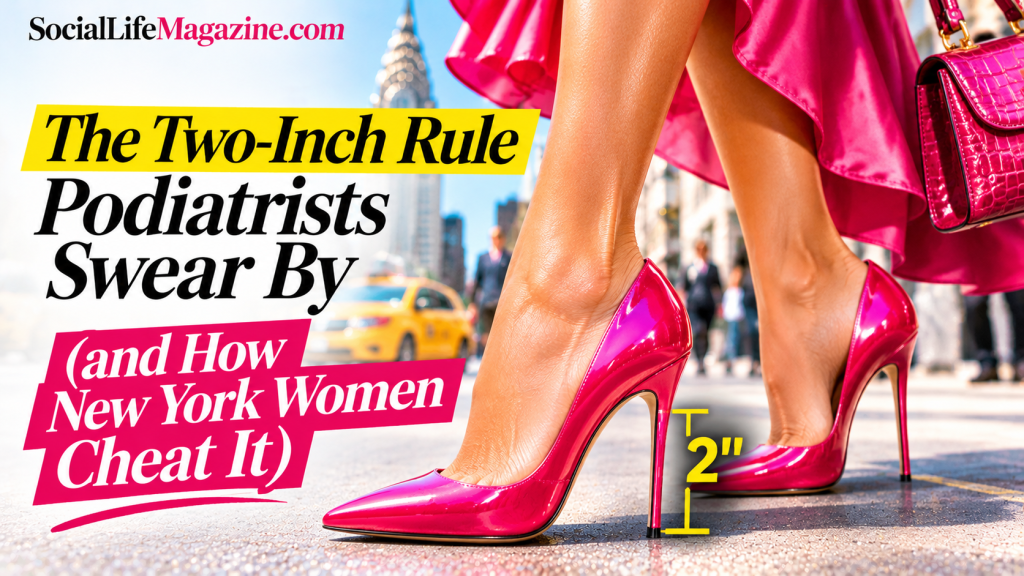
Nobody on Fifth Avenue is giving up her heels. Here is how to wear them like a strategist instead of a martyr.
The short version: Podiatrists, including the American Podiatric Medical Association, recommend everyday heels of two inches or less. Manhattan podiatrist Dr. Rebecca Pruthi’s strategy for higher heels is to get the fit right, choose leather, cushion the ball of the foot, rotate heel heights through the day, and save the tallest pairs for occasions.
The American Podiatric Medical Association recommends a maximum heel height of two inches. Dr. Rebecca Pruthi, the Madison Avenue podiatrist behind Foot Care of Manhattan, has given the same number to TheHealthy.com for anyone trying to avoid foot pain. Two inches. Read that out loud at a Midtown cocktail party and watch the room laugh.
The APMA’s own survey explains the laughter. Among women who own heels, nearly half said they could tolerate heels of three inches or higher. Only 3 percent said every heel is too high, though 92 percent drew the line at five inches. The rule and the reality live about an inch and a half apart, and that gap is where the strategy happens.
Why two inches?
The number isn’t arbitrary. As a heel rises, more of your body weight shifts forward onto the ball of the foot and the toes get pushed into the front of the shoe. The calf shortens to hold the position, and the knees, hips and lower back adjust to keep you balanced. Up to about two inches, most feet tolerate the shift. Above it, the pressure and the posture change climb quickly.
Think of it as a dial, not a switch. A two-and-a-half-inch block heel worn for a dinner is a very different event from a four-inch stiletto worn for a twelve-hour workday. The rule describes your everyday baseline. The strategy describes how to spend the exceptions.
Meet the strategist (a composite)
Call her Tessa, a composite: 36, a senior associate at a Midtown law firm who believes, with some evidence, that a sharp heel changes how opposing counsel hears her. She owns eleven pairs. She wears two of them regularly. She has a bottle of blister plasters in every bag she owns, and a drawer at the office she refers to as the shoe morgue.
Tessa doesn’t need a lecture. She needs a system. Pruthi’s published advice, scattered across a decade of magazine interviews and her own columns, adds up to one.
Rule one: the fit comes first
Fit sounds too obvious to mention, which is exactly why Pruthi starts there. She told Bustle the most common mistake she sees: “I see too many women with wide feet cramming into a narrow shoe.” Cramming is how bunions, hammertoes and neuromas get their start.
Her fixes are almost embarrassingly simple. Leave space between your longest toe and the end of the shoe. Shop at the end of the day, when your feet have swollen to their largest. And look honestly at the width of your foot, not the size on the box. Feet also change over time, after pregnancy and with age, so the size you wore at 25 may not be your size at 45.
Rule two: buy leather and break it in at home
Pruthi prefers shoes that give, leather over synthetics, so the shoe can stretch toward your foot instead of forcing your foot toward the shoe. Before a new pair goes out, she suggests wearing them around the apartment with socks for a few hours, or using a shoe stretcher. The first wearing should never be a gala.
Rule three: choose the right kind of heel
How you wear heels matters as much as how high. In her own Dr. Oz column, Pruthi favored wedges over stilettos, a lower heel over sky-high, a thin rubber sole for grip and cushion, and a strap around the ankle for support. A platform raises the front of the foot as well as the heel, which lowers the effective slope, so you can look taller without standing on tiptoe.
The current fashion cycle is on her side. Block heels, kitten heels, sculpted loafers and low slingbacks are everywhere from Madison Avenue boutiques to the Hamptons. Ten years ago they looked like a compromise. Now they look like a choice.
Rule four: pack the toolkit
A gel cushion under the ball of the foot, called metatarsal padding, takes some of the pressure a heel drives forward. Moleskin over bony spots stops friction before it becomes a blister. Pruthi is candid about the limits: padding helps the foot, but it does nothing for the calf, knee and back strain that come from the heel’s altered posture. That is what the next rule is for.
Rule five: rotate like an investor
The single most useful habit is changing shoes through the day. Pruthi’s line is to wear heels only for periods of time and give your feet a break. In New York this is already folk wisdom: sneakers on the subway, heels at the desk, flats for the walk to dinner. The podiatrist simply turns the habit into a rule and adds heel heights to the rotation.
A portfolio manager would recognize the logic. You don’t put the whole account in one stock, and you don’t put the whole week in one heel height. Diversify across days, too. Never the same pair two days running, which also lets the shoe dry out and keep its shape.
Rule six: know when your favorite pair has to go
Shoes wear out in ways that change how you walk. Pruthi has recommended replacing the shoes you wear every day about every six months. As for a beloved heel that is simply too tall, it is usually better promoted to special occasions than altered. Cutting down a heel can throw off the shoe’s balance and the way it carries your weight. If you love the style, look for the same shoe in a lower height.
Why it matters beyond the feet
Pruthi has also spoken about what heels cost the rest of the body: blisters and inflamed foot tendons, yes, but also ankle sprains and strain carried up into the neck, shoulders and back. The two-inch rule is about the whole frame, not only the toes.
That is also why the warning signs aren’t always in the foot. A woman who has chronic lower back pain, tight calves when she switches to flats, or knees that ache after a day in heels may be hearing from the same pair of shoes.
The event playbook
Some nights genuinely call for the tall pair. For those, the strategist plans ahead:
- Arrive in the heels, travel in something else. Fold-up flats in the clutch, heels on for the entrance and the photos.
- Sit when you can. Standing still in heels is often harder on the feet than walking.
- Match the heel to the ground. Wedges or block heels for grass and cobblestones, stilettos only for floors that won’t swallow them.
- Pad the shoe before you leave, not after the blister forms.
Tessa’s verdict
Tessa kept her best pair, a three-and-a-half-inch black pump, and demoted it to closing dinners and court days. Daily wear became a two-inch block heel in soft leather, a gel pad in every pair, sneakers for the commute. She bought her next pair at 6 p.m., one half size wider than her old habit.
Six months later, the blister plasters were still in her bags. She just stopped opening them. The shoe morgue now holds exactly two pairs, both of them retired with honors.
Frequently asked questions
What heel height is safe for everyday wear? Podiatrists, including the American Podiatric Medical Association, recommend everyday heels of two inches or less. Higher heels are best kept for shorter periods and special occasions.
Are block heels or wedges better for your feet than stilettos? Generally, yes. A wider heel or wedge is more stable and spreads your weight better, and a platform lowers the overall slope of the foot. A strap around the ankle adds support.
How can I make high heels hurt less? Buy shoes that fit your length and width, shop at the end of the day, choose leather, break new shoes in at home, add a gel cushion under the ball of the foot, and switch shoes during the day.
Is it bad to wear high heels every day? Daily wear of high heels can contribute to bunions, hammertoes, neuromas, a tight Achilles tendon and knee, hip and back pain. Rotating heel heights and wearing supportive flats or sneakers for walking lowers the risk.
Back to the series pillar: Manhattan’s Most Glamorous Women Walk Miles in Heels. Related: Don’t Blame the Manolos. Blame Your Mother.
Tessa is a composite. This article is for general information, not medical advice.
Author

Written by
Recent Posts
The Two-Inch Rule Podiatrists Swear By (and How New York Women Cheat It)
Your Pedicure Looks Clean. Your Footbath Might Not Be.
What Your Toenails Are Telling You That Your Pedicurist Won’t

She Walks Everywhere in This City. Her Heel Pain Has a Name.
Why a leather jacket is the ultimate investment piece for modern men
Categories
- Art
- Articles
- Business of Luxury
- Celebrities
- Culture
- Entertainment
- Events
- Faces of Summer 2026
- Fashion
- Fashion & Style
- Featured
- Finance
- Food, Spirits, Wine
- Hamptons
- Hamptons Celebrities
- Health
- Health & Beauty
- Lifestyle
- Luxury Lifestyle
- Press
- Profiles
- Real Estate
- Technology
- The Chronicles
- Travel
- Uncategorized
- Weddings