
When a Fish Becomes a Collectible
In the world of collecting, beauty often resides in the details: the brushstroke that distinguishes one painting from another, the subtle irregularity of a handmade object, or the provenance that gives an extraordinary piece its place in history. In the world of rare Thai bettas, those details are alive.
A flash of metallic turquoise, the delicate transition from deep crimson to violet, or fins that unfold like silk in moving water can transform an otherwise familiar aquarium fish into something remarkable. The betta, particularly the selectively bred ornamental varieties developed in Thailand, occupies an unusual intersection of natural beauty and human craftsmanship.
For discerning collectors, the appeal extends beyond color. Each fish possesses its own visual character, movement and temperament. Unlike a painting or sculpture, it is never entirely static. Its appearance changes with the light, its environment and its behavior.
This combination of individuality, artistry and living presence has helped establish rare Thai bettas as objects of appreciation among international ornamental fish enthusiasts.
Thailand’s Betta Breeding Heritage
Thailand’s relationship with the betta fish reaches back centuries. Native to Southeast Asia, Betta splendens, commonly known as the Siamese fighting fish, has a long history of domestication and selective breeding in the region.
Historical research suggests that bettas were selectively bred in Thailand for centuries, initially with an emphasis on fighting characteristics. Over time, breeding priorities expanded, and ornamental qualities became increasingly important. Coloration, fin development, body proportions and distinctive patterns helped shape the extraordinary diversity seen in contemporary varieties.
Scientific research published in The Proceedings of the National Academy of Sciences has examined the genetic consequences of betta domestication, demonstrating how human selection has influenced the species’ physical characteristics. Other research has documented the remarkable range of pigmentation and fin morphology that distinguishes modern ornamental bettas.
Thailand remains an important center of betta breeding culture. Its specialist breeders have contributed to the development and preservation of ornamental varieties through generations of observation, experimentation and selective pairing.
This history gives the modern Thai betta an identity that extends beyond its appearance. It represents a living tradition in which biological variation meets human aesthetic judgment.
Color, Form and Individuality
The visual language of a rare betta begins with color, but color alone rarely tells the whole story.
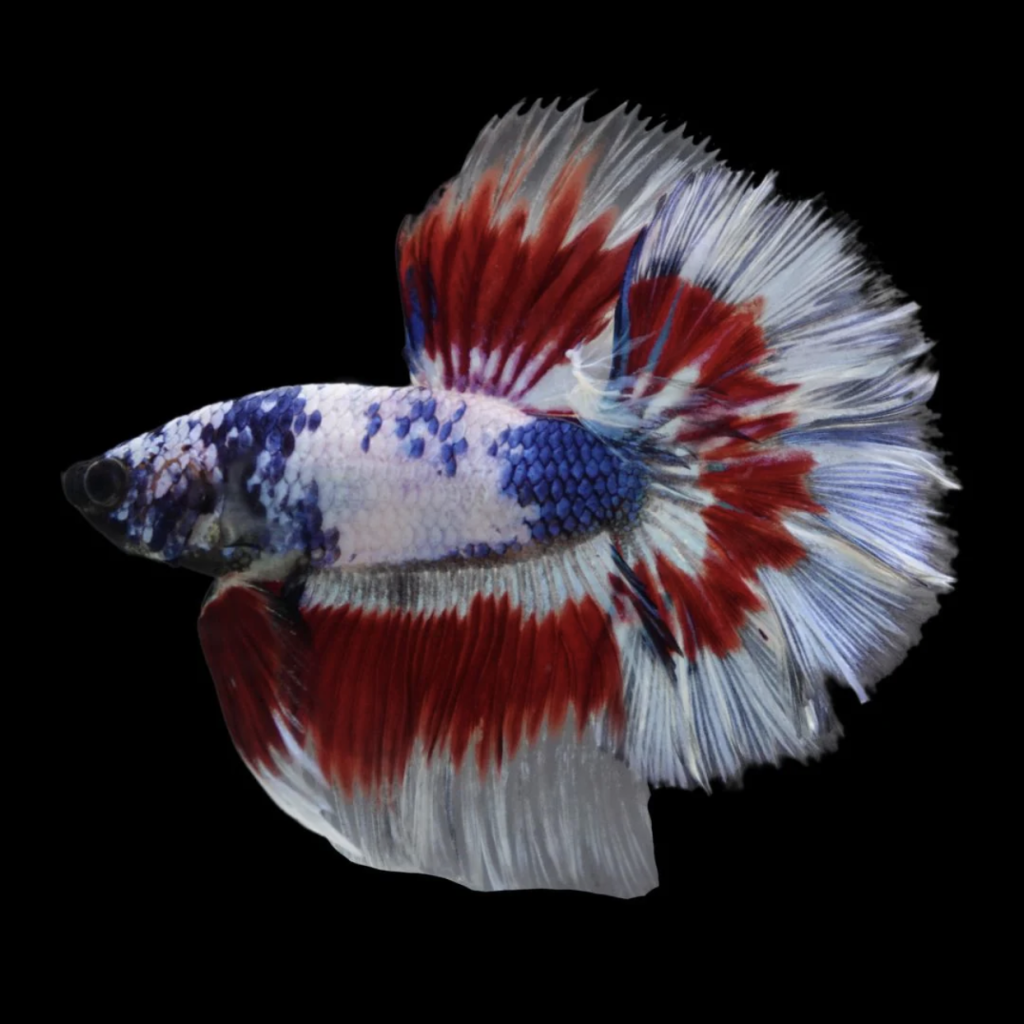
Some specimens display saturated reds, blues and yellows. Others feature iridescent layers that appear to shift between metallic green, turquoise and violet as the fish moves. Marble patterns, contrasting fin edges and intricate combinations of pigmentation create an almost painterly effect.
Then there is the finnage.
Halfmoon bettas are admired for their broad, fan-like caudal fins, while crowntails feature distinctive extended fin rays. Plakat varieties retain shorter fins and a more compact silhouette. Each form creates a different relationship between the fish’s body and the surrounding water.
Collectors often look for proportion and visual balance. The relationship between the body, dorsal fin, caudal fin and anal fin can determine whether a specimen appears harmonious or visually disproportionate.
Symmetry matters, but so does individuality. A fish with an unusual pattern or an unexpected combination of colors may possess a distinctive character that cannot be reduced to a standardized description.
In this respect, collecting bettas resembles collecting contemporary art. Technical quality provides a foundation, but personal attraction often determines which specimen ultimately feels exceptional.
What Makes a Betta Collector-Grade?
The expression collector-grade suggests more than rarity or an impressive photograph. It describes a combination of qualities that experienced enthusiasts consider when evaluating an individual fish.
Color intensity is one consideration, but consistency, pattern distribution and contrast are equally relevant. A striking color combination may lose some of its appeal if the overall appearance lacks balance.
Form is another essential consideration. The body should appear proportionate, the fins should be appropriately developed for the variety, and the fish should display natural, controlled movement. Fin condition, scale integrity and general physical health are also important.
Rarity can contribute to desirability, particularly when a specimen displays an unusual combination of established characteristics. However, an uncommon fish is not automatically an exceptional one. Its overall condition and visual coherence remain central to its quality.
For collectors exploring collector-grade Thai betta fish, the most useful approach is to evaluate the individual specimen rather than relying exclusively on variety names or descriptions.
A beautiful betta should be appreciated as a complete living subject: its color, proportions, pattern, condition and behavior considered together.
The Breeder as Curator
Behind an exceptional ornamental fish is often a breeder whose work combines scientific observation with an artist’s sensitivity to detail.
Selective breeding requires patience. Breeders evaluate parent fish, observe the characteristics expressed in successive generations and make decisions about which individuals should contribute to future pairings. The process involves understanding inheritance, recognizing desirable physical traits and accepting that biological outcomes are never entirely predictable.
The best breeding decisions are not simply about producing the brightest possible color. They involve considering how different characteristics interact: whether fin development complements body proportions, whether patterns remain visually coherent and whether the resulting fish maintains good physical condition.
This is where the breeder begins to resemble a curator. Rather than creating a work from an entirely blank canvas, the breeder works with an existing living organism, guiding its possibilities through careful selection.
For an introduction to Thailand’s specialist ornamental betta world, Thailand Betta Fish provides a point of reference for exploring the varieties and visual diversity associated with Thai betta collecting.
The breeder’s contribution is particularly significant because the finished specimen represents more than a single pairing. It reflects a sequence of decisions, observations and selections that may extend across multiple generations.
Rare Bettas in Contemporary Homes and Collections
A thoughtfully presented betta can bring an unexpected dimension to a sophisticated interior.
In contemporary homes, where sculpture, photography and carefully selected objects often define a room’s character, a well-maintained aquarium can function as a living focal point. The movement of the fish introduces an element that traditional decorative objects cannot replicate.
A single betta, presented in an appropriately maintained aquarium, can become an intimate visual experience. Natural lighting, restrained surroundings and a clean presentation allow its colors and movement to remain the focus.
The objective is not to turn an animal into an accessory. A beautiful aquarium must first function as a healthy environment, with suitable water conditions, temperature, filtration and space.
This distinction matters. The appeal of a rare betta should never come at the expense of its welfare.
For collectors interested in the relationship between craftsmanship and aesthetic value, Social Life Magazine’s discussion of Artist vs Artisan: Who Holds the Veto offers a complementary perspective on the difference between making something beautiful and understanding the skill behind its creation.
How Collectors Should Evaluate Bettas Online
The international market has made it easier for enthusiasts to discover ornamental fish from specialist breeders in different countries. Yet purchasing a living animal remotely requires considerably more care than acquiring a conventional collectible.
Anyone researching betta fish for sale online should begin with photographs and videos of the actual specimen rather than relying on representative images of a particular variety.
Recent, well-lit footage can reveal details that photographs sometimes conceal, including swimming behavior, fin condition, body proportions and coloration under different lighting conditions.
Transparency is equally important. Responsible sellers should be able to provide meaningful information about the individual fish, its approximate age where known, current condition, feeding habits and care requirements.
Collectors should also investigate shipping arrangements before committing to a purchase. Questions about packaging, transit duration, temperature management, delivery procedures and applicable import requirements deserve clear answers.
Arrival policies matter, too. Buyers should understand what happens if a fish arrives visibly unwell or does not survive transportation, including the documentation and notification requirements involved.
Animal welfare should remain the deciding consideration. International shipping can expose fish to stress, so buyers should favor sellers who prioritize appropriate handling, responsible transport and realistic delivery expectations.
Finally, prospective owners should prepare an established, species-appropriate aquarium before the fish arrives. Collecting begins with appreciation, but ownership creates an ongoing responsibility.
The Living Art of Thai Betta Collecting
Rare Thai bettas occupy an intriguing position in the modern collecting landscape. They are natural organisms shaped by generations of human selection, combining extraordinary visual variation with a distinctive cultural history.
Their appeal is not simply the intensity of a particular color or the rarity of a fin pattern. It is the relationship between form, movement, breeding knowledge and individuality.
For collectors accustomed to appreciating fine art, exceptional design and traditional craftsmanship, the Thai betta offers a different kind of encounter with beauty: one that cannot be separated from the responsibility of caring for a living creature.
Ultimately, the finest specimens invite more than admiration. They encourage a deeper appreciation of Thailand’s breeding heritage, the patience of specialist breeders and the remarkable possibilities that emerge when nature and human craftsmanship meet.
Author

Written by
Recent Posts
What Spring Harvesting Means For Artisanal Green Tea
How to Grill Thick Greek-Style Flatbread Properly
What Marine Accords Smell Like Once They Settle on Skin
The Art of the Rare Thai Betta: Color, Craftsmanship and Collecting
What to Do If You Have an Active Warrant
Categories
- Art
- Articles
- Business of Luxury
- Celebrities
- Culture
- Entertainment
- Events
- Faces of Summer 2026
- Fashion
- Fashion & Style
- Featured
- Finance
- Food, Spirits, Wine
- Hamptons
- Hamptons Celebrities
- Health
- Health & Beauty
- Lifestyle
- Luxury Lifestyle
- Press
- Profiles
- Real Estate
- Technology
- The Chronicles
- Travel
- Uncategorized
- Weddings