
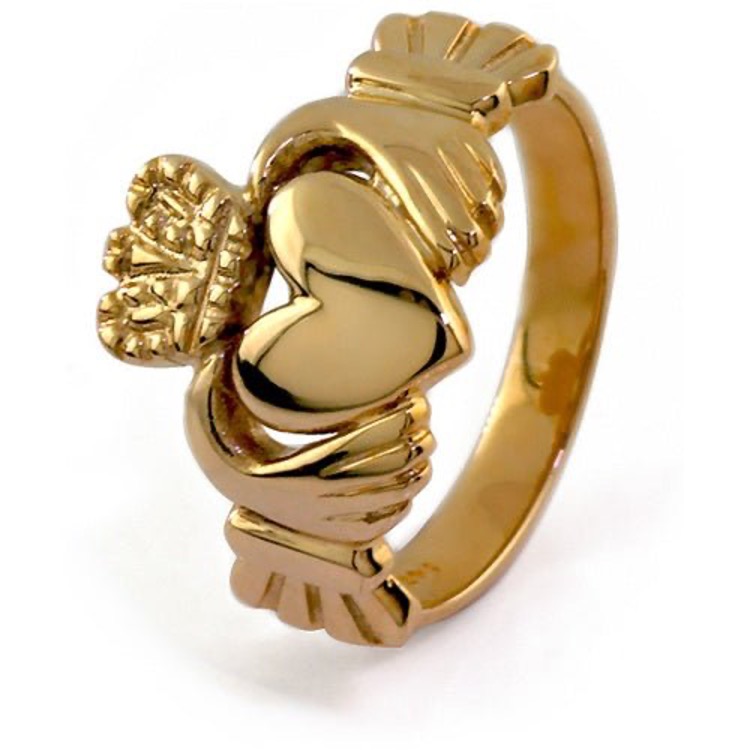
Few pieces of jewellery carry as much history in so small a space as the Claddagh ring. Two hands hold a heart, and a crown sits above it. The design is now recognised around the world, yet it grew from one fishing community on the edge of Galway, on Ireland’s Atlantic coast.
The village on the shore
The Claddagh took its name from the Irish An Cladach, meaning “the shore” or “the stony beach”. It lay just outside Galway’s old city walls, where the River Corrib meets Galway Bay. For centuries it was a close-knit, Irish-speaking fishing community with its own customs, and it was famous for choosing its own “king”, who settled disputes and led the fishing fleet.
The old village of thatched cottages was cleared in the 1930s and replaced with modern housing. Its most famous export, however, had already travelled far beyond the shore.
Older than Galway: the fede ring
The Claddagh did not appear from nowhere. Its clasped hands descend from the fede ring, from the Italian mani in fede, “hands in trust”. Rings showing two joined hands were used as tokens of agreement and betrothal in Roman times and became popular again across medieval and Renaissance Europe.
What Galway added was the heart, held between the hands, and the crown above it. Together they gave the old symbol of a pledge a clear new reading: friendship, love and loyalty.
Richard Joyce and the Algerian corsairs
The best-known origin story centres on Richard Joyce, a member of one of the merchant families known as the Tribes of Galway. According to the account told in early nineteenth-century histories of Galway, Joyce was sailing to the West Indies in the late 1600s when his ship was taken by Algerian corsairs. He was sold into slavery in Algiers, where a goldsmith bought him and taught him the trade.
The story says Joyce was released around 1689, after the new English king, William III, pressed for the freedom of his subjects held in North Africa. His master is said to have offered him his daughter and half his fortune if he would stay. Joyce refused, returned to Galway, and set up as a goldsmith, making the rings that would carry the village’s name.
There is real evidence behind the romance. Some of the earliest surviving Claddagh rings carry a maker’s mark with the initials “RI” and an anchor, which is usually read as Joyce’s own mark. Other early rings bear the marks of different Galway goldsmiths, which suggests that Joyce helped to popularise the design rather than inventing it alone.
Margaret and the eagle
Galway has a second, more fanciful legend. Margaret Joyce, a wealthy widow remembered for funding bridges across the west of Ireland, is said to have been rewarded for her charity when an eagle dropped a gold ring into her lap. That ring, the story goes, was the first Claddagh. No one treats this as history, but it shows how deeply the ring had become part of Galway’s own story about itself.
From village custom to worldwide symbol
In the Claddagh itself, the ring served as a wedding ring and was often handed down from mother to daughter. A custom grew up around how it was worn, and it still survives. On the right hand with the heart turned outward, the wearer is free. Turned inward, their heart is taken. On the left hand, it marks an engagement or a marriage. Today the Claddagh ring meaning is one of the first things people learn about the design, and for many it is the reason they choose one.
The ring’s great journey came with emigration. During and after the Great Famine of 1845–1852, millions left Ireland, and many carried family rings with them as one of the few heirlooms that fitted in a pocket. In the United States, Canada, Britain and Australia, the Claddagh became a badge of Irish identity for the families of emigrants.
A living tradition
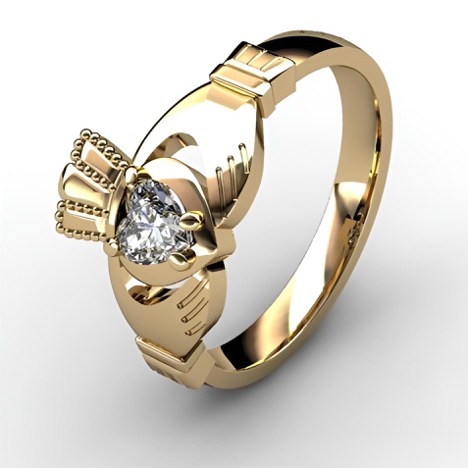
More than three centuries after Richard Joyce’s time in Algiers, Galway jewellers still make the ring, and so do craftspeople around the world. A Claddagh ring today might be plain gold, set with diamonds, or worked into a wedding band, yet it still carries the same three ideas that the fishing families of the Claddagh understood.
The details of its origin may never be fully settled. What is certain is that a design born in a small community on the shore of Galway Bay has outlived the village itself, and has become one of the most recognisable symbols of love in the world.
Author

Written by
Recent Posts
Seasonal Affective Disorder in Seniors: How to Spot and Ease the Winter Blues
Hands, Heart and Crown: The History of the Claddagh Ring
Seven Questions to Ask Before You Get Veneers

How to Give Your Bedroom a Makeover Without Buying New Furniture

Why Premium Supplements Are Becoming Part of the Hamptons Luxury Lifestyle
Categories
- Art
- Articles
- Business of Luxury
- Celebrities
- Culture
- Entertainment
- Events
- Faces of Summer 2026
- Fashion
- Fashion & Style
- Featured
- Finance
- Food, Spirits, Wine
- Hamptons
- Hamptons Celebrities
- Health
- Health & Beauty
- Lifestyle
- Luxury Lifestyle
- Press
- Profiles
- Real Estate
- Technology
- The Chronicles
- Travel
- Uncategorized
- Weddings