
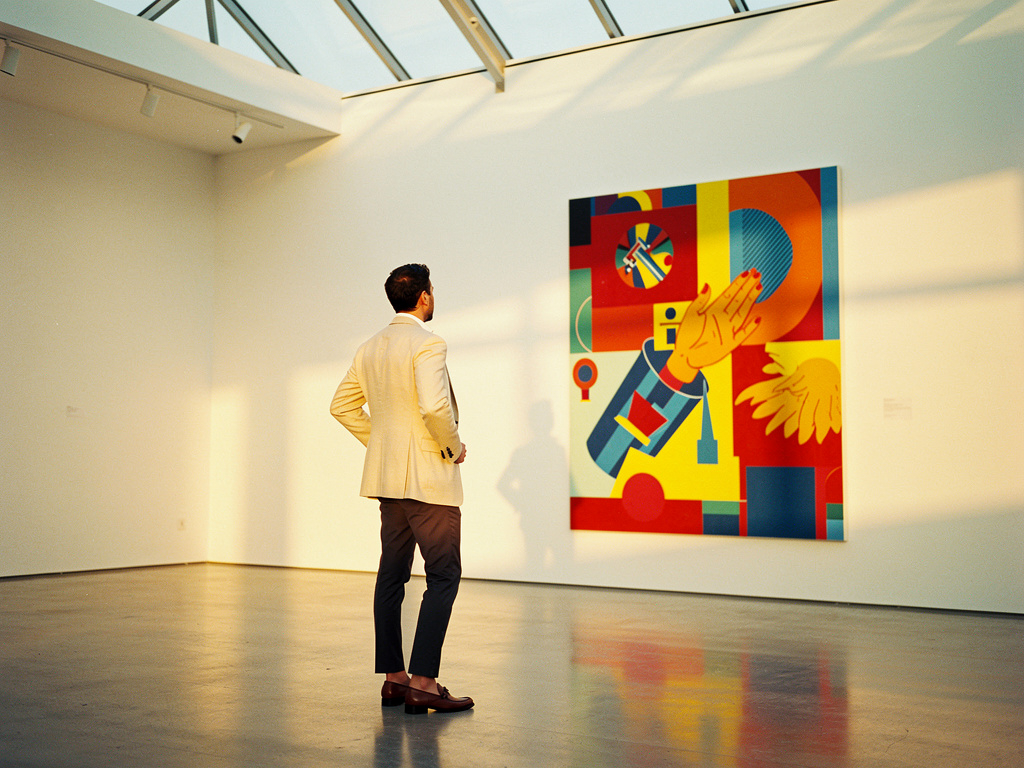
Summer 1972. Keith Richards scrambles eggs in a beachfront kitchen while Mick Jagger paces the dunes in a Missoni sweater. Jackie Kennedy reads on a weathered porch. Truman Capote nurses vodka as the Atlantic crashes below. The host watches from the shadows, snapping Minox photographs, rarely dancing, always observing. This was Andy Warhol pop art in practice—transforming a modest Montauk compound into the cultural crossroads of an era.
Andy Warhol Pop Art: The Montauk Chapter
In 1971, Warhol and filmmaker Paul Morrissey purchased Eothen, a five-cottage compound on Montauk’s eastern tip, for $225,000. The property’s name derives from ancient Greek meaning “from the east” or “from the dawn.” Built in the 1930s for the Arm & Hammer heirs as a fishing camp, the estate offered exactly what Warhol needed: distance from the Factory’s chaos without sacrificing access to the people who fueled his work.
Furthermore, Montauk in 1971 bore little resemblance to today’s scene. The village remained a quiet fishing community, far removed from Southampton’s social circuits. This isolation appealed to Warhol, who appreciated the “off-kilter architecture” of roadside motels like the Memory Motel and Ronjo. Nevertheless, the compound’s first summer tenant would immediately elevate its social cachet.
Lee Radziwill, Jackie Kennedy’s sister, rented the main house that inaugural summer. She brought her sister and children—Caroline and John Jr.—transforming the property into an extension of American royalty’s orbit. Filmmaker Jonas Mekas captured the Kennedy children dancing to Sticky Fingers. As Bob Colacello later noted, Eothen became “the Factory answer to Hyannisport.”
The Rolling Stones and the Art of Social Capital
The Stones’ 1972 American Tour brought Mick and Bianca Jagger to Eothen, where they stayed with Radziwill to decompress. Peter Beard, whom Jagger had hired to document the tour, introduced the rock stars to Warhol’s circle. The connection proved enduring. By 1975, the band returned to rehearse Black and Blue among the dunes, their sessions audible throughout the village.
This mixing of worlds—rock royalty, political aristocracy, literary celebrities, fashion icons—defined Warhol’s genius beyond canvas and silkscreen. He understood that Andy Warhol pop art extended far beyond objects. The artist manufactured social situations as deliberately as he manufactured images. Collectors who grasp this dimension approach his work with appropriate sophistication.
Elizabeth Taylor visited. Halston maintained a cottage. Liza Minnelli became a regular. Dick Cavett walked over from his neighboring property, waiting at the edge of Warhol’s land until invited in. Each visit added to a social ledger that Warhol maintained as carefully as any dealer tracks provenance. The guest list became another form of authentication.
What Eothen Reveals About Warhol’s Market
The property’s value trajectory mirrors his art market performance. Warhol paid $225,000 in 1971. Mickey Drexler, then J.Crew’s CEO, purchased it for $27 million in 2007. Gallerist Adam Lindemann acquired the compound in 2015 for $50 million—a 222-fold increase over 44 years. This appreciation rate exceeds most financial instruments and many art holdings.
However, the real estate merely illustrates broader market dynamics. According to MyArtBroker analysis, Warhol’s print market demonstrated a compounded annual growth rate of 27 percent over the past five years. His paintings routinely anchor major evening sales at Sotheby’s and Christie’s. In 2022, he ranked first among all artists for fine art auction turnover, generating £410 million in sales.
Consequently, Warhol functions as a market bellwether. When his prices soften, collectors reassess broader positions. When his records break, confidence ripples through contemporary sectors. Understanding Andy Warhol pop art means understanding the mechanics of the entire postwar market.
The Shot Marilyn and What It Teaches
May 2022 delivered the defining moment in Warhol’s posthumous market. Shot Sage Blue Marilyn (1964) sold at Christie’s New York for $195 million, becoming the most expensive twentieth-century artwork ever auctioned. The result exceeded expectations by $100 million and signaled that blue-chip pop art remained immune to broader market uncertainty.
The painting’s backstory amplifies its value. In 1964, performance artist Dorothy Podber visited the Factory and asked if she could shoot the Marilyns. Warhol, assuming she meant with a camera, agreed. She drew a pistol and fired into a stack of four canvases. Though repaired, the bullet hole transformed these works into art-historical events rather than mere objects. Provenance became performance.
This narrative dimension characterizes the strongest Warhol holdings. The work itself matters, but the story surrounding it compounds value. Collectors pursuing Andy Warhol pop art should prioritize pieces with documented exhibition histories, notable previous owners, or connections to significant cultural moments. Pure aesthetic appeal, while necessary, rarely suffices at the highest levels.
Entry Points: Building a Warhol Position
Not every collector arrives with nine-figure budgets. Fortunately, Warhol’s prolific output creates genuine accessibility at multiple price points. The Andy Warhol Foundation estimates he produced over 9,000 paintings and sculptures, nearly 12,000 drawings, and countless prints and photographs. This volume ensures steady supply across market tiers.
Authorized prints offer the most accessible entry. Smaller works from established series—Flowers, Cow, Campbell’s Soup—trade between $5,000 and $25,000 depending on size, condition, and colourway. These aren’t consolation prizes; they’re legitimate Warhol holdings with strong authentication and active secondary markets. Additionally, they develop the collector’s eye for quality that later guides larger acquisitions.
The mid-market spans $25,000 to $250,000, encompassing larger prints, trial proofs, and works from less celebrated series. Committee 2000, Endangered Species, and the Jagger portraits occupy this territory. Recent Phillips results showed Endangered Species prints breaking records, with African Elephant achieving £215,900 against a £60,000 estimate. This segment rewards research and patience.
What Sophisticated Collectors Know
Several principles separate successful Warhol collectors from frustrated speculators. First, condition matters enormously with prints. Fading, foxing, and handling damage dramatically affect value. Request condition reports from auction houses and examine works in person whenever possible. A pristine impression from a common series often outperforms a damaged example from a rare one.
Second, provenance creates premium. Works that passed through Warhol’s own collection, notable dealers like Leo Castelli, or significant private holdings command higher prices than identical pieces with sparse documentation. Moreover, this provenance gap widens during uncertain markets. Collectors retreat to works with unimpeachable histories, leaving questionable examples illiquid.
Third, rarity within series matters. The Flowers portfolio contains ten prints, but certain colourways—electric green, lilac-pink—appear less frequently at auction. Learning these distinctions requires market study but pays returns when acquisition opportunities arise. Furthermore, complete portfolios typically outvalue their component parts, making patience to assemble sets strategically advantageous.
The Sunset Series and Hamptons Influence
Warhol’s time at Eothen directly influenced his work. The Sunset series, created in 1972, captures Montauk’s dramatic Atlantic light in silkscreen. These works demonstrate how environment shaped his production beyond the Factory’s industrial aesthetic. The coast unlocked something different—contemplative rather than commercial, natural rather than manufactured.
This Hamptons connection provides collectors with compelling narrative when displaying works. A Sunset print acquired for a Montauk residence carries contextual resonance beyond its visual appeal. The work references both art history and local geography, creating conversation that purely decorative pieces cannot generate. Smart collectors leverage these connections.
Additionally, the Andy Warhol Preserve—15 acres donated to the Nature Conservancy from his estate—maintains his presence in the Montauk landscape. Visitors can walk trails where Jackie Kennedy strolled and the Stones rehearsed. This physical accessibility keeps Warhol’s Hamptons chapter alive for new generations of collectors and admirers.
Market Outlook: Why Andy Warhol Pop Art Endures
Several structural factors support continued Warhol market strength. The Foundation’s authentication standards create supply constraints that prevent flooding. Institutional holdings remove significant works from circulation permanently. Younger collectors, raised on Warhol’s celebrity imagery, maintain generational demand that outlasts economic cycles.
Furthermore, Warhol’s influence on contemporary practice ensures ongoing art-historical relevance. Jeff Koons, Takashi Murakami, KAWS, and countless others build on his foundation. Museums continue mounting retrospectives. Scholars publish new research. This institutional attention sustains the critical apparatus that supports high prices. Artists who fade from academic discourse eventually fade from market prominence. Warhol shows no signs of either fate.
The 2024 market contraction tested blue-chip holdings across categories. While total auction volume dropped 27 percent, established Warhol positions demonstrated relative resilience. Works under $5,000 actually saw increased transaction volume as collectors sought accessible entry points. This bifurcation—softening at the very top while strengthening at accessible tiers—benefits strategic collectors building positions gradually.
Your Warhol Strategy: Where to Begin
Understanding Andy Warhol pop art prepares you for action, but execution determines outcomes. Start by attending auction previews at Phillips, Christie’s, and Sotheby’s. Handle the works. Compare impressions. Develop the tactile vocabulary that separates serious collectors from casual observers. This education costs nothing but compounds returns indefinitely.
Next, establish relationships with reputable dealers and advisors. The Hamptons gallery scene includes specialists who maintain Warhol inventory and can alert you to private sale opportunities before public auction. These connections require cultivation but provide access unavailable to walk-in traffic. The best works often trade quietly.
Finally, buy what genuinely moves you within your means. Andy Warhol pop art rewards patient accumulation over impulsive acquisition. A modest print purchased thoughtfully outperforms a stretch acquisition that forces premature sale during market stress. Build positions you can hold through cycles. The collectors who regret Warhol purchases almost always bought for the wrong reasons—speculation, social pressure, or advisor recommendation rather than genuine appreciation.
The artist who transformed a Montauk fishing camp into cultural ground zero understood something essential: value accumulates around authenticity. His work continues rewarding collectors who approach it with similar intention.
Continue Your Collecting Journey
Social Life Magazine connects discerning collectors with the Hamptons art world.
- Inquire About Gallery Partnerships
- Subscribe for Art Market Updates
- Experience Polo Hamptons
- Print Subscription
More from The Collector’s Guide to Pop Art
- Previous: What Is Pop Art? The Collector’s Essential Guide
- Next: Pop Art Artists: 12 Names Collectors Are Watching Now
Author

Written by
Recent Posts
Diana Taurasi Net Worth: The Greatest Player Who Left the Country to Get Paid
Sabrina Ionescu Net Worth: The Star the WNBA Chose And The Audience Disagreed

Paige Bueckers Net Worth: The Heir Who Enters the WNBA
A’ja Wilson Net Worth: The $5 Million MVP Who Was Invisible Until…

Angel Reese Net Worth: The $7 Million Rival Who Needs the Hero to Exist
Categories
- Art
- Articles
- Beauty & Skincare
- Celebrities
- Celebrities|Entertainment
- Celebrities|Television
- Celebrities|The Chronicles
- celebrities|the-archive
- Chronicles
- Entertainment|Culture
- Event Photos
- Events
- Fashion
- Fashion & Style
- Featured
- Food & Beverage
- Food, Spirits, Wine
- Hamptons
- Hamptons Celebrities
- Hamptons Celebrities|Celebrities|The Chronicles
- Health
- Health & Beauty
- Lifestyle
- Luxury Lifestyle
- Press
- Profiles
- Real Estate
- Technology
- The Chronicles
- Travel
- Uncategorized
- Weddings