
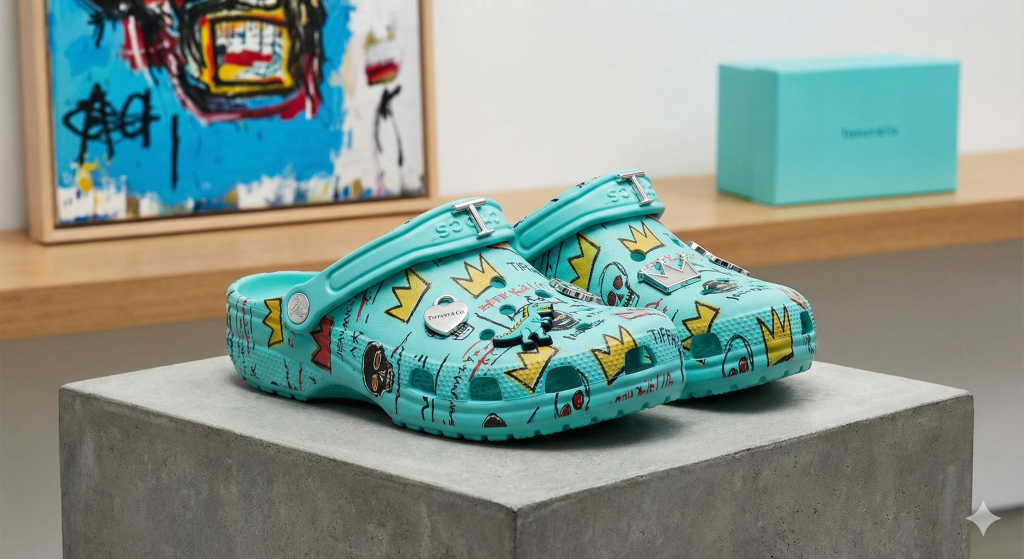
The Architecture of an Art Empire
When Jean-Michel Basquiat died at twenty-seven in 1988, he left behind approximately 600 paintings and 1,500 drawings. His father Gérard immediately stepped in to protect the work. “My dad was working in corporate himself,” Jeanine Basquiat, one of the artist’s two sisters, explained on the Talk Art podcast. “He took the knowledge he had as an accountant to manage the estate.”
Gérard Basquiat understood something crucial: flooding the market with paintings would depress values. Instead, he held onto works while methodically registering trademarks and copyrights. When he passed away in 2013, sisters Jeanine Heriveaux and Lisane Basquiat assumed control and accelerated the licensing strategy.
The key partner in this expansion is Artestar, a marketing and licensing firm that represents the estates of Basquiat, Keith Haring, Kenny Scharf, Robert Mapplethorpe, and other cultural icons. Artestar brokers deals between brands and estates, placing artist imagery everywhere from Converse sneakers to Dior runway shows. The company’s president David Stark has emphasized that commercial significance is “secondary” to the storytelling these partnerships offer. But the commercial results speak loudly.
The Collaboration Explosion
According to retail intelligence platform Edited, fashion products featuring Basquiat in the product description increased by 89 percent between 2019 and 2021. That explosion has only intensified since.
The collaborations span every price tier. At the accessible end: Uniqlo UT collections dating back to 2014, Crocs clogs at $75, and Doc Martens boots featuring the “Beat Bop” album cover. Mid-market offerings include Reebok sneaker lines that ran from 2009 to 2013, Casetify phone cases, and MEDICOM TOY BE@RBRICKs in various sizes. At the luxury apex: Saint Laurent capsule collections featuring $6,100 skimboards, Coach leather goods, and that controversial Tiffany campaign.
The streetwear sector has proven particularly receptive. Supreme’s 2013 collaboration remains a grail, with all-over print button-downs and M-65 jackets drawn from the 1983 painting “Replicas” now commanding secondary market premiums. Japanese labels like Comme des Garçons and Wacko Maria have integrated Basquiat imagery into collections that bridge art and fashion credibly.
The Tiffany Moment: When Commerce Met Controversy
No Basquiat collaboration has generated more discourse than the 2021 Tiffany & Co. “About Love” campaign featuring Beyoncé and Jay-Z. The imagery placed the power couple in front of “Equals Pi,” a 1982 painting that had remained hidden in private collections for nearly four decades. Beyoncé wore the 128-carat Tiffany Diamond. Jay-Z styled his hair to mimic Basquiat’s signature locs.
Tiffany purchased the painting specifically for the campaign. Alexandre Arnault, the company’s executive vice president, told Women’s Wear Daily that the blue in the painting must be “some kind of homage” to Tiffany’s signature hue. “We know he loved New York, and that he loved luxury and he loved jewelry.”
Basquiat’s actual collaborators weren’t convinced. Stephen Torton, who served as the artist’s assistant and personally mixed the paint for that background, responded on Instagram: “The idea that this blue background, which I mixed and applied was in any way related to Tiffany Blue is so absurd that at first I chose not to comment. But this very perverse appropriation of the artist’s inspiration is too much.”
Alexis Adler, who lived with Basquiat from 1979 to 1980, told The Daily Beast she was “horrified” by “the commercialization and commodification of Jean and his art. It’s really not what Jean was about.”
The Strategic Logic
Despite the criticism, the estate’s licensing strategy makes financial sense. When Basquiat paintings sell at auction, the proceeds go to collectors and dealers. The estate receives nothing from secondary market transactions. “Untitled” (1982) sold for $110.5 million in 2017. That windfall enriched its owner, Japanese billionaire Yusaku Maezawa, not the Basquiat family.
Licensing generates recurring revenue the estate can actually capture. “It would be very easy for us to sell off all of his paintings in order to take care of our expenses,” Jeanine Heriveaux explained to Artnet. “It is more important for us to hold on to those paintings and not dilute the work by selling off the work and it getting right into the hands of others.”
The math is compelling. A family receiving $3 to $5 per unit on millions of Uniqlo tees, Crocs clogs, and iPhone cases builds a substantial revenue stream without surrendering irreplaceable artworks. The Warhol Foundation’s licensing operation generated $3.2 million in the fiscal year ending April 2021, down from $10.7 million in 2019. Basquiat’s more aggressive licensing likely matches or exceeds those figures.
What Fashion Brands Actually Buy
When brands license Basquiat, they’re purchasing more than imagery. They’re acquiring what Interbrand’s global chief learning and culture officer Rebecca Robins calls “cultural capital” with a built-in community.
The Basquiat brand communicates several distinct messages depending on context. Streetwear labels like Supreme gain authentic downtown New York credibility and artistic rebellion. Luxury houses like Saint Laurent acquire sophistication with edge. Mass-market brands like Uniqlo democratize access to high culture.
Writer Charlie Porter, author of “What Artists Wear,” explains the persistent demand: “Both Basquiat and Haring were artists of the street, and the art industry has been playing catchup since. Even now that they are accepted as major artists, it’s pretty hard to see their work: there are no works by either of them in the Tate collection, and only works on paper by both at MoMA.”
The scarcity of museum access creates appetite for accessible alternatives. A consumer who can’t fly to see “Untitled” at a private collector’s home can wear the crown on a $20 t-shirt.
The 2024-2025 Collaboration Landscape
The Basquiat Crocs release in May 2024 exemplified the current strategy. Crocs positioned the collaboration alongside drops featuring Keith Haring and Kenny Scharf, reuniting three friends from the 1980s downtown scene. The Basquiat clog featured asymmetrical designs on each foot, with Jibbitz charms including a three-dimensional crown that rises above the shoe’s surface.
The collaboration sold through retailers including Foot Locker and Champs at $75. Secondary market prices on StockX have remained modest, suggesting adequate supply met demand without creating artificial scarcity. This is intentional: the estate appears to prioritize volume and accessibility over exclusivity on mass-market partnerships.
Uniqlo continues releasing new Basquiat UT collections annually, now extending to home goods, kitchenware, and collaborations with Warner Bros. featuring Looney Tunes characters that appeared in Basquiat’s childhood-influenced works. The pricing remains accessible: $7.90 to $39.90 for most items.
Lessons for Luxury Brand Founders
The Basquiat licensing model offers instructive parallels for founders building luxury or prestige brands in the Hamptons market. Several principles emerge from studying how the estate balances accessibility with exclusivity.
First, tiered partnerships allow simultaneous presence at multiple price points without brand dilution. A Basquiat Crocs clog doesn’t diminish the prestige of a Saint Laurent skimboard. Each serves a different customer and context. Luxury brands can similarly develop accessible entry points while maintaining aspirational hero products.
Second, storytelling matters more than logo placement. The most successful collaborations—like Supreme’s deep dive into the “Replicas” painting—engage with the artist’s actual work rather than simply slapping crowns on merchandise. As Artestar’s David Stark noted, brands must “interpret the artworks through their own lens” to create additive value.
Third, scarcity remains strategic. The estate limits certain categories and carefully controls which brands receive access. Not every request gets approved. This selectivity preserves the sense that Basquiat collaborations signify something beyond mere commercial transaction.
The Hamptons Connection
For collectors and brand builders in the Hamptons scene, Basquiat represents a particular kind of cultural capital. His work bridges downtown authenticity and uptown prestige—the exact tension that defines so much of East End social dynamics.
Early collectors like Isabella del Frate Rayburn recognized his genius before the prices became prohibitive. Today, owning original Basquiat works requires eight-figure budgets. But the licensing ecosystem provides alternative entry points for those seeking to signal sophisticated cultural awareness.
A Basquiat print in a summer house doesn’t carry the same weight as a canvas. But it does communicate something about the owner’s aesthetic sensibility and cultural fluency. This is precisely the dynamic driving status symbol choices among young millionaires today.
The artist who rose from SAMO graffiti to $110 million auction records and died at twenty-seven continues to shape how culture and commerce intersect. The Basquiat Crocs sitting in a teenager’s closet and the Basquiat canvas hanging in a collector’s Hamptons estate both participate in the same mythology. The crown means something. What it means depends on who’s wearing it.
For brand founders seeking to understand how art and commerce can coexist productively, the Basquiat estate provides a master class. Protect the core. License strategically. Tell stories worth telling. And never forget that accessibility and exclusivity aren’t opposites—they’re partners in building a legacy that outlasts any single transaction.
The Hamptons gallery scene continues to celebrate artists who bridged these worlds. Basquiat’s ongoing commercial presence ensures his relevance extends far beyond museum walls and auction houses. The crown, it turns out, fits everyone.
Author

Written by
Recent Posts
Diana Taurasi Net Worth: The Greatest Player Who Left the Country to Get Paid
Sabrina Ionescu Net Worth: The Star the WNBA Chose And The Audience Disagreed
Paige Bueckers Net Worth: The Heir Who Enters the WNBA
A’ja Wilson Net Worth: The $5 Million MVP Who Was Invisible Until…
Angel Reese Net Worth: The $7 Million Rival Who Needs the Hero to Exist
Categories
- Art
- Articles
- Beauty & Skincare
- Celebrities
- Celebrities|Entertainment
- Celebrities|Television
- Celebrities|The Chronicles
- celebrities|the-archive
- Chronicles
- Entertainment|Culture
- Event Photos
- Events
- Fashion
- Fashion & Style
- Featured
- Food & Beverage
- Food, Spirits, Wine
- Hamptons
- Hamptons Celebrities
- Hamptons Celebrities|Celebrities|The Chronicles
- Health
- Health & Beauty
- Lifestyle
- Luxury Lifestyle
- Press
- Profiles
- Real Estate
- Technology
- The Chronicles
- Travel
- Uncategorized
- Weddings