
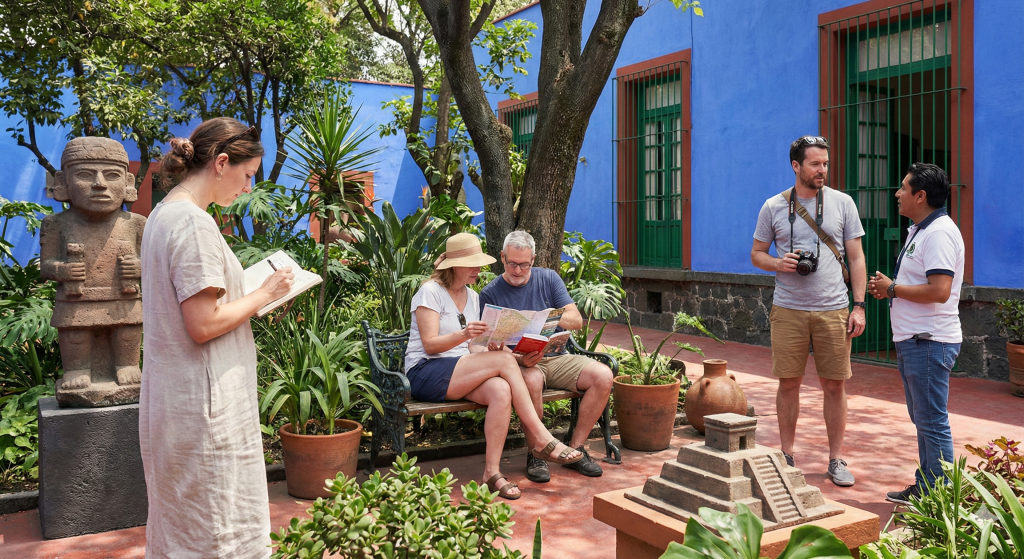
Every month, 25,000 visitors shuffle through Casa Azul. Most of them do it wrong. They arrive mid-afternoon, wait in crushing lines, rush through rooms shoulder-to-shoulder with tour groups, and leave wondering what the fuss was about. The sophisticated traveler approaches this differently. Consequently, they experience something the crowds never see: the actual intimacy of an artist’s life preserved in extraordinary detail.
Understanding the Frida Kahlo Blue House Mexico Phenomenon
La Casa Azul sits at Londres 247 in Coyoacán, a cobblestoned neighborhood that feels more like a colonial village than part of a 22-million-person metropolis. Kahlo’s father, German-Hungarian photographer Guillermo Kahlo, built the house in 1904. Frida was born here in 1907, returned after her devastating bus accident at eighteen, lived here with Diego Rivera, and died in the upstairs bedroom in 1954.
Three years after her death, Rivera donated the house and its contents to become a museum. His instructions were specific: preserve everything as she left it. Furthermore, lock away certain rooms and do not open them for fifty years. That directive created something unprecedented in art world history.
Today, the cobalt blue exterior walls have become one of the most photographed facades in Mexico City. The blue isn’t arbitrary. Kahlo chose this specific shade, now called “Frida Blue,” to ward off evil spirits according to Mexican tradition. Additionally, the saturated color photographs exceptionally well in the harsh Mexican sun, which Kahlo understood intuitively.
The Hidden Wardrobe Discovery That Changed Everything
In 2004, museum officials finally opened the bathroom adjacent to Kahlo’s bedroom, sealed since Rivera’s death in 1957. What they found transformed our understanding of the artist. Behind locked doors lay more than 300 garments, jewelry, cosmetics, orthopedic devices, and personal documents that Kahlo had accumulated over her lifetime.
The discovery’s significance cannot be overstated. Among the items was a photograph of Kahlo’s maternal family showing her mother dressed in traditional Tehuana style. This single image dismantled the long-held narrative that Diego Rivera encouraged Frida to wear indigenous Mexican dress. Instead, it revealed that her iconic style connected directly to her own heritage.
The permanent exhibition “Appearances Can Be Deceiving” now displays these belongings. You’ll see her signature Tehuana dresses from the Isthmus of Tehuantepec, a matriarchal society whose clothing Kahlo chose deliberately. Subsequently, you’ll understand that her fashion choices constituted a political statement about female power, Mexican identity, and the strategic concealment of her disability.
The painted plaster corsets are particularly affecting. Kahlo decorated medical devices meant to support her damaged spine with communist symbols, butterflies, and indigenous motifs. She transformed instruments of suffering into works of art. This exhibition alone justifies the pilgrimage to the Frida Kahlo Blue House Mexico site.
The Rooms That Matter Most
Casa Azul unfolds across a series of interconnected spaces that tell the story of an extraordinary life. However, not all rooms receive equal attention from rushing visitors. The discerning traveler knows where to linger.
The Studio
Kahlo’s wheelchair faces an unfinished portrait of Stalin, positioned before an easel that Rivera commissioned specifically for her. The mirror mounted above her bed allowed her to paint self-portraits while lying flat during long recoveries. Indeed, this setup produced some of the most recognized images in art history. The studio retains its working atmosphere rather than feeling curated for display.
The Kitchen
Traditional Mexican kitchens serve as gathering spaces, and Kahlo’s is no exception. Colorful Talavera tiles cover the walls. Clay pots and wooden utensils hang exactly as she arranged them. The names “Diego” and “Frida” appear spelled out in miniature clay vessels on the wall. This room reveals the quotidian pleasures Kahlo cultivated despite chronic pain. Furthermore, it demonstrates her commitment to Mexican folk traditions in every aspect of daily life.
The Bedroom
The most intimate space contains Kahlo’s death mask, displayed in a glass case near the bed where she painted and eventually died. A pre-Columbian urn on the dresser holds her ashes. The butterfly collection mounted on the wall above the bed represents resurrection. Meanwhile, the mirror in the canopy allowed her to study her own reflection while bedridden, creating the conditions for her prolific self-portraiture.
The Garden and Pyramid
In the 1940s, Rivera and architect Juan O’Gorman added a fourth wing to enclose the courtyard, creating a private garden sanctuary. A stepped pyramid displays pre-Columbian sculptures that Kahlo and Rivera collected obsessively. Subsequently, the walls surrounding the courtyard incorporate shells and mirrors in a style that merges Mexican folk art with modernist sensibility.
The Practical Intelligence: Visiting Like an Insider
The difference between a frustrating tourist experience and a meaningful cultural encounter comes down to logistics. Apply these protocols precisely.
Booking Strategy
Online advance booking is now mandatory. The museum limits daily visitors to preserve the historic structure. Therefore, tickets sell out weeks ahead during high season. Book through the official museum website the moment your travel dates are confirmed. The first time slot (10am, or 11am on Wednesdays) offers the least crowded experience. By early afternoon, all remaining slots for that day typically sell out.
The Photography Question
Standard admission prohibits photography. However, you can purchase a photography pass for an additional fee that permits non-flash images. This add-on proves worthwhile for serious travelers who want to document specific details rather than rely on the gift shop postcards. Nevertheless, put your phone away for at least the first thirty minutes. Experience the rooms before you start capturing them.
Time Investment
Most visitors spend 1.5 to 2 hours. Allow three hours if you’re genuinely interested. The garden alone merits forty-five minutes of careful attention. Furthermore, rushing through the wardrobe exhibition means missing the exhibition’s central thesis about identity construction through dress.
Combining with Anahuacalli
Your Casa Azul admission includes entry to the Diego Rivera Anahuacalli Museum, a volcanic stone pyramid Rivera designed to house his pre-Columbian collection. Located about twenty minutes away in San Pablo Tepetlapa, this austere building offers a completely different aesthetic experience. The serious art traveler visits both on the same day, experiencing the contrast between Kahlo’s intimate domestic space and Rivera’s monumental public vision.
The Coyoacán Context
Intelligent travelers extend the Frida Kahlo Blue House Mexico visit into a full-day Coyoacán immersion. The neighborhood itself functions as a living museum of colonial Mexican architecture and bohemian culture.
Before Casa Azul
Arrive in Coyoacán early. Walk the Jardín Centenario and the adjacent Plaza Hidalgo before the crowds materialize. The 16th-century Church of San Juan Bautista anchors the plaza’s northern edge. Street vendors selling traditional Mexican breakfast items cluster around the gazebo. This context matters. You’re seeing the neighborhood as Kahlo experienced it daily, not as a tourist attraction built around her fame.
After Casa Azul
The Leon Trotsky House Museum sits ten minutes away on foot. Kahlo and Rivera hosted the exiled Russian revolutionary and his wife from 1937 to 1939. The affair between Kahlo and Trotsky began during this period. Subsequently, Trotsky was assassinated nearby in 1940. Visiting both houses illuminates the political and romantic entanglements that defined Kahlo’s middle years.
Where to Eat
Avoid the restaurants immediately surrounding Casa Azul, which cater to tourists and charge accordingly. Instead, walk toward the Coyoacán Market for authentic antojitos: quesadillas, tlacoyos, and tostadas prepared by vendors who have held their stalls for generations. For a proper sit-down meal, Los Danzantes on the plaza serves contemporary Mexican cuisine with exceptional mezcal selections. The Hamptons crowd will recognize the quality calibration.
The Collector’s Perspective on Casa Azul
For those who approach art as both passion and investment, the Frida Kahlo Blue House Mexico visit offers specific intelligence. Understanding Kahlo’s working methods and personal iconography enriches engagement with her paintings wherever you encounter them.
The recent $54.7 million auction record for Kahlo’s El sueño (La cama) depicted her on the very bed you’ll see in the museum bedroom. The papier-mâché skeleton on the canopy appears in the painting. Consequently, visiting Casa Azul means seeing the primary sources for some of the most valuable works in the Latin American art market.
Mexico declared Kahlo’s works national cultural patrimony in 1984, prohibiting export. Therefore, paintings in private hands outside Mexico command extraordinary premiums. The serious collector gains contextual knowledge at Casa Azul that proves valuable when evaluating works, understanding provenance, and conversing knowledgeably at art world gatherings.
Planning Your Mexico City Art Itinerary
Casa Azul anchors but shouldn’t monopolize a Mexico City cultural visit. The city’s museum density rivals any global capital, and strategic planning maximizes cultural exposure.
Combine Coyoacán day with the nearby UNAM campus to see Juan O’Gorman’s mosaic-covered Central Library and the university’s sculpture garden. Furthermore, the Museo Dolores Olmedo in Xochimilco houses the largest collection of Kahlo works outside Casa Azul, including several major paintings you won’t see anywhere else.
In Roma and Condesa neighborhoods, contemporary galleries present emerging Mexican artists whose work engages with Kahlo’s legacy. Meanwhile, the Museo Nacional de Arte (MUNAL) and Palacio de Bellas Artes in Centro Histórico contextualize Kahlo within the broader Mexican art tradition, including Rivera’s famous murals.
Accommodation Strategy
Where you stay shapes your experience. The obvious choice places you in Polanco or Roma Norte for restaurant access and international hotel standards. However, boutique properties in Coyoacán itself allow early morning walks through Kahlo’s actual neighborhood before the museum opens.
Agata Hotel Boutique & Spa sits within a seven-minute walk of Casa Azul. Tonalli Casa Boutique offers similar proximity with a more intimate scale. For those preferring luxury chain standards, properties near the World Trade Center provide fifteen-minute car access to Coyoacán while maintaining proximity to Polanco dining and shopping.
The Deeper Resonance
The Frida Kahlo Blue House Mexico experience ultimately transcends tourism. You’re entering a space where an artist transformed personal suffering into universal art. The bed where she painted. The garden where she found respite. The kitchen where she hosted Trotsky, Breton, and the luminaries of Mexican cultural life.
Most significantly, Casa Azul demonstrates how Kahlo curated her own image with the same intentionality she brought to her canvases. The Tehuana dresses weren’t costumes. The flowers in her hair weren’t decoration. Every element communicated something specific about identity, heritage, and resistance. Subsequently, understanding this changes how you see her paintings forever.
For the collector building cultural knowledge, for the traveler seeking meaning beyond monuments, for anyone who responds to art that confronts mortality and pain with unflinching beauty, Casa Azul delivers something no reproduction can approximate: presence in the space where genius lived and worked and died.
Book early. Arrive first. Stay longer than you planned. The Frida Kahlo Blue House Mexico isn’t a checkbox on a tourist itinerary. It’s a reckoning with what art can cost and what it can redeem.
Stay Connected with Social Life Magazine
- Contact Social Life Magazine for editorial inquiries
- Experience Polo Hamptons — where culture meets sport
- Subscribe to Our Newsletter for insider access
- Print Subscription — join the conversation
- Support Independent Journalism
Related Reading
Author

Written by
Recent Posts

Diana Taurasi Net Worth: The Greatest Player Who Left the Country to Get Paid

Sabrina Ionescu Net Worth: The Star the WNBA Chose And The Audience Disagreed

Paige Bueckers Net Worth: The Heir Who Enters the WNBA

A’ja Wilson Net Worth: The $5 Million MVP Who Was Invisible Until…

Angel Reese Net Worth: The $7 Million Rival Who Needs the Hero to Exist
Categories
- Art
- Articles
- Beauty & Skincare
- Celebrities
- Celebrities|Entertainment
- Celebrities|Television
- Celebrities|The Chronicles
- celebrities|the-archive
- Chronicles
- Entertainment|Culture
- Event Photos
- Events
- Fashion
- Fashion & Style
- Featured
- Food & Beverage
- Food, Spirits, Wine
- Hamptons
- Hamptons Celebrities
- Hamptons Celebrities|Celebrities|The Chronicles
- Health
- Health & Beauty
- Lifestyle
- Luxury Lifestyle
- Press
- Profiles
- Real Estate
- Technology
- The Chronicles
- Travel
- Uncategorized
- Weddings