
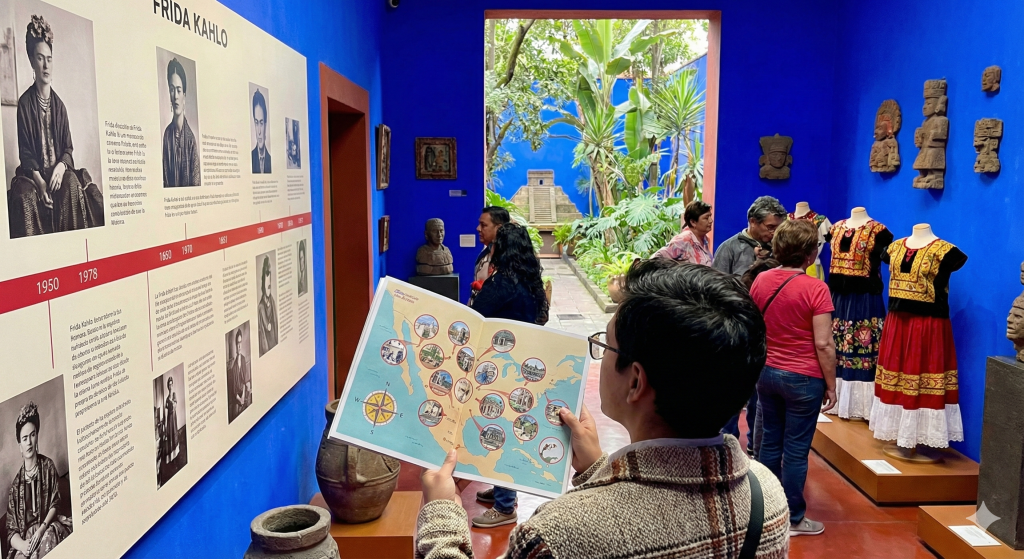
The Four Essential Frida Kahlo Museums
Mexico City now offers four distinct venues for understanding Kahlo’s life and work. Each serves a different purpose. Visiting all four transforms casual appreciation into genuine comprehension.
1. Museo Frida Kahlo (Casa Azul)
Address: Londres 247, Col. Del Carmen, Coyoacán
Hours: Tuesday-Sunday 10:00-18:00, Wednesday 11:00-18:00, closed Mondays
Tickets: MXN $320 (foreign adults), must be purchased online in advance
The blue house where Kahlo was born in 1907 and died in 1954 remains the primary pilgrimage site. Diego Rivera transformed it into a museum in 1958, four years after her death. The rooms preserve her domestic environment: the studio where she painted, the bedroom with a mirror mounted above her bed for self-portraits, the kitchen with names spelled in clay vessels on the walls, and the garden where she kept pet monkeys and hairless Xoloitzcuintli dogs.
The collection includes her final painting Viva la Vida (1954), Portrait of My Father Guillermo Kahlo (1952), and various works created during her bedridden periods. Additionally, her diaries, personal effects, and the decorated plaster corsets she wore to make medical equipment bearable occupy dedicated exhibition spaces.
The most significant recent addition is the “Appearances Can Be Deceiving” permanent exhibition, displaying contents from a bathroom sealed after her death and opened in 2004, fifty years later. This hidden wardrobe contained over 300 garments, orthopedic devices, and jewelry that reshape understanding of how she constructed her visual identity.
Critical booking intelligence: Tickets sell out one to three months in advance during peak season. The museum strictly enforces timed entry slots, typically thirty-minute windows. Book the 10:00 AM slot on Tuesday or Thursday for smallest crowds. Wednesday’s 11:00 AM opening means delayed entry but sometimes less competition for tickets. Your ticket includes admission to Museo Diego Rivera-Anahuacalli, so plan accordingly.
2. Museo Casa Kahlo (Casa Roja) — NEW
Address: Aguayo 54, Col. Del Carmen, Coyoacán
Hours: Wednesday-Monday 9:00-19:00, closed Tuesdays
Tickets: MXN $270 (foreigners), available online
This museum opened September 27, 2025, transforming a family home blocks from Casa Azul into a public institution. Casa Roja belonged to Kahlo’s parents before she purchased it for her sister Cristina to raise her family. Direct descendants lived there until 2023. It’s the first Kahlo museum operated by her relatives.
Where Casa Azul focuses on Kahlo the artist and wife of Diego Rivera, Casa Roja reveals Kahlo the daughter, sister, aunt, and friend. The collection includes handwritten letters showing her wit and observational sharpness, childhood photographs, her father Guillermo’s photographic equipment (she learned retouching and composition helping him in his studio), embroidery she completed at age five, and what’s believed to be her only mural, discovered in the kitchen depicting a grapefruit tree in the courtyard.
The basement served as Frida’s private refuge. Visitors can see the microscope she used as a child to examine insects, collections of ephemera, and the paints she worked with in this hidden space. Rockwell Group designed the exhibition experience, emphasizing domestic atmosphere over institutional presentation.
Strategic advantage: Because Casa Roja just opened, crowds remain manageable compared to Casa Azul. Combining both museums in one Coyoacán visit provides the most complete picture of Kahlo’s life available anywhere. The five-minute walk between venues makes this practical.
3. Museo Dolores Olmedo
Address: Av. México 5843, La Noria, Xochimilco
Hours: Tuesday-Sunday 10:00-18:00, closed Mondays
Tickets: MXN $120 (general admission)
Businesswoman Dolores Olmedo assembled the world’s largest private collection of Kahlo paintings. The museum, housed in a seventeenth-century hacienda, displays 25 Kahlo works alongside 27 Diego Rivera paintings. This is where you see the masterpieces.
The Broken Column resides here permanently. So does Henry Ford Hospital, the devastating 1932 painting documenting her miscarriage in Detroit. Self-Portrait with Monkey (1945), A Few Small Nips (1935), and The Deceased Dimas (1937) round out a collection that demonstrates Kahlo’s full range from intimate self-examination to political commentary to Mexican folk tradition.
The hacienda setting offers advantages over crowded tourist venues. Peacocks and hairless Xoloitzcuintli dogs roam the gardens. The atmosphere encourages contemplation rather than rushed photography. Furthermore, in September 2019 the museum reunited Rivera and Kahlo works in a shared gallery for the first time, allowing visitors to see their artistic dialogue directly.
Getting there: Xochimilco lies in southern Mexico City, accessible via the Tren Ligero light rail (Xochimilco station) followed by a short taxi or rideshare. The journey takes roughly an hour from central areas. Consider combining with Xochimilco’s famous floating gardens and trajinera boat rides.
4. Museo de Arte Moderno
Address: Paseo de la Reforma, Bosque de Chapultepec
Hours: Tuesday-Sunday 10:15-17:30, closed Mondays
Tickets: MXN $95 (general admission)
The Two Fridas hangs here. Measuring 173 by 173 centimeters, this 1939 double self-portrait is Kahlo’s largest and arguably most important work. Painted during her divorce from Rivera, it depicts two versions of herself, European and Mexican, connected by a single artery linking their exposed hearts.
Unlike the house museums, Museo de Arte Moderno contextualizes Kahlo within the broader Mexican modernist movement. Rivera, Orozco, Siqueiros, and Tamayo occupy adjacent galleries. This positioning matters for understanding Kahlo not as an isolated phenomenon but as part of a generation reshaping Mexican visual culture.
The museum’s location in Chapultepec Park makes it easy to combine with other major cultural institutions including the National Museum of Anthropology and Chapultepec Castle.
Secondary Venues Worth Considering
Museo Casa Estudio Diego Rivera y Frida Kahlo
Address: Diego Rivera corner Altavista, San Ángel
Hours: Tuesday-Sunday 10:00-18:00
Architect Juan O’Gorman designed these functionalist twin houses connected by a rooftop bridge in 1931. Kahlo and Rivera lived and worked here before returning to Casa Azul after her father’s death. The studio contains Rivera’s painting equipment, pre-Columbian objects from their collection, and rotating exhibitions. A small selection of works by both artists remains on permanent display.
The architectural significance rivals the art. O’Gorman’s design influenced Mexican modernism and demonstrates how Kahlo and Rivera lived when at the height of their fame.
Museo Leon Trotsky
Address: Río Churubusco 410, Coyoacán
Hours: Tuesday-Sunday 10:00-17:00
A ten-minute walk from Casa Azul, this fortified house sheltered the exiled Russian revolutionary from 1939 until his assassination in 1940. Kahlo and Rivera arranged Trotsky’s asylum in Mexico. Kahlo had an affair with him during his residence. The museum preserves bullet holes from an earlier failed assassination attempt and the study where Trotsky was killed with an ice axe.
Visiting contextualizes Kahlo’s political commitments and the international circle surrounding her and Rivera during their most productive years.
Diego Rivera Mural Museum
Address: Balderas corner Colón, Centro Histórico
Hours: Tuesday-Sunday 10:00-18:00
Dream of a Sunday Afternoon in Alameda Central, Rivera’s 50-foot mural from 1947, depicts himself as a child holding hands with the skeletal figure La Catrina while adult Kahlo stands protectively behind them. The mural survived the 1985 earthquake and was relocated to this purpose-built museum. It offers the most intimate glimpse of how Rivera situated their relationship within Mexican history.
Planning Your Frida Kahlo Museum Circuit
The One-Day Intensive
If you have only one day, focus on Coyoacán. Book the earliest available slot at Casa Azul (10:00 AM Tuesday or Thursday). Arrive fifteen minutes early. Spend two hours inside. Walk to Casa Roja for a contrasting perspective on her family life. Lunch in the Coyoacán market or at Café El Jarocho. Visit Museo Leon Trotsky in the afternoon. This sequence provides biographical depth without exhausting transit.
The Two-Day Comprehensive
Day One: Casa Azul and Casa Roja in the morning, Museo de Arte Moderno (for The Two Fridas) in the afternoon. The Chapultepec location is far from Coyoacán, so building in transit time matters.
Day Two: Museo Dolores Olmedo in Xochimilco. Combine with the floating gardens if time permits. The hacienda deserves at least three hours of unhurried attention.
The Collector’s Deep Dive
Serious engagement requires all four primary museums plus the secondary venues. Budget three to four days. Add the Museo Casa Estudio in San Ángel and the Diego Rivera Mural Museum downtown. Furthermore, consider day trips to the forthcoming exhibitions: Museum of Fine Arts Houston opens “Frida: The Making of an Icon” in January 2026, and Tate Modern follows in June 2026.
Practical Intelligence for Every Visit
Tickets
Casa Azul tickets must be purchased through the official website (museofridakahlo.org.mx). No in-person sales exist. Third-party resellers like Viator, GetYourGuide, and Tiqets sometimes have availability when official slots sell out, but prices run significantly higher. Book one to three months ahead for peak periods (December through March, Mexican holidays, weekends).
Your Casa Azul ticket includes complimentary admission to Museo Diego Rivera-Anahuacalli, Rivera’s volcanic stone pyramid housing his pre-Columbian collection. The Fridabus shuttle connects both venues on weekends for MXN $160 including transportation and admission.
Photography
Casa Azul permits photography for personal use without flash. An additional MXN $30 fee covers indoor photography permits. Outdoor areas are free to photograph. Tripods and professional equipment require advance authorization from the museum trust.
Accessibility
Casa Azul, as a preserved historic house, presents limitations. However, the museum provides wheelchairs, ramps, an elevator, and Braille labels for certain areas. Staff trained in Mexican Sign Language are available. Free admission applies to visitors with disabilities. Contact the museum in advance to arrange accommodations.
What to Bring
Backpacks larger than 35 by 20 centimeters must be checked at reception. The coat room remains temporarily unavailable, so travel light. Printed tickets or phone screenshots with QR codes work for entry. Comfortable walking shoes matter for Coyoacán’s cobblestone streets.
Beyond the Museums: Coyoacán Context
The neighborhood itself functions as a Kahlo museum. Jardín Centenario and Plaza Hidalgo anchor the historic center where she walked daily. The Coyoacán market offers traditional food, folk art, and the sensory experience of Mexican daily life that shaped her aesthetic. Cantinas and cafés preserve the colonial atmosphere she inhabited.
Street murals and bronze statues of Kahlo proliferate throughout the neighborhood, sometimes to the point of kitsch. The commercialization deserves acknowledgment: her face appears on merchandise ranging from tasteful to tacky. Nevertheless, underneath the tourist infrastructure, the physical environment that produced her art survives largely intact.
What the Museums Teach Together
Visiting a single Frida Kahlo museum provides an incomplete education. Casa Azul shows the artist and wife. Casa Roja reveals the daughter and sister. Museo Dolores Olmedo displays the masterworks. Museo de Arte Moderno positions her within Mexican modernism. Each venue contributes essential understanding that the others cannot provide.
The circuit approach transforms Kahlo from image to person. You see where she slept, where she learned photography from her father, where she painted her most devastating self-portraits, and how Mexican art historians situate her achievement. Furthermore, the physical act of moving through her spaces, walking her streets, and encountering her work at human scale conveys something that reproductions cannot.
Book the tickets now. The demand for access to Kahlo’s world only increases. The museums limit capacity to preserve the experience. Consequently, the travelers who plan ahead encounter intimacy. Everyone else encounters disappointment.
Stay Connected with Social Life Magazine
- Contact Social Life Magazine for editorial inquiries
- Experience Polo Hamptons — where culture meets sport
- Subscribe to Our Newsletter for insider access
- Print Subscription — join the conversation
- Support Independent Journalism
Related Reading
- Frida Kahlo Facts: What Serious Collectors Actually Need to Know
- Frida Kahlo Blue House Mexico: The Insider’s Guide to Casa Azul
- Artwork Frida Kahlo: Which Paintings Actually Matter and Why
- Frida Kahlo and Diego Rivera: The Partnership That Explains Everything
- The Broken Column Frida Kahlo: The Painting That Makes Everyone Look Away
Author

Written by
Recent Posts

Diana Taurasi Net Worth: The Greatest Player Who Left the Country to Get Paid

Sabrina Ionescu Net Worth: The Star the WNBA Chose And The Audience Disagreed

Paige Bueckers Net Worth: The Heir Who Enters the WNBA

A’ja Wilson Net Worth: The $5 Million MVP Who Was Invisible Until…

Angel Reese Net Worth: The $7 Million Rival Who Needs the Hero to Exist
Categories
- Art
- Articles
- Beauty & Skincare
- Celebrities
- Celebrities|Entertainment
- Celebrities|Television
- Celebrities|The Chronicles
- celebrities|the-archive
- Chronicles
- Entertainment|Culture
- Event Photos
- Events
- Fashion
- Fashion & Style
- Featured
- Food & Beverage
- Food, Spirits, Wine
- Hamptons
- Hamptons Celebrities
- Hamptons Celebrities|Celebrities|The Chronicles
- Health
- Health & Beauty
- Lifestyle
- Luxury Lifestyle
- Press
- Profiles
- Real Estate
- Technology
- The Chronicles
- Travel
- Uncategorized
- Weddings