
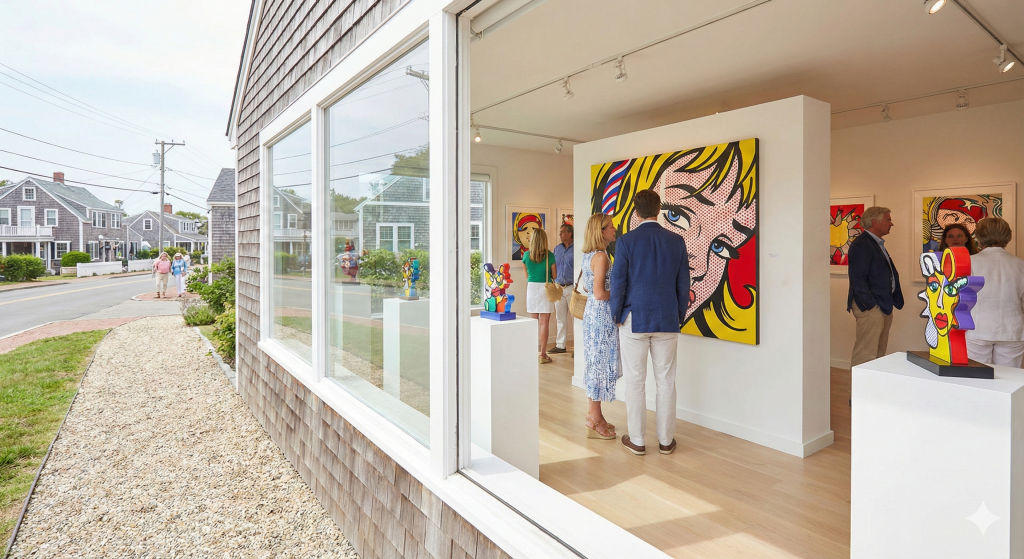
The collector steps off Gin Lane and into Phillips Southampton, where a Lichtenstein hangs in the same light that illuminated the artist’s studio three blocks away. Down the street, Christie’s occupies a restored art deco glass-front building, showing works by de Kooning, Pollock, and Warhol—artists who made this stretch of Long Island their creative home. This isn’t Manhattan transported east for summer. The Hamptons art galleries operate on different terms, offering access and intimacy unavailable in Chelsea’s crowded corridors.
The Auction House Presence: Hamptons Art Galleries with Global Reach
Three major auction houses maintain Hamptons operations, transforming the summer season into an extended preview opportunity. These spaces don’t conduct live auctions locally, but they bring forthcoming sale inventory east, creating viewing conditions impossible to replicate in Manhattan’s compressed schedules.
Phillips Southampton
Phillips occupies a nearly 6,000-square-foot, two-story space at 1 Hampton Road—the former Southampton town hall, redesigned by studioMDA architects. The location opened in August 2020 as blue-chip galleries rushed east during lockdown, and has remained operational through subsequent seasons. Phillips uses the space to preview works from upcoming New York sales while hosting dedicated selling exhibitions.
The 2022 Roy Lichtenstein presentation exemplified the Southampton advantage: Diana and Ajax, two paintings commissioned by Gianni Versace, displayed in the artist’s own neighborhood alongside Girl in Mirror (1964) and Shipboard Girl (1965). Such focused presentations, impossible amid competing demands of Manhattan salesrooms, allow sustained engagement with significant works. Hours run Tuesday through Sunday, 11 a.m. to 6 p.m. during season.
Christie’s Southampton
Christie’s established their Southampton presence in 2021, occupying a restored 5,600-square-foot glass car showroom at 1 Pond Lane through ongoing seasonal commitments. The inaugural exhibition, “Out East,” featured works by artists connected to the region: Willem de Kooning, Helen Frankenthaler, Lee Krasner, and Roy Lichtenstein. Subsequent seasons have brought Francesco Clemente presentations, interior-themed selling exhibitions, and collaborations with Carpenters Workshop Gallery featuring functional design alongside fine art.
The Southampton operation connects to Christie’s broader network, including seasonal pop-ups in Palm Beach and Aspen. Works displayed here can often be purchased directly, with specialists curating material appropriate to Hamptons clientele. The setting—anchoring one end of Southampton’s gallery corridor—provides strategic visibility for both house and collectors seeking discrete acquisition opportunities.
Sotheby’s East Hampton
Sotheby’s positioned their East End outpost in East Hampton’s retail and gallery district, creating a lifestyle gallery combining fine art with watches, jewelry, and design objects. Rotating presentations feature postwar and contemporary art by Andy Warhol, George Condo, and Ed Ruscha alongside 20th-century design by Jean Prouvé and Charlotte Perriand, plus timepieces from Patek Philippe and Rolex.
The Sotheby’s model emphasizes immediate purchase availability—everything displayed can be acquired on the spot. Their “The Hamptons” exhibition specifically celebrated artists who found creative freedom in the local landscape, featuring de Kooning, Krasner, Pollock, Frankenthaler, Lichtenstein, Fairfield Porter, and Stanley Whitney. Contact the gallery for extended catalog access and appointment scheduling.
The Museum Foundation: Context for Hamptons Art Galleries
Three institutions provide the scholarly framework that elevates East End collecting above mere acquisition. Understanding their programs and collections informs purchase decisions while creating social opportunities unavailable through commercial channels alone.
Parrish Art Museum
The Parrish, housed in Herzog & de Meuron’s luminous barn-inspired structure in Water Mill, maintains the region’s most significant collection of work by artists connected to the East End. The 14-acre campus opened in 2012 after outgrowing the original Southampton location, with 4,600 square feet dedicated to temporary exhibitions and 7,600 square feet displaying over 3,500 works from the permanent collection.
Holdings include the world’s most important collection of William Merritt Chase (over 40 paintings and works on paper) alongside masterworks by Dan Flavin, Roy Lichtenstein, Jackson Pollock, Lee Krasner, and Willem de Kooning. Fairfield Porter’s representation proves particularly strong. Current programming includes Rudolf Stingel’s interactive installation in the Interior Lobby, Hiroshi Sugimoto’s Seascapes through February 2026, and career retrospectives of James Howell and Nina Yankowitz.
The Parrish hosts the Hamptons Fine Art Fair VIP Opening Preview, benefiting the museum while connecting collectors with participating galleries. Membership provides year-round access, exhibition previews, and invitations to programming that facilitates relationship-building within the collecting community. Location: 279 Montauk Highway, Water Mill. Hours vary seasonally; check parrishart.org.
Guild Hall
Guild Hall has anchored East Hampton’s cultural life since 1931, combining visual art exhibition spaces with the Hilarie and Mitchell Morgan Theater for performing arts. The permanent collection exceeds 2,400 works, featuring legendary East End artists including Pollock, Krasner, and de Kooning. The 2025 season includes “Rauschenberg 100,” celebrating the centennial of Robert Rauschenberg’s birth with works from the permanent collection and loans from connected collectors.
The annual Clothesline Art Sale, operating since 1946, remains one of the Hamptons’ most beloved and accessible art traditions—providing entry-level acquisition opportunities while supporting local artists. Guild Hall’s programming bridges historical context with contemporary practice, offering educational initiatives that deepen collector understanding. Location: 158 Main Street, East Hampton. Galleries open Friday through Monday, noon to 5 p.m.
Dia Bridgehampton
Housed in a converted firehouse designed by Dan Flavin himself, Dia Bridgehampton offers immersive engagement with minimalist practice. The permanent installation features nine sculptures in fluorescent light (1963-81) by Flavin, while rotating exhibitions occupy the downstairs gallery—currently Amy Sillman: Alternate Side Permutations #1-32. The space emphasizes site-specific experience over survey presentation, rewarding sustained attention.
Dia’s broader network includes Beacon, Chelsea, and international locations, but the Bridgehampton space carries particular significance given Flavin’s local connections and the broader East End minimalist legacy. Understanding this context enriches any pop art collection by establishing the period’s artistic dialogues and counterpoints.
Southampton Village: The Gallery Corridor
Southampton has emerged as the Hamptons’ primary gallery destination, with Jobs Lane and surrounding streets hosting the highest concentration of exhibition spaces. The 2021 arrival of Phillips and Christie’s catalyzed expansion, transforming the village into a year-round art destination rather than merely seasonal attraction.
Arthur T. Kalaher Fine Art
Located at 28E Jobs Lane, Kalaher presents modern and contemporary art in focused exhibitions. Open daily 10 a.m. to 5 p.m., the gallery maintains a program balancing established names with emerging practitioners. The Jobs Lane location positions it within the village’s gallery cluster, facilitating multi-stop collector itineraries.
Black and White Gallery / Project Space
At 4 N. Main Street, this space offers contemporary programming with an emphasis on conceptual practice. Open Wednesday, Friday, and Saturday 1 to 5 p.m. and by appointment, the gallery provides an alternative to commercial presentation formats, often featuring work that challenges conventional expectations.
Southampton Arts Center
The Southampton Arts Center at 25 Jobs Lane presents museum-quality exhibitions without museum-scale budgets. The 2024 “Organic Abstraction: Contemporary Outdoor Sculpture” exhibition, curated by Cheryl Sokolow, featured nine internationally recognized, museum-collected sculptors. Programming emphasizes formalist and conceptual work alongside community engagement initiatives. Open Friday through Sunday, noon to 5 p.m.
Peter Marino Art Foundation
Architect Peter Marino’s foundation brings museum-level ambition to Southampton, presenting works from his significant collection alongside curated exhibitions. The foundation adds institutional weight to the village’s gallery ecosystem, attracting collectors interested in design-art intersections that Marino’s practice exemplifies.
East Hampton and Sag Harbor: Established Destinations
East Hampton’s gallery scene developed earlier than Southampton’s recent explosion, with established dealers maintaining long-term presences. Sag Harbor offers a more intimate alternative, with walkable concentration and distinct village character.
Eric Firestone Gallery
Firestone operates spaces in both East Hampton and New York, bridging the geographic divide that challenges many Hamptons galleries. The program emphasizes historical reassessment alongside contemporary practice, uncovering undervalued artists while maintaining market relevance. The East Hampton location facilitates access to the gallery’s network during summer months.
Halsey McKay Gallery
Founded in East Hampton, Halsey McKay has earned recognition for programming that introduces emerging artists while maintaining critical engagement. The gallery’s curatorial voice distinguishes it from purely commercial operations, attracting collectors interested in discovery rather than confirmed market positions.
The Drawing Room
At 55 Main Street, East Hampton, The Drawing Room focuses on works on paper—a collecting category offering significant value relative to paintings. The specialization creates expertise unavailable at generalist galleries, benefiting collectors building positions in this often-undervalued medium. Open Friday through Monday from 11 a.m.
Grenning Gallery
Located at 26 Main Street in Sag Harbor, Grenning represents contemporary realist painters with particular strength in landscape and figurative work. The 2025 season includes exhibitions by Carl Bretzke and Terry Elkins, masters of nocturne and prismatic landscape painting respectively. The gallery’s Sag Harbor location provides village-scale intimacy while maintaining exhibition ambition.
Keyes Art
At 45 Main Street, Sag Harbor, Keyes Art presents solo exhibitions in rotating programs. Open daily 10 a.m. to 7 p.m., the gallery maintains accessible hours that accommodate varied collector schedules. The Main Street location anchors Sag Harbor’s gallery cluster.
The Art Fair Opportunity: Hamptons Fine Art Fair
The Hamptons Fine Art Fair, staged annually at Southampton Fairgrounds on County Road 39, brings approximately 150 galleries into a 70,000-square-foot pavilion complex. The 2026 edition runs July 9-12, featuring the Pollock and de Kooning Luxury Pavilions and galleries from 20 countries.
VIP Opening Preview on Thursday, July 10 benefits Guild Hall and the Parrish Art Museum, combining acquisition opportunity with philanthropic engagement. Friday Collectors Day sessions provide additional VIP access before general admission opens Saturday and Sunday. The fair’s cosmopolitan scope—presenting galleries from scores of countries and states—exposes collectors to material unavailable through local dealers alone.
For collectors, fairs compress discovery timelines. Material that might require months of gallery visits appears concentrated in single venues. However, the compressed format demands preparation: research participating galleries beforehand, identify priority booths, and arrive early for first selection. The Hamptons Fine Art Fair particularly rewards collectors seeking accessible price points alongside blue-chip material.
Collecting Strategy: How to Use Hamptons Art Galleries
The East End’s gallery ecosystem rewards sustained engagement over transactional encounters. Building relationships with dealers, curating museum memberships strategically, and attending programming consistently creates advantages unavailable to casual browsers.
Begin with museum memberships at the Parrish and Guild Hall. These provide access to opening events where dealers, collectors, and curators gather in social contexts that facilitate introductions. The exhibition programming deepens understanding of the regional artistic legacy that informs contemporary market dynamics.
Next, identify three to five galleries aligned with your collecting interests. Visit repeatedly, engaging with staff about programming decisions, artist backgrounds, and market positioning. Dealers reward genuine interest with early access to significant works, holding inventory for established clients before broader presentation. This relationship-building requires time investment that summer-only engagement cannot provide.
Use auction house outposts strategically. Phillips, Christie’s, and Sotheby’s bring preview material unavailable elsewhere, but their Hamptons presences also facilitate relationship-building with specialists who manage year-round sales. Establishing rapport during quieter Hamptons appointments creates advantages when competing for lots in crowded Manhattan salesrooms.
Finally, attend the Hamptons Fine Art Fair with prepared lists rather than open browsing. The concentrated format rewards targeted acquisition over wandering discovery. Preview the exhibitor list, research unfamiliar galleries, and schedule booth visits in priority order. The fair’s accessibility—works at every price point—makes it ideal for both building positions and finding specific pieces.
The Year-Round Opportunity
Hamptons art galleries increasingly operate beyond summer season, recognizing that collectors maintain year-round residences and that off-season viewing provides advantages unavailable during crowded July and August. Southampton’s transformation into a gallery destination has accelerated this shift, with multiple spaces maintaining regular hours through fall, winter, and spring.
Off-season visits offer unhurried engagement impossible during peak months. Dealers have time for extended conversations. Works can be viewed repeatedly without scheduling pressure. Prices occasionally reflect reduced competition, though blue-chip material rarely discounts significantly.
The Hamptons’ artistic legacy—Warhol’s Montauk compound, Lichtenstein’s Gin Lane studio, Pollock and Krasner’s Springs home, de Kooning’s decades in East Hampton—provides context that transforms acquisition from transaction into historical engagement. Understanding where artists lived, worked, and found inspiration deepens appreciation for works produced in this environment. The light that drew them here still illuminates gallery walls.
Hamptons art galleries represent more than convenient summer access to quality material. They constitute a distinct ecosystem with its own rhythms, relationships, and opportunities. Collectors who engage this community thoughtfully—building relationships, deepening knowledge, participating in institutional programming—discover advantages unavailable through any other regional market. The investment required extends beyond purchase prices into time, attention, and genuine cultural engagement. The returns justify the commitment.
Continue Your Collecting Journey
Social Life Magazine connects discerning collectors with the Hamptons art world.
- Inquire About Gallery Partnerships
- Subscribe for Art Market Updates
- Experience Polo Hamptons
- Print Subscription
More from The Collector’s Guide to Pop Art
- Previous: Roy Lichtenstein Pop Art: The Southampton Master Collectors Still Chase
- Next: Pop Art Investment: Building a Collection That Appreciates
Author

Written by
Recent Posts

Tom Cruise Net Worth: The Operating Budget of a Man Who Cannot Stop
Glen Powell Net Worth: The Man Trying to Become Something That Might Not Exist

Miles Teller Net Worth: The Actor Who Arrived First and Watched the Moment Leave
Jennifer Connelly Net Worth: The Industry’s Most Honest Disappearing Act

Diana Taurasi Net Worth: The Greatest Player Who Left the Country to Get Paid
Categories
- Art
- Articles
- Beauty & Skincare
- Celebrities
- Celebrities|Entertainment
- Celebrities|Television
- Celebrities|The Chronicles
- celebrities|the-archive
- Chronicles
- Entertainment|Culture
- Event Photos
- Events
- Fashion
- Fashion & Style
- Featured
- Food & Beverage
- Food, Spirits, Wine
- Hamptons
- Hamptons Celebrities
- Hamptons Celebrities|Celebrities|The Chronicles
- Health
- Health & Beauty
- Lifestyle
- Luxury Lifestyle
- Press
- Profiles
- Real Estate
- Technology
- The Chronicles
- Travel
- Uncategorized
- Weddings