
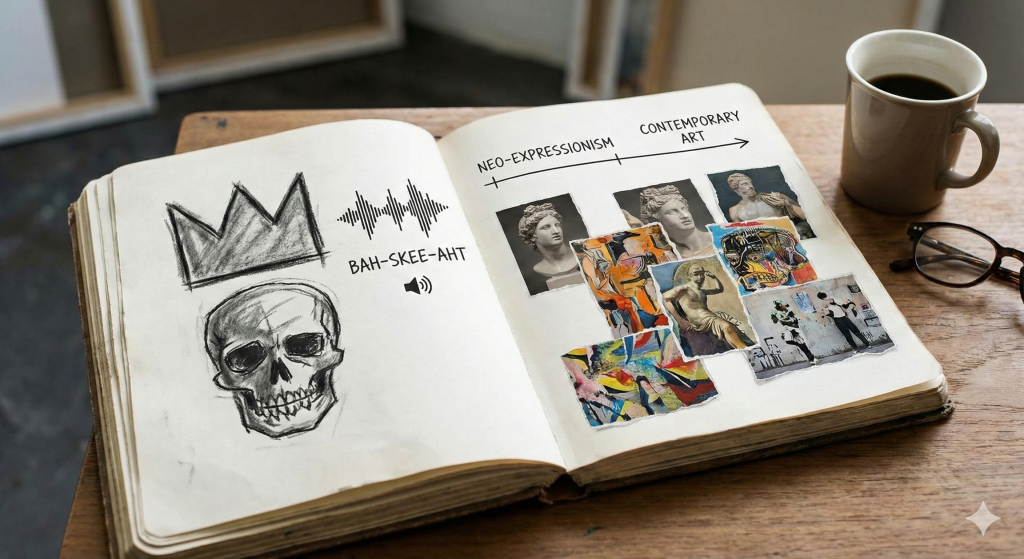
Here’s the answer: BAH-skee-AHT.
Three syllables. Emphasis on the final syllable. The “T” is soft but present. In the International Phonetic Alphabet used by linguists, it’s rendered as /ˌbɑːskiˈɑː(t)/. Say it once. Say it again. Now you own it.
The Full Name: Jean-Michel Basquiat
His complete name carries French pronunciation throughout. Jean-Michel sounds like “Zhon Mee-SHELL” with that distinctive French “J” that resembles the “s” in “vision.” Put it together and you get: Zhon Mee-SHELL BAH-skee-AHT.
Most Americans simplify Jean-Michel to something closer to “John Michael,” and that’s acceptable in casual conversation. But if you’re at a gallery opening, an auction preview, or discussing the artist with collectors, the French pronunciation signals you’ve done your homework.
The art world tends to favor “BAHZ-kee-aht” with a slightly longer first syllable. Friends who knew him personally confirm this was how he said his own name. When in doubt, follow the artist’s lead.
Why the Name Sounds French
Jean-Michel Basquiat was born in Brooklyn to a Haitian father and a Puerto Rican mother. His father, Gérard Basquiat, came from Port-au-Prince, Haiti, which remained culturally French long after independence in 1804. French names, French language, and French customs persisted through generations.
The young Basquiat grew up trilingual. By age eleven, he spoke fluent French, Spanish, and English. He read voraciously in all three languages. This multilingual foundation would later infuse his artwork with layered textual elements that critics spent decades decoding.
His first name combines two biblical French names: Jean means “God is gracious” and Michel means “Who is like God?” Together they create a name weighted with divine implications—fitting for an artist whose signature crown suggested royal, even sacred, ambitions.
The Noble Origins of Basquiat
The surname itself carries unexpected history. According to French genealogical records, the “de Basquiat” family belonged to the nobility in the Landes region of southwestern France. The name derives from the Basque Country, a region spanning the border between France and Spain.
Historical records trace Jean de Basquiat as a squire in the sixteenth century living in Saint-Sever. Louis XIV confirmed the family’s noble status. Later generations included Bernard de Basquiat, known as Baron de Toulouzette, who served as a musketeer in the king’s guard.
Some historians speculate that members of the de Basquiat family fled France during the Revolution, eventually reaching Haiti and losing their aristocratic particle along the way. The possibility that Jean-Michel descended from French nobility adds layers to his obsessive use of the crown symbol.
Did he know this history? The evidence suggests yes. He researched his roots constantly, spoke French admirably, and titled works with references to kings and royalty. The three-pointed crown wasn’t merely aesthetic—it may have been ancestral.
Common Mispronunciations to Avoid
Several variations circulate that mark the speaker as unfamiliar with the artist. Avoid these:
“Bass-kwee-AT” with a hard “QU” sound treats the name like an English word. It isn’t.
“Bass-KEY-at” emphasizes the wrong syllable and flattens the elegant French vowels.
“Bask-ee-AHT” misses the “S” sound in the first syllable entirely.
The correct pronunciation flows: BAH (like “father”) + skee (like the winter sport) + AHT (rhymes with “yacht”).
In strict French pronunciation, the final “T” would be silent. But the Americanized art world consensus includes a soft “T” sound. Either approach works. What matters is confidence and the correct vowel sounds.
Why Pronunciation Signals Cultural Fluency
Names carry weight in art world conversations. Pronouncing Basquiat correctly signals that you’ve engaged with the artist beyond surface-level awareness. It suggests you’ve visited exhibitions, read criticism, perhaps even collected prints.
This matters especially in markets like the Hamptons, where cultural capital circulates alongside financial capital. Collectors discussing works by art advisors like Isabella del Frate Rayburn expect fluency with major names. Mispronouncing Basquiat at a gallery dinner creates the same impression as mispronouncing a sommelier’s wine recommendation.
The same principle applies to other frequently mangled art names: Mondrian (mon-dree-AHN), Caravaggio (car-ah-VAH-jee-oh), Gauguin (go-GAN). Mastering these demonstrates respect for the artists and their cultural contexts.
The Artist Behind the Name
Now that you can say it, you should know what it represents. Jean-Michel Basquiat rose from Brooklyn graffiti artist to $110 million auction record holder in less than a decade.
He became the youngest artist ever to exhibit at Documenta at age twenty-one. His collaboration with Andy Warhol produced over one hundred paintings. At twenty-seven, a heroin overdose claimed his life, placing him in the tragic 27 Club alongside Jimi Hendrix, Janis Joplin, and Kurt Cobain.
His work commands attention across every cultural tier. Original paintings trade for eight and nine figures. Estate prints offer entry points for serious collectors. And fashion collaborations from Crocs to Tiffany bring his imagery to audiences who may never set foot in a museum.
The crown that became his signature appears everywhere now—on $75 clogs and $6,100 skimboards alike. Understanding what it meant to him, including the possible noble ancestry encoded in his surname, adds depth to encounters with his work.
Practice Makes Permanent
Say it three more times: BAH-skee-AHT. Zhon Mee-SHELL BAH-skee-AHT.
The next time someone at a Hamptons gallery mentions the crown motif, the neo-expressionist movement, or the record-breaking auctions, you’ll engage with confidence. The name will roll off your tongue like you’ve been saying it for years.
Because cultural literacy isn’t about knowing everything. It’s about knowing enough to participate. And sometimes that starts with something as simple as pronouncing a name correctly.
The Hamptons art scene rewards those who show up prepared. Basquiat remains one of the most discussed artists in contemporary conversation. His work signals cultural sophistication among collectors and aspirants alike.
Now you know how to say his name. The rest is just details.
Author

Written by
Recent Posts
Diana Taurasi Net Worth: The Greatest Player Who Left the Country to Get Paid
Sabrina Ionescu Net Worth: The Star the WNBA Chose And The Audience Disagreed

Paige Bueckers Net Worth: The Heir Who Enters the WNBA
A’ja Wilson Net Worth: The $5 Million MVP Who Was Invisible Until…

Angel Reese Net Worth: The $7 Million Rival Who Needs the Hero to Exist
Categories
- Art
- Articles
- Beauty & Skincare
- Celebrities
- Celebrities|Entertainment
- Celebrities|Television
- Celebrities|The Chronicles
- celebrities|the-archive
- Chronicles
- Entertainment|Culture
- Event Photos
- Events
- Fashion
- Fashion & Style
- Featured
- Food & Beverage
- Food, Spirits, Wine
- Hamptons
- Hamptons Celebrities
- Hamptons Celebrities|Celebrities|The Chronicles
- Health
- Health & Beauty
- Lifestyle
- Luxury Lifestyle
- Press
- Profiles
- Real Estate
- Technology
- The Chronicles
- Travel
- Uncategorized
- Weddings